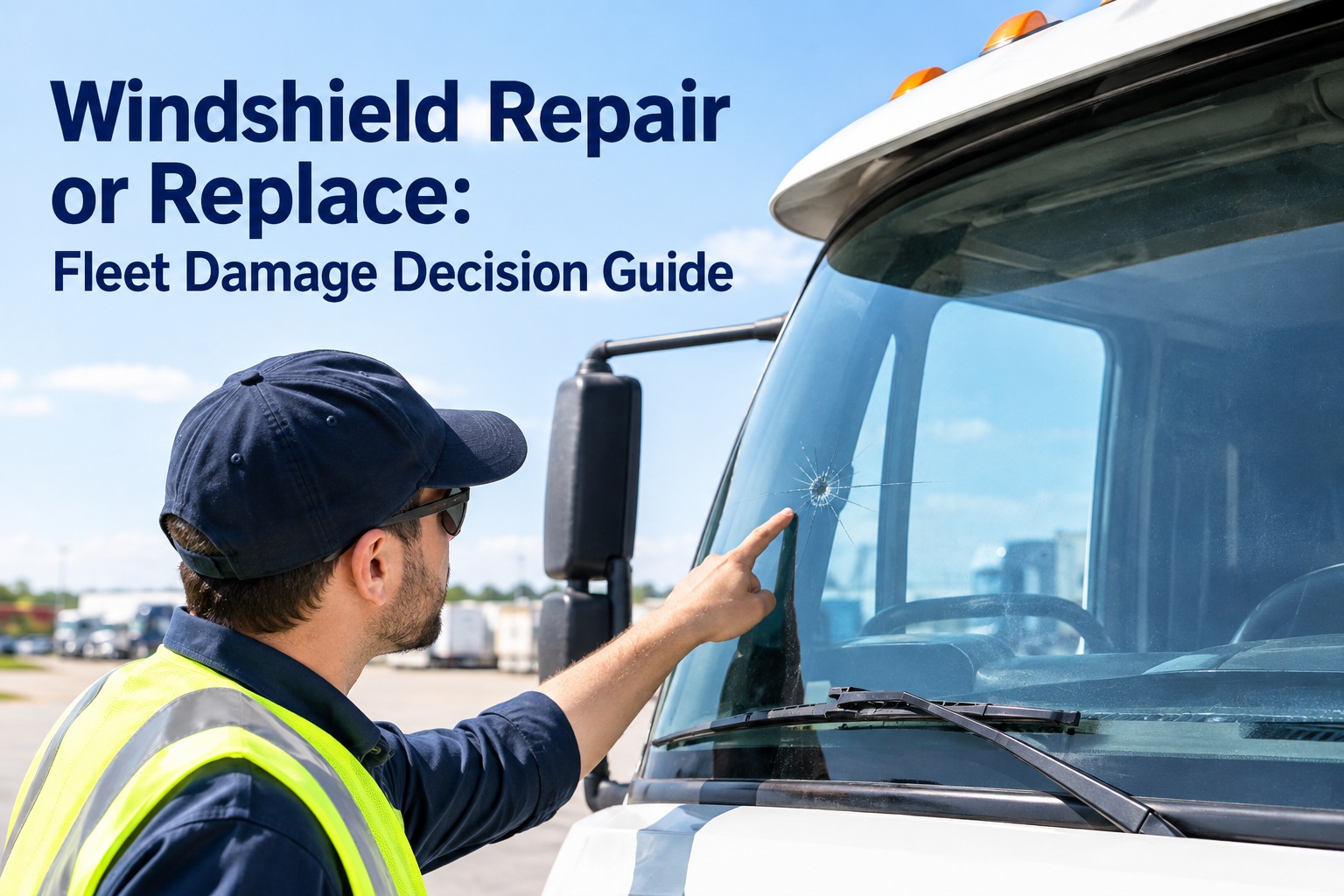
Two trucks, two windshields. One has a six-inch crack low on the passenger side — and it's legal. The other has a dime-sized chip right in front of the driver — and it's an out-of-service violation. That's what trips fleets up on the windshield repair-or-replace call: it isn't about how big the damage is, it's about where it sits, whether it's spreading, and whether an ADAS camera behind it turns a cheap chip into an expensive recalibration. See glass defects caught and routed before they spread
Where the Damage Sits Changes Everything
Move the defect around the windshield. The same chip is a legal non-issue in one zone and an out-of-service violation in another.
Damage in the area swept by the driver's wiper is the highest-risk zone. Inspectors treat the driver's line of sight as the wiper-swept area, and a crack here can put the truck out of service on the spot. Size barely matters — a small chip here outranks a long crack elsewhere. This is a replacement, and if a camera sits behind it, a recalibration too.
In the critical viewing area above the steering wheel, the rule is geometric. A single chip is allowed only if a 3/4-inch disc covers it and it's 3+ inches from any other damage; a crack is allowed only if nothing else intersects it. Cross that line — a spreading crack, an intersection, an oversized chip — and it's a violation. This zone is a measurement, not a guess.
The regulated area excludes a 2-inch border at the top and a 1-inch border at each side. Damage confined to those borders, below the critical view, is frequently outside the disqualifying zone — which is why a long low crack can be legal while a tiny high one isn't. But "legal today" isn't "safe forever": any crack can spread into the critical area, so it still gets logged and watched.
Federal windshield enforcement under 49 CFR § 393.60 is geometry-based — location, obstruction, and intersection, not raw size. The same damage is a shrug in one zone and a shutdown in another.
A windshield isn't just glass — it carries a big share of the cab's structural strength in a rollover, it mounts the cameras that run modern safety systems, and it's one of the first things a roadside inspector checks. That is a lot riding on a repair-or-replace call most fleets make reactively, at the worst possible moment. The way to win it: make the call early, by the right criteria, with the damage documented.
Repair or replace: the four questions that decide
Forget the folk rule about "bigger than a quarter." The real repair-or-replace decision comes down to four questions, asked in order — and the first one that lands on "replace" ends the decision.
Run those four and the decision makes itself: a repairable chip outside the swept area with no camera drama is a quick fix; anything that fails question one, two, or three is a replacement, and question four tells you what that replacement really costs. The trap is letting a question-one-safe chip sit until it becomes a question-two crack. Book a demo to see every chip captured at pre-trip while it's still a repair.
The chip that becomes a windshield: why speed is the whole game
The economic heart of windshield management is almost entirely about time. The exact same chip is a cheap repair or an expensive replacement depending only on how fast it's caught.
A stone chip caught the morning it happens is frequently a quick resin fix for a modest cost. Done in the yard, truck rolls on time.
Temperature swings, road vibration, and a pothole spread it into a crack. Now it's a replacement — and on an ADAS truck, a mandatory recalibration and a violation.
So the real lever isn't the repair-or-replace decision — it's how fast you catch the damage. That gap between finding it early in the yard and late at the roadside is where the entire cost difference lives. Fleets keep windshield spend low by having far fewer replacements, not by negotiating better on them. Book a demo to see chips flagged and routed before they spread
The ADAS factor: why modern glass changed the math
A decade ago a windshield was structure and visibility. Today it also mounts the cameras that run advanced driver-assistance systems — and those systems are aimed through the glass, so moving the glass means re-aiming them.
That's exactly why the incentive to repair early — before a chip forces a replacement — is stronger than ever. Confirm the specific procedure with the glass and equipment manufacturer for each truck. Book a demo to see replacement and recalibration tracked as one closed job
The 60-second windshield check every driver should run at pre-trip
Most windshield spend comes from damage found late. This is the quick glass pass a driver should run before the first mile — the difference between resining a chip in the yard and replacing a cracked windshield at the roadside. Keep it on the phone and log any find with a photo. Use this windshield check online free, so every chip is captured with its size, location, and a photo the moment it's spotted.
Every item here is either a person-safety call or a money call. Start free and build this glass check into every pre-trip
Turning a glass call into a documented, controlled decision
The difference between a fleet that bleeds money on windshields and one that doesn't isn't the price it pays per pane — it's whether the damage gets found early, judged consistently, and acted on before it spreads or rolls out to a roadside. That's a process, and it's a short one.
Each step closes a gap where windshield cost and risk usually leak. Photo capture finds the chip while it's cheap and fixes an objective record of where it was. Criteria-based assessment stops the inconsistent "looks fine to me" calls that let disqualifying glass roll.
A dispatch lock keeps a swept-area crack from leaving the yard to earn an OOS. And documented resolution — including the recalibration on ADAS trucks — gives you the proof an inspector, insurer, or incident review will ask for. Book a demo to see the four-step glass loop run inside your inspection workflow.
From a fleet manager who stopped replacing windshields
Our windshield bill was insane and I couldn't figure out why until I looked at the timeline on a few of them. Every one was the same story: a driver noticed a chip, didn't say anything, and two or three weeks later it was a crack across the swept area and we were replacing the whole windshield — plus a camera recalibration on the newer trucks, which I hadn't even budgeted for. We were paying replacement prices for chip-repair problems.
We made the pre-trip capture a photo of any glass damage, no exceptions, and routed it straight to a decision the same day. Now most of them get resined in the yard for next to nothing and never become a crack. The replacements dropped hard, the recalibration surprises stopped, and when a truck does have a disqualifying crack, dispatch can't send it out to collect a violation. We weren't overpaying for glass — we were finding it too late.
Windshield repair or replace FAQs
When can a truck windshield be repaired instead of replaced?
Usually when the damage is small, caught early, and outside the driver's critical-viewing and wiper-swept area — resined before it spreads. It comes down to location, chip-vs-spreading-crack, and the § 393.60 geometry (a 3/4-inch disc must cover it, 3+ inches from other damage). The catch is timing: repairable damage doesn't stay repairable, so speed is everything.
What are the FMCSA rules for a cracked windshield?
Under 49 CFR § 393.60 the standard is geometry-based, not size. In the critical area above the wheel (top 2-inch and side 1-inch borders excluded), a crack passes only if nothing intersects it and a chip only if a 3/4-inch disc covers it, 3+ inches from other damage. Separately, any crack in the driver's wiper-swept area can be an OOS — which is why a low passenger-side crack may be legal while a small chip in front of the driver isn't. Confirm any additional state rules.
Does a cracked windshield really need ADAS recalibration after replacement?
Yes. If a windshield-mounted camera runs the driver-assistance systems, it's aimed through the glass at a precise angle — and replacing the glass changes that aim. A miscalibrated forward camera misjudges distance, undermining the system meant to prevent a crash. So a replacement isn't complete or compliant until recalibration is done and documented as part of the same job. Confirm the procedure with the glass and equipment manufacturer.
Why does the location of windshield damage matter more than the size?
Because the rules protect the driver's field of vision, not damage in the abstract. Section 393.60 governs the critical area above the wheel, and the OOS criteria focus on the wiper-swept area — so a small chip in front of the driver can trigger an out-of-service order while a longer crack low on the passenger side may not. That's why a "bigger than a quarter" rule of thumb fails: judge by zone first, then geometry and spread.
How can a fleet control windshield repair and replacement costs?
Attack the timeline, not the price per pane — the biggest cost driver is damage found late. A repairable chip left alone becomes a crack that forces a full replacement, and on an ADAS truck a mandatory recalibration too. The fix: make a photo of any chip a required pre-trip step and route it to a decision the same day, while it's still small. Fleets cut windshield spend by having fewer replacements, not by paying less per pane.
Make every windshield repair-or-replace call early, by the right criteria
HVI captures glass damage at pre-trip with photo evidence that fixes its size and location, routes it to a repair-or-replace decision before it spreads, tracks replacement and ADAS recalibration as one closed job, and locks dispatch on a documented out-of-service windshield crack so it never rolls out to a violation. Fewer replacements, no recalibration surprises, and a defensible record on every pane.
No credit card · Photo-documented glass defects from day one · Repair-or-replace routing built in