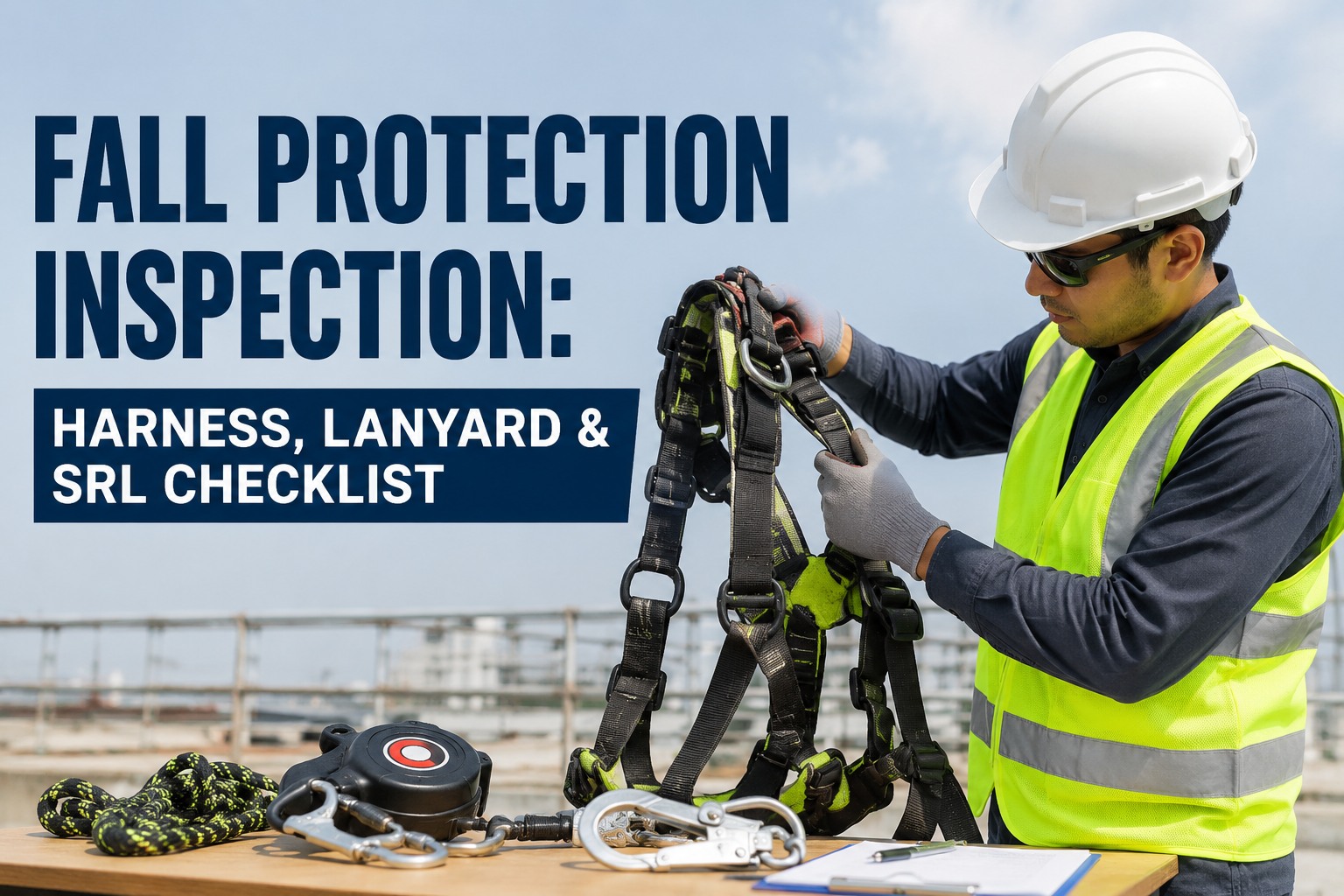
A harness that arrested a fall last week gets tossed back in the common gear bin, and Monday someone clips into it not knowing it already did its one job. That's how fall protection equipment kills people — not random failure, but damage that went unnoticed because nobody could say which harness this was. A real fall protection inspection isn't a glance; it's an equipment-level control system. This guide covers what to inspect on harnesses, lanyards, and SRLs, what forces removal from service, and why individual tracking prevents reuse. Book a demo to track each piece of fall-protection gear in HVI.
Fall Protection Inspection: Harness, Lanyard & SRL Checklist
Fall protection is the most-cited OSHA standard. Turning inspection from a quick visual check into per-item tracking is what keeps damaged gear off a worker's back.
Educational safety information — not a substitute for the applicable OSHA standard, your fall-protection program, manufacturer instructions, or qualified safety expertise.
Fall protection equipment shouldn't be treated as generic safety gear that gets a passing glance. A personal fall arrest system is the last thing between a worker and the ground, and its components fail in ways that are genuinely hard to spot — a stretched webbing fiber, a hairline crack in a D-ring, an SRL that no longer locks cleanly. A proper inspection identifies damage, wear, missing or illegible information, improper configuration, and any condition that could compromise performance. This guide walks the OSHA requirements, the specific inspection criteria for each equipment type, what to do after a fall, and how individual equipment records tie it all together.
Which OSHA standard applies to you
Fall protection inspection requirements depend on your work environment, and mixing up the two federal standards is a common mistake. Both require pre-use inspection and removal of defective gear — the details and trigger heights differ.
Personal fall protection systems must be inspected before initial use during each work shift for mildew, wear, damage, and other deterioration, and defective components removed from service. Fall protection generally triggers at 4 feet.
Personal fall arrest systems must be inspected prior to each use for wear, damage, and other deterioration, and defective components removed from service. Fall protection generally triggers at 6 feet.
A note on going beyond OSHA: the widely used ANSI/ASSP Z359 standards add more detailed inspection criteria and a documented competent-person inspection benchmark, and manufacturers impose their own requirements — but those are industry best practice and manufacturer rules, not federal OSHA mandates. It matters to keep them straight so you know what's legally required versus strongly recommended. Determine the standard that applies to your operation, then build your program on it.
Pre-use vs. formal inspection: two different things
"Inspection" covers two distinct activities with different performers and frequencies. Conflating them is how gear goes months without a real examination.
Performed by the worker before each use or work shift, as the applicable standard requires. A hands-on check of the whole system for obvious damage before clipping in — the OSHA-required baseline that happens every single time.
A more thorough, documented inspection by a competent person at an interval set by your program, the manufacturer, or applicable industry guidance — commonly at least annually under ANSI/ASSP Z359, sometimes more often by environment or manufacturer rule.
The distinction matters because each catches what the other misses: the pre-use check stops obvious damage the same day, while the formal inspection is a trained, documented look that catches subtle deterioration and creates the record. Frequency and who's qualified to perform the formal inspection depend on the applicable OSHA standard, your fall-protection program, and the equipment manufacturer — there isn't one universal number that fits every operation. Start free on HVI to schedule recurring formal inspections per item and log every pre-use check.
Inspecting the harness
The full-body harness is the core of the system. Work through it methodically — webbing, stitching, hardware, and labels — rather than eyeballing it as a whole. Here's what each part is telling you.
Run the straps through your hands, bending them to expose damage. Look for cuts, tears, fraying, abrasion, burns or heat glazing, chemical staining or softening, excessive wear, and UV or environmental degradation.
Check every stitch pattern for broken, cut, pulled, or burned threads. Loose or missing stitching at load-bearing junctions is a serious finding — the stitching is what holds the harness together under load.
Inspect D-rings, buckles, adjusters, and grommets for cracks, distortion or deformation, corrosion or pitting, sharp edges, rough spots, and improper function. The dorsal D-ring should sit and pivot correctly.
Confirm the ID, model, ratings, and inspection markings are present and legible. If required information can't be verified, the equipment must be evaluated per manufacturer and employer requirements before use.
One important caveat on damage criteria: exact thresholds for what constitutes removable damage — how much abrasion, what degree of discoloration — come from the equipment manufacturer, not a universal rule, and they vary by product and material. When in doubt on a specific item, the manufacturer's inspection instructions govern, and a competent person makes the call. Book a demo to capture harness findings with photos against each serial number
Inspecting lanyards and energy absorbers
Lanyards and shock-absorbing lanyards get abused as hard as harnesses and, in practice, get replaced far less often than they should. The webbing or rope criteria mirror the harness, with a few lanyard-specific points.
Same criteria as harness webbing — cuts, fraying, broken strands, abrasion, burns, chemical and heat damage, excessive wear. Rope lanyards need every strand checked.
Inspect the shock-absorbing pack for signs of deployment or partial activation, damage to the cover, and an intact warning indicator. A deployed absorber means the lanyard arrested a fall.
Check that snap hooks and carabiners operate smoothly, gates close and lock fully, and there's no distortion, corrosion, or cracking. Verify the connector is compatible with what it attaches to.
Configuration matters as much as condition here: a lanyard connected in a way the manufacturer didn't intend — for example, between a harness and a self-retracting device unless specifically allowed — can create additional free fall the system was never designed for. Inspection isn't only "is it damaged," it's "is it the right component, connected the right way."
Inspecting self-retracting lifelines (SRLs)
SRLs deserve their own section because they're mechanical devices, not just webbing and hardware — and their inspection and servicing requirements vary significantly by model. The manufacturer's instructions are authoritative here; these are the general check points.
Inspect the housing for cracks, distortion, corrosion, loose fasteners, or impact damage. A damaged housing can compromise the internal mechanism you can't see.
Pull the lifeline fully out and let it retract under control. It should extend and retract smoothly without hesitation, sticking, or slack, along its full length. Inspect the line itself for damage.
Give the lifeline a sharp pull to confirm the brake engages and locks positively. A device that doesn't lock crisply on a sudden pull is a critical failure — that's its entire job.
Check the connector operation and any load or impact indicator. Many SRLs have an indicator that shows the device arrested a fall and must be removed and returned to the manufacturer.
The critical point on SRLs: many models require periodic factory or authorized servicing on a schedule the manufacturer defines, separate from your pre-use and formal inspections — and after arresting a fall, many must be removed and sent back to the manufacturer rather than field-inspected and returned to use. Don't assume an SRL follows the same rules as a harness. Start free to track SRL service intervals alongside inspections.
After a fall: removal from service
This is the highest-stakes moment in the whole lifecycle, and it's where individual tracking earns its keep. Any personal fall protection system or component subjected to impact loading — meaning it arrested a fall or took a comparable impact — has strict handling requirements.
The system or component must come out of use the moment it's subjected to impact loading. It cannot be used again for fall protection until cleared.
Physically and administratively separate it so it can't be picked up and worn. This is exactly where anonymous pooled gear fails — the item ends up back in circulation.
It stays out of service until a competent person inspects it and determines it's undamaged and safe — or, per manufacturer instructions, it's sent back or retired.
Handle repair, return, or disposal per the manufacturer's instructions. Where policy requires destruction, the goal is to make reuse physically impossible.
An accurate nuance here: OSHA's rule is removal and competent-person evaluation, not a blanket command that every item be destroyed after any fall — the manufacturer's inspection and disposition procedures govern what happens next. That said, many employers choose to retire gear outright after it arrests a fall, because impact damage to webbing, stitching, and hardware can be genuinely hard to detect. Either way, the item must never quietly return to service. Book a demo to flag removed-from-service gear so it can't be reissued
Why individual equipment records change everything
Everything above depends on one capability: knowing exactly which piece of equipment you're talking about. The moment fall-protection gear is anonymous and pooled, inspection history evaporates and unsafe reuse becomes a matter of time. Individual tracking is the fix.
Give each harness, lanyard, and SRL an asset or serial number so its entire history attaches to that specific item, not a generic category.
Log the date, findings, inspector identity, photos, and pass/fail status each time — building a defensible history per item.
Set recurring intervals per item and get ahead of due dates, so formal inspections don't silently lapse across a large inventory.
Flag a defective or fall-arrested item so its status is unmistakable and it can't be issued again until cleared or retired.
With a large inventory spread across workers and sites, this is the difference between a program you can prove and a pile of gear you hope is fine. When an auditor — or your own conscience — asks "when was this specific harness last inspected and has it ever arrested a fall," an item-level record answers instantly. That's the entire premise of what HVI does for fall-protection equipment. Book a demo to give every piece of gear its own inspection record
From a safety manager who found a reused harness
We had harnesses, lanyards, and SRLs spread across four crews and a couple hundred pieces total, all living in shared gear bins. The wake-up call was finding a harness back in rotation that I was almost certain had been in a fall arrest a few months earlier — but I couldn't prove it either way, because nothing was tracked to a specific unit. That "couldn't prove it" is the scary part.
We serialized every item and put it on individual records — inspection dates, photos, next-due, and a hard removal-from-service flag. Now when something arrests a fall, it's tagged out in the system and physically can't be reissued without someone clearing it. Last audit, I pulled the full inspection history on any harness the officer pointed at, in seconds. The gear didn't change. Knowing which one is which changed everything.
Inspect the gear, but track the item
A real fall protection inspection is methodical and equipment-specific: it works through the harness webbing, stitching, hardware, and labels; the lanyard's webbing or rope, energy absorber, and connectors; and the SRL's housing, lifeline, locking action, and impact indicator — each against the manufacturer's criteria rather than a single universal threshold. It distinguishes the user's pre-use check, required before each use or shift under the applicable OSHA standard, from the more thorough formal inspection by a competent person. And it takes the post-fall rule seriously: any system subjected to impact loading comes out of service immediately and doesn't return until a competent person or the manufacturer's process clears it. Which OSHA standard governs — 1910.140 for general industry, 1926.502 for construction — depends on your environment, and ANSI/ASSP Z359 and manufacturer requirements add criteria beyond the federal minimum worth following but not to be confused with OSHA mandates.
The thread running through all of it is identity: inspection only protects a worker if you know which specific harness, lanyard, or SRL was checked, what was found, and whether it's ever been in a fall. Anonymous, pooled gear is where inspection history disappears and unsafe reuse creeps in. That's the gap HVI closes — giving each piece of fall-protection equipment an individual record with configurable inspection intervals, findings and photo evidence, defect status, removal-from-service control, and searchable history, so the right item's full story is always one lookup away. To be clear about the boundary: HVI tracks the equipment and its records, but it doesn't determine whether a given item is safe, and it doesn't replace a competent person, the manufacturer's inspection requirements, or your fall-protection program. This article is educational safety information, not a substitute for the applicable OSHA standard, manufacturer instructions, or qualified expertise. Book a demo to track fall-protection equipment inspections in HVI.
Frequently asked questions
How often should a fall protection harness be inspected?
There are two inspection layers, and both apply. First, the user must inspect the harness before use — OSHA's general industry standard, 29 CFR 1910.140, requires inspection before initial use during each work shift, and the construction standard, 29 CFR 1926.502, requires inspection prior to each use. That means a hands-on check every time before clipping in. Second, beyond the pre-use check, a more thorough formal inspection by a competent person is widely expected on a recurring interval. This formal-inspection frequency is driven primarily by the ANSI/ASSP Z359 consensus standards — which call for a documented competent-person inspection at least annually — and by the manufacturer's instructions and your fall-protection program, rather than by a single explicit federal OSHA interval. Some environments and manufacturers call for more frequent formal inspections, such as every six months. It's important not to treat any one interval as a universal legal requirement: the correct frequency depends on the applicable OSHA standard, the manufacturer, your program, and the conditions the equipment sees. What is universal is that the pre-use inspection happens every time, and that any equipment found defective — or subjected to a fall — comes out of service immediately regardless of when its next scheduled inspection was due.
What should you look for when inspecting a harness?
Inspect the harness methodically, part by part, rather than giving it a general glance. On the webbing, run the straps through your hands while flexing them to expose damage, looking for cuts, tears, fraying, abrasion, burns or heat glazing, chemical damage, excessive wear, and UV degradation. On the stitching, check every stitch pattern for broken, cut, pulled, or burned threads, especially at load-bearing junctions. On the hardware — D-rings, buckles, adjusters, grommets — look for cracks, distortion, corrosion or pitting, sharp edges, and improper function, and confirm the dorsal D-ring sits and pivots correctly. On labels and markings, verify the equipment ID, model, ratings, and inspection markings are present and legible; if required information can't be verified, the equipment must be evaluated per manufacturer and employer requirements before use. A crucial caveat applies throughout: the exact thresholds that define removable damage come from the equipment manufacturer and vary by product and material, so they shouldn't be treated as a single universal visual standard. When a finding is borderline, the manufacturer's instructions govern and a competent person makes the determination.
What happens to fall protection equipment after a fall?
Any personal fall protection system or component subjected to impact loading — meaning it arrested a fall or took a comparable impact — must be removed from service immediately and must not be used again for fall protection until a competent person inspects it and determines it's undamaged and safe, or until it's handled according to the manufacturer's instructions. This requirement appears in both OSHA's general industry standard, 1910.140, and the construction standard, 1926.502. The practical steps are: remove the equipment from use immediately; physically and administratively prevent accidental reuse; keep it out of service pending a competent-person determination or the manufacturer's process; and follow the manufacturer's inspection, repair, return, or disposal instructions for that specific product. It's worth being accurate about a common misconception: OSHA's rule is immediate removal and competent-person evaluation, not a blanket legal command that every item be destroyed after any fall — the manufacturer's disposition procedures determine the outcome. That said, many employers choose to retire equipment outright after a fall, because impact forces can stretch webbing, stress stitching, and deform hardware in ways hard to detect. Self-retracting lifelines are a special case: many models must be removed and returned to the manufacturer rather than field-inspected. In all cases, the equipment must never quietly return to use.
How do you inspect a self-retracting lifeline (SRL)?
An SRL requires more than the webbing-and-hardware inspection used for harnesses, because it's a mechanical device, and its specific inspection and servicing requirements vary by model, so the manufacturer's instructions are authoritative. The general check points are: inspect the housing for cracks, distortion, corrosion, loose fasteners, or impact damage, since a damaged housing can compromise the internal mechanism you can't see; extend the lifeline fully and let it retract under control, confirming it moves smoothly without hesitation, sticking, or slack along its full length, while inspecting the line for damage; give the lifeline a sharp pull to verify the locking or braking mechanism engages positively, because a device that doesn't lock crisply on a sudden pull has failed at its core function; and check the connector operation and any load or impact indicator, since many SRLs have an indicator showing whether the device has arrested a fall. Two points are especially important. First, many models require periodic factory or authorized-service-center servicing on a manufacturer-defined schedule separate from your pre-use and formal inspections. Second, after arresting a fall, many SRLs must be removed and returned to the manufacturer rather than field-inspected and returned to use. Never assume an SRL follows the same rules as a harness; always work from that model's manufacturer instructions.
What should a fall protection inspection record include?
A useful inspection record is built around the individual piece of equipment, because inspection only protects a worker if you can tie the history to the specific item in their hands. At minimum, each record should identify the equipment by a unique asset or serial number; capture the date of each inspection; record the findings, including any damage or wear; identify the inspector; and note the resulting status, such as pass, defect, or removed from service. Strong records also include photographic evidence, the type of inspection performed (pre-use versus formal competent-person inspection), and the next scheduled inspection date so recurring formal inspections don't lapse. For equipment involved in a fall, the record should clearly reflect the removal-from-service status so the item can't be reissued. The reason this detail matters is practical: fall-protection equipment is typically spread across many workers and worksites, and when it's tracked only as an anonymous category rather than as individual items, it becomes impossible to know which harness, lanyard, or SRL was inspected, when, what was found, or whether it was ever removed from service — which is precisely how damaged gear ends up back in use. This is the operational problem HVI is built to solve: individual equipment records, configurable inspection intervals, defect and removal-from-service status, evidence capture, and searchable history. HVI maintains the records and tracking; it doesn't determine whether equipment is safe or replace a competent person or the manufacturer's requirements.
Track every piece of fall-protection gear in HVI
HVI gives each harness, lanyard, and SRL its own record — serial-level identity, configurable inspection intervals, findings with photo evidence, defect status, and a removal-from-service flag that keeps fall-arrested gear out of rotation. Run pre-use and formal inspections, and retrieve any item's full history in seconds. HVI tracks the equipment and records; it doesn't replace a competent person or the manufacturer's requirements. Mobile-first for the field, live in under two weeks.
No credit card · Individual equipment records · Inspection intervals & removal-from-service on day one