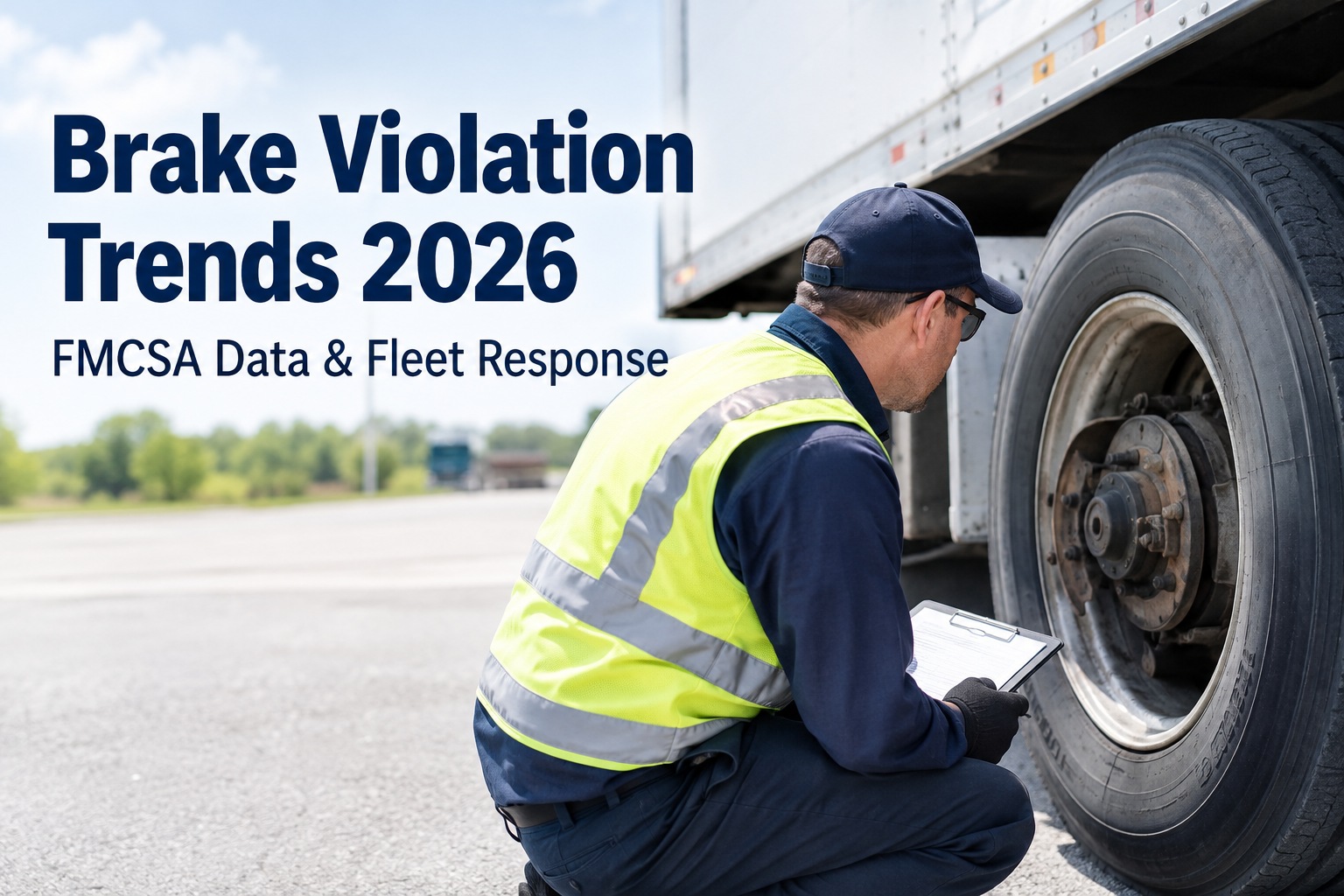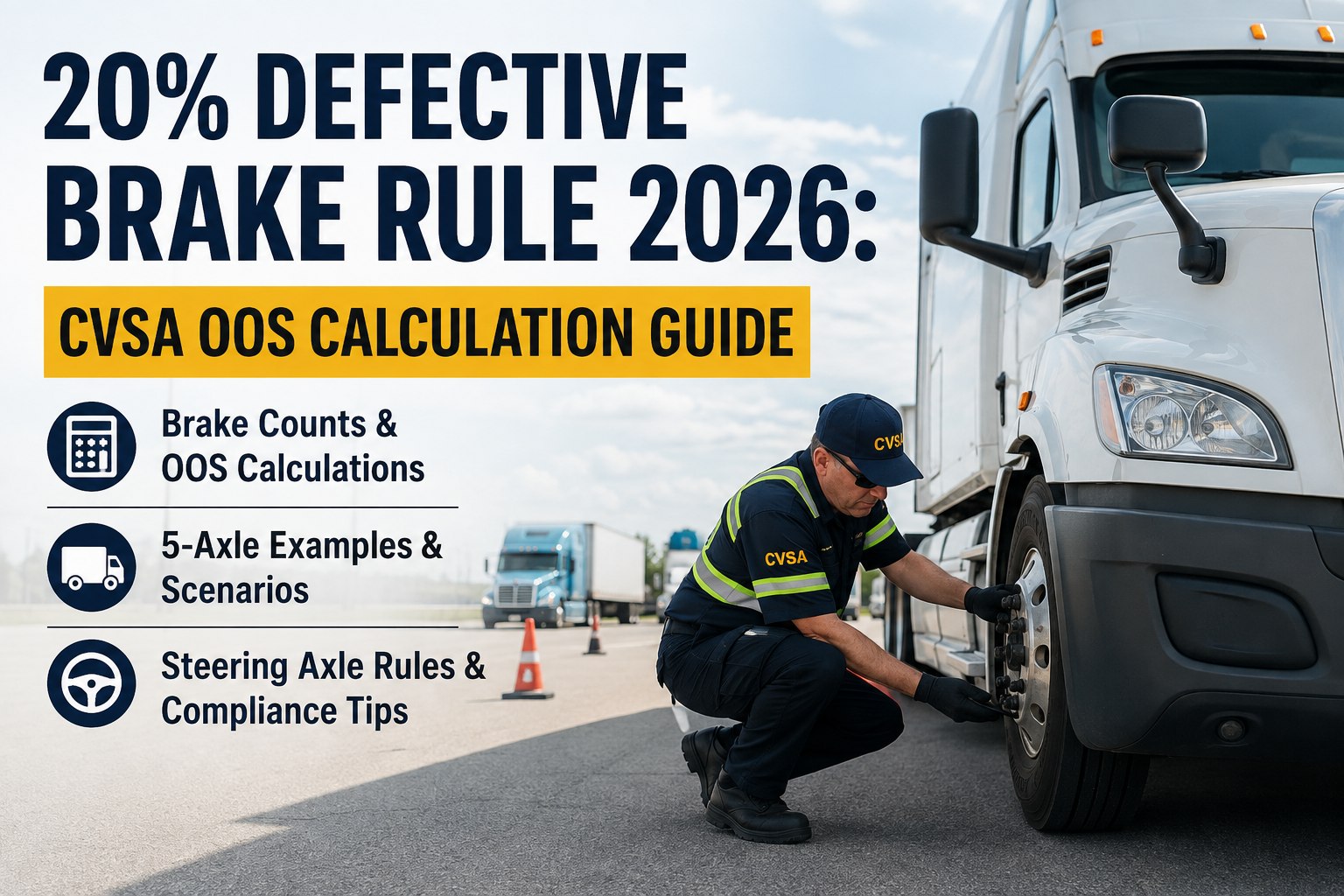
Two defective brakes on a 5-axle tractor-trailer means the whole rig gets a neon-orange out-of-service sticker on the side of the road. That's the 20 percent defective brake rule in one sentence — and it's the single largest reason commercial vehicles were placed out of service in 2025 and 2026. During CVSA's May 2026 Brake Safety Day, 313 vehicles hit the 20% threshold in one enforcement window. What makes the rule tricky isn't the percentage — it's the counting. This guide walks the math, the 2026 update, and the fleet workflow that keeps trucks off the OOS list. Book a demo
The 20% formula — four steps that decide whether the truck rolls or gets a sticker
Simple math. Specific rules. One wrong count and the roadside inspector's decision goes the other way.
The 20% rule sounds mechanical until you're standing at a scale house watching an inspector count wheel-ends on a rig you dispatched an hour ago. What matters isn't the percentage — it's the counting convention that decides which defects add up. Two brake shoes gone at the same wheel-end are one defective brake, not two. A ruptured brake chamber diaphragm at another wheel is one defective brake. Half-thickness lining is 0.5. Get any of these wrong in the pre-trip and you're gambling with the OOS list.
2026 CVSA Brake Safety Day — what one unannounced enforcement day actually caught
The clearest picture of how this rule actually gets enforced is the CVSA Brake Safety Day held on May 14, 2026. Results released May 19 showed the scale of what one 24-hour enforcement window produces — and what the rule targets first.
The 313 figure is the important one. On one unannounced day, more than half of all brake-related OOS violations came from the 20% rule — not from single catastrophic failures. That pattern is consistent with the 2025 Brake Safety Week results, where the 20% rule produced 1,199 OOS violations out of the total, or 52.2% of brake OOS. The 20% rule isn't an edge case — it's the primary enforcement mechanism. Book a demo to see per-wheel-end defect tracking mapped against the 20% threshold live
Worked example: the 5-axle tractor-trailer 20% calculation
Here's the math on the most common configuration in North American trucking — a 3-axle tractor pulling a 2-axle trailer with brakes at every wheel. That's 10 brakes total for the combination.
Two important nuances in this calculation. First, the 20% applies to the entire combination, not each vehicle separately — a 10-brake combination with 2 defectives on the trailer alone still puts the trailer OOS. But if the tractor has no defective brakes, the tractor may proceed while the trailer stays parked. Second, individual half-defective brakes count as 0.5 toward the total; when your final defective count comes out fractional, it rounds DOWN to the nearest whole number for the 20% calculation. So 1.5 defective brakes counts as 1, not 2. Book a demo to see the 20% threshold calculated live per unit before dispatch
The same wheel-end rule — why two problems can still be one defective brake
The wheel-end counting rule is where most fleet techs miscount defects. CVSA doesn't count individual damaged components — it counts defective brakes as functional units. Two defects at the same wheel-end still equal one defective brake. Understanding this rule is the difference between passing inspection with 1 defective brake and being placed OOS thinking you're at 2.
Two defects at same wheel-end
Both defects are on the same wheel-end. Count as one defective brake, not two. The math treats the wheel as the unit.
Two defects at different wheel-ends
Different wheel-ends, so both count. On a 10-brake combination this triggers the 20% threshold and OOS.
Single "half-defective" condition
A half-defective brake counts as 0.5 toward the total. Combined with other partials or half-defectives, the fractional total rounds down.
Miscounting at this step is common, and it goes both ways. Fleets sometimes miscount 2 defects at the same wheel as 2 defective brakes and pull the truck unnecessarily. Roadside inspectors, working with certified training, get this right most of the time — but the truth is that the underlying discipline lives in your fleet inspection records, not in the roadside argument. Records that map defects to specific wheel-end positions are what let you predict outcomes before an inspector shows up. Start free and get wheel-end position tracking on day one
The steering axle exception — where the 20% math doesn't apply
The 20% rule has one clean carve-out worth knowing cold. If any single steering axle brake has a defective condition, the vehicle is placed OOS immediately — regardless of whether the total combination count reaches the 20% threshold. The steering axle doesn't get amortized into the wider math because it's the axle that keeps the driver in control at speed.
Steer axle brake defect
A single defective condition on either the left or right steer axle brake triggers immediate OOS. The 20% percentage calculation is skipped — this is a fast-lane grounding.
Drive & trailer axle defects
Defects on drive axles and trailer axles feed into the 20% calculation. The threshold determines OOS. Each wheel-end defect counts once toward the total.
Pre-trip inspection discipline should treat the steer axle as its own category — check it first, verify it independently, and never assume it's fine because "we just had it in the shop." A steer-axle brake stroke check takes 30 seconds and saves the trip. And the 2026 CVSA Brake Safety Day caught 47 steer-axle defects in one day — each one an immediate grounding.
2026 CVSA updates you need to know — effective April 1, 2026
The CVSA approved 17 amendments to the North American Standard OOS Criteria on December 5, 2025, with enforcement beginning April 1, 2026. Three specifically affect the 20% brake rule mechanics or brake OOS categorization.
Lining thickness measurements aligned
Hydraulic and electric brake lining thickness measurements now align with federal regulations, eliminating prior discrepancies between US and Canadian standards. Same measurement, same threshold, same enforcement.
Parking/Emergency brake heading
The "Parking Brake" heading in the OOSC updated to "Parking/Emergency Brake" reflecting both possible applications. Same rules, clearer scope.
Disconnected service air connections
Moved under the 20% defective brakes rule — no longer automatic OOS by themselves. Fleets should still catch these in pre-trip because they count toward the 20% total, but a single disconnected connection alone won't ground the vehicle.
Approved by 51 of 70 CVSA Class I jurisdictions across the U.S., Canada, and Mexico, these updates carry the full force of the North American Standard OOS Criteria. Fleet inspection templates should reflect them by the April 1 effective date — and digital inspection platforms typically push the updates automatically. Book a demo to see the 2026 amendments already pushed to inspection templates
From a Fleet Safety Manager who cut brake OOS violations 71% in one year
We were getting hit with brake OOS violations every couple of weeks — usually the 20% rule, occasionally a steer-axle immediate. Our shop was doing good work, but the same wheel-ends kept coming back defective within a few months. Nobody was tracking which position on which unit had a history. Every inspection was a fresh start.
When we switched to position-level digital inspections — every defect logged at the specific wheel-end — the pattern surfaced in two weeks. We had four tractors where the same wheel-end had been rebuilt three times in a year. The root cause turned out to be a slack adjuster issue nobody had connected across visits. Fixed once, correctly. Our brake OOS violations dropped 71% year-over-year. My insurance broker sent me a note about it. The visibility was the whole game.
Frequently asked questions
What is the 20 percent defective brake rule?
The 20 percent defective brake rule is a criterion in CVSA's North American Standard Out-of-Service Criteria (OOSC) that places a commercial motor vehicle out of service when 20% or more of the vehicle's or vehicle combination's service brakes have a defective condition. On a typical 5-axle tractor-trailer with 10 brakes, this means 2 or more defective brakes result in an OOS violation. The rule applies to the entire combination total, not each vehicle separately — but the OOS designation applies only to the vehicles within the combination that have defective brakes. A tractor with zero defective brakes may proceed while the trailer with 2+ defective brakes stays parked. The 20% rule is the single most-cited brake violation in CVSA enforcement: during 2025 Brake Safety Week, it produced 1,199 OOS violations (52.2% of all brake OOS), and during 2026 Brake Safety Day it produced 313 vehicles OOS in a single 24-hour enforcement window — the largest single violation category. Individual defect conditions that count toward the 20% total include: brake stroke beyond adjustment limit, audible air leaks at brake chambers (ruptured diaphragms), cracked or broken brake shoes or pads, missing brake components, defective slack adjusters, lining thickness below spec, and (as of April 1, 2026) disconnected service air connections.
How do you calculate defective brakes for the 20% rule?
The calculation is a four-step process: (1) Count the total number of brakes on the vehicle combination — typically 10 on a 5-axle tractor-trailer, but based on the actual number of brakes equipped (if the combination has more brakes than required, use the equipped count). (2) Multiply the total by 0.2 to get the OOS threshold. For a 10-brake combination, that's 2 defective brakes. (3) Count defective brakes by wheel-end position — multiple defects at the same wheel-end count as one defective brake, not multiple. Individual half-defective conditions (such as lining measurement below spec but not by a full disqualifying amount) count as 0.5. (4) Compare defective count against threshold — if defectives meet or exceed the threshold, the vehicle (or the vehicles in the combination that have defective brakes) is placed OOS. When your final defective-brake count comes out fractional (from half-defective conditions), the total rounds DOWN to the nearest whole number for the 20% calculation. So 1.5 defective brakes counts as 1, not 2. The threshold itself is not rounded — 2 defective brakes on a 10-brake combination is exactly 20% and triggers OOS. This is why position-level defect tracking matters: without it, fleets frequently miscount and either dispatch a vehicle that's actually OOS or ground a vehicle unnecessarily.
Does the 20% rule apply to steering axle brakes?
No — the steering axle has its own stricter rule that bypasses the 20% calculation entirely. Any single defective brake condition on the front steering axle results in immediate OOS regardless of the total defective count across the vehicle combination. This is because steering axle brakes are critical for driver control at highway speed, and CVSA's OOSC treats them as safety-critical rather than as a fractional contribution to a percentage. During CVSA's 2026 Brake Safety Day on May 14, 2026, 47 vehicles were placed OOS specifically for steering axle brake defects — each one an immediate grounding independent of whatever the overall 20% math would have shown. Practical implication for pre-trip inspection: the steer axle should be inspected first and verified independently, with special attention to brake stroke measurement (must be within adjustment limit), lining thickness, brake chamber integrity (no audible leaks), and hose/tubing condition. A steer-axle brake stroke check takes approximately 30 seconds per side and prevents both the immediate-OOS scenario and the safety incident it exists to prevent. Steering axle defects that do NOT trigger immediate OOS but still count toward the 20% total include some cosmetic conditions covered elsewhere in the OOSC. When in doubt, treat any steer-axle defect as immediate-OOS and address it before dispatch.
What are the 2026 CVSA brake rule updates?
The CVSA approved 17 amendments to the North American Standard Out-of-Service Criteria on December 5, 2025, with enforcement beginning April 1, 2026, following approval by 51 of 70 CVSA Class I jurisdictions. Three specifically affect brake OOS mechanics. First: hydraulic and electric brake lining thickness measurements now align with federal regulations, eliminating prior discrepancies between US and Canadian standards — same measurement, same threshold, same enforcement across all three CVSA member countries. Second: the "Parking Brake" heading in the OOSC was updated to "Parking/Emergency Brake" reflecting both possible applications; the underlying rules are unchanged but the scope is now clearer. Third: disconnected service air connections were moved UNDER the 20% defective brakes rule — they are no longer automatic OOS by themselves. Fleets should still catch these in pre-trip because they count toward the 20% total, but a single disconnected air connection alone won't automatically ground the vehicle. Beyond these three, the 2026 amendment package covered wheels and rims, cargo securement, HazMat placarding, ELD tampering, and driver qualifications — but the brake amendments are the ones fleets most need in their inspection templates by the April 1 effective date. Digital inspection platforms typically push updates automatically; paper-based fleets need to manually update templates and retrain inspectors.
How does HVI help fleets stay ahead of the 20% brake rule?
HVI records every brake defect at the axle and wheel-end position level — steer left, steer right, drive 1 left, drive 1 right, drive 2 left, drive 2 right, and each trailer wheel-end — rather than as a single "brakes checked" summary line. This position-level tracking is what makes the 20% rule manageable rather than mysterious. Live 20% threshold calculation surfaces per unit based on current defect status; vehicles approaching the threshold alert before dispatch, so fleet dispatch and maintenance can prioritize the repair before a roadside inspection catches it. Repeat defects at the same wheel-end position surface automatically — the pattern that Derek R.'s fleet used to cut brake OOS violations 71% year-over-year by identifying units where the same wheel-end kept coming back defective across multiple shop visits. Every inspection preserves photo evidence, hour-meter reading, GPS location, and mechanic sign-off with certification of return-to-service, creating the audit trail that satisfies CVSA scrutiny during a records review. The 2026 CVSA amendments push automatically to the inspection templates on April 1, so fleets aren't relying on paper checklists updated once a year. Published customer data shows fleets on HVI report approximately 25% lower annual maintenance cost with typical payback around 3 months, and for fleets with meaningful brake-OOS exposure, the recovered OOS-event costs alone (typically $5,000–$15,000 per event covering tow, mobile repair, lost revenue, customer penalty, and CSA-driven insurance impact) can pay back the software within the first prevented violation.
The 20% rule is arithmetic. Whether your fleet passes it is a workflow question.
HVI tracks brake defects at the exact wheel-end position, calculates the 20% threshold live per unit, surfaces repeat defects, and pushes CVSA amendments automatically. Live in under two weeks. One prevented OOS event ($5,000–$15,000 all-in cost) typically pays for the first year of software.
No credit card · Position-level brake templates ready on day one