An industrial air compressor doesn't fail on Tuesday because it was Tuesday. It fails at 6,400 hours because the inlet filter was rated for 2,000 and nobody was counting. This air compressor maintenance checklist is built the way the machine wears out — on the hour meter, not the wall calendar — and covers every service point between inlet filter and receiver tank. The difference between reliable air and a $12,000 airend rebuild is which schedule you follow — book a demo to manage compressor PM in HVI.
The Compressor Doesn't Care What Month It Is — It Counts Hours
Every service item has its own hour threshold. When runtime crosses the line, wear starts. When two thresholds are missed together, failure follows. This is what a healthy PM window actually looks like.
Inlet air filter
HealthyWeekly visual check; replace at interval. Dusty environments: cut by 25–50%.
Oil filter
HealthySkipping this destroys the separator downstream and shortens oil life dramatically.
Compressor oil
ApproachingOr annually, whichever first. Draw sample at 2,000 hrs — sampling missed = warranty denied.
Air/oil separator
ApproachingReplace when pressure drop across separator exceeds 10 psi — whichever comes first.
Full PM service
OverdueComprehensive service touching every wear item. Overdue = compounding risk on every subsequent hour.
A compressor running 60 hours per week hits 3,000 runtime hours in about a year. A 24/7 operation hits it in about four months. Hours — not months — are what govern the schedule.
The rest of this page covers the daily / weekly / hour-based checks, the failure modes each check prevents, and the tracking discipline that lets a plant with dozens of compressors stay ahead of every one at once. Book a 30-minute demo to see runtime + calendar PM scheduling combined per asset.
The full checklist — by cadence, not by memory
Compressor maintenance breaks into four cadences, and each of them exists for a specific failure mode. Skip the daily and small problems compound into weekly ones. Skip the hour-based and the airend eventually pays for it.
Sight, sound, feel — 5 minutes
- Walk the unit — listen for abnormal noise or vibration
- Scan for air, oil, and coolant leaks (visible + audible)
- Check oil level via sight glass, top off if needed
- Verify condensate drain functioning (auto or manual)
- Check discharge pressure and temperature vs. baseline
- Read the controller for active warnings or alarms
Inspection & test — 15 minutes
- Clean or inspect inlet air filter (replace at 2,000 hrs)
- Test load/unload cycling and pressure setpoints
- Inspect belts and couplings for wear or misalignment
- Clean enclosure air filters and cooling fins
- Verify safety relief valve manual test cycle
- Check hour-meter reading & log against schedule
Cooling & drive — 30 minutes
- Clean aftercooler and oil-cooler heat exchanger fins
- Check belt tension to OEM spec (or verify direct-drive coupling)
- Inspect all hoses, fittings, and quick-connects for leaks
- Verify motor bearing grease (per hour or calendar interval)
- Compressed-air leak survey with ultrasonic detector
- Review controller trend data for pressure/temperature drift
Major service — per hour meter
- 2,000 hrs: Air filter, oil filter, oil sample analysis
- 4,000–8,000 hrs: Oil change (or annual, whichever first)
- 4,000–8,000 hrs: Air/oil separator element
- Annual: Full PM including motor bearing service, safety valve certification, receiver inspection
- Per pressure vessel code: Receiver tank inspection (varies by state/jurisdiction)
Every OEM publishes specific intervals for the model on the pad. The numbers above are baseline industry norms — use them to set up the schedule, then adjust up or down based on the actual OEM manual and the environment the compressor lives in. Cement plants, food-grade lubricants, and hot metallurgy environments all shorten the intervals; clean climate-controlled rooms can sometimes stretch them slightly, though most OEMs specify the interval as a maximum rather than a target. The common pattern in plants running well: the shortest applicable interval from either the OEM or the environmental adjustment governs, and the calendar backstop kicks in on any compressor that doesn't accumulate hours fast enough to trigger the runtime interval within a year. Book a demo to see HVI hold runtime and calendar intervals side by side per asset and fire the alert on whichever hits first.
Why each service item matters — the failure it prevents
Every scheduled service exists to prevent a specific downstream failure. Understanding the chain is what makes it feel worth doing on the 47th Wednesday of the year, not just the first.
| Service item | Interval | If skipped → what fails | Downstream cost |
|---|---|---|---|
| Inlet air filter | 2,000 hrs | Dirt reaches airend → abrasive wear on rotors | Airend rebuild: $8,000–15,000+ |
| Oil filter | 2,000 hrs | Contaminants circulate → separator plugs → oil carryover | Separator + oil + downstream contamination: $2,000–5,000 |
| Compressor oil | 4,000–8,000 hrs | Oxidized oil loses viscosity → airend metal-to-metal contact | Airend damage, warranty voided |
| Air/oil separator | 4,000–8,000 hrs | >10 psi drop → energy waste + oil carryover into piping | Efficiency loss + downstream equipment damage |
| Condensate drain | Daily check | Water in receiver → corrosion + freeze damage + tool damage | Receiver replacement + tool failures |
| Heat exchangers | Monthly clean | Overheating → oil degradation → shutdown alarms | Unplanned production stops |
| Belts / couplings | Monthly inspect | Slippage or failure → loss of pressure or catastrophic damage | Motor damage, downtime |
| Compressed-air leak survey | Monthly | Undetected leaks → 20–30% energy waste | Six-figure annual electricity bill exposure |
The compressed-air leak line is the one most maintenance managers underestimate. In a poorly maintained industrial system, leaks alone can consume 20–30% of the compressor's total output — and roughly 80% of those leaks are inaudible without an ultrasonic detector. A monthly leak survey is often the highest-ROI single maintenance activity on the whole checklist. A 100 HP compressor running 80 hours per week can produce annual electricity costs in the $40,000–$70,000 range depending on local energy rates, so a 25% leak rate means $10,000–$17,500 disappearing through fittings, hoses, and stuck-open drains every year the survey doesn't happen. Payback on an ultrasonic detector plus one afternoon of tag-and-repair work is measured in weeks, not months.
The 5 warning signs to catch before the shutdown alarm
Compressor controllers alarm when a threshold is breached. The problems that shut the machine down usually gave you weeks of warning — if anyone was watching.
Discharge temperature creeping up
Normal is 175–200°F. A steady climb of 5–10°F over baseline points to cooler fouling, low oil, or degraded coolant flow — well before the high-temp shutdown at ~220°F.
Pressure drop across the separator > 10 psi
Baseline drop on a fresh separator is 1–3 psi. When the reading climbs past 10 psi, the element is loaded and the compressor is burning energy pushing air through it. Replace at the threshold, not at the warning.
Oil carryover downstream
Oil showing in the airline filters or downstream equipment indicates a failing separator, over-filled reservoir, or degraded oil. Fix at the compressor, not with more downstream filters.
Cycling frequency change
Load/unload cycles per hour that suddenly change usually mean an air leak, a demand-side change, or an inlet valve issue — not the compressor itself. Trend the number weekly.
New vibration or noise signature
Airend bearings, motor bearings, and coupling problems all announce themselves acoustically before they fail. Anything new in the sound profile earns an immediate vibration analysis, not "let's watch it."
These five signals give you days to weeks of runway. The alarm gives you zero. Which one the maintenance program listens to determines whether the compressor is a scheduled task or a 3 a.m. phone call. Trending controller data weekly is the discipline that turns each signal into a scheduled response instead of a scramble. Book a demo to see HVI trend controller data per compressor, or start a free trial to load the compressor PM template today.
Safety & regulatory items that aren't optional
Lockout/tagout, pressure-vessel inspection, and oil sampling for warranty
Three items on the compressor checklist are not optional and get missed most often. First, OSHA 1910.147 lockout/tagout: every service that opens the compressor requires disconnected power, verified zero energy state, and depressurization confirmed on the gauge. Skipping this is how technicians get injured and how OSHA citations get issued. Second, receiver tank (pressure vessel) inspection: requirements vary by state and jurisdiction under ASME code and state boiler/pressure-vessel laws, but most jurisdictions require periodic external and internal inspection by a qualified inspector on a defined schedule. The inspection is not the compressor OEM's responsibility — it's the operator's, and non-compliance can shut the vessel down until it's inspected. Third, oil sampling for warranty: many OEMs including Kaishan explicitly require documented oil sample analysis at 2,000-hour intervals as a condition of extended warranty coverage. Failing to sample — even if the compressor never fails — can void the warranty when a failure eventually does occur. Fold all three into the standing PM schedule so they don't get treated as optional add-ons the technician skips when the shift runs long.
A plant maintenance manager on the compressor that ran to 12,000 hours
We inherited a 200 HP screw compressor from a plant expansion — came with no service records. Ran it two years assuming the previous group had been on schedule. First time we pulled a comprehensive service, we found the separator element was 12,000 hours old on a 4,000-hour interval. Airend clearances were still in spec, but the energy waste from the plugged separator was measurable on the utility bill — roughly 15% over what a well-maintained unit that size should draw.
New rule for the whole plant: every compressor gets its hour meter read weekly and logged against the schedule, no exceptions. Six compressors, one shared spreadsheet, then a proper CMMS. Energy consumption on the compressed-air line dropped meaningfully within a quarter, and we haven't had an unplanned compressor shutdown in over two years. Turned out the biggest ROI was the separator schedule, not the oil.
The story generalises across most industrial compressed-air operations. The compressor that runs the longest between failures is almost never the newest one on the pad — it's the one on the tightest, most consistently followed maintenance schedule. Hour meter read weekly, log against schedule, service on interval, document every replacement, review the whole fleet's status monthly. Six items in the routine, no exceptions, no shortcuts. The plants that build that discipline stop having compressor emergencies. The plants that don't spend the difference on emergency service calls, expedited parts, production loss, and eventually a rebuild that would have been avoidable at a fraction of the cost.
Frequently asked questions
How often should I service an industrial air compressor?
Service frequency on a rotary screw compressor is driven by operating hours, not the calendar — though annual intervals apply as a whichever-first backstop. Standard baseline intervals across most manufacturers: inlet air filter every 2,000 hours with weekly visual checks; oil filter every 2,000 hours; compressor oil every 4,000–8,000 hours or annually; air/oil separator element every 4,000–8,000 hours or when pressure drop across it exceeds 10 psi; oil sample analysis every 2,000 hours (often a warranty requirement); full PM service every 2,000–4,000 hours or annually. These are baseline norms — verify against the specific OEM manual for your model. Environments that are dusty, hot, humid, or run food-grade lubricants typically require reducing intervals by 25–50%. A compressor running 60 hours per week hits 3,000 runtime hours in about a year, so a well-set-up schedule combines runtime and calendar triggers and fires on whichever comes first.
What should be included in an air compressor maintenance checklist?
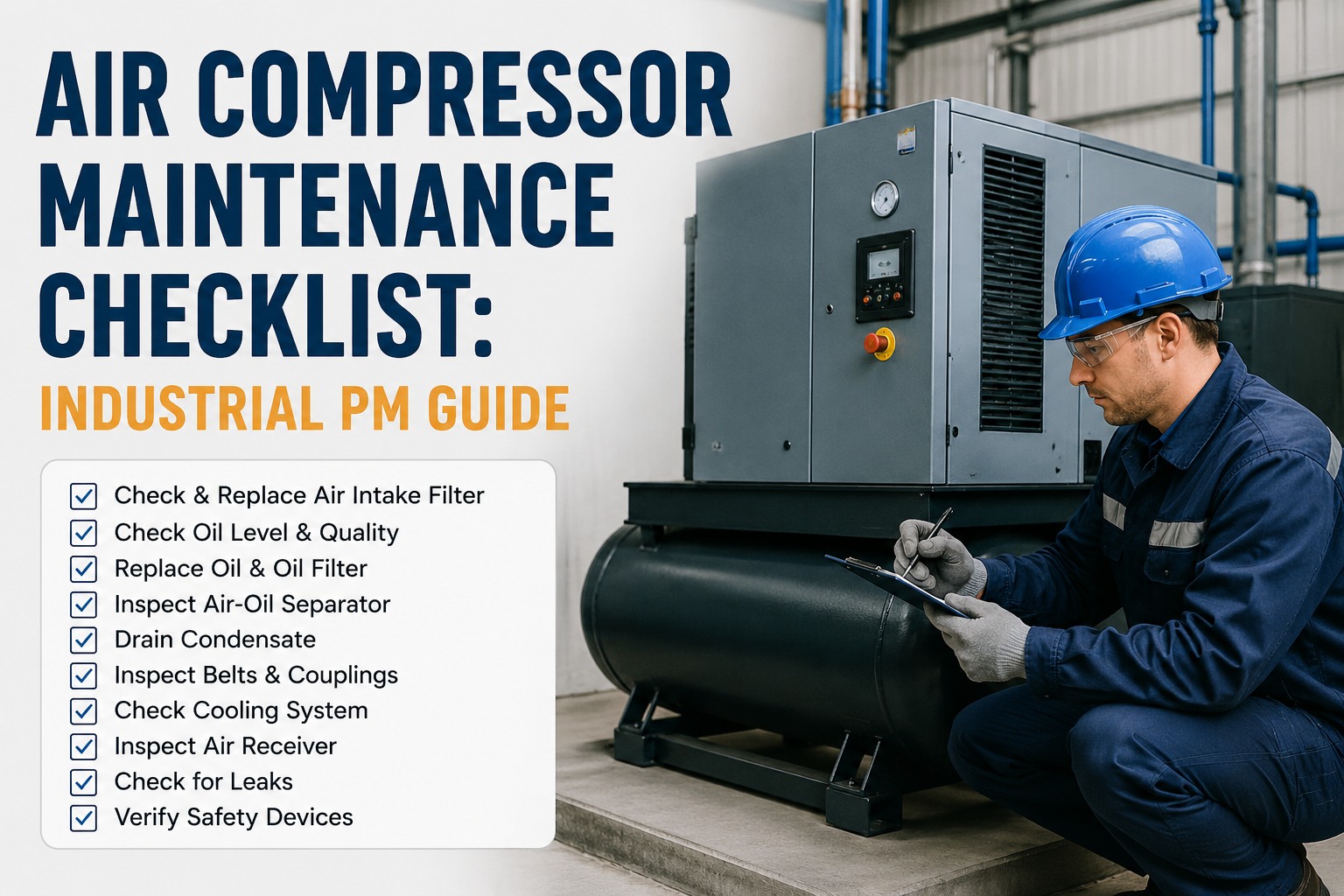
A complete checklist covers four cadences. Daily (5 minutes): walk the unit, listen for abnormal noise or vibration, scan for air/oil/coolant leaks, check oil level via sight glass, verify condensate drain functioning, check discharge pressure and temperature against baseline, read the controller for active warnings. Weekly (15 minutes): clean or inspect inlet air filter, test load/unload cycling and pressure setpoints, inspect belts and couplings, clean enclosure filters and cooling fins, test safety relief valve, log hour-meter reading. Monthly (30 minutes): clean aftercooler and oil-cooler heat exchangers, check belt tension, inspect hoses and fittings, verify motor bearing grease intervals, run a compressed-air leak survey with ultrasonic detector, review controller trend data. Hour-based (major service): 2,000-hour filter and oil sample service, 4,000–8,000-hour oil and separator service, annual full PM including motor bearing service and safety valve certification, and pressure-vessel receiver inspection per state jurisdiction. Every item generates a documented observation, not just a tick.
How much do compressed-air leaks cost a facility?
In a poorly maintained industrial compressed-air system, leaks alone can consume 20–30% of the compressor's total output — and roughly 80% of those leaks are inaudible without an ultrasonic detector. That translates directly into wasted electricity: a 100 HP compressor running 80 hours per week can produce annual electricity costs in the range of $40,000–$70,000 depending on local energy rates, meaning a 25% leak rate is $10,000–$17,500 per year vanishing through unrepaired fittings, worn seals, cracked hoses, and stuck-open condensate drains. A monthly ultrasonic leak survey with a tag-and-repair follow-through is often the highest-ROI single maintenance activity on the whole checklist, and it typically pays back the detector cost within one survey cycle. The economics get worse the longer leaks are ignored, because leaks widen over time and compressor runtime hours accumulate to cover the increased demand — which then accelerates the wear schedule on every other service item.
Why does the air/oil separator need replacement?
The air/oil separator element in a rotary screw compressor is the component responsible for stripping oil from the compressed air before it leaves the compressor and enters the piping system. Over runtime hours, the element loads with fine oil mist particles it captures. Two indicators mean it's time to replace: hitting the OEM-specified hour interval (typically 4,000–8,000 hours), or measured pressure drop across the separator exceeding 10 psi. Either threshold means the element has reached the end of its useful life. Running past the threshold has two direct costs. First, energy waste: every additional psi of pressure drop the compressor has to overcome costs energy at every operating hour, and the drop grows non-linearly as the element loads further. Second, oil carryover: a failed separator lets oil pass into the compressed-air piping and downstream equipment, contaminating pneumatic tools, coating instruments, and creating cleanup and warranty problems downstream. The separator element is inexpensive compared to what it prevents on both counts.
Do I need to inspect the compressor receiver tank?
Yes. The receiver tank is a pressure vessel and falls under state or provincial pressure-vessel inspection requirements in most jurisdictions across the United States, Canada, and the UK. The specific rules vary by jurisdiction — typically administered by a state boiler and pressure-vessel inspection board or equivalent authority under ASME Boiler and Pressure Vessel Code standards — but the general requirement is periodic external inspection and periodic internal inspection by a qualified inspector on a defined schedule, along with maintained documentation. Inspection is the operator's responsibility, not the compressor OEM's. Non-compliance can result in the vessel being ordered out of service until inspection is completed, and in the event of a rupture the absence of inspection records exposes the operator to significant liability. Beyond the regulatory requirement, receiver inspection catches corrosion from water accumulation (making the daily condensate drain check even more consequential), external damage, and safety valve degradation before a failure. Fold the inspection cycle into the standing PM schedule with the applicable jurisdiction's exact interval logged against the asset.
Turn compressor maintenance from a spreadsheet into a running dashboard
HVI holds runtime and calendar intervals per asset, fires alerts on whichever hits first, launches the inspection template on the technician's phone with photo and measurement capture, flows defects into work orders with parts and labor logged, and builds the maintenance history warranty reviewers and insurance underwriters actually want to see. Live in under two weeks. No hardware. No credit card.
Trusted by plants and fleets across North America · Ready on day one