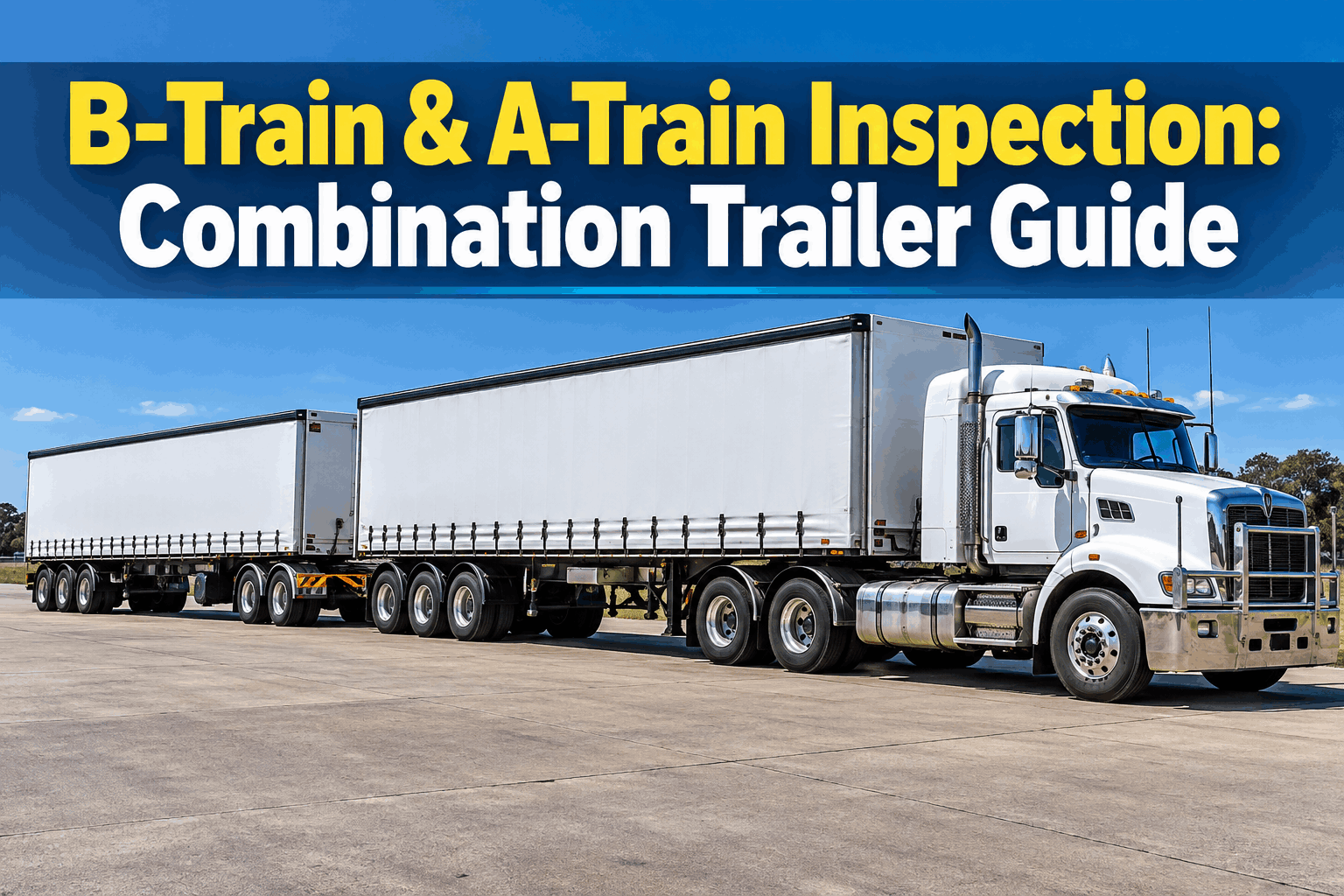
A B-train inspection isn't just a longer single-trailer walkaround — it's a different job, because every extra unit adds another coupling, brake circuit, air line,and lighting run that can fail the whole combination. Miss one connection on a double and you're risking a runaway rear unit, not just one trailer. Book a demo to see combination inspections tracked per unit.
Two Trailers, Twice the Points That Can Fail
B-trains and A-trains couple differently — but both add connections a single trailer never has. The inspection has to follow every one, and keep each tractor, trailer and dolly on its own record.
A separate dolly hooks to a pintle on the lead trailer — an extra unit and an extra articulation point, so more sway.
The lead trailer carries a fifth wheel on its extended frame; the rear kingpin couples straight in — one fewer pivot, more stable.
Here's the full picture — why combinations multiply inspection points, how B-trains and A-trains actually differ, how to inspect a converter dolly, the coupling, air and lighting continuity checks, the right inspection sequence, and why each unit in the combination needs its own maintenance and inspection history.
Why a combination multiplies the inspectionevery added unit is another set of failure points
A single trailer has one coupling to the tractor. Add a second trailer and you add another coupling, another brake circuit, another air connection, another lighting run — and on an A-train, a whole converter dolly on top of that. The inspection doesn't just get longer; it gets more places to go wrong.
That's why a combination can pass a glance and fail on the road — one unchecked gladhand or a dolly with a cracked drawbar is enough. The discipline is the same one behind a proper DOT pre-trip inspection, extended across every unit in the string.
the couplings to verify versus a single trailer — each one a potential separation point.
whole converter dolly to inspect on an A-train — a small trailer of its own.
brake and lighting run has to stay unbroken to the last unit, or the rear rides unsafe.
Add it up and a double simply has more that must be right before it rolls — which is exactly why inspectors give combinations a closer look. Book a demo to see a combination checked unit by unit
B-train vs A-train: what actually differsthe coupling method changes what you inspect
The two configurations solve the same problem — pulling two trailers — in different ways, and the difference decides your inspection points. Knowing which you're looking at tells you whether there's a dolly in the mix and how many couplings to verify.
| A-train | B-train | |
|---|---|---|
| How it couples | Converter dolly on a pintle hook at the lead trailer's rear | Fifth wheel on the lead trailer's extended frame; rear kingpin couples directly |
| Extra unit | Yes — a converter dolly to inspect and maintain | No dolly — the lead trailer carries the fifth wheel |
| Articulation | More pivot points, more sway to manage | One fewer pivot point, more stable |
| Coupling checks | Tractor + pintle/dolly + rear trailer | Tractor + direct fifth-wheel to rear trailer |
Neither is "safer to skip" — a B-train has fewer parts but a directly-coupled rear trailer whose fifth wheel still has to be verified locked, and an A-train adds an entire dolly. This is where a structured annual inspection per unit matters most. Start free and set the right checklist per configuration.
The converter dolly is its own inspectionthe extra unit an A-train adds — don't treat it as an afterthought
On an A-train, the converter dolly is a small trailer in its own right, and it carries some of the most safety-critical connections in the whole combination. It deserves a full check, not a glance on the way past — a failure here can drop the entire rear trailer on the road.
Drawbar straight, no cracks or bent members; the eye and pintle engagement tight with no excess play. A worn eye is a slow-building failure that ends in a separation.
Plate clean and lubed, jaws lock fully around the kingpin, release handle seated — no gap after coupling. A visible gap means it isn't locked, full stop.
Crossed, hooked, rated, and not dragging — the last line if the primary coupling lets go. Crossing them cradles the drawbar instead of dropping it.
Chambers, pushrods and lines secure and leak-free; air must reach the dolly and the trailer behind it, or the rear brakes won't set at all.
Tread, pressure, no bulges; hubs checked for leaks and bearing noise, lug nuts all tight. Dolly tires wear fast from cornering, so they get checked often.
Marker, clearance and brake lights working through the dolly's connection to the rear trailer — a break here leaves the last unit invisible at night.
Because the dolly moves between trailers, its faults get lost unless it has its own record — the same principle behind proper trailer inspection requirements, where the asset carries its history, not the driver. Book a demo to give each dolly its own inspection record
Continuity: coupling, air and lightingthe checks that must hold through the whole combination
The signals that keep a combination safe — braking, lighting, and the couplings themselves — have to run unbroken from the tractor to the last unit. A break anywhere in the chain is a failure of the whole string, so each is verified end to end.
Every fifth wheel and pintle locked with no gap; tug-test each connection by pulling against set brakes; landing gear up and secured. On a double there's more than one coupling to prove, so each gets its own tug test — not just the first.
Red and blue gladhands on the right couplers, gaskets intact, shut-off valves open to the rear, tractor protection valve tested to confirm rear brakes set. A closed valve mid-string means the last trailer rolls with no brakes — a classic doubles mistake.
Connector pins clean and clicked in; brake, turn, clearance and marker lights confirmed working on every unit including the last.
The tug test and the tractor-protection check are the two most-skipped and most-important — they're what prove the rear unit will stop and stay attached. Start free and make every continuity check a required step.
The right sequence to inspect a doubleorder matters when you're building a combination
A combination is inspected as it's built — check each unit before it's coupled, verify the connection, then move to the next. Working in order is how you avoid a missed check hidden behind a coupled unit, and it's the sequence a CDL doubles examiner expects to see too.
Done in this order, nothing gets buried behind a coupled unit — and captured on a phone as you go, it becomes a record instead of a memory. Book a demo to see the sequence as a guided checklist
From a fleet compliance officer
Our dollies were the black hole — they'd move between trailers and nobody could tell you when one was last inspected or what had been fixed on it. We had a dolly fail an annual because its brakes hadn't been touched in who-knows-how-long. Once every dolly and trailer got its own record instead of riding on the truck's, the combination inspection finally added up to something we could stand behind at a roadside.
How HVI handles combination inspectionsmulti-asset inspections, per-unit history and photo capture
A combination inspection is only trustworthy when each unit's history is intact. HVI records the whole string in one inspection while keeping the tractor, trailers and dollies on separate records — each with its own annual-inspection alert, defects and photos.
Inspect the whole combination
One guided inspection walks every coupling, dolly and unit in the right sequence.
Capture defects & photos per unit
A fault on the dolly attaches to the dolly; a crack on the rear trailer to that trailer.
Keep each unit's clock
Every tractor, trailer and dolly holds its own annual-inspection alert and history.
See how a combination inspection and each unit's history live together inside HVI's inspection and maintenance platform. Line it up in a quick demo
B-train & A-train inspection: quick answers
What is the difference between a B-train and an A-train?
It's how the second trailer couples. An A-train uses a converter dolly hooked to a pintle on the rear of the lead trailer — an extra unit and an extra pivot point, so more sway. A B-train mounts a fifth wheel on the lead trailer's extended frame, so the rear trailer's kingpin couples directly with no dolly and one fewer articulation point, making it more stable. For inspection, the practical difference is simple: an A-train adds a whole converter dolly to check, a B-train does not.
What do you inspect on a converter dolly?
Treat it as its own trailer: the tow bar and drawbar eye for cracks and play, the fifth wheel for a clean plate and fully locked jaws, safety chains crossed and rated, brakes and air lines secure and leak-free, tires and wheel ends for wear and bearing condition, and the lighting run through to the rear trailer. Because the dolly moves between trailers, it needs its own inspection record.
How do you check air-line continuity on a double?
Confirm the red and blue gladhands are on the correct couplers with intact gaskets, the shut-off valves are open to the rear so air reaches the last unit, and test the tractor protection valve by disconnecting the rear service line to verify the emergency brakes set. Air must reach every unit or the rear trailer's brakes won't work.
Why does each unit in a combination need its own inspection history?
Because the units get shuffled — a dolly or trailer moves between combinations, so a fault logged against "the truck" gets lost the moment the string is broken up. When each tractor, trailer and dolly carries its own record with its own annual-inspection date, defects and photos, the history stays accurate no matter how the units are recombined. It's also what keeps a roadside inspection honest — the inspector checks the unit in front of them, not the truck it happened to arrive with.
How does HVI handle combination inspections?
HVI records the whole combination in one multi-asset inspection, then keeps the tractor, each trailer and each converter dolly on its own history — each with an annual-inspection alert, defect log and photo evidence. A dolly's defect follows the dolly, not whichever trailer it was under, so every unit's record stays complete and audit-ready.
Inspect the whole combination — keep every unit's history straight
HVI records B-train and A-train inspections as one guided multi-asset check, then keeps the tractor, trailers and converter dollies on separate records — each with its own annual-inspection alert, defects and photos. The dolly that used to be a black hole finally has a history.
No credit card · Multi-asset combination inspections on day one
- Every coupling & tug-test result
- Converter dolly full inspection
- Air & lighting continuity checks
- Defects & photos per unit
- Annual-inspection date per asset