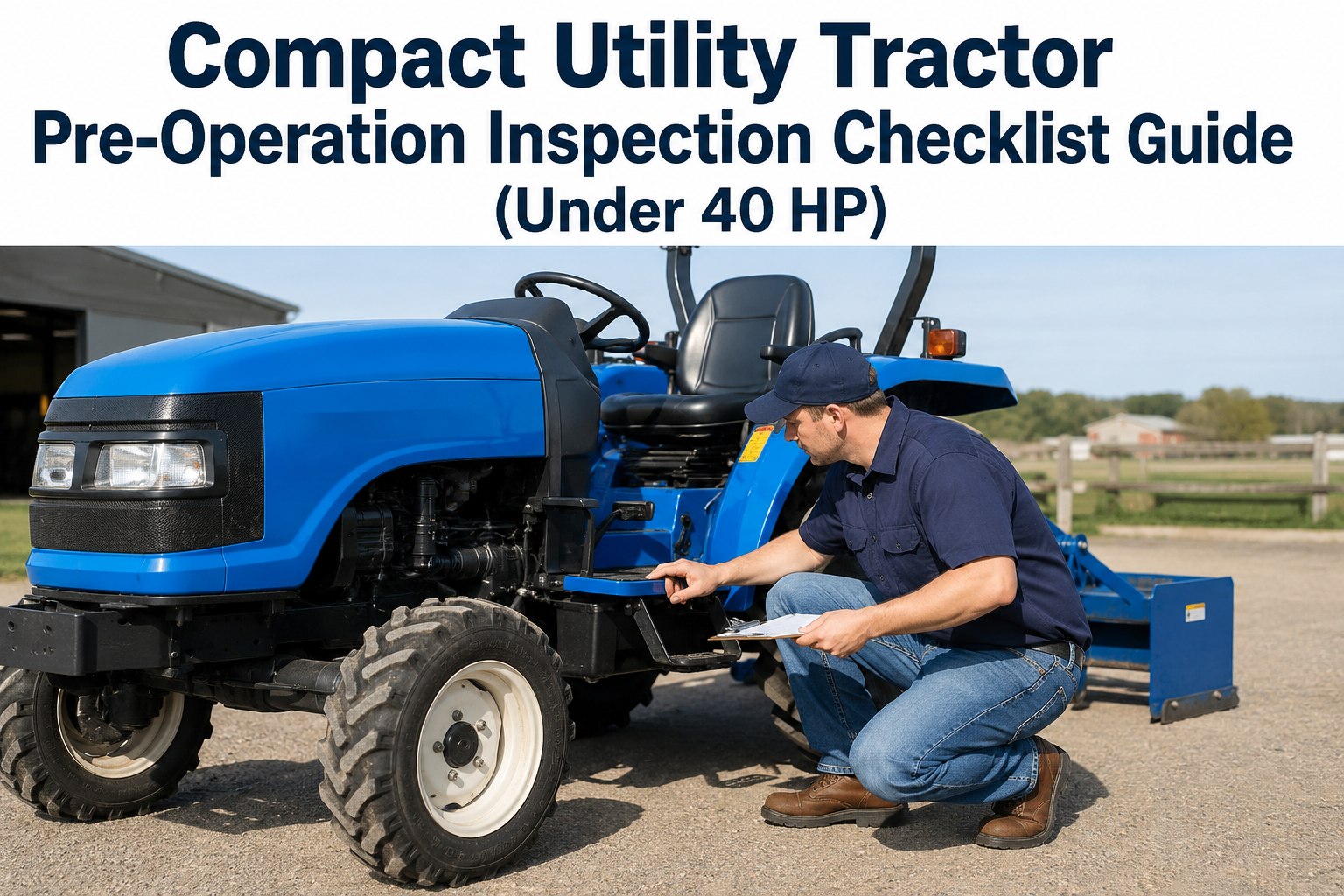
A compact utility tractor under 40 HP feels small enough to be safe — a sub-compact you mow with, load gravel with, and forget about. That feeling is exactly what makes it dangerous. Tractor overturns, runovers, PTO entanglements, and roadway collisions kill roughly 250 people a year and are the single leading cause of death in agriculture, and rollovers alone account for more than half of all farm fatalities. The killers are almost always the same handful of items: a missing PTO shield, a ROPS that's been folded down or modified, a seatbelt that doesn't click, a worn tire on a slope. The fix is a five-minute walkaround before the key turns — and the numbers back it up: a ROPS used with a seatbelt is 99% effective at preventing death in an overturn. This checklist covers every system on a compact tractor — ROPS and seatbelt, PTO, 3-point hitch, loader, hydraulics, tires, brakes, steering, and controls — as a pre-shift inspection you can run in minutes. HVI's inspection & maintenance software puts that walkaround on a phone, turns every failed check into a work order, and keeps a record for every machine in your fleet. Book a 30-minute walkthrough to see it set up for your operation.
It's a small tractor. The hazards that kill on it are full-size.
A complete pre-operation inspection checklist for compact utility tractors under 40 HP — ROPS, seatbelt, PTO, 3-point hitch, loader, hydraulics, tires, brakes, steering, and safety controls. HVI inspection & maintenance software runs the whole check on a phone or tablet, raises a work order on any defect, schedules preventive maintenance, and keeps a compliance record for every machine — fully offline in the field.
The four hazards behind almost every tractor death
Compact tractors don't fail in mysterious ways. The fatal incidents cluster into four well-known mechanisms — and every one of them is something a pre-operation check is designed to catch.
Overturns
Side and rear rollovers cause more than half of all farm fatalities. A high center of gravity, a slope, and a sharp turn are all it takes — which is why ROPS and seatbelt are non-negotiable.
PTO entanglement
A spinning, unshielded PTO shaft catches clothing in an instant and pulls the operator in. A missing or damaged PTO shield is one of the most common — and most lethal — defects found on tractors.
Runovers
Bypass-starting, no parking brake, or an extra rider — runovers happen when a tractor moves with no one in the seat or a passenger falls. Brakes, interlocks, and a clear platform all matter.
Roadway collisions
Faded SMV emblems, dead flashers, and weak lighting make a slow tractor invisible on public roads. Visibility checks are part of the pre-op for a reason.
The lesson in the data is brutal and simple: the safety items are cheap, the check is fast, and the cost of skipping it is somebody's life and often the farm itself. Treat the lines marked critical below as hard stops — if any one fails, the tractor does not run until it's fixed.
The pre-operation inspection checklist
Walk the tractor the same way every time — start at the operator station, work through the safety systems, then the drivetrain and ground contact. The starred items are the ones that kill: a failure there means the machine is grounded, not flagged for later.
Operator protection — ROPS & seatbelt
- ROPS present, upright, and free of cracks, rust, or bends
- ROPS not modified, drilled, welded, or permanently folded
- Seatbelt present, latches firmly, webbing not frayed
- Seat securely bolted; no excessive movement or damage
- Operator platform and steps clear of mud, tools, and debris
PTO & power transmission
- PTO master shield in place and undamaged
- PTO shaft shield rotates freely and fully covers the shaft
- No frayed clothing risk — shaft guards complete end to end
- PTO engages and disengages cleanly with no grabbing
- Implement driveline guard intact where fitted
3-point hitch, loader & implements
- Lift arms, top link, and pins sound with no cracks or wear
- Hitch raises, holds, and lowers smoothly with no drift
- Loader arms, bucket, pins, and cylinders undamaged
- Quick-attach locks fully engaged on any implement
- No fluid weeping at loader or hitch cylinder seals
Fluids, hydraulics & engine bay
- Engine oil, coolant, and hydraulic fluid at correct levels
- No fluid leaks or fresh puddles under the tractor
- Hydraulic hoses free of chafing, cracking, or bulging
- Air filter and fuel filter within service life
- Fan belt not frayed; no loose or missing fasteners
Tires, brakes & steering
- Tire pressure correct; tread sound with no cuts or bulges
- Wheel lug nuts tight; no missing studs
- Service brakes firm; left and right pedals lock together
- Parking brake holds the tractor on a slope
- Steering responsive with no excessive play or wander
Visibility, controls & warnings
- Headlights, work lights, and warning flashers all working
- SMV emblem bright, intact, and not faded
- Horn and all gauges functioning
- Start-in-neutral / seat interlock prevents unsafe starting
- Fire extinguisher charged and in date, if fitted
Six zones, around thirty checkpoints, on every machine before every shift — paper forms get skipped the day a field is wet and the season is short. sign up free and run this checklist in HVI's inspection & maintenance software, or book a demo to see a failed PTO-shield check auto-raise a work order.
If a check fails: critical vs. flag-for-later
Not every defect grounds a tractor — but the safety-critical ones absolutely do. This is the call every operator has to make at the end of the walkaround.
Stop — tag out of service
- ROPS cracked, modified, or folded down
- Seatbelt missing or won't latch
- PTO shield missing or damaged
- Brakes fail or parking brake won't hold
- Steering loose or unresponsive
- Worn or damaged tire on a machine used on slopes
Flag — schedule the fix
- Faded SMV emblem due for replacement
- A work light out (not the warning flashers)
- Minor seep at a fitting, levels still good
- Air filter approaching its service interval
- Gauge reading intermittently
- Cosmetic damage with no structural effect
The hard part of this on paper is that "flag for later" usually means forgotten — the note never becomes a repair. In HVI, a flagged item becomes a scheduled work order with a due date, and a critical failure tags the machine out of service until the repair is signed off. Nothing falls through.
Paper checklist vs. HVI inspection & maintenance software
Both record the same checks. Only one makes the critical items impossible to skip, photographs every defect, raises the repair as a work order, and keeps a record per machine you can actually find.
Paper / clipboard
- Walkaround rushed or skipped in a busy season
- No proof the PTO shield or ROPS was actually checked
- "Flag for later" notes lost before the repair happens
- Service intervals tracked in someone's head
- No photo evidence when a defect is found
- Records scattered across trucks, sheds, and binders
With HVI software
- Critical items must be answered before sign-off
- Mandatory photo capture on any defect found
- Failed checks auto-raise a maintenance work order
- Preventive maintenance scheduled per machine
- Timestamped digital records ready for any audit
- Works fully offline in the field, syncs when back online
Five minutes before the key turns. Every machine, every shift.
Put the full compact tractor checklist on every operator's phone — critical items that can't be skipped, mandatory defect photos, instant work orders, and preventive maintenance scheduled per machine.
Frequently asked questions
What should a compact utility tractor pre-operation inspection cover?
A complete pre-operation check on a compact tractor under 40 HP works through six areas, starting with the ones that kill: operator protection (ROPS upright and unmodified, seatbelt latching, seat secure, platform clear); PTO and power transmission (master shield in place, shaft shield rotating and fully covering the shaft, clean engage/disengage); the 3-point hitch, loader, and implements (lift arms and pins sound, hitch holds without drift, quick-attach locks engaged); fluids and hydraulics (oil, coolant, and hydraulic levels, no leaks, hoses sound, filters in service); tires, brakes, and steering (pressure and tread, lug nuts tight, brakes firm, parking brake holds on a slope, steering responsive); and visibility and controls (lights, flashers, SMV emblem, start interlock). The ROPS, seatbelt, PTO shield, brakes, and steering are safety-critical — a failure there grounds the tractor. HVI delivers all six as a phone checklist where critical items must be answered before sign-off.
How often should a compact tractor be inspected?
The pre-operation walkaround should happen before the first start of every working day or shift — it's a quick visual and functional check, not a service. On top of that daily check, follow the manufacturer's maintenance schedule for oil and filter changes, lubrication, and hydraulic service at the recommended hour intervals, and do a post-operation look for fresh leaks or new damage after heavy use. The daily check catches the safety hazards that cause same-day incidents; the scheduled maintenance keeps the machine reliable over its life. HVI handles both in one place — the pre-op checklist on a phone and preventive maintenance scheduled per machine by hours or calendar, with reminders before each service comes due.
Why is the PTO shield such a big deal on a small tractor?
Because horsepower doesn't change how a PTO kills. The power take-off shaft spins fast enough to catch a sleeve, a pant leg, or a loose drawstring and wind the operator into the machine in under a second — and a sub-compact's shaft does this just as readily as a big tractor's. Inspections of farm tractors repeatedly find PTO master shields missing or damaged on a large share of machines, and a missing shield is one of the most common defects tied to entanglement fatalities. The fix costs little and the check takes seconds: confirm the master shield is in place, the shaft shield rotates freely and covers the shaft fully end to end, and any implement driveline guard is intact. On HVI, a failed PTO-shield check is a critical item that grounds the tractor and raises a work order automatically.
Do small tractors really need ROPS and a seatbelt?
Yes — arguably more than large ones, because compact tractors are used on lawns, slopes, ditches, and uneven ground where a high center of gravity tips easily. Rollovers cause more than half of all farm fatalities, and the data on the fix is overwhelming: a rollover protective structure used with a seatbelt is about 99% effective at preventing death in an overturn, and roughly 70% effective even without the belt. The two only work together — a ROPS keeps a survival space, and the seatbelt keeps the operator inside it. That's why the pre-op flags a folded, modified, or damaged ROPS and a missing or non-latching seatbelt as hard stops: the tractor doesn't run until both are right. HVI treats these as critical checks that block sign-off when they fail.
How does HVI's inspection & maintenance software help with a tractor fleet?
HVI runs the whole inspection and maintenance program for a compact tractor fleet in one platform. The pre-operation checklist lives on a phone or tablet so it can't be rushed — critical items like ROPS, seatbelt, and PTO shield must be answered before sign-off, with mandatory photo capture the moment a defect is flagged. A failed check instantly becomes a maintenance work order, and a critical failure tags the machine out of service until the repair is signed off, so nothing gets noted and forgotten. Beyond the daily check, the software schedules preventive maintenance per machine by engine hours or calendar and reminds you before each service is due. Everything works fully offline in the field and syncs when back in range, and every inspection and repair is a timestamped digital record, exportable as the audit trail an insurer or auditor will accept. book a demo and we'll set it up around your specific tractor fleet on the call.
The cheapest five minutes on the whole farm.
HVI inspection & maintenance software turns this checklist into a digital pre-operation inspection — critical items that can't be skipped, mandatory defect photos, auto-generated work orders, scheduled preventive maintenance, and a full record for every machine, all working offline in the field. Protect your operators, your equipment, and your operation on every shift.
No credit card required · Live in under two weeks · Digital checklists + critical-item stops + defect photos + work orders + PM scheduling, fully offline