A vibratory roller doesn't compact material with its weight — it compacts with force. A Bomag BW120SL-5 running at 4,320 vibrations per minute and 0.020-inch amplitude generates roughly 8,993 pounds of centrifugal force per pass. That's what actually compresses the aggregate. When the vibration system drifts out of spec, when the water spray clogs, or when the drum buffers wear, compaction density falls off and nobody notices until the density test fails at the end of the shift. Compactor inspection is really vibration-system inspection — the check nobody teaches operators to make, but the one that decides whether the pavement holds. Book a demo
The compaction physics equation — three dials that decide every pass
Amplitude, frequency, and pass count. Every setting error compounds into a rework bill.
Compactors are the only heavy-equipment class where operator settings matter more than machine size. A well-set 12-ton tandem outperforms a poorly-set 15-ton machine every pass. That means the inspection has to cover both mechanical condition and vibration-system health — two very different things that fail in very different ways. A compactor with a healthy engine and worn vibration bearings will look fine on paper and fail every density test on the site.
The 3 compactor families — different jobs, different inspection priorities
Not every roller compacts the same way. The type of compactor decides which components matter most, and the inspection checklist should match. Here's the practical split you'll see on site.
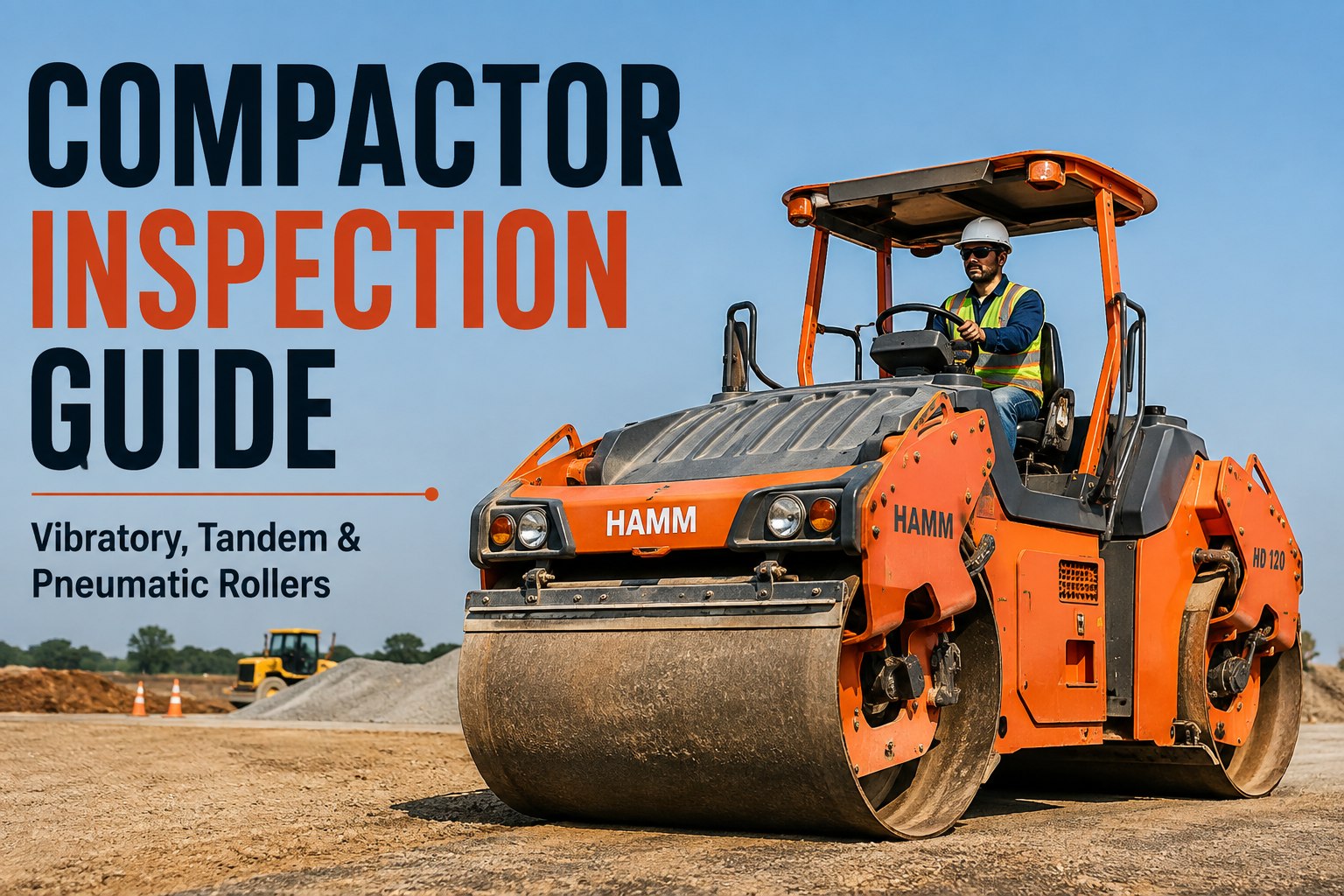
Vibratory rollers do the heavy lifting on soil; tandem vibratories handle asphalt finish work; pneumatic-tire rollers knead asphalt in the intermediate rolling phase. Same jobsite often uses all three in sequence. The inspection focus shifts per type: vibration health for the first two, tire and ballast discipline for the third. Running the wrong checklist on the wrong machine is a common mistake fleets make when they use a single generic template. Book a demo to see OEM-specific templates per compactor family
The 6-station walkaround — compactor edition
Same 6-station discipline, tuned for compactor-specific systems. Runs 12–15 minutes on a mid-size roller when digitized; stations 3 and 4 — drum and vibration system — are where the compactor-specific value lives.
Station 4 — the vibration system — is what separates compactor inspection from any other machine walkaround. Get station 4 wrong and you'll spend a day rolling before finding out the density isn't being achieved. That's a full day of production plus rework, on materials that don't get cheaper the second time. Book a demo to see the vibration system tied to hour-meter intervals per unit
The 4-point vibration system health check — the inspection nobody teaches
Every compactor operator knows how to check engine oil. Almost none of them can tell you whether the vibration bearing housing is intact. That's the gap. Here are the four vibration-system checks that catch the failures that ruin production days.
Vibration bearing oil level
Check via sight glass or dipstick per OEM. Low oil = imminent bearing failure. Bomag calls for 1,000-hour interval on vibration bearing oil replacement; the level check is daily.
Bearing housing seal integrity
Visual check for oil weep, discoloration, or vibration marks around the housing. Failing seals let contamination in and oil out — both accelerate bearing wear.
Amplitude switch function
Test both amplitude settings from the cab: low and high. Both should engage cleanly with distinct machine response. Sticking or partial engagement is a control-system fault.
Frequency check & calibration
Every 500 hours per OEM. Frequency drift means centrifugal force is off-spec — compaction density will suffer even at correct amplitude. Hamm recommends annual recalibration; Cat uses SOS oil analysis for early warning.
All four checks together take about 6 minutes at pre-shift. The failure mode most fleets don't budget for is a bearing seizure mid-shift, which typically runs $8,000–$20,000 in parts plus 3–7 days of downtime on a rental replacement. Catching the wear signals in the daily check versus after failure is a 20:1 cost difference. Start free and get vibration-system alerts tied to hour meters on day one
Amplitude & pass-count matrix — setting the roller for the material
Amplitude and pass-count aren't arbitrary. They're determined by the material, the lift thickness, and the density spec. Getting this wrong on the roller is what makes the density test fail on the QC lab report — not the machine, the setting. Here's the practical reference.
These are starting points, not laws. Field density testing calibrates the final settings per project, per material lot. But the compactor has to be capable of holding those settings — and that's where the pre-shift inspection determines whether the day's compaction is going to hold up under the QC lab test at 5pm.
From a Road Construction Manager who cut density-test failures 78% in one season
We were failing density tests on maybe 15% of our asphalt lots. Rework costs on those failures were killing our margin — every failed lot meant milling, hauling, and re-laying. We assumed it was operator technique or mix design. When we finally started tracking vibration system status per roller through digital inspections, the pattern was obvious: three of our four rollers had drifted amplitude or worn bearings that nobody had caught because paper checklists didn't cover it.
One quarter later, with vibration checks as a required photo on every pre-shift, we were down to 3% density-test failure — a 78% reduction. Same crews, same mix designs. What changed was the machine was actually delivering the compaction force it was supposed to. Recovered maybe $340,000 in rework we didn't have to do that season. The paper checklist was the problem — not the operators, not the mix.
Frequently asked questions
What does a proper compactor inspection cover?
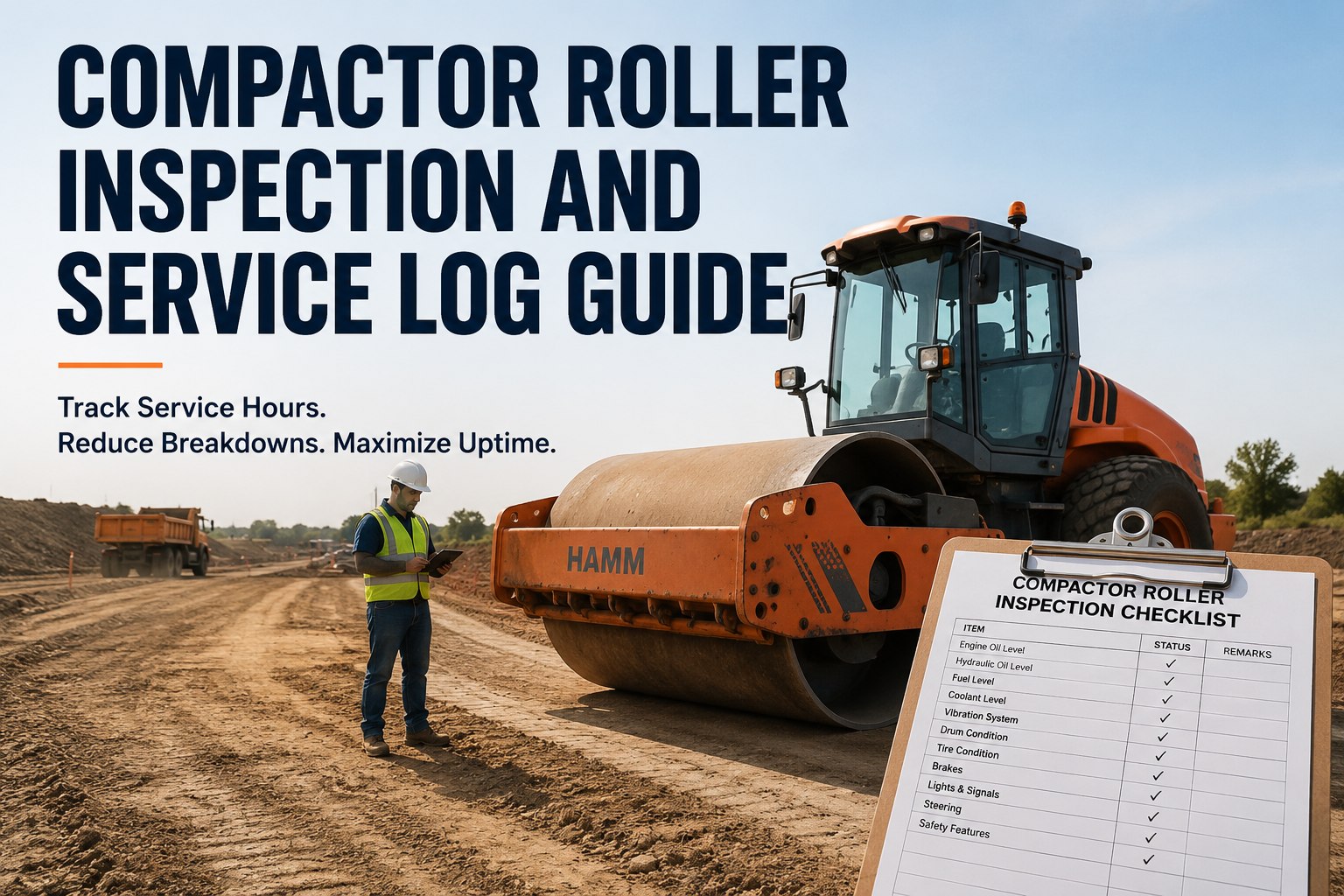
A proper compactor inspection is a pre-shift and interval-based check of a roller compactor — single-drum vibratory, tandem vibratory, or pneumatic-tire — with equal emphasis on mechanical condition and vibration-system health. A thorough walkaround takes 12–15 minutes on a mid-size roller and covers six stations: cab and controls (including amplitude, frequency, and vibration cutoff sensor function); engine bay (coolant, oil, hydraulic oil, filters); drums (thickness, wear pattern, cracks, drum scrapers, drum buffers); vibration system (bearing oil level, housing seal integrity, amplitude switch function, frequency check); water spray system (tank, nozzle pattern per drum, filters); and articulation joint and tires (pins, bushings, steering cylinders, rear tires or drums per model). Because compactors are governed by OSHA construction pre-shift rules at 29 CFR 1926.20 and 1926.602 with penalties up to $16,550 per serious violation, digital inspection documentation with GPS verification and photo evidence protects fleets in audit scenarios. But the real value of compactor inspection is preventing density-test failures downstream: a compactor with drifted vibration frequency or worn bearings will look fine mechanically and fail every density test, generating rework costs that dwarf any inspection program's operating cost.
Why is the vibration system so critical on a compactor?
The vibration system is what makes a compactor a compactor. Modern vibratory rollers don't compact material by static weight alone — they compact by generating centrifugal force through internal rotating eccentric weights that vibrate the drum at a specified frequency and amplitude. A Bomag BW120SL-5 running at 4,320 vpm and 0.020" amplitude generates 8,993 pounds of centrifugal force per pass. That force number determines whether the density spec is achievable. When the vibration bearing wears, the oil level drops, the amplitude switch sticks, or the frequency drifts out of calibration, the actual force delivered to the material falls off. Nobody sees it happen; the machine still looks fine; the operator still runs the correct pass count. But the density test at end of shift fails. Four checks separate proper vibration-system inspection from a generic walkaround: vibration bearing oil level (Bomag calls for 1,000-hour interval on the oil itself; daily level check is required); bearing housing seal integrity (leaking seals mean contamination in and oil out); amplitude switch function (both settings must engage cleanly with distinct machine response); and frequency check on 500-hour intervals with annual recalibration recommended by Hamm and OSC-style calibration programs. Miss any of the four and productivity looks normal while quality fails. Cat's Scheduled Oil Sampling (SOS) program adds oil analysis to catch bearing wear before symptoms appear.
How often should compactors and rollers be inspected?
Compactor inspection follows a stacked cadence with four intervals. Daily / pre-shift: the 12–15 minute six-station walkaround before the first pass, plus fluid level check, fault code review, vibration cutoff sensor test, water spray function test. This is required under OSHA pre-shift rules. Weekly / 50 hours: deep drum inspection with wear measurement, drum scraper adjustment, water spray nozzle pattern check on each drum, articulation joint grease points, hydraulic hose visual, battery and electrical connections. 100–500 hours: drum buffer inspection every 100 hours per general roller-industry practice; vibration frequency check every 500 hours; oil sampling and filter change per OEM specification (Cat SOS program, Bomag intervals, Hamm intervals); amplitude system function test under load; articulation pin and bushing measurement. 1,000+ hours or annual: Bomag vibration bearing oil replacement at 1,000 hours; Hamm annual vibration frequency recalibration; comprehensive electrical safety interlock testing (seat switch, emergency stop, vibration cutoff); telematics software updates (Bomag Compatec, Cat Compact Assist, Hamm HCQ Navigator); complete component wear measurement. Documentation matters as much as the check itself — per Blades Direct guidance, disciplined maintenance documentation builds resale value and warranty credibility. Digital inspection records with photo evidence and timestamps satisfy OSHA documentation requirements cleanly while paper records with variable legibility create audit exposure.
Why does the water spray system matter for asphalt compaction?
Water spray on asphalt compactors prevents the hot asphalt mix from sticking to the drums or pneumatic tires during compaction. Modern tandem vibratory rollers like the Bomag BW120SL-5 use pressurized double-filtered water spray systems on both drums; the filtration prevents nozzle clogging from mineral deposits or debris in the water supply. When the water spray fails or the nozzle pattern drifts uneven, asphalt sticks to the drum in patches, transferring to the mat surface and creating tear marks or texture defects that fail visual QC and sometimes density spec. Common water-spray-system failures caught by pre-shift inspection: empty or dirty water tank (fills daily on a working roller); clogged filters (check and clean per interval); blocked or unevenly-spraying nozzles (each nozzle on each drum should produce a fan pattern of uniform density); leaking hoses or fittings; and in cold-weather regions, freeze damage to lines that weren't drained at end of previous shift. Five minutes of inspection catches all of these; missing any of them creates surface defects that either require milling and rework or accept a downgraded product. On pneumatic-tire rollers, the water spray also cools the tires and prevents asphalt pickup on the rubber, which is why the same discipline applies even without vibration systems.
How does HVI support compactor inspection and PM programs?
HVI ships pre-built digital inspection templates for the major compactor families — Cat CS74/CB54/CS78B, Bomag BW120SL/BW213/BW226DH, Hamm HD 12/3410/HP 100i, Volvo SD115B, Dynapac CC2200/CC6200, and configurable templates for Sakai, Ammann, and CASE — with model-specific inspection points, required photo capture at critical stations (drums, vibration system, water spray, articulation joint), and hour-meter integration. Every inspection is tied to the specific machine, operator, and location with GPS verification and timestamped photo evidence, meeting OSHA pre-shift documentation requirements at 29 CFR 1926.602. The four-point vibration system check (bearing oil level, housing seal integrity, amplitude switch function, frequency check) is photo-required at each morning walkaround, creating a visual trend per machine that reveals vibration-system wear before density-test failure. On the PM side, HVI schedules the full interval matrix (daily, weekly/50-hour, 100-hour drum buffer, 500-hour frequency check, 1,000-hour Bomag bearing oil, annual Hamm recalibration) per machine with automatic due-date alerts and mechanic sign-off. Native integration with the major OEM telematics platforms (Cat Compact Assist, Bomag Connect/Compatec, Hamm HCQ Navigator) pre-populates overnight fault codes and hour-meter readings before the walkaround starts. Published customer data shows fleets on HVI report approximately 25% lower annual maintenance cost with typical payback around 3 months. For paving contractors, the density-test failure reduction alone typically pays back the software in a single season — every failed lot avoided saves the milling, hauling, and re-laying costs that dwarf any inspection program's operating cost.
The density test fails or passes based on 4 vibration-system checks nobody's teaching. Start teaching them.
HVI ships pre-built templates for Cat CS74/CB54, Bomag BW120SL/BW213, Hamm HD 12, and Volvo SD115B rollers — with required vibration-system photos, frequency intervals, and full PM scheduling. Live in under two weeks. Density-test failure rates typically drop meaningfully within the first month.
No credit card · Cat, Bomag, Hamm, Volvo templates ready on day one