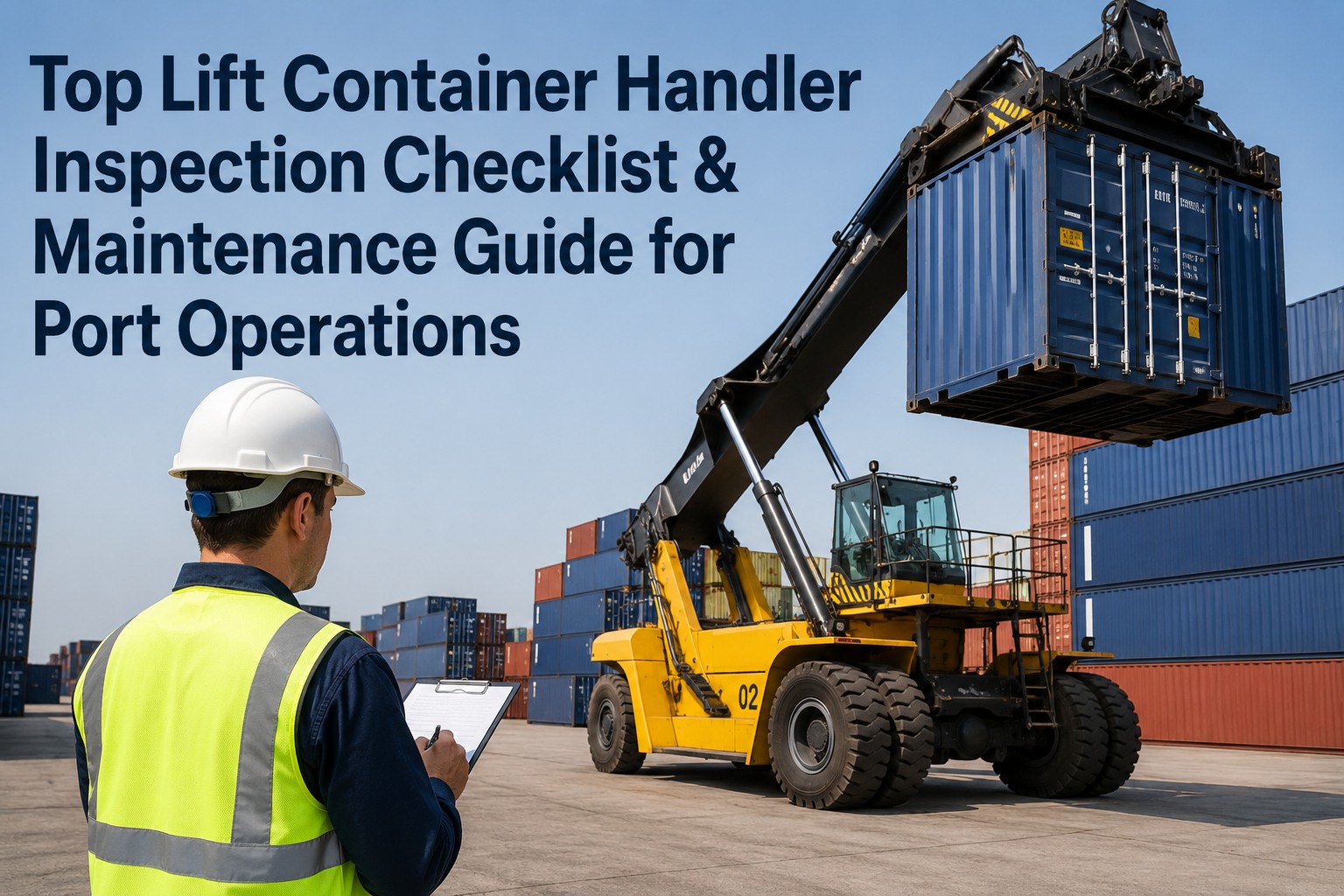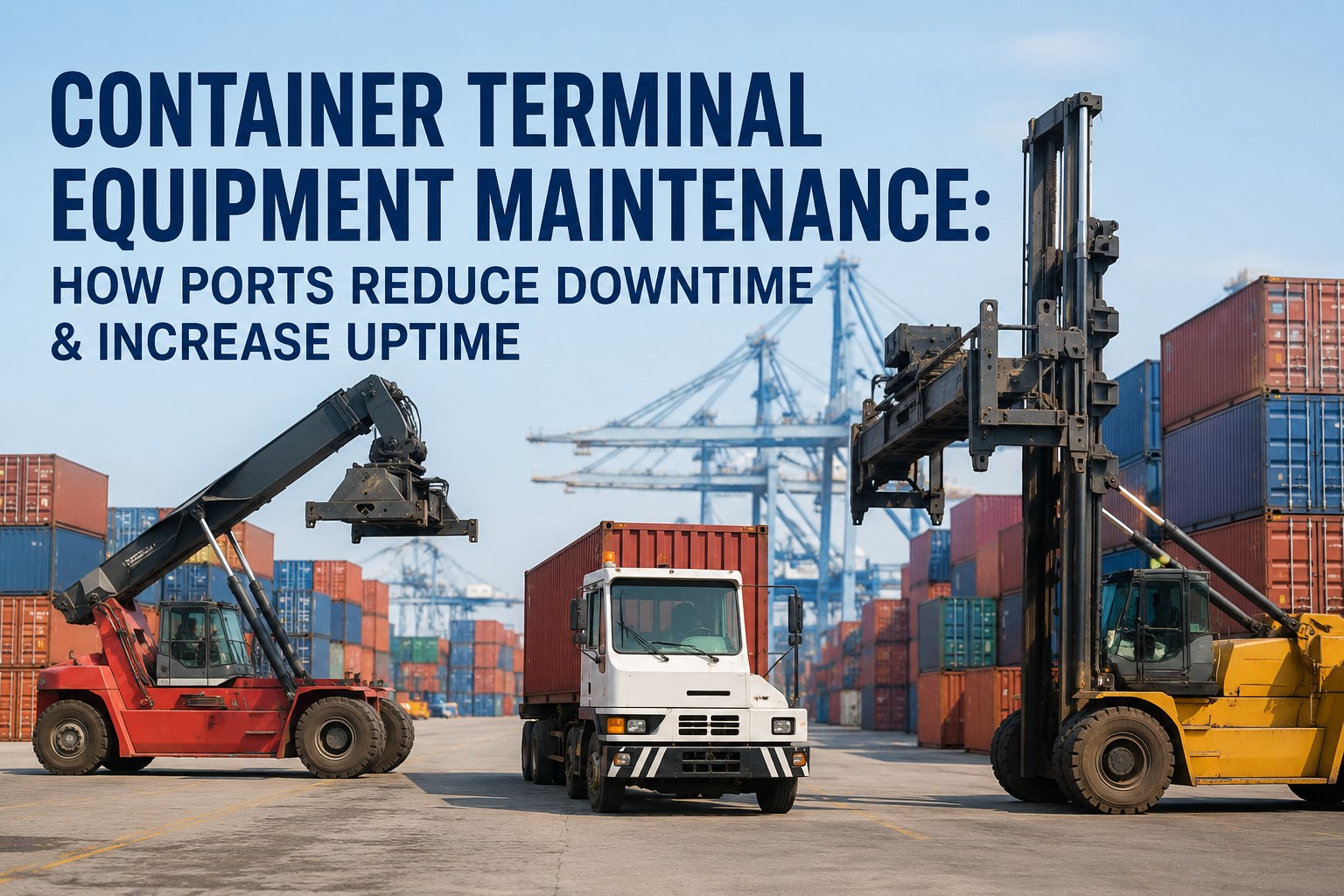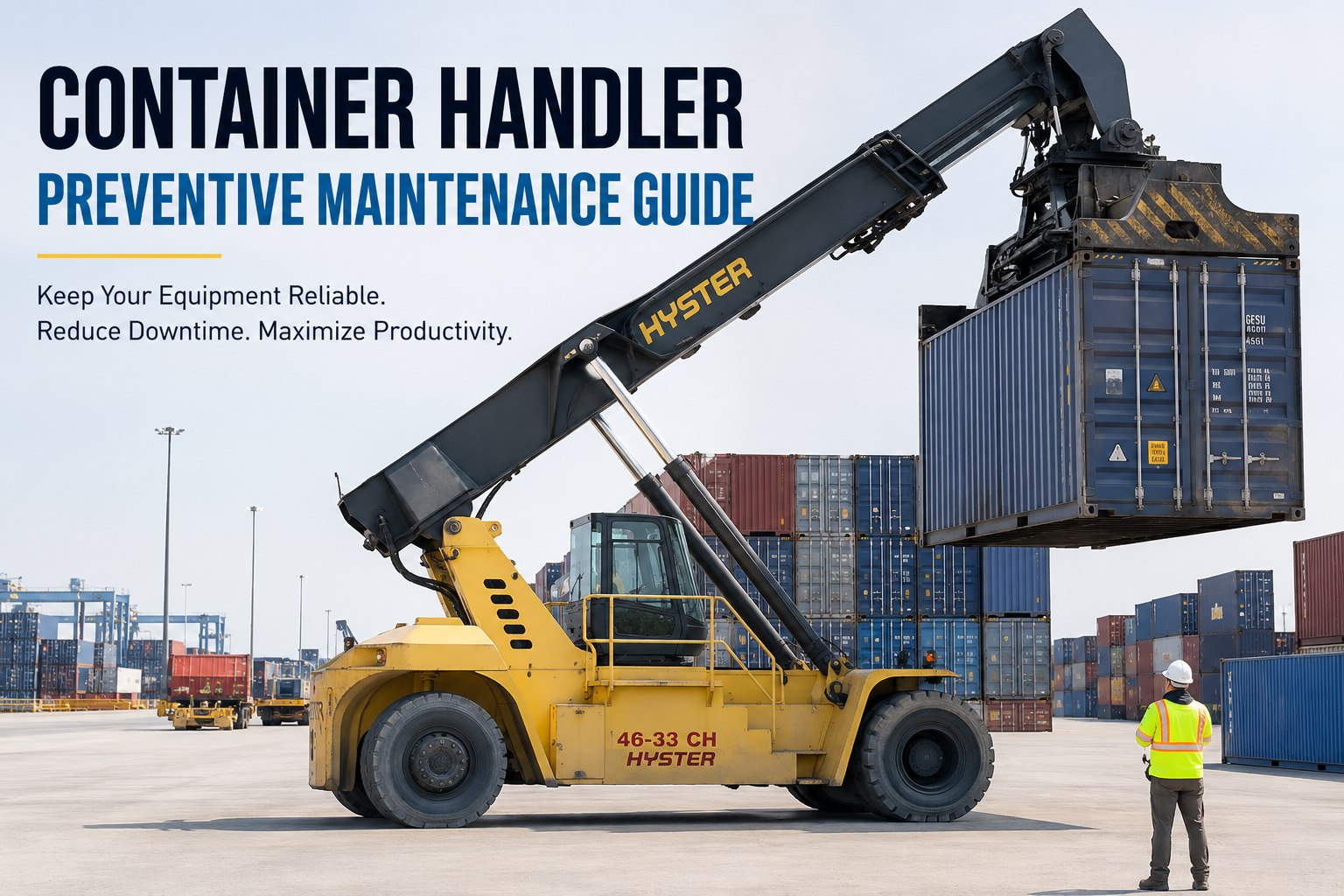
In a port or intermodal terminal, the container handler is the bottleneck the whole operation flows through. Every box moved is revenue, every minute a handler sits idle is a stack that doesn't get worked and a truck or vessel that waits — which is why terminals obsess over cost per box moved and why an unplanned breakdown is so much more expensive than the repair itself. The good news is that modern container handlers are engineered for uptime, with major engine and drivetrain components built around 500-hour service intervals and ground-level access for fast servicing. But the part that actually makes or breaks a container handler isn't the engine — it's the spreader and twistlock system, the business end that engages every container, and the mast chains that lift them. Neglect those and you don't just lose a shift; you risk a dropped container. This guide breaks down the difference between empty and loaded handlers, the spreader and mast systems that need the closest watch, the 500-hour PM cadence, the safety interlocks every pre-shift check must verify, and how to track it all. book a 30-minute walkthrough to see it set up for your terminal fleet.
Every minute a container handler sits idle, the stack waits and the cost per box climbs.
HVI fires 500-hour PM by operating hours, tracks the spreader, twistlocks, and mast chains that actually fail, runs the pre-shift check on a phone, verifies safety interlocks, and turns defects into work orders — for empty handlers, loaded handlers, and reach stackers across your terminal fleet.
Why handler uptime is the whole game
A container handler isn't just another lift truck — it's the throughput choke point of the terminal. The economics make preventive maintenance non-negotiable.
Cost per box moved
Every terminal competes on cost per box. A handler down for an unplanned repair drives that number up fast — idle equipment moves zero containers but still costs to own.
The stack backs up
One handler offline stalls a yard lane, queues trucks at the gate, and can cascade into vessel and berth delays the whole terminal feels.
A dropped box is catastrophic
A spreader or twistlock failure under load isn't downtime — it's a dropped container, a safety incident, and damaged cargo. The stakes sit on the attachment.
Manufacturers design handlers for longer component life and less unplanned downtime precisely because terminal operators know the math: planned service at the 500-hour mark costs a fraction of an emergency repair that strands the machine mid-shift. The whole point of a PM program is to keep every breakdown on your schedule, not the container's.
Empty vs. loaded: two machines, two clocks
"Container handler" covers two distinct machines with different duty cycles and wear profiles. A PM program has to treat them differently.
Empty container handlers
Light loads, high cycle count, stacking up to nine high with a mast and side-lift spreader. The mast, chains, and spreader take constant repetitive duty — high-frequency cycling is the wear driver, often handling two empties at once.
Loaded handlers & reach stackers
Heavy laden containers up to ~100,000 lbs, fewer cycles but far higher structural load. The boom or high-strength mast, drive axle, and hydraulics carry enormous stress — load magnitude is the wear driver, not cycle count.
A single blanket schedule can't serve a high-cycle empty handler and a heavy-load reach stacker — they wear out completely different components. sign up free and set type-specific PM templates for every handler, or book a demo to see empty, loaded, and reach-stacker tracking live.
The spreader & mast: the heart of the machine
The engine gets the attention, but the spreader, twistlocks, and mast chains are where a container handler actually lives or dies. These are the components a PM program must watch hardest.
Twistlocks & engagement
The locks that grip every container's corner castings. Inspect for wear, deformation, and full open/close function — a twistlock that doesn't fully engage is a dropped-container risk on every lift.
Spreader & sideshift
Telescopic extension, sideshift, reefer-correction movement, and powered pile slope. The hydraulics and structure that position the load — wear here means inaccurate, unsafe placement.
Mast & lift chains
The 2-over-1 chain system and mast carry every lift. Inspect chains for stretch, wear, and lubrication, and the mast for alignment — chain failure under load is catastrophic.
Hydraulics & cylinders
Lift, tilt, and spreader cylinders, hoses, and on-demand hydraulic system checked for leaks and pressure — the power behind every spreader and mast function.
Twistlock indicator lights on the spreader and in the cab tell the operator the load is locked — but they only mean something if the underlying mechanism is maintained. Tracking spreader and chain condition on every inspection is what keeps the indicator honest. HVI builds these attachment-specific items into every container-handler template.
The 500-hour PM cadence
Modern handlers are engineered around a 500-hour service interval, layered over the daily pre-shift check. Each tier builds on the one below it.
Operator check
Walk-around for leaks and damage, twistlock and spreader function, mast and chains, brakes, tires, lights, horn, and safety interlocks — before the first box of the shift.
Scheduled service
Engine and drivetrain service, fluids and filters, hydraulic system, spreader and twistlock servicing, mast-chain inspection and lubrication, and brake checks — the core interval the machine is built around.
Comprehensive service
Deep structural inspection of mast, boom, and frame, full hydraulic service, chain wear measurement against limits, spreader overhaul, and load-system verification.
Ground-level access and centralized service points mean the 500-hour service is fast — but only if it's actually triggered on time across a busy fleet. The 24/7 terminal duty cycle means there's no natural window, so PM has to be scheduled around shift changes. HVI fires each interval automatically off real operating hours.
Verify the safety interlocks every shift
Container handlers carry built-in interlocks that prevent the worst outcomes — but only if they work. Confirming them is a non-negotiable part of every pre-shift check.
Mast over-lowering interrupt
Stops the mast from lowering further once the spreader is landed on a container — preventing damage to the box, the spreader, and the stack below.
Twistlock lift interrupt
Blocks the lift if the twistlocks aren't fully open or fully closed — the interlock that stops a half-engaged container from ever leaving the ground.
Twistlock indication
Indicator lights on the spreader and in the cab confirm lock status to the operator — verified working so the operator can trust what they see.
A safety interlock that's failed silently is worse than none, because the operator trusts it. sign up free and make interlock verification a tracked item on every pre-shift check.
Paper checklists vs. HVI
Both technically run a PM program. Only one fires the 500-hour interval off real hours, tracks the spreader and chains that actually fail, and turns a found defect into a verified repair.
Paper / reactive
- 500-hour services slip as hours go untracked
- One blanket schedule across empty & loaded handlers
- Spreader, twistlock & chain wear noticed too late
- Safety interlocks assumed working, never verified
- Defects on paper, repairs unverified
- No maintenance history at resale or audit
With HVI software
- Every 500-hour service fired off real operating hours
- Type-specific templates for empty, loaded & reach stackers
- Spreader, twistlock & chain condition tracked & trended
- Interlock checks built into the pre-shift inspection
- Every defect auto-creates an assigned work order
- Complete maintenance history per machine, export-ready
cost per box moved. Container handlers are designed for longer component life and less unplanned downtime — but that only pays off if the 500-hour intervals are actually hit and the spreader and chains are watched. A digital PM program keeps every handler working the stack instead of waiting on a mechanic, which is exactly what drives the cost-per-box number every terminal competes on. HVI runs the whole terminal fleet in one platform.
Frequently asked questions
What's the service interval for a container handler?
Modern container handlers and reach stackers are engineered around a 500-hour service interval for major engine and drivetrain components, with ground-level access and centralized service points designed to make that service fast. Layered over the 500-hour scheduled service is a daily pre-shift operator check covering the walk-around, spreader and twistlock function, mast and chains, brakes, and safety interlocks, plus an annual comprehensive service with deep structural and chain-wear inspection. The key is firing the 500-hour interval off each machine's real operating hours rather than a guess, because terminal handlers run a 24/7 duty cycle with no natural downtime window — services have to be scheduled around shift changes or they slip. HVI's inspection and maintenance software tracks each handler's hours and fires the interval automatically. sign up free and keep every handler on its 500-hour schedule.
How is maintaining an empty container handler different from a loaded one?
They're two distinct machines with different wear drivers. Empty container handlers run light loads at high cycle counts, stacking empties up to nine high — often two at a time — so the wear driver is high-frequency repetitive cycling on the mast, lift chains, and spreader. Loaded handlers and reach stackers move heavy laden containers up to around 100,000 lbs at lower cycle counts, so the wear driver is load magnitude: enormous structural stress on the boom or high-strength mast, drive axle, and hydraulics. Running one blanket PM schedule across both either over-services the empty handler or under-services the loaded one. The right approach is type-specific service templates that reflect each machine's real duty cycle. HVI's inspection and maintenance software lets you set distinct templates per handler type, all fired by each machine's operating hours.
What's the most critical system to maintain on a container handler?
The spreader, twistlocks, and mast chains — the business end that engages and lifts every container. The twistlocks grip each container's corner castings, and one that doesn't fully engage is a dropped-container risk on every single lift. The spreader's telescopic extension, sideshift, and reefer-correction hydraulics position the load, so wear there means inaccurate, unsafe placement. And the mast's 2-over-1 chain system carries every lift, so chain stretch or wear is a catastrophic-failure risk under load. The engine and drivetrain matter, but a failure there is downtime, while a failure on the attachment is a dropped box and a safety incident. That's why a container-handler PM program has to watch the spreader and chains hardest, and why HVI's inspection and maintenance software builds those attachment-specific items into every handler template. book a demo to see spreader and chain tracking.
What safety interlocks should a pre-shift check verify?
Container handlers carry built-in interlocks that prevent the worst outcomes, and a pre-shift check has to confirm each is working because a silently failed interlock is more dangerous than none — the operator trusts it. The mast over-lowering interrupt stops the mast from lowering further once the spreader is landed on a container, preventing damage to the box, spreader, and stack. The twistlock lift interrupt blocks the lift entirely if the twistlocks aren't fully open or fully closed, which is what stops a half-engaged container from leaving the ground. And the twistlock indicator lights on the spreader and in the cab confirm lock status to the operator. Verifying these every shift turns them from assumed-working into known-working. HVI's inspection and maintenance software makes interlock verification a tracked item on every pre-shift inspection. sign up free and verify interlocks every shift.
How does HVI help with container handler maintenance?
HVI is an inspection and maintenance software platform built for port and terminal fleets. It fires the 500-hour PM interval automatically off each machine's real operating hours, with type-specific templates for empty handlers, loaded handlers, and reach stackers so each is serviced for its actual duty cycle. Operators run the daily pre-shift check from a phone or tablet — including the spreader, twistlock, mast-chain, and safety-interlock items that matter most on these machines — with mandatory photo capture on defects, and it works offline and syncs when back in range. Every defect auto-creates a tracked work order routed to the right technician, a safety-critical fault can tag the handler out of service until verified repaired, and the platform keeps a complete maintenance history per machine for resale and audits. Because it's the same platform running your whole terminal fleet, the inspection, the defect, and the repair all connect. book a demo and we'll map the software onto your terminal fleet on the call.
Keep every handler working the stack, not waiting on a mechanic.
HVI fires 500-hour PM by operating hours, tracks the spreader, twistlocks, and mast chains that actually fail, runs the pre-shift check on a phone, verifies safety interlocks, turns defects into work orders, and keeps a complete history per machine — for empty handlers, loaded handlers, and reach stackers. Drive down your cost per box and keep every breakdown on your schedule, not the container's.
No credit card required · Live in under two weeks · 500-hour PM tracking + spreader & chain monitoring + interlock checks + work orders in one platform