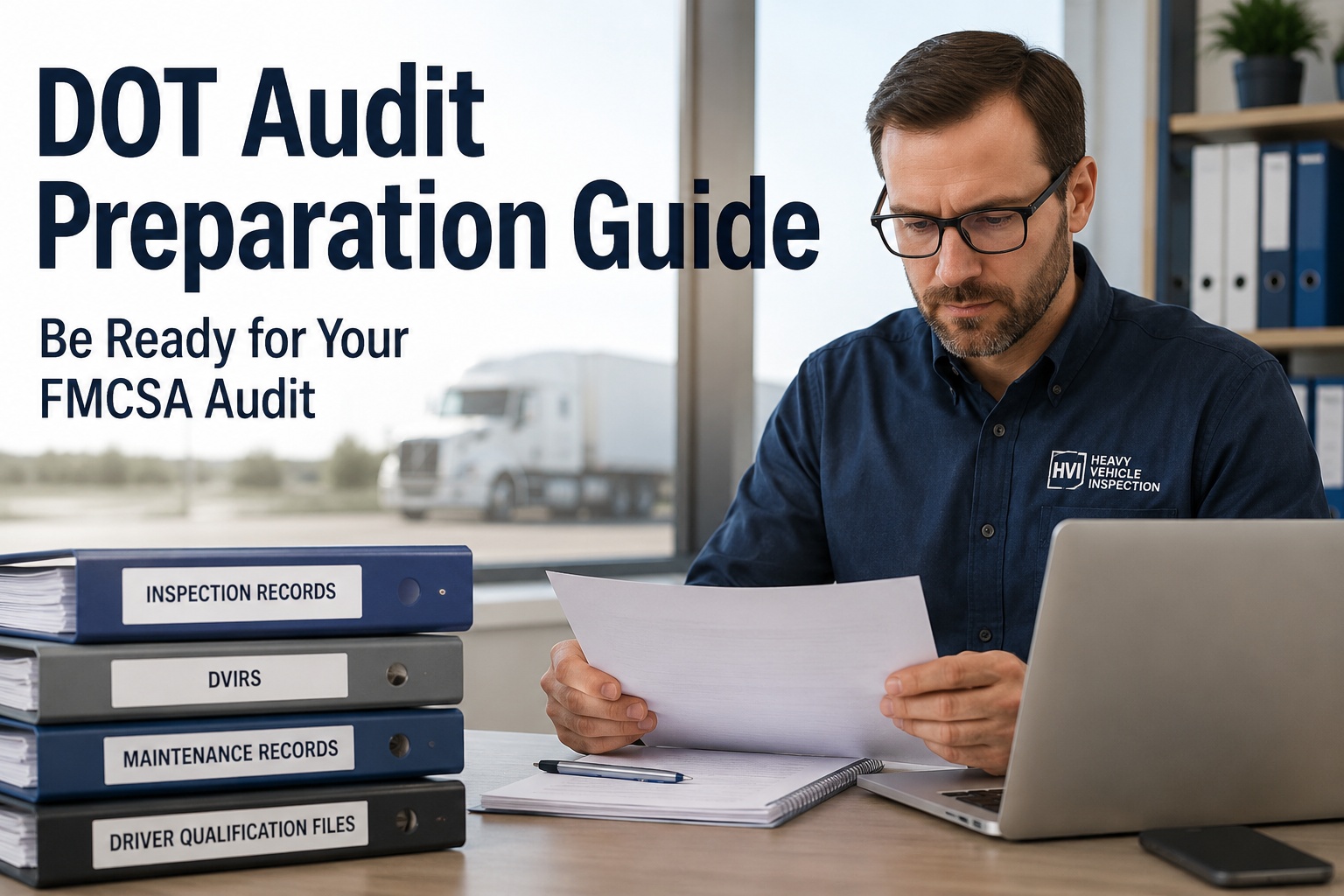
A DOT audit letter arrives with as little as 48 hours notice for off-site reviews and 10 business days for on-site compliance reviews. Inside that window, a carrier must produce months to years of DVIRs, driver qualification files, maintenance records, hours-of-service logs, drug and alcohol testing records, and the accident register — every document organized, complete, and defensible under FMCSA scrutiny. The difference between an audit that ends with a Satisfactory rating and one that ends with a Conditional or Unsatisfactory finding isn't the quality of the fleet's operations — it's the quality of the documentation. This guide covers the 5 types of DOT/FMCSA audits, what triggers each, the complete document scope auditors will request, and the 3-phase prep timeline that separates audit-ready fleets from the ones scrambling. Book a demo to see audit-ready records built into your operation.
Your fleet's audit readiness at a glance
Overall score · category-by-category status · every document, one screen
The 5 types of DOT / FMCSA audits
Not all audits are the same. FMCSA runs five distinct audit types, each with its own scope, trigger events, and documentation requirements. Knowing which one you're facing determines what to prioritize in prep.
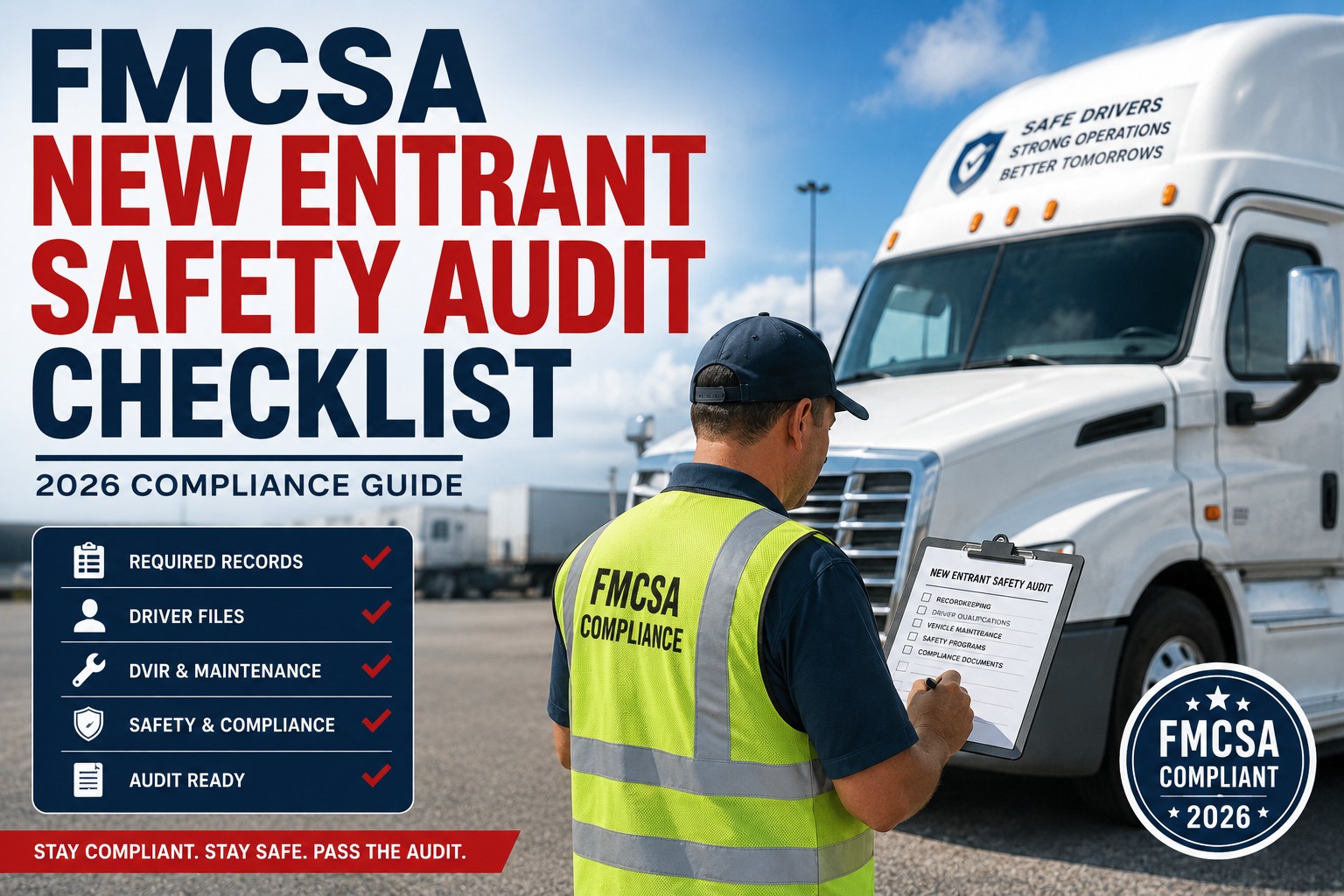
New Entrant Safety Audit
Required for every new carrier within the first 12 months of operation under 49 CFR Part 385. Focuses on foundational compliance systems — driver qualification, hours-of-service, vehicle maintenance, drug/alcohol testing. Usually conducted off-site.
Compliance Review (CR)
The most comprehensive audit. Triggered by elevated CSA BASIC scores, complaints, crashes, or random selection. Typically on-site, 3–10 business days notice. Reviews every regulatory area with a resulting Safety Rating: Satisfactory, Conditional, or Unsatisfactory.
Focused Compliance Investigation (FCI)
Targeted at specific BASICs where the carrier scores above intervention thresholds. Auditor reviews only the relevant regulatory area (e.g., Vehicle Maintenance or Hours-of-Service). Faster and narrower than a full CR but still binding.
Off-Site Investigation
Records submitted electronically to a remote FMCSA investigator. Increasingly common post-2020. Notice can be as short as 48 hours for document submission. Digital record systems shine here — the ability to export by category in minutes is decisive.
Cargo Tank Facility Review
Applies to HazMat / cargo tank carriers under 49 CFR 180. Reviews specialized documentation: cargo tank testing records, HazMat driver training, HM-232 security plan, tank vehicle inspection cycles. Highly specific to hazmat operations.
Compliance Reviews and Focused Compliance Investigations carry the highest stakes because they produce a Safety Rating that appears on your DOT profile and drives insurance, broker vetting, and future audit selection. Every fleet's default posture should be prepared for a Compliance Review at any time. Book a demo to see the full-fleet audit-ready dashboard
What triggers a DOT audit
DOT audits don't happen randomly for most fleets. Six trigger categories account for the majority of audits initiated in a given year — and each is measurable, which means each is manageable if you know what you're monitoring.
Percentile scores above the intervention threshold (65% general, 60% HazMat, 50% passenger carrier) automatically flag a fleet for investigation. Vehicle Maintenance and Unsafe Driving are the most common trigger BASICs.
Any fatal crash typically triggers a post-crash focused investigation. Fatal crashes involving alleged carrier negligence often escalate to a full Compliance Review within 60 days.
Complaints from drivers (via the National Consumer Complaint Database), competitors, shippers, or the general public can trigger targeted investigation. FMCSA follows up on documented pattern complaints.
Repeated out-of-service violations at roadside — especially the same BASIC across multiple inspections — feeds the Safety Measurement System (SMS) and drives BASIC percentile elevation.
Reports from state DOT enforcement, Department of Labor, OSHA, or other agencies can trigger FMCSA follow-up. Interagency coordination has increased significantly in recent years.
Every new carrier under the New Entrant program is audited within its first 12 months under 49 CFR Part 385 — a mandatory milestone, not a triggered event.
The complete audit document scope
Auditors request records across six distinct categories. Some are stable (DQ files), some accumulate month-over-month (DVIRs, HOS logs), and some are triggered by events (accident register). All six need to be current and organized before the notice letter arrives.
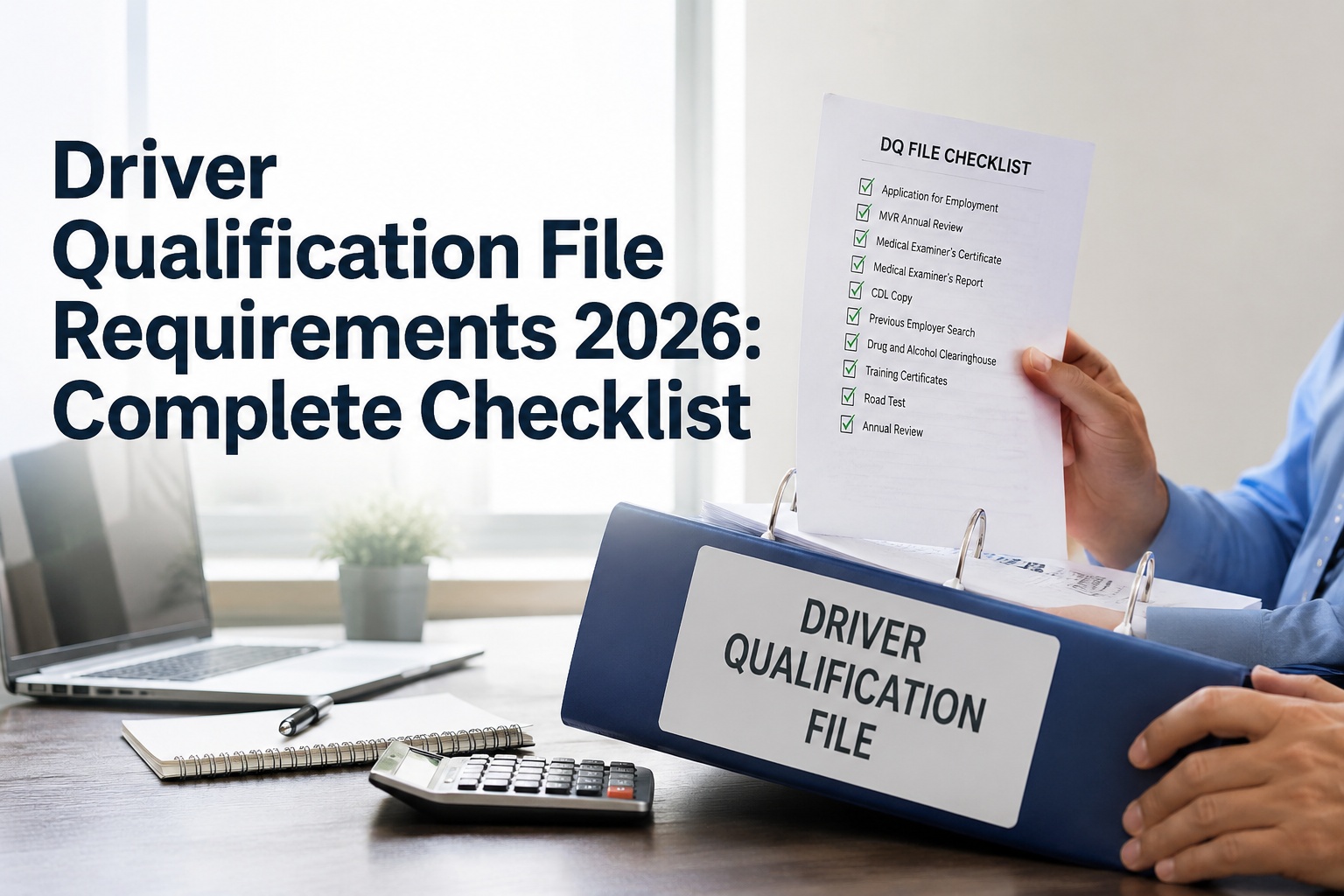
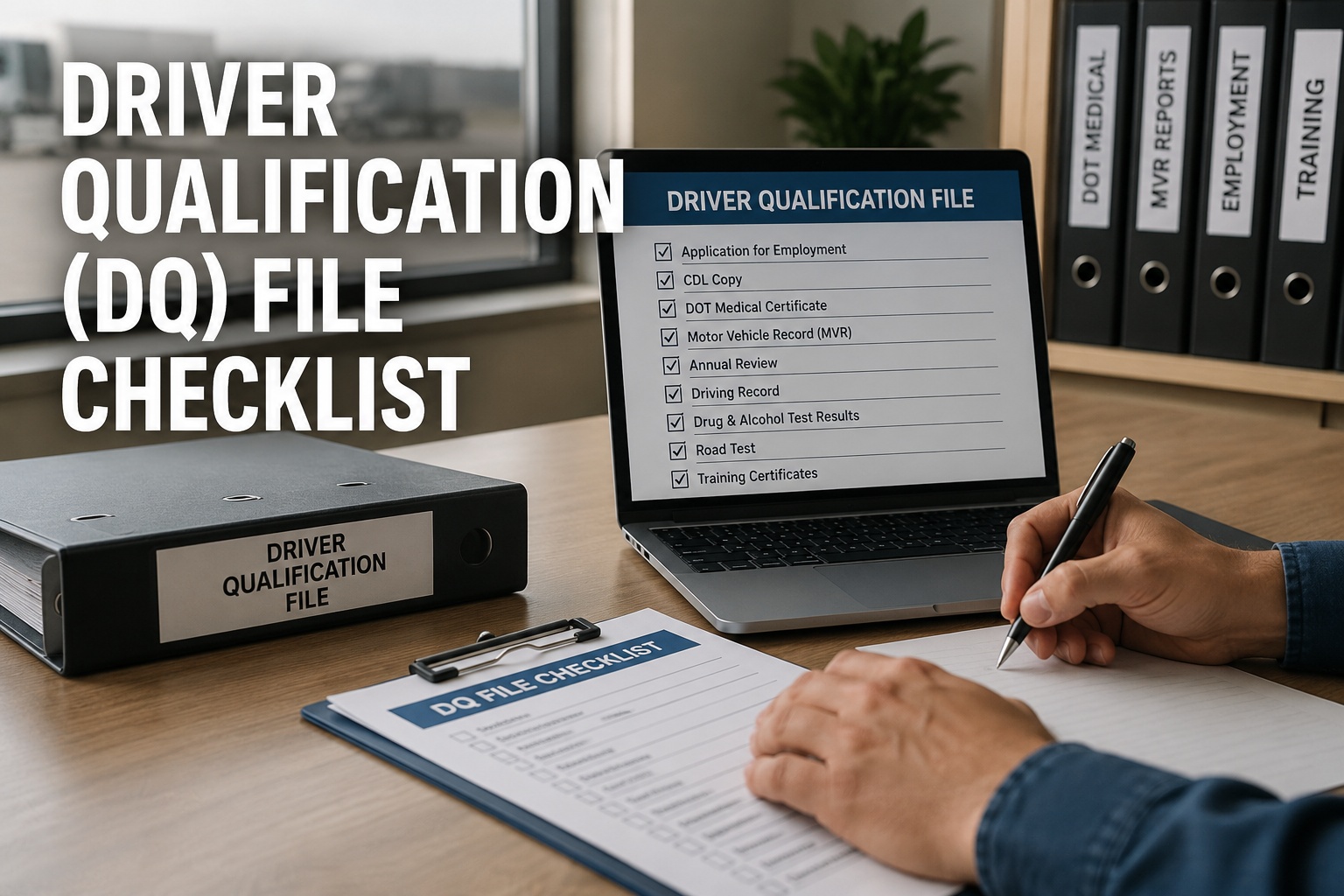
Complete 12-document DQ file for every active driver plus 3 years post-separation. Employment application, previous employer verification, road test, MVR, annual review, certification of violations, medical certificate, and National Registry verification.
Pre-trip and post-trip DVIRs, typically 90 days to 12 months requested. Must include defect documentation, driver signature (or electronic equivalent), and any repair certifications for defects.
Annual DOT inspection reports, preventive maintenance schedules, work orders, brake inspection records, and vehicle history files. Retention: 18 months minimum on-site plus additional periods for annual inspections.
ELD data for the past 6 months (minimum) plus supporting documents. Includes drivers' Records of Duty Status (RODS), edit logs, and any grid-graph paper logs from short-haul or exempted operations.
Pre-employment, random, reasonable-suspicion, post-accident, and return-to-duty test results. Clearinghouse queries and consortium reports for owner-operators. Retained 5 years for positives, 1 year for negatives.
3-year rolling register of every DOT-recordable accident: date, location, driver, injury/fatality details, hazmat release information, and outcome. Must be produced immediately on request — this is where many fleets have retention gaps.
HazMat carriers add a seventh category — cargo tank testing records, HM-232 security plan, HazMat training certifications — reviewed under 49 CFR 172, 173, and 180. Passenger carriers add commercial driver medical monitoring under 49 CFR 391.41. Start a free trial to audit-proof all six categories on one dashboard this week.
The 3-phase audit preparation sprint
Once the notice letter arrives, prep time is measured in hours, not weeks. Fleets running paper systems face 40–80 hours of scramble across the three phases below. Digital systems compress that to 4–8 hours of verification.
Immediately after receiving notice, run a complete category-by-category readiness check. Identify gaps in DQ files, missing DVIRs, expired credentials, and any accident register omissions. Flag every gap for remediation.
- Pull complete DQ file inventory — verify all 12 documents per driver
- Sample 30 random days of DVIRs — check for completeness
- Review 12 months of maintenance records for gaps
- Verify HOS ELD data pulled and reconciled
Compile every requested document into the specific format the auditor requested. For off-site audits, this is electronic submission; for on-site, this is organized physical or digital folders ready at the reception desk when the auditor arrives.
- Export DQ files in FMCSA-audit format for the requested driver list
- Compile 12 months of DVIRs indexed by unit and date
- Prepare maintenance history by unit with annual inspection certificates
- Draft accident register with all incidents in the reporting period
Auditor arrives (or begins remote review). Present records in the order requested, answer questions accurately, and never guess. If the auditor asks for a specific record and it can't be located within reasonable time, note the item and produce it later — don't fabricate on the spot.
- Assign one point-of-contact to interface with the auditor
- Have safety manager, maintenance manager, and dispatch supervisor available
- Keep a running log of everything the auditor requests and reviews
- Address any findings raised at close-out with a documented corrective plan
From a compliance director who went from Conditional to Satisfactory in 8 months
Our last audit found 23 individual violations across 4 BASICs. We received a Conditional rating and 90 days to file a corrective action plan. Insurance premiums went up 22% at the next renewal, three of our shipper contracts required us to prove remediation before restoring load tenders, and one broker network dropped us entirely.
Digital records fixed the underlying discipline. Every DVIR photo-verified, every maintenance work order tracked to closure, every DQ file complete before dispatch. The follow-up audit 8 months later found 3 minor items and upgraded us to Satisfactory. The auditor spent 6 hours on-site instead of the 3 days he'd budgeted. Insurance rolled back at renewal. We're not just compliant — we're auditable, and that turns out to be a competitive advantage.
Frequently asked questions
How much notice does FMCSA give before a DOT audit?
Notice periods vary by audit type. For an off-site investigation (records-only), FMCSA can require document submission with as little as 48 hours notice. For on-site Compliance Reviews and Focused Compliance Investigations, carriers typically receive 3 to 10 business days notice from receipt of the FMCSA "Notice of Investigation" letter, though FMCSA can shorten this window for cause. New Entrant Safety Audits during the first 12 months of operation are scheduled, so notice is longer — often 30 days or more. Cargo Tank Facility Reviews for HazMat carriers are also scheduled with extended notice. In practice, fleets with paper-based record systems need every day of that notice window to compile requested documents. Fleets with digital record systems can complete compilation in hours, leaving days for review and gap remediation before the auditor arrives.
What is the difference between Satisfactory, Conditional, and Unsatisfactory safety ratings?
FMCSA issues one of three safety ratings following a Compliance Review, per 49 CFR Part 385. Satisfactory means the carrier has adequate safety management controls in place — the normal, unrestricted operational status. Conditional means the carrier has some deficiencies in safety management controls but not enough to render the carrier unfit for operation; the carrier can continue operating but must file a corrective action plan and remediate the findings, and the Conditional rating appears on public records affecting insurance, broker vetting, and shipper contracting. Unsatisfactory means the carrier's safety management is so deficient that the carrier is deemed unfit for operation; Unsatisfactory carriers cannot operate as motor carriers of property or passengers, effectively an out-of-service placement for the entire company. The consequences cascade: Conditional ratings typically drive insurance premium increases of 15–30% and can trigger broker vetting failures, while Unsatisfactory ratings are business-ending for most carriers absent immediate remediation and appeal.
What documents does a DOT auditor typically request?
A typical DOT/FMCSA audit requests documents across six categories: (1) Driver Qualification Files — complete 12-document DQ file per active driver under 49 CFR 391.51, plus files for drivers who separated within the past 3 years; (2) Driver Vehicle Inspection Reports (DVIRs) — typically 90 days to 12 months of pre-trip and post-trip inspections under 49 CFR 396.11; (3) Maintenance and Inspection Records — annual DOT inspections, preventive maintenance schedules, work orders, and brake inspection records under 49 CFR 396.3 and 396.17; (4) Hours-of-Service Records — 6 months minimum of ELD data plus supporting documents under 49 CFR 395; (5) Drug & Alcohol Testing Records — pre-employment, random, post-accident, and Clearinghouse queries under 49 CFR 382; (6) Accident Register — 3-year rolling record of DOT-recordable accidents under 49 CFR 390.15. HazMat carriers add cargo tank testing records and HazMat training documentation. Passenger carriers add specialized medical monitoring. The scope varies by audit type — Focused Compliance Investigations may only touch one or two categories, while a full Compliance Review touches all six.
How can digital inspection records help pass a DOT audit?
Digital inspection records solve the three biggest problems paper-based fleets face during audits. First, discoverability: an auditor asks for "all DVIRs for unit 4472 from June through August" — digital fleets export in under a minute; paper fleets spend hours searching binders. Second, completeness: digital DVIRs enforce required fields at submission time, so incomplete records don't exist in the first place, eliminating the "missing signature" and "illegible entry" findings that auditors cite most frequently. Third, defensibility: every digital record carries a server timestamp, GPS metadata, and mandatory photo evidence on defects, making it impossible for an auditor to question whether the inspection was actually performed. Beyond the audit itself, digital systems enable proactive readiness — the fleet knows its audit readiness score in real time instead of discovering gaps only when the notice letter arrives. In practice, fleets that migrate to digital DVIRs typically see audit prep time drop from 40–80 hours to 4–8 hours, and first-attempt Satisfactory ratings become the norm rather than the exception.
How long do I need to keep records for a DOT audit?
Record retention requirements vary by document category. Driver Qualification Files: retained for active drivers plus 3 years after separation under 49 CFR 391.51(d). Annual MVR and driver review: 3 years. DVIRs (Driver Vehicle Inspection Reports): 3 months minimum under 49 CFR 396.11, but industry best practice is 12 months for audit defensibility. Maintenance records: 18 months on-site plus additional periods for annual DOT inspection certificates under 49 CFR 396.3(c). Annual inspection reports: 14 months. Hours-of-Service ELD data and RODS: 6 months. Drug & Alcohol Testing records: 5 years for positive test results, refusals to test, and Clearinghouse violations; 1 year for negative tests. Accident register under 49 CFR 390.15: 3 years from the incident date. Best practice in audit-ready fleets is to retain everything for at least 3 years in digital archive, which satisfies every category's minimum with room to spare and eliminates any retention-gap findings. Paper-based fleets often lose records between the minimum retention date and the audit date, which becomes an audit finding even when the underlying compliance was actually in place.
Turn audit prep into audit readiness — every day, not just when the letter arrives
HVI keeps every audit category continuously current, exports FMCSA-format records in seconds, and gives you real-time audit readiness scoring so you know your standing before FMCSA does. Live for your fleet in under two weeks. First-attempt Satisfactory ratings become the default, not the exception.
No credit card · DOT-audit-ready templates · Works with any ELD provider