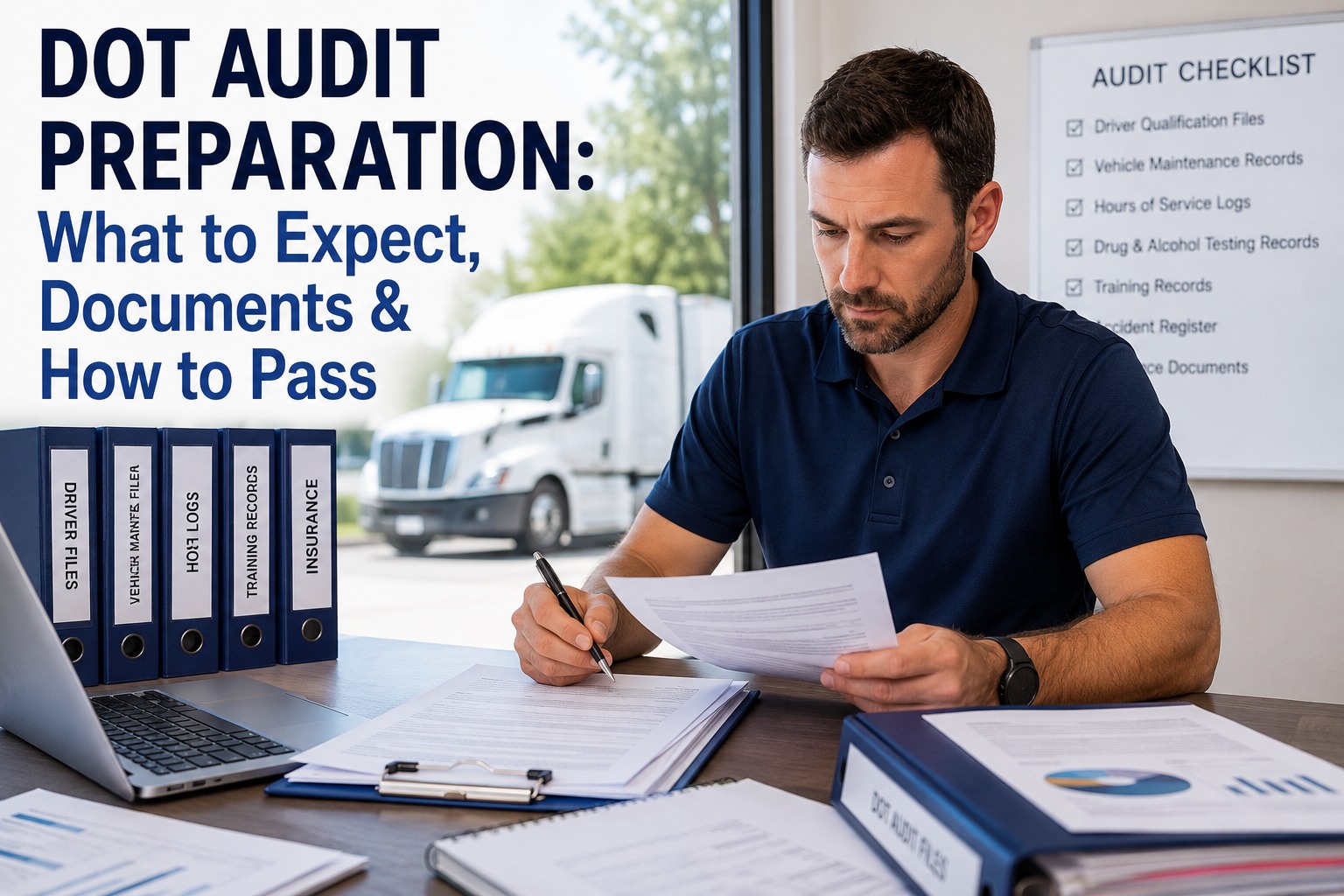
The carriers who sail through a DOT audit aren't the ones with the best luck — they're the ones who could hand an investigator any record, on any truck, in minutes. A DOT audit preparation strategy isn't a binder you assemble the week a notice arrives; it's a way of keeping records so complete that an auditor tracing a defect to its repair finds no gaps. This guide covers what an FMCSA compliance review examines, the document chain investigators follow, and how to self-audit. Book a demo to see an audit-ready evidence chain in HVI.
DOT Audit Preparation: What to Expect, Documents & How to Pass
An FMCSA compliance review is a records test of your safety-management system. The carriers who pass are simply the ones who kept the evidence organized before the investigator arrived.
Educational overview — not legal advice. FMCSA procedures, requirements, and outcomes vary and can change. Confirm current requirements at fmcsa.dot.gov and seek qualified compliance advice for any active enforcement matter.
A DOT audit — more precisely, an FMCSA compliance review — is an examination of whether a motor carrier has adequate safety-management controls in place across its operation. Investigators review records, may interview staff, and evaluate compliance across driver qualification, hours of service, drug and alcohol testing, vehicle maintenance and inspection, accidents, and financial responsibility. Reviews can be triggered by elevated CSA scores, a serious crash, a complaint, or selection, and may be conducted on-site or through document submission. The consistent thread is that it's a documentation exercise: the investigator can only evaluate what you're able to produce, which is exactly why preparation is really about recordkeeping.
What a compliance review is — and how it differs
First, some clarity, because "DOT audit" gets used loosely for a few different things. Understanding which review you're dealing with shapes how you prepare.
A broader investigation of a carrier's safety-management controls that can occur at essentially any time — often triggered by CSA scores, crashes, or complaints. It examines records across multiple areas and can result in a safety rating. This is the review most established carriers mean by "DOT audit."
A more limited review specific to new carriers, typically within the first months of operation, verifying that basic safety-management controls exist. It's a distinct process from a full compliance review, though the record categories overlap heavily.
The practical upshot is the same for both: an investigator evaluates the records you can produce across core safety areas. Whichever applies to you, the preparation is identical in spirit — complete, consistent, retrievable documentation. Because the scope and process can vary and change, confirm what applies to your situation with current FMCSA guidance. Book a demo to keep maintenance and inspection records review-ready year-round
How the scope can vary
Not every review looks the same. The scope depends on what triggered it and what the investigator is focused on, which affects how much of your operation comes under the microscope.
Scoped to one or a few specific areas — often prompted by a pattern of violations in a particular category, such as repeated hours-of-service or brake-related issues.
Broader examinations spanning the full range of safety-management areas, from driver qualification through maintenance and accident records.
Some reviews happen at your place of business; others are conducted by submitting records electronically. Either way, retrievable documentation is what's tested.
Because you can't always predict the trigger or the scope in advance, the only reliable strategy is to keep every core record category continuously ready — rather than gambling that a review will stay narrow. Start free on HVI to keep your inspection and maintenance records organized continuously.
The record categories investigators may review
A compliance review can touch several document categories, each tied to a part of the federal regulations. Here's what belongs in each — and where fleets most often have gaps.
Per driver: application, 3-year employment history, prior-employer inquiries, CDL and endorsements, current medical certificate, MVRs, and road-test or equivalent.
ELD data or logs with supporting documents, examined for gaps, form-and-manner issues, and unassigned driving time.
Written policy, pre-employment and random testing at required rates, and Clearinghouse queries, for carriers with CDL drivers.
A maintenance file per vehicle, annual periodic inspections, and DVIRs — the area HVI is purpose-built to organize.
A register of recordable accidents with supporting documentation, plus any post-accident testing where applicable.
Proof of required insurance coverage, with correct legal details and filings — lapses tend to be flagged quickly.
Notice how much of this is documentation generated simply by operating — inspections happen, repairs happen, tests happen. The failures usually aren't that the work wasn't done; they're that the record is missing, incomplete, or can't be found. Vehicle maintenance and inspection records, in particular, accumulate constantly and are exactly where a searchable system pays off. Book a demo to keep the Part 396 side audit-ready per vehicle
The document chain an investigator follows
This is the mental model that changes how you keep records. An investigator rarely evaluates a single document in isolation — they trace a thread, and every link needs to connect cleanly to the next.
An inspection finding, roadside report, or flagged issue is the starting point of the thread.
The record showing the issue was captured — what was found, when, and on which vehicle.
Evidence the issue was addressed — the work order, the repair, the parts used.
Confirmation the repair was completed and certified, with any required sign-off and verification.
This is why scattered records are a liability even when the underlying work was done properly. If the finding is in one system, the repair invoice in a shop folder, and the certification in someone's memory, you can't demonstrate the chain — and an investigator sees gaps rather than a story. Start free to keep every defect-to-repair chain connected and complete.
How to run a structured self-audit
The single most effective preparation is to review your own records the way an investigator would — before one ever asks. A structured self-audit across the same core categories surfaces the gaps while you still have time to fix them. Work through these checks.
Unsigned or undated records are among the most common and avoidable findings. Verify every document that requires a signature has one.
Medical certificates, MVRs, annual inspections — flag anything expired or missing required elements before an investigator does.
For every noted defect, confirm there's a corresponding repair and certification. Unmatched findings are exactly what an investigator's chain-following looks for.
Pull DQ files and confirm each has every required element — application, inquiries, CDL, medical certificate, MVRs.
Check that required drug-and-alcohol testing, Clearinghouse queries, and any required training records are present and complete.
Run this as a recurring routine, not a one-time scramble. Catching a single missing signature during a monthly self-check is trivial; discovering a dozen gaps under a two-week audit notice is not. The carriers who never scramble are the ones who made the self-audit a habit. Book a demo to make self-audits fast with searchable records
Building continuous readiness
The theme across everything above is that audit readiness isn't an event — it's a state you maintain. A few practical habits turn "preparing for an audit" into "always being ready for one."
Keep each record category structured and searchable so any document can be produced in minutes, not days of digging.
Different records have different retention periods. Keep documents for as long as required and be able to produce them for the relevant period.
Name who owns each record category and each recurring task, so nothing falls between roles or gets forgotten.
Schedule the self-audit monthly or quarterly so gaps surface continuously rather than all at once under pressure.
When a gap or defect is found, track it through to a documented, certified resolution — don't let open items linger unresolved.
The ability to find and export any record instantly is what separates a calm review from a frantic one — especially for off-site submissions.
None of these require heroics — they require a system and a routine. Built into everyday operations, they mean a review notice is a formality to respond to rather than an emergency to survive.
Possible outcomes — and why they vary
It's important to be accurate rather than alarmist about outcomes, because they genuinely depend on the specifics. Not every review produces the same result, and not every finding carries the same consequence.
Two honest caveats matter here. First, not every investigation results in a safety rating, and a rating is a snapshot from the time of the review rather than a permanent verdict. Second, the consequences of any finding depend on the type and severity of the violations, the applicable regulations, the carrier's history, and the enforcement process — so it's inaccurate to assume any given finding automatically produces a particular penalty. For any active enforcement matter, confirm current FMCSA procedures and seek qualified compliance advice.
From a safety manager who's been through several
The first compliance review I handled, years ago, was a nightmare — not because we were unsafe, but because our records were everywhere. The investigator asked for the repair history on a truck that had a brake violation, and I spent two hours pulling it together from the shop's files and a filing cabinet. You could see them start to wonder what else I couldn't find quickly.
Now, everything runs through one system: the inspection finding, the photo, who signed off, the repair, the certification. When an investigator asks about a specific defect, I pull the whole chain up on screen in front of them. It completely changes the dynamic — instead of me scrambling and them getting suspicious, they see an organized operation and move on. I can't promise any particular rating; that depends on actually doing the work right. But being able to prove we did it? That's entirely within my control now.
Preparation is a habit, not a scramble
An FMCSA compliance review tests one thing: whether you can produce complete, consistent records across your safety-management system. The carriers who pass calmly kept them organized all along. Here's the whole guide, distilled into four moves.
The review evaluates what you can produce across driver qualification, HOS, drug & alcohol, maintenance, accidents, and insurance — not what you say you do.
Defect → documentation → repair → certification. Every break or mismatch invites scrutiny; a clean chain answers the question before it's asked.
Review your own records the way an investigator would — signatures, dates, expirations, findings matched to repairs — monthly, not under a notice.
Assign responsibility, meet retention rules, keep everything retrievable. Then a review is something you respond to, not something you survive.
The defect-to-repair chain, kept whole
The vehicle maintenance and inspection side is exactly what HVI is built to organize — a connected, searchable audit trail per vehicle, so the evidence an investigator follows is complete and retrievable in seconds instead of scattered across systems and memories.
To be clear on the boundaries: HVI is a documentation and inspection-management system — not legal or compliance advice. It doesn't determine your safety rating or guarantee any outcome, and the obligation to actually maintain your vehicles and your program is yours. Because FMCSA requirements, review procedures, and enforcement processes can change, confirm current requirements at fmcsa.dot.gov, and for any active enforcement matter seek qualified compliance counsel. Keep the records complete, run the self-audit, and stay ready. Book a demo to get your fleet audit-ready with HVI.
Frequently asked questions
What is a DOT audit?
A DOT audit — more precisely called an FMCSA compliance review — is an examination of whether a motor carrier has adequate safety-management controls in place across its operation. During the review, an investigator examines the carrier's records, may interview staff, and evaluates compliance across several core areas: driver qualification, hours of service, drug and alcohol testing, vehicle maintenance and inspection, accident records, and financial responsibility. These reviews can be triggered by a range of factors, including elevated CSA scores, a serious crash, a complaint, or selection, and they may be conducted on-site at the carrier's place of business or off-site through electronic document submission. The defining characteristic is that it is fundamentally a documentation exercise: the investigator evaluates the safety-management system based on the records the carrier can produce, which is why organized, complete, and retrievable recordkeeping is the heart of preparation. A full compliance review is also distinct from a new entrant safety audit, which is a more limited review specific to newer carriers, though the record categories overlap heavily. Because the scope, triggers, and procedures can vary and change over time, carriers should confirm the current process and what applies to their situation through authoritative FMCSA guidance rather than assuming every review looks the same.
What documents does an FMCSA investigator request?
An FMCSA compliance review can touch several document categories, each tied to a part of the federal regulations, and investigators may request records across the carrier's safety-management system. The core categories include: driver qualification files under Part 391, covering the application, employment history, prior-employer inquiries, CDL and endorsements, medical certificate, and MVRs; hours-of-service records under Part 395; the drug and alcohol testing program under Part 382, including policy, testing, and Clearinghouse queries for CDL drivers; vehicle maintenance and inspection records under Part 396, including a maintenance file per vehicle, annual inspections, and DVIRs; the accident register under Part 390; and financial responsibility under Part 387. Which specific records are requested, and how many, depends on the scope of the review and the carrier's operation. A recurring theme is that most of these records are generated simply through normal operation — the common failure is not that the underlying work wasn't done, but that the record is missing, incomplete, or can't be produced when asked. Confirm the specific requirements that apply to your operation with current FMCSA guidance.
How can I prepare for a DOT audit?
The most effective preparation is to keep your records continuously organized and to review them yourself the way an investigator would, rather than scrambling when a notice arrives. A practical approach centers on a structured self-audit across the same core categories a review examines. Work through several checks: look for missing signatures and dates, which are among the most common and avoidable findings; identify expired or incomplete documents such as lapsed medical certificates, MVRs, or overdue annual inspections; match every inspection finding to a corresponding repair and certification record, since investigators tend to follow that exact chain; verify that each driver qualification file contains all required elements; and confirm that required drug-and-alcohol testing, Clearinghouse queries, and training documentation are complete. Beyond the self-audit, build continuous readiness by organizing records by category for retrieval on demand, meeting retention requirements, assigning clear responsibility, running recurring internal reviews monthly or quarterly, tracking corrective actions to documented closure, and ensuring rapid retrieval for off-site electronic submissions. The principle is that audit readiness is a state you maintain, not an event you prepare for — catching one missing document during a routine self-check is far easier than discovering many gaps under a short audit notice.
What are the possible outcomes of a compliance review?
The outcomes of an FMCSA compliance review vary depending on the specifics, and it's important to be accurate rather than alarmist. Where a review results in a safety rating, FMCSA may issue one of three: Satisfactory, meaning the carrier has adequate safety-management controls to meet the safety fitness standard; Conditional, meaning the carrier lacks adequate controls but may continue operating while addressing corrective action; or Unsatisfactory, meaning the carrier lacks adequate controls and, if issues aren't corrected within the required timeframe, may be prohibited from operating. Two caveats matter. First, not every investigation results in a safety rating, and a rating is a snapshot from the time of the review rather than a permanent verdict. Second, the consequences of any given finding depend on the type and severity of the violations, the applicable regulations, the carrier's history, and the enforcement process — so it's inaccurate to assume any particular finding automatically produces a specific penalty. Where findings occur, a corrective-action process generally applies, and FMCSA considers demonstrated improvement. For any active enforcement matter, confirm current FMCSA procedures and seek qualified compliance advice.
How does inspection documentation help in an audit?
Inspection and maintenance documentation is central to an audit because vehicle maintenance and inspection is one of the core areas an FMCSA compliance review examines, and it's an area where investigators frequently follow a chain of records. When an investigator identifies a defect or violation, they often trace it through the documentation: was the issue recorded, was corrective action taken, was the repair completed, was it certified, and does the follow-up match? Each break or inconsistency in that chain — a finding with no repair record, a repair with no certification, mismatched dates, or a missing signature — gives the investigator a reason to look more closely. Strong inspection documentation keeps that chain intact and retrievable, so the story of each defect from identification through resolution is complete and can be produced quickly. This is where a dedicated inspection and maintenance documentation system adds value: it connects the inspection finding, photographs, signatures, the repair order and parts, the certification, and the full maintenance history against the specific vehicle, in a searchable trail. Rather than assembling evidence from a shop's files, a filing cabinet, and someone's memory while an investigator waits, a carrier can retrieve the entire defect-to-repair chain in seconds. It doesn't replace the obligation to perform the maintenance or determine the rating, but it makes demonstrating a well-run maintenance program straightforward — a meaningful advantage during a review.
Get your fleet audit-ready with HVI
When an FMCSA investigator follows the chain from a defect to its repair, HVI has every link ready: the inspection finding, photos, signatures, the repair order and parts, the certification, and the full maintenance history — connected against each vehicle in a searchable audit trail you can retrieve in seconds. Run faster self-audits, keep your defect-to-repair chains unbroken, and turn a review into a routine. HVI is your documentation layer, not legal or compliance advice. Start free, or book a demo to see it built around your fleet.
Free to start · Inspection & maintenance records · Searchable defect-to-repair audit trail