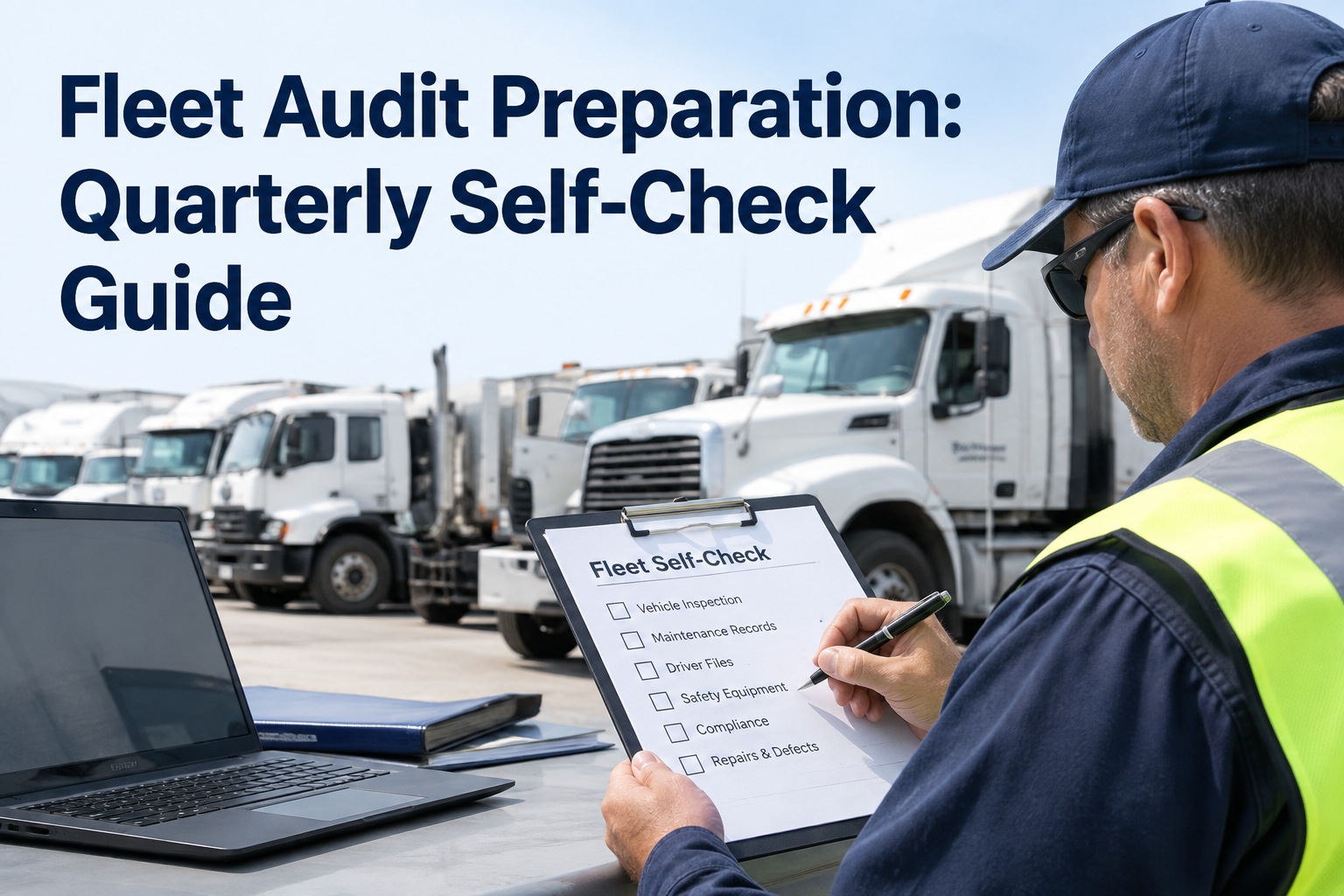
The external audit notice gives you 48 business hours to produce records — not 48 hours to find out your driver qualification files have been quietly incomplete since March. A quarterly fleet self-audit exists to catch exactly that gap while you still have a quarter to fix it, not a two-day scramble. See a self-audit run start to finish
Same defect, two very different meanings
Switch below. The exact same missing signature or overdue inspection can be a five-minute fix — or evidence your process is broken fleet-wide.
A single driver's file is missing one signed acknowledgment. Everything else in the sample checks out clean, this driver's own history is otherwise complete, and there is no pattern connecting it to anything else in the fleet. Correct the one record, note it, move on — treating this like a systemic failure would waste the audit's limited time on noise.
The same missing signature shows up on three drivers across two terminals. That's no longer a one-off — it means whoever is supposed to be reviewing these files before they're filed isn't catching it, at scale, every month. This calls for a corrective action plan, a look backward at how far the gap goes, and a fix to the review step itself, not just the three files you happened to sample.
Getting this call right is most of what a self-audit is actually for — treating everything as isolated hides real risk, and treating everything as systemic burns out the programme in a quarter.
A quarterly fleet self-audit isn't a lighter version of the external one. It's a different tool entirely — a sampling exercise designed to surface the kind of gap that's invisible in daily operations but obvious the moment someone deliberately goes looking for it. Done right, it turns "we think we're fine" into "here's what we checked, here's what we found, and here's what we fixed before anyone outside the company asked."
Running a Quarterly Fleet Self-Audit Without Reviewing Every Single Recorddepth on a sample beats a shallow pass at everything
Trying to review every vehicle, every driver, and every record every quarter guarantees a shallow pass across all of it — nobody has the hours for genuine depth at that scale. A representative sample, reviewed thoroughly, finds more real problems than a superficial look at the whole fleet ever will.
Mixed vehicle age
Include your newest and oldest units — new equipment can reveal onboarding gaps, older equipment reveals whether wear-driven defects are actually getting closed out.
Recent driver turnover
Any driver onboarded or terminated in the last quarter belongs in the sample — qualification file gaps concentrate heavily around transitions.
Every terminal or site
A single-location sample can miss a location-specific process failure entirely. At least one vehicle and one driver from each site keeps the sample honest.
Prior findings
Anything flagged last quarter gets re-checked this quarter, regardless of whether it would otherwise make the random sample — that's how you confirm a fix actually held.
A sample built this way surfaces the same categories of gap a real DOT, CCMTA, DVSA, or NHVR review would find — while there's still a quarter left to close them quietly. Build your first self-audit sample free
The Chain-Following Technique: From Defect to Closed Repaira self-audit doesn't stop at "was it logged" — it follows the whole chain
Finding a logged defect proves almost nothing on its own. The real test is following that single defect all the way through the process it's supposed to trigger — and seeing exactly where, if anywhere, the chain breaks.
Any missing link in that chain — a defect with no work order, a work order with no repair record, a repair with no verification — is a finding, even if every individual document technically exists somewhere. See the record mistakes that most often break the defect-to-repair chain.
The Record-Retrieval Stress Testan external auditor gives you business hours, not weeks — test that now
Most compliance reviews give a fleet a fixed, short window to produce specific documents once requested. A self-audit is the time to actually test whether that's realistic — not assume it, discover the gap live in front of an outside reviewer.
| Record type | What to test | Target retrieval time |
|---|---|---|
| Inspection records | Pull a specific vehicle's last 4 inspection reports | Under 5 min |
| Maintenance records | Show the full repair history tied to one named defect | Under 5 min |
| Driver qualification files | Produce one driver's complete DQ file on request | Under 15 min |
| Corrective-action closure | Prove a specific finding from last quarter was actually resolved | Under 15 min |
If any of those takes an hour of searching through folders, filing cabinets, or three different systems, that delay is itself a finding — the records may all technically exist, but "exists somewhere, eventually" doesn't hold up when an external reviewer is standing there with a countdown running. See records pulled in seconds, not hours
The Four Record Areas Every Quarter Should Touchskip one and you have a blind spot, not a shorter audit
Inspection completion
Were scheduled inspections actually performed on time, on the right vehicles, with the required fields filled in — not just marked complete?
Maintenance records
Does every completed repair tie back to a specific vehicle, a specific defect, and a specific technician, with dates that make sense?
Driver qualification
Are medical certificates current, employment history complete, and required checks documented for every driver in the sample?
Corrective-action closure
Is every open finding from prior quarters actually closed, with verification — or just marked "in progress" indefinitely?
In the U.S., FMCSA-focused reviews frequently center on exactly these four areas; fleets operating under Canada's CCMTA-aligned rules, the UK's DVSA and Traffic Commissioner framework, or Australia's NHVR standards will find the same four categories map closely onto what their own regulators examine, even where the specific forms and terminology differ. See all four areas checked in one pass
Turning One Quarterly Fleet Self-Audit Into a Trend Linea single quarter tells you where you stand — four in a row tell you where you're headed
One audit is a snapshot. The real value shows up once you have three or four quarters to compare, because that's what reveals whether a corrective action actually worked or whether the same finding is quietly recurring under a different vehicle number each time.
A declining line like this is what proves a corrective action actually changed behavior. A flat or rising line on the same finding, quarter after quarter, means the fix that was documented never actually fixed anything — and that's a systemic finding in its own right. See how an AI auditor catches documentation gaps early before they show up as a trend like this.
From a compliance officer who stopped dreading audit season
We used to do a mad scramble every time an audit notice came in, because our "compliance" was really just hoping nothing had slipped. The first real quarterly self-audit we ran found a driver qualification gap that had been open for two months and nobody had noticed.
Now every quarter has its own sample, its own findings log, and last quarter's corrective actions get re-checked before we even pick this quarter's new sample. When the real audit notice comes now, it's a records pull, not a crisis.
Nadia's fleet didn't get safer overnight — it got a process that surfaced its own gaps every 90 days instead of once every audit cycle. See findings tracked to a verified close
Frequently asked questions
What should a quarterly fleet self-audit actually cover?
A thorough quarterly fleet self-audit should cover four core record areas: inspection completion (were scheduled inspections actually performed and documented correctly), maintenance records (does every repair tie back to a specific vehicle and defect), driver qualification files (are certificates current and files complete), and corrective-action closure (are prior findings actually resolved, not just marked in progress). Reviewing a representative sample of vehicles, drivers, and records in depth is generally more effective than a shallow pass across the entire fleet.
How do you choose which vehicles and drivers to sample?
A representative sample should include a mix of vehicle ages (both newest and oldest units), any drivers onboarded or terminated in the recent quarter, at least one vehicle and driver from every terminal or site, and anything flagged in a prior quarter's findings, regardless of whether it would otherwise be selected. This mix surfaces onboarding gaps, wear-related maintenance issues, location-specific process failures, and whether previous corrective actions actually held.
How do you tell if a finding is an isolated lapse or a systemic failure?
A finding that appears once, in an otherwise clean record, with no connection to other files or vehicles, is typically an isolated lapse that can be corrected directly. A finding that recurs across multiple drivers, vehicles, terminals, or quarters points to a systemic failure in the underlying process, such as a review step nobody is actually completing. Systemic findings warrant a broader corrective action plan and a look backward to determine how far the gap extends, rather than a single-record fix.
Why does record-retrieval speed matter during a self-audit?
External compliance reviews typically give a fleet a fixed, short window to produce specific documents once requested. Testing retrieval speed during a self-audit — timing how long it takes to produce a specific vehicle's inspection history or a driver's complete qualification file — reveals whether that window is realistic before an actual reviewer is standing there with a countdown running. A record that technically exists but takes hours to locate creates the same practical problem as a missing record.
Why compare self-audit results across multiple quarters instead of reviewing each one in isolation?
A single quarter's audit shows a snapshot of compliance at one point in time, but it can't distinguish a corrective action that actually worked from one that only looked resolved on paper. Comparing findings across three or four consecutive quarters reveals whether a specific issue is genuinely declining after a fix was implemented, or quietly recurring under different vehicles or drivers each time, which is itself evidence that the underlying process was never actually corrected.
Run Your Quarterly Fleet Self-Audit on a Schedule, Not a Scramble
HVI schedules recurring self-audits on Calendar Scheduling, flags expiring certificates and inspections with Expiry Alerts, and tracks every finding through to a verified close with Completion Tracking — so record retrieval, defect chains, and quarter-over-quarter trends are a few clicks away, not a scramble. Live in under two weeks.
No credit card · Recurring audit scheduling included · Completion tracking ready on day one