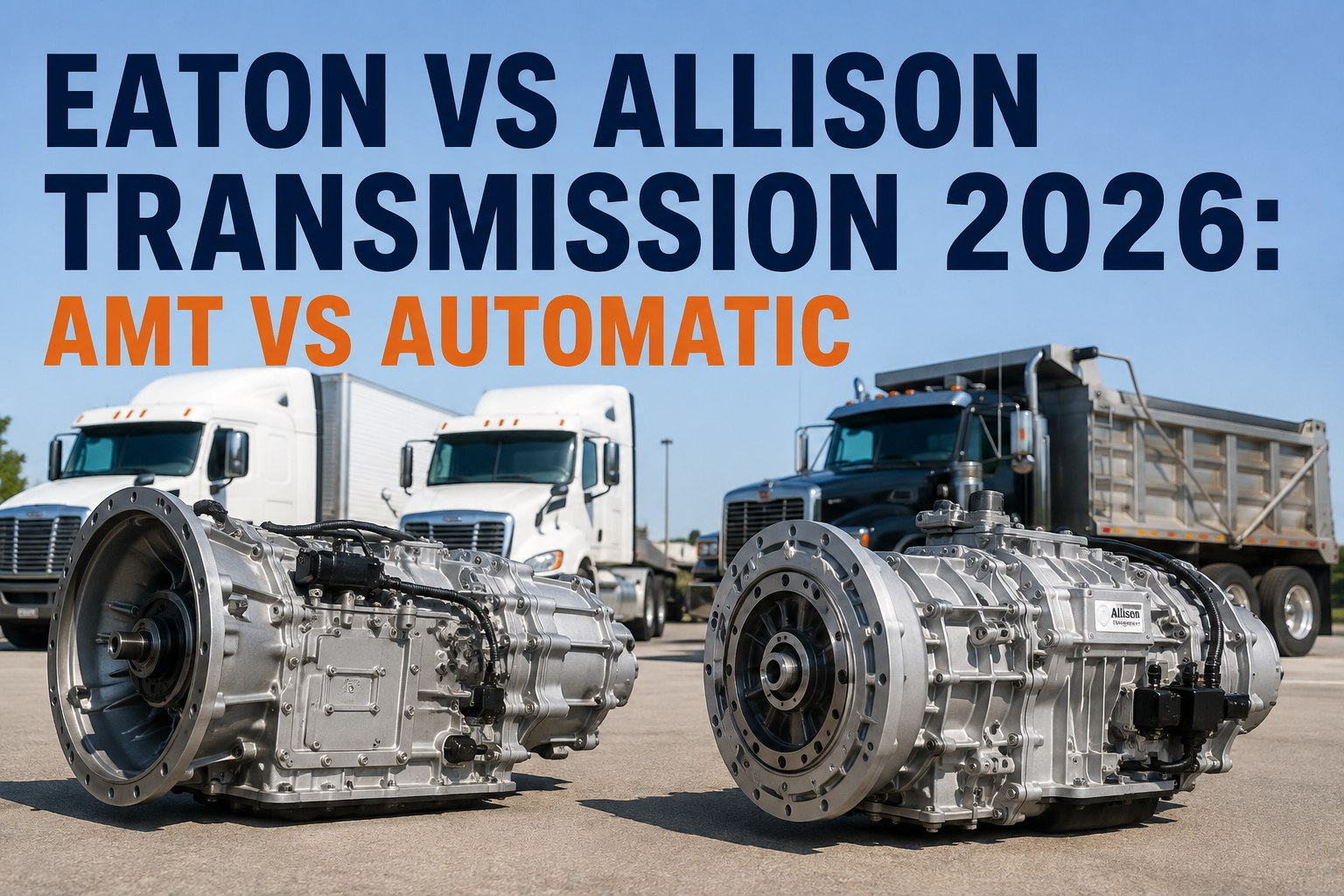
Ask two fleet managers whether Eaton or Allison makes the better transmission and you'll get two confident, opposite answers — and both can be right. The Eaton vs Allison transmission debate isn't about which brand is superior; it's about which architecture fits how your trucks actually work. Eaton's automated manual transmissions (AMTs) like the Endurant dominate highway and line-haul for fuel efficiency and long service intervals. Allison's fully automatics rule vocational and stop-start duty where a torque converter earns its keep. Pick the wrong one for your duty cycle and you pay for it every mile. Book a demo to compare drivetrain TCO from your own fleet data.
Eaton vs Allison Transmission: AMT vs. Automatic
Two fundamentally different machines. The right one depends entirely on your duty cycle.
General comparison for fleet spec decisions — not a substitute for OEM guidance. Specifications, intervals, and pricing vary by model, model year, application, and configuration. Always confirm current details with Eaton, Allison, and your OEM before speccing.
The whole comparison starts with one mechanical fact. An Eaton AMT is a manual gearbox — clutch, gears, countershafts — that a computer shifts for you: nothing sits between the engine and the gears, so power moves efficiently and the unit stays light. An Allison automatic replaces the clutch with a torque converter, a fluid coupling that multiplies torque and delivers seamless, stepless power from a standstill. That single design difference cascades into everything that follows: fuel economy, how each behaves in stop-and-go, what maintenance they need, and where each one shines or struggles. Neither is better in the abstract. One is better for your trucks.
Head-to-head: the core differences
Here's the side-by-side at a glance. Read it as tendencies by design type — exact figures depend on the specific model, application, and configuration.
| Factor | Eaton AMT (Endurant) | Allison Automatic (3000/4000) |
|---|---|---|
| Mechanism | Clutch + gears, auto-shifted | Torque converter, no clutch |
| Best duty cycle | Highway, line-haul, regional | Vocational, stop-start, PTO |
| Fuel efficiency | Strong on highway (locked, direct path) | Converter losses; strong under load |
| Weight | Lighter (more payload) | Heavier |
| Stop-and-go / launch | Capable; clutch works harder | Excels; smooth, no clutch wear |
| Oil change interval | Up to ~750k mi line-haul (HD) | ~50k mi / 2,000 hr; ~25k severe |
| Required fluid | Eaton PS-386 synthetic | TES-295 (e.g., TranSynd) |
| Purchase cost | Typically lower | Typically higher upfront |
| Clutch wear item | Yes (clutch) | No clutch to wear |
Notice there's no column that wins every row — each transmission's strengths are the other's trade-offs. That's why the real question isn't "which is better," but "which set of trade-offs matches my operation." Start free on HVI to weigh these trade-offs against your fleet's actual numbers.
The decision that actually matters: duty cycle
Forget brand loyalty. The single best predictor of the right transmission is how your trucks spend their day. Find your operation below.
- Line-haul & regional — steady highway miles where a locked, direct gear path saves fuel
- Weight-sensitive freight — the lighter unit returns payload
- Long routes, few stops — extended oil intervals shine when miles pile up in line-haul duty
- MPG-driven operations — efficiency compounds across high annual mileage
- Refuse & municipal — constant stop-start where a clutch would suffer
- Construction & vocational — torque multiplication for launch under heavy load
- Heavy PTO use — continuous power take-off without clutch strain
- Emergency & utility — smooth, reliable launch is worth the premium
If you can only remember one thing from this whole comparison, make it this: match the transmission to the duty cycle, and most of the other decisions take care of themselves. Start free on HVI to track performance by unit and duty cycle across a mixed fleet.
Total cost of ownership: beyond the sticker
Two transmissions with the same purchase price can have wildly different ten-year costs. These are the factors that actually decide it — and every one of them is measurable once you're tracking the right data.
Allison automatics typically carry a higher upfront price than a comparable Eaton AMT — but it's only the first line of the ledger.
On steady highway miles, a locked AMT's direct path tends to favor MPG; under constant load and launch, the converter's behavior differs. Fuel is often the biggest lifetime cost.
Eaton's extended line-haul drains vs. Allison's mileage/hour-based service — the right comparison depends on your actual duty, not the headline number.
A clutch is a wear item; a torque converter isn't. Diagnostic access, parts availability, and shop familiarity all shape real downtime cost.
Both remove manual shifting and reduce fatigue. Driver behavior still affects clutch wear on an AMT and fuel use on both.
Spec desirability in the used market varies by application and region — a factor easy to ignore at purchase and costly to overlook at trade-in.
The pattern is clear: the purchase price is the one number everyone fixates on and the smallest one that matters. The rest only becomes visible when you track it — which is precisely the gap a fleet's maintenance data can close. Book a demo to turn these six factors into one lifecycle number
The model lineup, briefly
Within each brand, the specific model matters. Here are the ones fleets compare most, and where each fits.
Match the specific model to GCW, terrain, and duty — an Endurant HD and an Endurant XD are not interchangeable, and neither are the Allison 3000 and 4000. Confirm the exact current specs and ratings with the manufacturers before speccing. Book a demo to keep model, spec, and service history per asset in one place
A quick word on the electric future
It's worth a brief note, without overstating it: alternative powertrains will reshape this comparison over time. Battery-electric trucks often use simpler single- or few-speed reduction gearing rather than a traditional multi-speed transmission, and hybrid and natural-gas configurations bring their own drivetrain requirements. Both Eaton and Allison are developing electrified and alternative-powertrain products.
The takeaway: keep an eye on the transition, but spec today's trucks for today's duty cycles. When your fleet does start evaluating alternative powertrains, the same discipline — match the drivetrain to the work, decide on lifecycle cost — carries straight over. Book a demo to keep drivetrain data consistent across any powertrain
From a fleet spec buyer who runs both
We used to argue about Eaton versus Allison like it was a religious question. Then we actually pulled our own numbers by duty cycle and the argument just evaporated. Our line-haul tractors on Eaton AMTs were returning better fuel and going forever between transmission services. Our refuse and municipal trucks on Allison automatics weren't eating clutches because there's no clutch to eat.
The mistake we'd made for years was trying to standardize on one transmission fleet-wide to simplify parts and training. But the "savings" from standardizing were tiny next to what we lost running the wrong box for the job. Once we spec'd by application and tracked the real lifecycle cost per unit, the picture was obvious. The transmission that's cheapest to buy isn't always the cheapest to own — and the only way to know is to measure it.
The verdict: it's a duty-cycle decision
There's no universal winner in Eaton vs Allison — there's a right answer for each application. Here's the whole decision in three moves.
Highway and line-haul lean Eaton AMT for efficiency and long intervals; vocational and stop-start lean Allison automatic for launch and no clutch wear.
Weigh fuel, maintenance, downtime, repair exposure, and resale — not just purchase price, which is the smallest piece.
In a mixed fleet, run both where each fits. Forcing one transmission across every duty cycle is what inflates cost.
Both Eaton and Allison build excellent, proven transmissions — the winning choice is simply the one that matches the work and costs least to own over its life. The fleets that get this right aren't guessing from brand reputation; they're deciding from their own maintenance, fuel, and downtime data. That's the difference between a spec that looks good on paper and one that pays off for a decade. Book a demo to calculate drivetrain TCO in HVI.
Frequently asked questions
Eaton or Allison — which transmission is better?
Neither is universally better; the right choice depends on your duty cycle, and that's the honest answer any experienced fleet spec buyer will give. Eaton's automated manual transmissions (AMTs), such as the Endurant family, are a manual gearbox shifted automatically by software — they keep a direct, efficient mechanical path from engine to wheels, tend to be lighter, and often deliver strong fuel economy on steady highway miles, which makes them a common choice for line-haul and regional operations. Allison's fully automatic transmissions, such as the 3000 and 4000 series, use a torque converter instead of a clutch, giving smooth stepless launch and torque multiplication under load with no clutch to wear out — which is why they dominate vocational, municipal, refuse, construction, and stop-start applications and heavy power take-off (PTO) work. The mechanical difference between an AMT's clutch-and-gears and an automatic's torque converter cascades into fuel economy, stop-and-go behavior, maintenance needs, and cost profile. So rather than asking which brand wins, identify how your trucks actually operate — highway versus stop-start, weight-sensitive versus launch-heavy, PTO-intensive or not — and match the transmission architecture to that reality. Many mixed fleets run both, speccing each transmission where it fits best.
Eaton Endurant vs Allison 4000 — how do they compare?
The Eaton Endurant and Allison 4000 series are often cross-shopped, but they're built for somewhat different centers of gravity. The Eaton Endurant is an automated manual transmission designed with line-haul and on-highway efficiency in mind; the HD variant is a lightweight 12-speed suited to typical Class 8 line-haul weights, while XD and XD Pro variants handle higher gross combination weights and more severe-duty on-highway and vocational work, with more speeds for load and grade control. Its appeal is low weight, fuel efficiency on steady miles, and extended oil-drain intervals in line-haul service. The Allison 4000 series is a fully automatic transmission aimed at heavier-duty vocational and severe-service applications — refuse, construction, and demanding stop-start duty cycles — where its torque converter provides smooth launch and torque multiplication with no clutch to wear. In practice, an Endurant tends to be the stronger pick for high-mileage highway operations prioritizing fuel and weight, while an Allison 4000 tends to be the stronger pick for punishing vocational duty with frequent stops, heavy loads, and PTO use. The best comparison isn't spec-sheet to spec-sheet but duty-cycle to duty-cycle, evaluated on lifecycle cost. Confirm current specifications and ratings directly with each manufacturer before speccing.
Is an AMT or an automatic cheaper to maintain?
It depends heavily on duty cycle, so there's no single answer, but the cost structures differ in ways worth understanding. Eaton AMTs like the Endurant can offer very long oil-drain intervals in line-haul applications — figures up to several hundred thousand miles are cited for line-haul HD service using the specified synthetic fluid — which can mean fewer scheduled transmission services over a highway truck's life. However, an AMT has a clutch, which is a wear item that can require replacement, and diagnostic access for AMTs isn't always available at every independent shop. Allison automatics require more frequent fluid and filter service — commonly on a mileage-or-hours basis, with severe-duty intervals shorter than normal-duty ones — and require a specific approved fluid, which carries a cost. But an automatic has no clutch to wear, and its prognostics feature can shift service from fixed intervals to condition-based timing. Critically, the extended AMT intervals apply to the duty cycle they were developed for: a vocational or severe-duty truck won't see line-haul drain intervals, and running highway intervals on a stop-start truck invites problems. The only reliable way to compare real maintenance cost is to track it for your specific trucks and duty cycles rather than relying on headline interval numbers. Always follow the manufacturer's current maintenance requirements for your application.
Which transmission is best for vocational trucks?
For most vocational applications — refuse, construction, municipal, utility, and other stop-start or off-road duty — a fully automatic transmission such as an Allison is very widely used and often the preferred choice, for reasons rooted in the mechanics. Vocational work involves constant starting and stopping, frequent launches under heavy load, off-road or low-speed maneuvering, and often heavy power take-off use. A torque converter automatic handles this beautifully: it launches smoothly and multiplies torque without a clutch, so there's no clutch to overheat or wear out under the relentless stop-start cycling that defines vocational duty. That said, Eaton does offer AMT variants engineered for vocational and severe-duty use, such as the Endurant XD and XD Pro and vocational UltraShift PLUS configurations, and they perform well in many vocational settings — so the choice isn't absolute. The deciding factors are the specific duty cycle, the severity of stop-start and PTO demands, terrain, gross weight, and lifecycle cost. As a general tendency, the more a truck's day looks like constant stop-start and launch-under-load, the more a torque converter automatic's strengths come to the front. Evaluate the specific application and confirm suitability and ratings with the manufacturer and your OEM.
How does HVI help choose or manage a transmission?
Heavy Vehicle Inspection (HVI) doesn't tell you which transmission to buy — that's a spec decision for your team and your OEM — but it gives you the fleet data to make and then manage that decision on evidence rather than opinion. On the decision side, HVI helps you build a real total-cost-of-ownership picture per unit: it tracks drivetrain repair costs and downtime by vehicle, monitors preventive-maintenance compliance against each transmission's service intervals, logs operating hours so hour-based intervals (which matter for idle-heavy and vocational duty) are handled correctly alongside mileage, and retains full asset history so you can compare how different transmissions actually perform across your duty cycles. Instead of speccing your next order from a brochure or purchase price alone, you can look at what your own Eaton and Allison units have cost to fuel, maintain, and repair over their lives. On the management side, HVI keeps each transmission serviced on the right schedule — by miles, engine hours, or calendar, whichever comes first — with defects tracked to documented repairs, so a spec decision is backed by disciplined maintenance. What HVI provides is analytics and record-keeping to support the decision; it doesn't replace manufacturer guidance or guarantee a particular outcome. Pair it with current OEM specifications for the most reliable result.
Calculate drivetrain TCO in HVI
Whether you run Eaton, Allison, or both, HVI turns your maintenance data into a decision tool: drivetrain repair costs and downtime by unit, PM compliance against each transmission's intervals, operating hours for hour-based service, and lifecycle TCO per asset. Spec your next order — and manage the trucks you already own — on evidence from your own fleet, not a spec sheet. HVI provides the analytics; the spec decision stays yours.
Drivetrain TCO · Repair-cost tracking · PM by miles/hours/calendar · Asset history