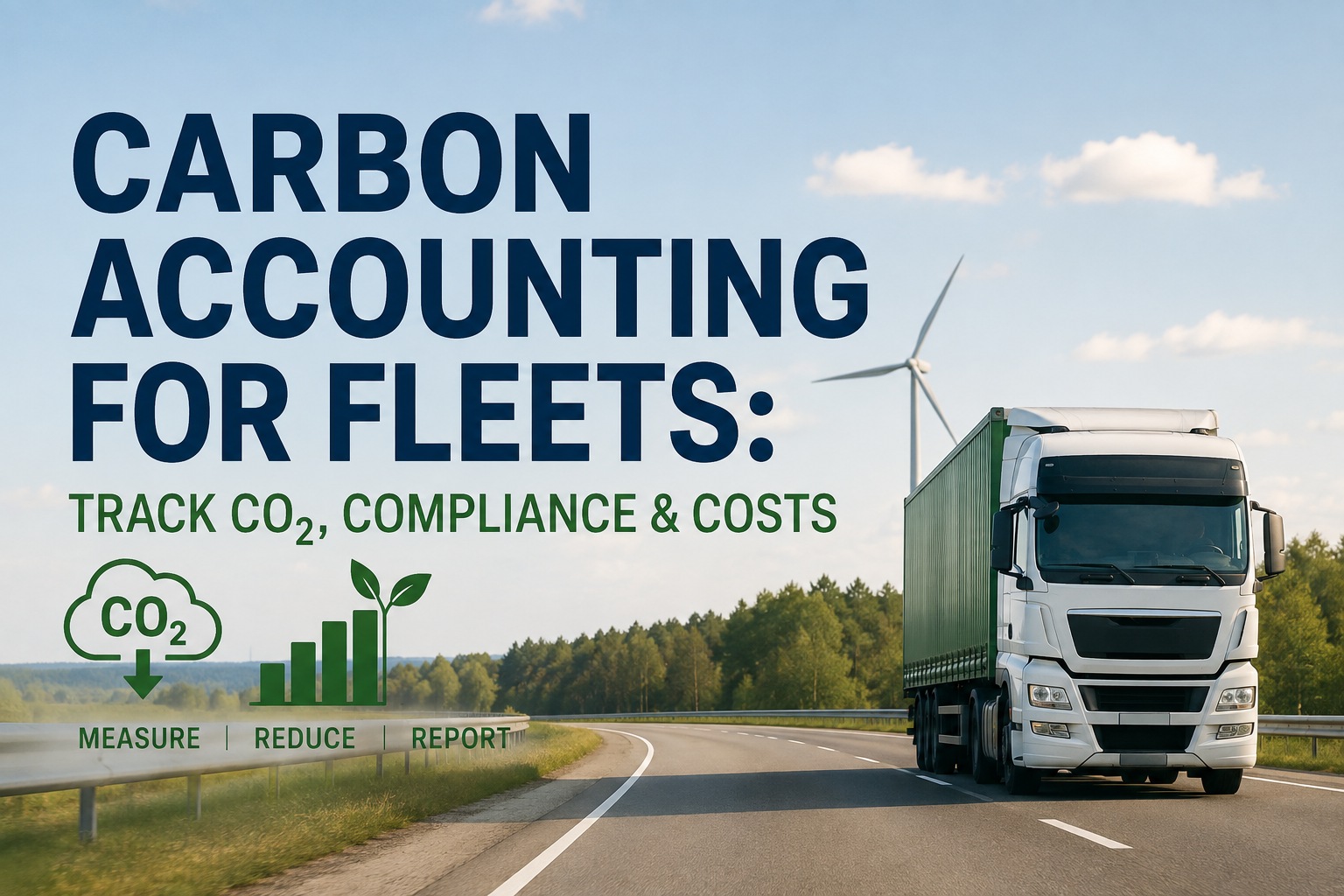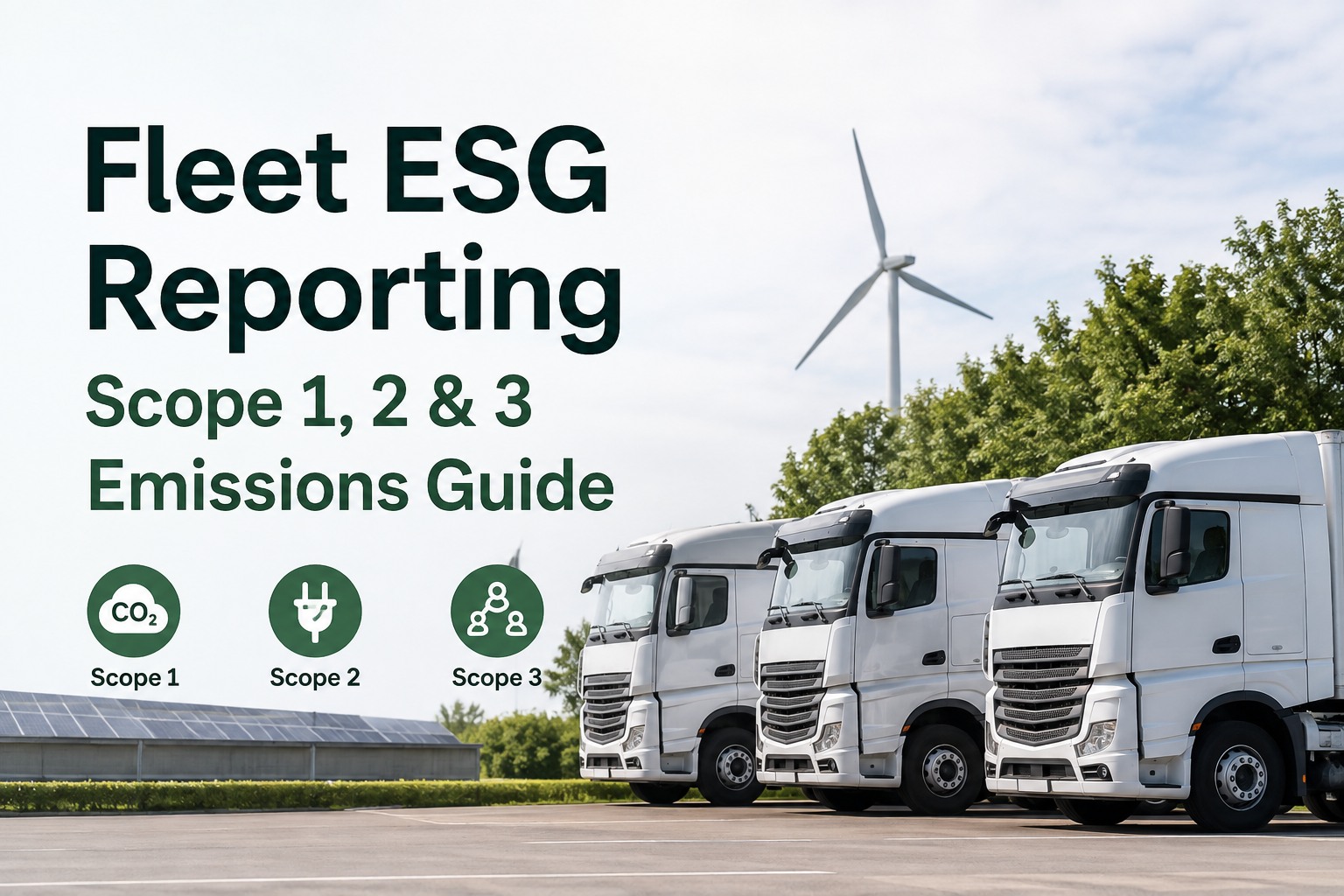
If you run a fleet in 2026, someone is asking for your emissions numbers — a regulator, a customer's ESG team, an insurer, or all three. Fleet ESG reporting is where those requests land. This guide walks through what Scope 1, 2 and 3 actually mean for a fleet operation, which regulatory frameworks apply after the 2026 CSRD Omnibus changes, and how to build a reporting workflow that survives an audit. Book a demo
Fleet ESG reporting — what to measure, what to report, who's asking
The 2026 landscape shifted. Scope narrowed, timelines moved, but the pressure from customers, banks and shippers didn't. Here's how to run it clean.
Two things changed the ESG reporting picture for fleets in 2026 — and both need a clear-eyed response. Regulatory scope narrowed under the EU Omnibus package, but customer-driven and bank-driven reporting expectations expanded. So even fleets no longer legally required to file CSRD reports are being asked for the same data by their largest shippers, lenders and insurers. The playbook below is how the top-quartile fleets are running it.
The three scopes explained — what actually belongs where
Under the GHG Protocol Corporate Standard — the framework every major reporting regime (CSRD, SEC climate rule, CDP, SBTi) sits on top of — emissions get sorted into three scopes. Getting the classification right is where most fleet reports go wrong.
Emissions from sources you own or control — the fleet burning fuel today, the generators running at your terminal, the refrigerant leaking from your reefer units.
- Diesel, gasoline, CNG, LNG or DEF burned by owned or operated vehicles
- Fuel burned by owned support equipment (generators, forklifts, terminal tractors)
- Refrigerant leaks from company-owned reefer trailers or A/C systems
- On-site fuel storage tank fugitive emissions
Emissions from electricity, steam, heating or cooling you buy from a utility — someone else burned the fuel, but you consumed the energy.
- Grid electricity charging EV fleets or plug-in hybrids
- Grid electricity at yards, terminals, wash bays and maintenance shops
- Purchased steam or heating for shop or terminal use
- Purchased chilled water or cooling for climate-controlled facilities
Emissions from everything else in the value chain — upstream (purchased goods, employee commuting, hired transport) and downstream (customer use of your services).
- Transport by third-party carriers you hire (major line for shippers)
- Well-to-tank emissions from fuel you buy (upstream production)
- Vehicle manufacturing embedded emissions
- End-of-life vehicle disposal, tire recycling, battery recycling
- Employee commuting, business travel
Two boundary calls that consistently trip fleets up. First: leased vehicles — if you have operational control (fuel card, dispatch, maintenance), they're Scope 1; if it's a fully-managed lease, they may be Scope 3. Second: fuel — the CO₂ from the diesel you burn is Scope 1, but the CO₂ from producing and transporting that diesel to your pump is Scope 3 (well-to-tank). GHG Protocol calls both out; most fleets miss the second. Book a demo to see Scope 1/2/3 mapped per unit on one platform
Who's actually asking — the 2026 regulatory & commercial map
The reporting landscape shifted significantly in early 2026 with the EU Omnibus I package. Fewer companies are legally required to file, but more companies are practically required to report because the largest ones are cascading Scope 3 requirements down their supply chains. Here's who's asking, and what they want.
The critical read: even if you're out of legal CSRD scope after Omnibus I (which most sub-1,000-employee fleets now are), your largest shippers and banks aren't — and they're pulling the same data from you as part of their own Scope 3 or PCAF reporting. Practical reporting obligation now cascades commercially, not just legally. Start free and get customer-ready emissions output on day one
The 6-stage fleet ESG reporting workflow
Every mature reporting program runs the same six stages. Skip any one and the audit trail breaks somewhere the assurance provider will find it. Here's the sequence.
-
01Define reporting boundary
Operational control vs equity share. Which vehicles, sites and business units are in scope. Written down and approved by finance — not left to interpretation later.
-
02Classify emissions by scope
Every source mapped to Scope 1, 2 or 3. Leased vehicles, third-party carriers, well-to-tank fuel, refrigerant leaks — all placed correctly before the counting starts.
-
03Capture activity data at unit level
Fuel gallons, kWh charged, miles driven, tons hauled — per vehicle, per site, per reporting period. Traceable to a source document (fuel card, ELD, invoice).
-
04Apply verified emission factors
EPA, DEFRA, IEA or GLEC factors, documented source, correct year. Fuel to CO₂e math done in a system that shows the calculation, not a black box.
-
05Aggregate & normalize
Total CO₂e in metric tons for GHG Protocol / CSRD. Intensity metrics in g CO₂e per ton-mile for SmartWay and customer RFPs. Trend against prior years.
-
06Report with audit trail
Publish to the required output (ESRS, CDP questionnaire, SmartWay submission, customer scorecard). Retain source data and calculation records for third-party assurance.
The stage that fleets consistently underinvest in is Stage 3 — unit-level activity data. Fleet-average estimates and industry-benchmark placeholders don't survive assurance. Every dollar spent building clean per-unit data capture in Stage 3 saves ten in remediation later. Book a demo to see per-unit activity data captured automatically
Common reporting mistakes — and how to avoid them
Across HVI's mining, construction and transportation customer base, the same five errors show up in first-time fleet ESG reports. Each one is straightforward to prevent if you know to look for it.
Fleet-average fuel estimates
Wrong: "We used ~180,000 gal of diesel this year across the fleet."
Right: Per-unit fuel gallons captured from fuel card records, reconciled to invoices. Auditors don't accept averages.
Missing well-to-tank emissions
Wrong: Reporting only tailpipe CO₂ and calling it Scope 1.
Right: Tailpipe = Scope 1. Fuel production upstream = Scope 3, Category 3. ISO 14083 requires both.
Leased vehicle mis-classification
Wrong: Placing all leased vehicles in Scope 3 by default.
Right: Operational control test. Fuel-card, dispatched, maintained = Scope 1. Managed lease = Scope 3.
Ignoring refrigerant & DEF
Wrong: Diesel-only Scope 1 report on a reefer fleet.
Right: HFC refrigerant leaks from reefer units carry very high GWP — can equal 10%+ of fleet Scope 1.
No audit trail for calculation
Wrong: Reporting a number from a black-box tool with no source data retained.
Right: Calculation methodology, emission factor source and inputs retained for 5+ years.
Every one of these mistakes traces back to the same root cause: activity data scattered across systems the assurance provider can't reconcile. Fix the data plumbing and four of the five errors disappear at the source. Book a demo to see the full audit trail from fuel receipt to reported CO₂e
From a Sustainability Director who built a fleet ESG report through assurance
Our first CSRD-adjacent report in 2024 was an embarrassment — not because the number was wrong exactly, but because we couldn't defend how we got to it. When the assurance provider asked to see per-unit fuel data, we had it in six systems, three spreadsheets and no consistent audit trail. They flagged it as unverifiable.
The fix wasn't more sophisticated carbon software. It was consolidating fuel, mileage, PM and vehicle spec data into one system per unit. Once that plumbing was clean the report went from a four-week annual scramble to a monthly export. We're still not legally in scope after Omnibus — but our three biggest shippers ask for the same data as part of their Scope 3, and we can now hand it over in a day instead of a month.
Frequently asked questions
What is fleet ESG reporting and why does it matter in 2026?
Fleet ESG reporting is the systematic disclosure of environmental, social and governance data related to a fleet's operations — with emissions reporting sitting at the center. Under the GHG Protocol Corporate Standard, fleet emissions are categorized into Scope 1 (direct emissions from owned or operated vehicles), Scope 2 (purchased electricity for EVs and facilities), and Scope 3 (indirect value-chain emissions, including hired transport and upstream fuel production). It matters in 2026 for three converging reasons. First, regulatory: the EU's Corporate Sustainability Reporting Directive (CSRD) — even after the Omnibus I scope narrowing in early 2026 — still applies to companies above 1,000 employees and €450M turnover, with Wave 2 companies reporting on FY 2027. The EU's proposed CountEmissionsEU regulation will make ISO 14083 the reference for transport emissions. Second, commercial: large shippers now include Scope 3 transport emissions in their RFP scoring, and even fleets not legally required to report are commercially required to. Third, financial: banks under the Partnership for Carbon Accounting Financials (PCAF) framework are pricing loans against financed emissions, and ESG-linked pricing on fleet loans is expanding. Fleet ESG reporting has moved from a nice-to-have to a business requirement.
What's the difference between Scope 1, Scope 2, and Scope 3 fleet emissions?
Scope 1 covers direct emissions from sources you own or control — the diesel, gasoline, CNG or LNG burned by your fleet, refrigerant leaks from reefer units, and fuel burned by owned support equipment. For most traditional fleets, Scope 1 is by far the largest reporting category. Scope 2 covers indirect emissions from purchased electricity, steam, heating or cooling — typically small for a diesel fleet today (mostly yard and shop electricity), but growing quickly as EV fleets scale. Scope 3 covers everything else in the value chain: transport by third-party carriers you hire (a major category for shippers reporting on their transportation providers), well-to-tank emissions from the diesel you purchase (production and distribution before it reaches your pump), vehicle manufacturing embedded emissions, end-of-life disposal, employee commuting, and business travel. Two boundary calls consistently trip fleets up. First, leased vehicles: if you have operational control (fuel card, dispatch, maintenance) they're Scope 1; if it's a fully-managed lease you're just paying for, they may fall in Scope 3. Second, fuel: the tailpipe CO₂ is Scope 1, but the upstream production and distribution CO₂ of that same fuel is Scope 3 Category 3. GHG Protocol requires both to be classified correctly.
Is my fleet still required to comply with CSRD after the 2026 Omnibus changes?
The Omnibus I package finalized in February 2026 significantly narrowed CSRD scope. Under the new thresholds, mandatory CSRD reporting applies primarily to EU companies with more than 1,000 employees and more than €450M net turnover (with similar EU-turnover triggers for non-EU groups). Wave 1 companies (large public-interest entities) continue reporting under existing rules for FY 2024, 2025 and 2026, though many will fall out of scope for FY 2027. Wave 2 reporting was delayed by two years and now begins with FY 2027 data published in 2028. Wave 3 (listed SMEs) was similarly delayed. For most small and mid-sized fleet operators, the legal reporting obligation likely no longer applies directly — but the practical reporting obligation has expanded, not shrunk. Larger shippers, banks and insurers are still in scope, and they cascade Scope 3 reporting requirements down to their carriers, borrowers and insured. That means fleets no longer required to file CSRD reports themselves are still receiving the same data requests from their customers, their lenders and increasingly their insurers. Getting the underlying data pipeline right remains a commercial necessity even without the regulatory one.
Which reporting frameworks should a fleet operator align with in 2026?
The practical answer for most fleet operators is to build the underlying data pipeline once and produce output for the frameworks that customers and regulators actually ask for — because the data inputs are largely the same across all of them. The primary framework to align with is the GHG Protocol Corporate Standard, which underpins essentially every other reporting regime including CSRD/ESRS, SEC climate disclosure, CDP, SBTi and PCAF. On top of that, transport-specific alignment with ISO 14083:2023 is increasingly expected — it's the reference methodology for the EU's proposed CountEmissionsEU regulation and is compatible with the GLEC Framework used by many freight buyers. For US fleets, EPA SmartWay is voluntary but influential, producing the g CO₂/ton-mile efficiency scores that many US shippers use in RFP evaluation. For companies with any EU exposure, CSRD alignment (even if not in mandatory scope) is worth building toward because customers and banks in Europe will ask for it. The right sequence for most fleets: build clean per-unit data capture first, calculate to GHG Protocol, produce ISO 14083 transport intensity metrics second, submit to SmartWay and CDP third, layer CSRD/ESRS output on top if in scope or commercially needed.
How does HVI help fleets produce audit-defensible ESG reports?
The single hardest part of fleet ESG reporting isn't the calculation or the framework selection — it's the data plumbing. Auditors and third-party assurance providers verify inputs, not just totals: they want to see per-unit fuel gallons matched to a source document (fuel card record, invoice), per-unit mileage matched to an ELD or telematics record, per-trip payload matched to a bill of lading, and vehicle spec data matched to registration records. When those inputs live in six different systems, three spreadsheets, and a supplier portal, the audit trail breaks. HVI consolidates all of it on one platform: per-unit fuel logs, mileage from telematics or manual entry, digital DVIRs and PM history, work orders, vehicle specifications, and cost data — with the audit trail retained per unit, per date. Applying verified emission factors (EPA, DEFRA, GLEC) to that data produces Scope 1 totals in metric tons CO₂e for GHG Protocol/CSRD, ton-mile intensity metrics for SmartWay and customer RFP scoring, and the underlying source records for third-party assurance. Published customer data shows the same fleets that use HVI for cost and maintenance optimization report ~25% lower annual maintenance cost and ~3-month payback — the audit-ready ESG output is essentially a byproduct of running clean fleet data.
Scope 1, 2 & 3 emissions on the same platform running your maintenance
HVI holds every input that lands in a fleet ESG report — per-unit fuel, mileage, payload, spec and PM history — and outputs the Scope 1 totals, ton-mile intensity metrics, and audit trail your CSRD, SmartWay, CDP or shipper RFP submissions actually need. Configured for your fleet in under two weeks.
No credit card · No hardware · ESG-ready dashboard on day one