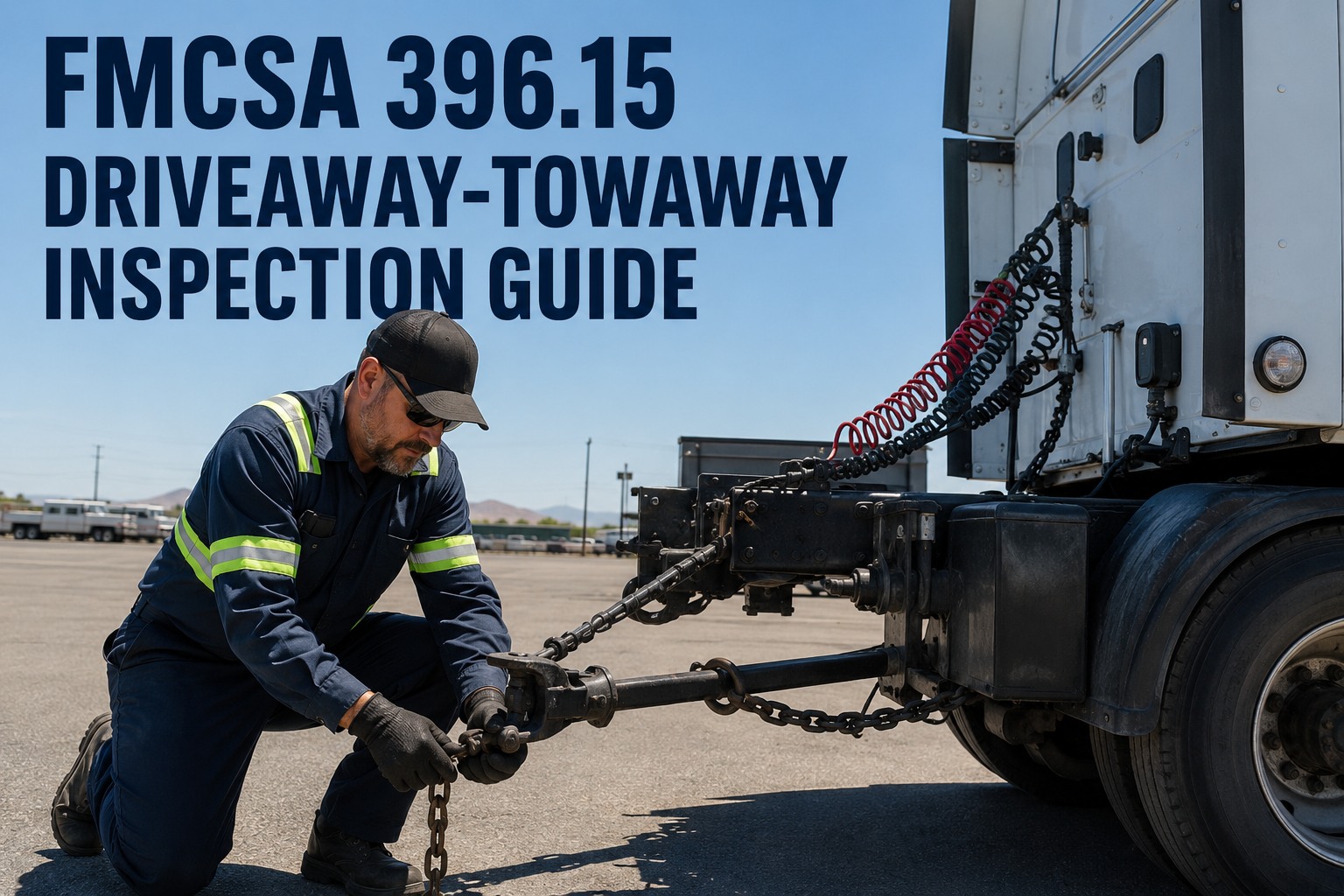
FMCSA §396.15 sets the inspection framework for driveaway-towaway operations — motor vehicles being delivered as the shipment itself using tow-bar or saddle-mount combinations. Two mandatory inspections bracket every trip: pre-trip verification that tow-bar/saddle-mount connections are secure, function without cramping, and track properly — and post-trip disassembly of the tow equipment to check for worn, bent, cracked, broken, or missing parts before reuse. Three Part 396 requirements are specifically exempted for vehicles being delivered as the shipment. Book a demo .
FMCSA §396.15 — Driveaway-Towaway Pre-Trip + Post-Trip Inspection Rules
Two inspections bracket every driveaway-towaway trip. Before departure: verify tow-bar or saddle-mount is secure. After the trip: disassemble the tow equipment before reuse. Records exceptions apply to delivered vehicles specifically.
FMCSA 49 CFR §396.15 — "Driveaway-towaway operations and inspections" — is the Part 396 subsection covering the unique operational scenario where motor vehicles themselves are the shipment being transported, using tow-bar or saddle-mount combinations to move multiple vehicles under a single power unit. Common driveaway-towaway operations include delivery of newly manufactured commercial motor vehicles from manufacturer to dealership, delivery of new or used vehicles from dealership to purchaser, and specific movements of vehicles to repair or maintenance facilities. The regulation does two things: it establishes required pre-trip and post-trip inspections specific to the tow-bar and saddle-mount connections, and it exempts vehicles being delivered as the shipment from three specific Part 396 recordkeeping requirements that would otherwise apply. Both provisions must be understood together — the exception is narrow and applies only to the delivered vehicle, not to the towing equipment or the power unit.
What counts as a driveaway-towaway operationThe regulatory scope, common scenarios, and what falls outside §396.15
A driveaway-towaway operation is any operation in which motor vehicles themselves constitute the commodity being transported, with one or more of the vehicles serving as the load. The distinguishing feature: the transported vehicles are the shipment, not the cargo inside them. This distinction matters because standard Part 396 requirements (maintenance records, DVIR, periodic inspection) apply to the transporting vehicle in normal operations — but for delivered vehicles under §396.15, those specific requirements are exempted. Book a demo to see HVI's driveaway-towaway inspection templates
Newly manufactured commercial motor vehicles moved from the manufacturing facility to a dealership location. Common configuration: multi-vehicle combinations using saddle-mounts to stack up to four units under one power unit. The delivered vehicles are the shipment; §396.15 pre-trip and post-trip inspection rules apply to the tow-equipment connections.
New or used motor vehicles being delivered from a dealership to the end purchaser. Often single-vehicle tow-bar configurations for individual vehicle deliveries; multi-unit saddle-mount for fleet deliveries. Same §396.15 pre-trip and post-trip framework applies regardless of quantity.
Certain movements of vehicles to a repair or maintenance facility using tow-bar or saddle-mount combinations. The transported vehicle is the shipment (going for repair); §396.15 pre-trip and post-trip rules apply. The specific applicability to a given repositioning scenario should be confirmed with qualified DOT compliance counsel.
Ordinary commercial motor vehicle operations where cargo is being transported inside or on the vehicle (freight, containers, tank contents) are not driveaway-towaway operations regardless of whether the vehicle also tows a trailer. Standard Part 396 requirements apply in full — no §396.15 exceptions.
Pre-trip inspection detail — the three §396.15(b) checksWhat "careful inspection and test" actually requires before combination departs
Section 396.15(b) requires a careful inspection and test before any driveaway-towaway combination operation begins. Three specific ascertainments must be made and documented at the operational level. The regulation's language ("shall make a careful inspection and test to ascertain") requires active verification, not passive walk-around.
What to verify: Both ends of the tow-bar (or all connection points of the saddle-mount) properly secured to both the towed vehicle AND the towing vehicle. All pins, locks, latches, and safety devices in place and engaged. Fasteners torqued or secured per equipment specification.
Common failure mode: One end connected but not fully secured; safety pins missing or partially inserted; connections made in poor light and not re-verified in daylight before departure.
What to verify: Tow-bar articulation joints move freely through the range of motion required for normal turning; saddle-mount components articulate without binding; no part of the connection is under excessive stress that could cause failure during operation.
Common failure mode: Rusted joints that bind under load and only reveal the problem after a few miles; misaligned installations that appear connected but bind at articulation; damaged components carried over from prior trip without post-trip disassembly.
What to verify: A test movement (typically at slow speed in a controlled area) confirms the towed motor vehicle follows substantially in the path of the towing vehicle without whipping (uncontrolled lateral movement) or swerving (side-to-side motion beyond normal tracking).
Common failure mode: Whipping or swerving that develops only at highway speeds and can't be caught in a low-speed yard test; tire inflation mismatches or steering-axle issues that produce tracking problems; incorrect saddle-mount weight distribution.
Post-trip inspection: disassembly is required, not optional§396.15(c) requires actual disassembly of tow-bars and saddle-mounts before reuse
Section 396.15(c) sets an operational discipline stronger than pre-trip: motor carriers must maintain practices to ensure that following completion of any driveaway-towaway trip, and before the tow-equipment is used again, the tow-bars and saddle-mounts are disassembled and inspected for worn, bent, cracked, broken, or missing parts. Visual walk-around is not sufficient — actual disassembly is required. Start a free trial to configure post-trip disassembly inspection templates.
Components showing wear beyond manufacturer specification — bushings, bearings, articulation surfaces, contact points. Wear that reduces the equipment's ability to secure and articulate properly during towing operations.
Structural members bent out of specification, typically from prior impact or overload. Bent components produce misalignment that affects both the "function without cramping" and the "follows in path" requirements for the next trip.
Cracks visible in structural members, welds, or high-stress connection points. Cracked components can fail catastrophically under towing load and are a leading cause of driveaway-towaway equipment failure incidents.
Components that have already failed — broken pins, snapped brackets, failed fasteners. Any broken component identified during post-trip disassembly must be repaired or replaced before reuse.
Components that should be present but aren't — missing safety pins, missing fasteners, missing safety chains, missing cotter keys. Missing parts commonly result from prior maintenance that wasn't properly completed or from parts that failed in transit.
Suitable repair or replacement of any defective parts identified during disassembly, followed by proper reassembly per equipment manufacturer specification, before the tow-bar or saddle-mount can be used again for another driveaway-towaway operation.
Photo evidence of the disassembled state paired with component-by-component defect checkpoints produces the audit-defensible post-trip record §396.15(c) requires. Book a demo to see HVI's disassembly inspection workflow
The §396.15(a) exceptions — what does NOT apply to delivered vehiclesThree specific Part 396 requirements exempted for vehicles being delivered as the shipment
Section 396.15(a) exempts vehicles that are part of the shipment being delivered from three specific Part 396 requirements. The exceptions are narrow and specific: they apply only to the delivered vehicle, not to the power unit performing the driveaway-towaway operation, not to the tow equipment itself, and not to other Part 396 requirements.
General maintenance records (nature and due date of inspections, dates and descriptions of maintenance operations) are not required for a vehicle that is part of the shipment being delivered under driveaway-towaway operations. The vehicle is transient in the carrier's care; ongoing maintenance records don't apply.
DVIR is not required for the delivered vehicle in driveaway-towaway operations. The rationale: the delivered vehicle is not being operated as a driver-operated CMV in the ordinary sense; it's being transported as cargo. Standard DVIR requirements continue to apply to the power unit performing the towing operation.
The annual periodic inspection required under §396.17 is not required for the delivered vehicle in driveaway-towaway operations. The vehicle is in transit as shipment; the annual inspection framework doesn't attach to the transported vehicle during that delivery operation.
The three exceptions apply ONLY to vehicles that are part of the shipment being delivered. The power unit performing the towing, the tow-bar/saddle-mount equipment, and the driver operating the power unit remain fully subject to all Part 396 requirements — including DVIR, maintenance records, periodic inspection, and §396.15's own pre-trip and post-trip inspection requirements.
Separate records tracks for the power unit (full Part 396 discipline) versus the delivered vehicles (exemptions apply) versus the tow equipment (§396.15 pre/post-trip required) is the operational split most driveaway-towaway fleets need. Book a demo to see multi-asset-type records separation
From a driveaway-towaway operations manager on §396.15 discipline
The compliance failure that woke us up on §396.15 wasn't the pre-trip inspection — every driver was doing the walk-around and confirming the tow-bar was connected. The failure was the post-trip disassembly. We were reusing saddle-mounts across multiple deliveries without ever actually taking them apart for internal inspection. When one failed on a delivery run and produced an incident, the investigation asked for the post-trip disassembly records for that saddle-mount going back six months. We had none. Not because the equipment was neglected — it just wasn't documented.
What changed our operation was making post-trip disassembly a required documented workflow with photo evidence at each disassembly. Every saddle-mount and tow-bar comes off the truck after each trip, gets photographed disassembled with the specific components visible, gets checked against the worn/bent/cracked/broken/missing criteria, and gets a written pass or defect note before reassembly. Same crew, same equipment — different records discipline. Two years later, zero equipment failures on driveaway-towaway operations. §396.15(c) isn't optional; it took an incident to make us treat it that way.
Frequently asked questions
What is FMCSA 396.15?
FMCSA 49 CFR §396.15 is the Federal Motor Carrier Safety Regulation covering driveaway-towaway operations and inspections — motor carrier operations where motor vehicles themselves constitute the commodity being transported using tow-bar or saddle-mount combinations. Common driveaway-towaway operations include delivery of newly manufactured commercial motor vehicles from manufacturer to dealership, delivery of new or used vehicles from dealership to purchaser, and certain movements of vehicles to repair or maintenance facilities. The regulation has three subsections: (a) General provisions establishing that Part 396 applies to driveaway-towaway operations with three specific exceptions for delivered vehicles (§396.3 maintenance records, §396.11 DVIR, §396.17 periodic inspection do not apply to any vehicle that is part of the shipment being delivered), (b) Pre-trip inspection requiring the motor carrier to make a careful inspection and test before departure to ascertain that tow-bar or saddle-mount connections are properly secured, function without cramping or binding, and that the towed vehicle follows substantially in the path of the towing vehicle without whipping or swerving, and (c) Post-trip inspection requiring disassembly of tow-bars and saddle-mounts after each trip to inspect for worn, bent, cracked, broken, or missing parts before reuse.
What must be inspected before a driveaway-towaway trip?
Under §396.15(b), before any driveaway-towaway operation of motor vehicles in combination, the motor carrier shall make a careful inspection and test to ascertain three specific conditions. (1) The tow-bar or saddle-mount connections are properly secured to both the towed and towing vehicle — both ends of the tow-bar or all connection points of the saddle-mount fully engaged with all pins, locks, latches, and safety devices in place. (2) The tow-bar or saddle-mount components function adequately without cramping or binding of any of the parts — articulation joints move freely through the range of motion required for normal turning, no part of the connection is under excessive stress. (3) The towed motor vehicle follows substantially in the path of the towing vehicle without whipping (uncontrolled lateral movement) or swerving (side-to-side motion beyond normal tracking) — typically verified via slow-speed test movement in a controlled area before highway operation. The regulation's language ("shall make a careful inspection and test to ascertain") requires active verification rather than passive walk-around. Pre-trip inspection applies to the tow equipment and combination behavior, not to the delivered vehicle's mechanical condition, which is exempted from DVIR requirements under §396.15(a).
Are DVIRs required for vehicles being delivered in a driveaway-towaway operation?
No — §396.15(a) specifically exempts vehicles that are part of the shipment being delivered from three Part 396 requirements: §396.3 maintenance records, §396.11 Driver Vehicle Inspection Report (DVIR), and §396.17 periodic inspection. The rationale is that the delivered vehicle is being transported as cargo, not operated as a driver-operated commercial motor vehicle in the ordinary sense. However, the exemption is narrow and specific — it applies only to the vehicle being delivered as the shipment. The power unit performing the driveaway-towaway operation (the tractor or truck doing the towing), the tow-bar or saddle-mount equipment, and the driver operating the power unit all remain fully subject to Part 396 requirements including DVIR requirements per §396.11, maintenance records per §396.3, and periodic inspection per §396.17. In addition, §396.15's own pre-trip and post-trip inspection requirements apply to every driveaway-towaway operation regardless of the delivered-vehicle exemptions — the tow-bar and saddle-mount inspections are always required. Specific applicability determinations for a given operator's configuration should be confirmed with qualified DOT compliance counsel.
What does the post-trip inspection require?
Section 396.15(c) requires motor carriers to maintain practices ensuring that following completion of any trip in driveaway-towaway operations of motor vehicles in combination, and before the tow equipment is used again, the tow-bars and saddle-mounts are disassembled and inspected for worn, bent, cracked, broken, or missing parts. Before reuse, suitable repair or replacement shall be made of any defective parts and the devices shall be properly reassembled. Three critical elements: (1) Disassembly is required — the tow-bar or saddle-mount must be taken apart for internal component inspection, not just visually walked around while still assembled. (2) Inspection covers five specific defect categories — worn parts (beyond manufacturer specification), bent parts (structural members out of alignment), cracked parts (visible cracks in structural members or welds), broken parts (already failed components), and missing parts (safety pins, fasteners, safety chains, cotter keys). (3) Before reuse, defective parts must be repaired or replaced and the tow equipment properly reassembled per manufacturer specification. Post-trip records should document the disassembly, components inspected, defects identified, corrective action taken, and reassembly verification. The disassembly requirement is what specifically distinguishes §396.15(c) post-trip inspection from a general walk-around and is a common source of compliance findings when only visual inspection is documented.
How does HVI support §396.15 driveaway-towaway compliance?
HVI provides the digital inspection template, defect capture, repair records, and searchable inspection history infrastructure that §396.15 compliance operates within. Features that apply to driveaway-towaway workflow include: configurable pre-trip inspection templates aligned to the three §396.15(b) required checks (connections properly secured, function without cramping/binding, towed vehicle follows in path) with digital sign-off supporting audit-defensible pre-trip records; post-trip disassembly inspection templates aligned to the §396.15(c) requirements (disassemble, inspect for worn/bent/cracked/broken/missing parts, document repair or replacement, verify reassembly) with photo evidence of the disassembled state and component-by-component defect checkpoints; tow-bar and saddle-mount equipment tracking with per-unit inspection history supporting equipment lifecycle decisions; defect capture with photo evidence and routing to work orders for repair-before-reuse discipline; and searchable multi-year records supporting incident investigation and compliance-review response. HVI is not itself an FMCSA compliance authority, tow-equipment certifier, driveaway-towaway operator, or legal compliance counsel — those functions remain with qualified regulatory personnel and specialized compliance professionals. What HVI provides is the digital inspection records infrastructure that turns §396.15 pre-trip and post-trip requirements into daily operational discipline with audit-ready documentation.
Post-trip disassembly is what separates §396.15(c) from a walk-around — the disassembly record is what the audit specifically requests
HVI supports pre-trip §396.15(b) three-check templates and post-trip §396.15(c) disassembly inspection with photo evidence, defect capture, repair-before-reuse workflow, and tow-equipment history — the digital records infrastructure that turns driveaway-towaway inspection compliance into a documented operational discipline rather than an assumed workflow.
No credit card · No hardware · Setup in minutes