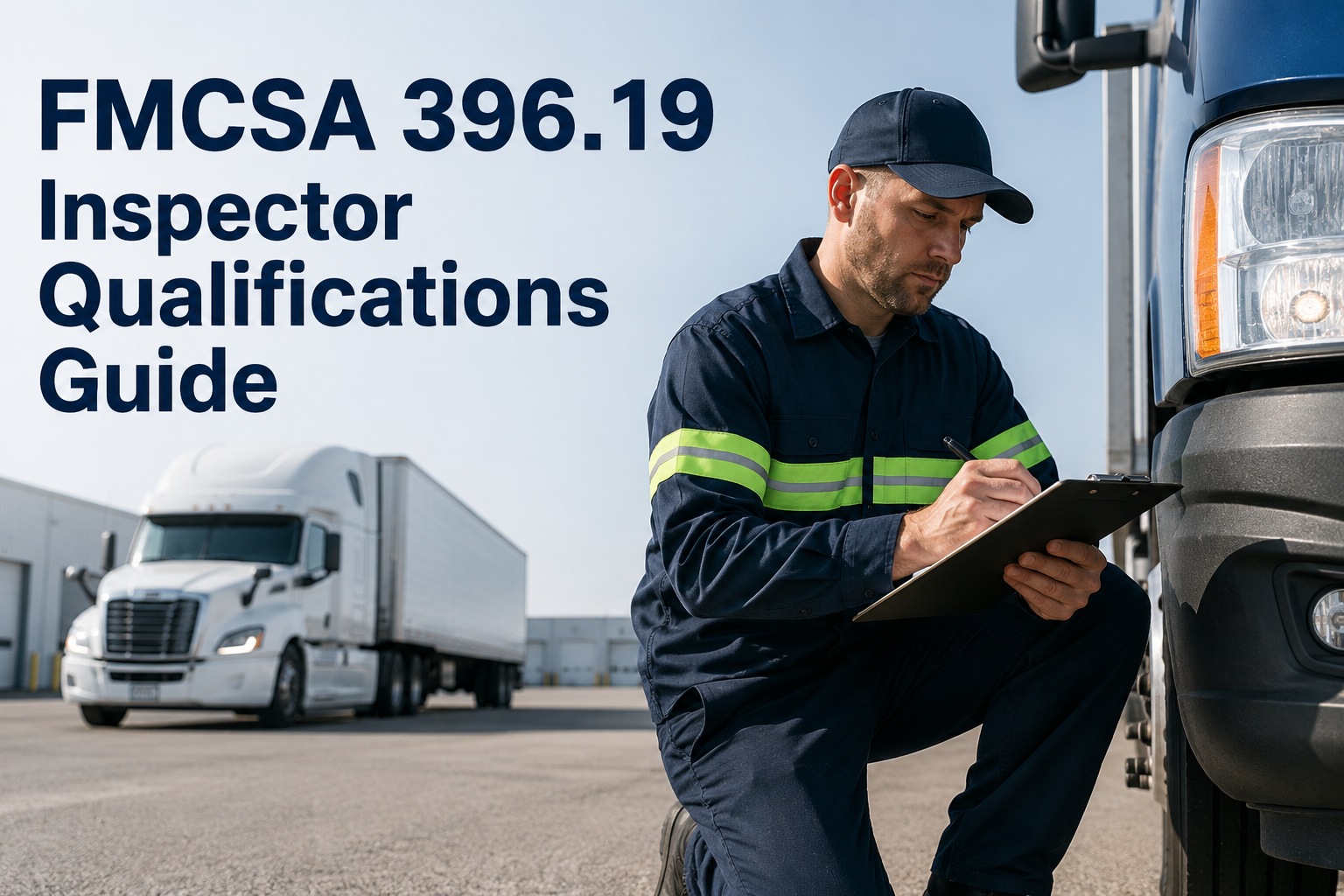
FMCSA §396.19 sets qualifications for anyone performing the DOT annual (periodic) commercial motor vehicle inspection under §396.17. Two qualification pathways exist: complete a Federal or State-sponsored training program (or hold a state/provincial certificate), OR combine training and experience totaling at least one year across four subcategories. Qualification evidence must be retained for the full period the person performs annual inspections plus one year after. §396.19 is the FULL annual inspector qualification — distinct from §396.25 which governs brake-work qualifications. Book a demo .
FMCSA §396.19 — The Two Annual Inspector Qualification Pathways
Full DOT annual inspection scope. Two routes to qualify. Records kept while person performs inspections plus one year after. Distinct regulation from §396.25 brake work.
Successfully completed a Federal- or State-sponsored training program, OR hold a certificate from a State or Canadian Province that qualifies the person to perform commercial motor vehicle safety inspections.
FMCSA 49 CFR §396.19 — "Inspector qualifications" — establishes the minimum qualification requirements for the individual performing an annual (periodic) commercial motor vehicle inspection under §396.17(d) or (e). This is the whole-vehicle DOT annual inspector covering every Appendix A component category: brakes, coupling, exhaust, fuel, lighting, safe loading, steering, suspension, frame, tires, wheels and rims, windshield glazing, wipers, and related items. The regulation applies to motor carriers, intermodal equipment providers, and any third-party inspection facility performing annual inspections on behalf of a carrier. Two pathways exist to qualify: a single-credential Federal or State training program, OR a combination of training and experience totaling at least one year across four defined subcategories. Motor carriers must retain evidence of qualification for the full period the person performs annual inspections plus one year afterward.
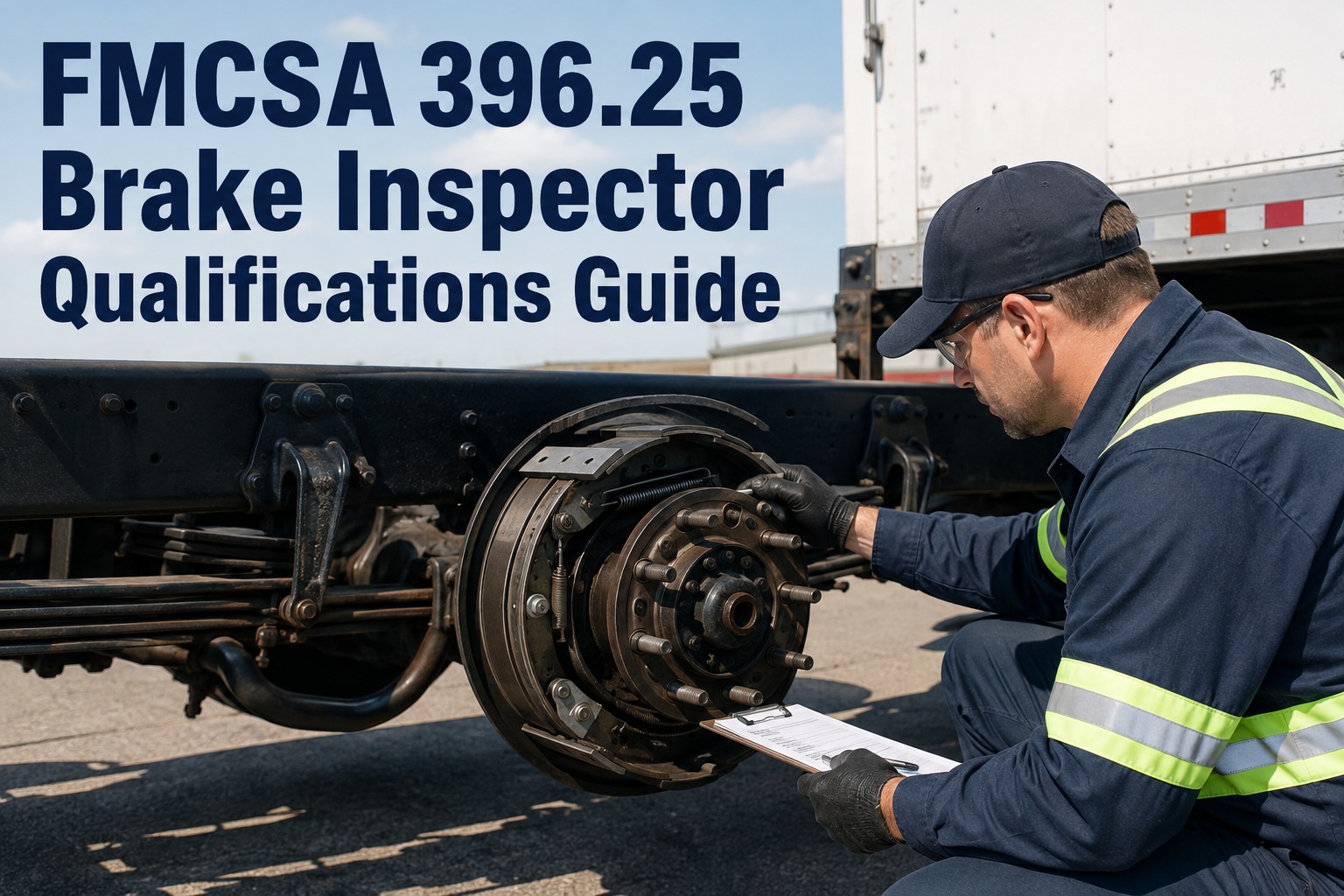
§396.19 vs §396.25 — different regulations, different qualifications, common confusionFull annual inspector under §396.19 vs brake-work inspector under §396.25
The two regulations sit next to each other in Part 396, both cover inspector qualifications, and both require records on file — but they cover different work with different qualification structures. Confusing them produces compliance gaps in both directions: mechanics qualified under §396.25 for brake work incorrectly assumed to be qualified for full annual inspections, and full-annual inspectors qualified under §396.19 incorrectly assumed to cover all brake service under §396.25. Book a demo to see HVI's per-regulation qualification records
Pathway (i): Federal or State training program — the single-credential routeCompleted training program or state/provincial certificate qualifies the person directly
Pathway (i) is the fastest, cleanest documentation route under §396.19. A person who has completed a Federal or State-sponsored commercial motor vehicle safety inspection training program, or holds a state/provincial certificate qualifying them for commercial motor vehicle safety inspections, qualifies under §396.19 by that credential alone — no additional experience requirement applies. Start a free trial to configure §396.19 qualification records.
Federal-sponsored commercial motor vehicle safety inspection training program. Completion certificate serves as evidence.
State-sponsored commercial motor vehicle safety inspection training program. State-issued completion certificate serves as evidence.
Certificate from a State or Canadian Province that qualifies the person to perform commercial motor vehicle safety inspections. State-issued qualification card or certificate.
Pathway (i) is the fastest audit-response route because a single credential answers the qualification question — digital storage of the credential copy paired with the qualification statement makes response nearly instant. Book a demo to see credential-attached qualification statements
Pathway (ii): Combined training or experience totaling at least 1 yearFour subcategories (A/B/C/D) that count toward the 1-year minimum requirement
Pathway (ii) is how the majority of shop-experienced mechanics qualify under §396.19. The regulation allows a combination of training and/or experience totaling at least one year, drawn from four defined subcategories. Combined means literally combined — time under different subcategories adds together toward the 1-year minimum.
What qualifies: Participation in a commercial motor vehicle manufacturer-sponsored training program (Kenworth, Peterbilt, Freightliner, Volvo, International, Mack, etc.) or similar commercial training program designed to train students in commercial motor vehicle operation and maintenance.
Evidence: Training program certificate, course description showing CMV inspection content and duration, dates of completion.
What qualifies: Experience as a mechanic or inspector in a motor carrier or intermodal equipment provider maintenance program. Direct in-house shop experience working on the fleet's CMVs under the carrier's maintenance operation.
Evidence: Employment verification letter from prior carrier or IEP describing CMV mechanic or inspector role, dates of employment, description of vehicle types serviced.
What qualifies: Experience as a mechanic or inspector in commercial motor vehicle maintenance at a commercial garage, fleet leasing company, or similar facility. Third-party or contract shop experience specifically on CMVs (not light-duty automotive).
Evidence: Prior-employer verification from garage or leasing operation, description of CMV work performed, dates of experience, vehicle types serviced.
What qualifies: Prior experience as a commercial motor vehicle inspector for a State, Provincial, or Federal government. Includes state DOT inspectors, state patrol commercial vehicle enforcement, and equivalent Canadian Provincial or federal roles.
Evidence: Prior government employer verification, role description, dates of service as CMV inspector. Government inspector experience is among the most audit-defensible under Pathway (ii).
Digital qualification statements with subcategory-by-subcategory duration tracking (versus a single "worked as mechanic" note) produce the audit-defensible Pathway (ii) documentation that compliance review specifically looks for. Book a demo to see subcategory-tracking qualification records
Records retention — employed + 1 year after last annual inspection§396.19(b) retention requirement and the state-program exception
Section 396.19(b) specifies retention: motor carriers and IEPs must retain evidence of inspector qualifications for the period during which the individual is performing annual motor vehicle inspections for the carrier or IEP, plus one year thereafter. A separate provision exempts state periodic inspection programs and random roadside inspections from the documentation retention requirement.
Qualification evidence must be on file for the entire period the person performs annual inspections for the carrier or IEP. Starts when the person is first authorized to perform annual inspections; continues through every year of active inspection work.
Records must be retained for one additional year after the person stops performing annual inspections for the carrier or IEP. Applies whether the person left the company entirely or moved to a role no longer performing annual inspections.
Motor carriers do not have to maintain qualification documentation for inspections performed as part of a State periodic inspection program per §396.23 — the state program handles inspector qualification independently. Also exempted: qualification documentation for random roadside inspections performed by enforcement officers.
When a third-party commercial garage or fleet leasing operation performs the annual inspection, the carrier still needs assurance the third-party inspector is §396.19-qualified — but the specific documentation retention depends on the arrangement. Best practice: retain the third-party's inspector qualification statement in the carrier's file for the same duration as in-house records.
From a maintenance director on §396.19 records discipline
The finding that got our attention wasn't on the annual inspections themselves — every truck had a current inspection report. The finding was that we couldn't produce §396.19 qualification statements for two of our three shop mechanics performing those annual inspections. Both had 10+ years of shop experience across motor carrier and commercial garage backgrounds — genuinely qualified under Pathway (ii), just no written statement documenting the specific subcategory breakdown. The auditor made the finding stick because the records requirement is separate from the actual qualification.
What we built for the next review was a §396.19 qualification statement for each annual inspector documenting the pathway (i or ii), the specific credential or subcategory breakdown, evidence attached from prior employers or training providers, and dates covering the full qualifying period. For the two veterans on Pathway (ii), we requested verification letters from their prior employers documenting motor carrier maintenance experience (subcategory B) and commercial garage experience (subcategory C). Same mechanics, same skill, better records. Passed clean the next cycle. §396.19 compliance lives in the records file, not in the toolbox.
Frequently asked questions
What are the FMCSA 396.19 inspector qualifications?
Under 49 CFR §396.19(a), motor carriers and intermodal equipment providers must ensure that any individual performing an annual inspection under §396.17(d) or (e) meets three core requirements: (1) understands the inspection criteria set forth in Part 393 and Appendix A to Part 396 and can identify defective components (Appendix A covers brakes, coupling, exhaust, fuel, lighting, safe loading, steering, suspension, frame, tires, wheels and rims, windshield glazing, wipers, and related items), (2) is knowledgeable of and has mastered the methods, procedures, tools, and equipment used when performing an inspection, and (3) is capable of performing the inspection by reason of experience, training, or both via one of two qualification pathways: Pathway (i) — successfully completed a Federal- or State-sponsored training program, OR hold a certificate from a State or Canadian Province that qualifies the person to perform commercial motor vehicle safety inspections; OR Pathway (ii) — have a combination of training or experience totaling at least 1 year drawn from four subcategories: (A) CMV manufacturer or commercial training program, (B) motor carrier or IEP maintenance experience, (C) commercial garage or fleet leasing experience, (D) government CMV inspector experience. Motor carriers must retain evidence of qualification for the period the individual performs annual inspections plus one year afterward per §396.19(b).
Who can perform a DOT annual inspection?
Any individual meeting the §396.19 qualification requirements can perform a DOT annual (periodic) commercial motor vehicle inspection. The regulation does not restrict inspections to specific job titles — a shop mechanic, in-house inspector, third-party commercial garage technician, or fleet leasing service provider can all perform the inspection if they meet §396.19 qualifications. Three practical options exist for fleets: (1) in-house carrier or IEP technicians meeting §396.19 qualification requirements, with the qualification statement retained per §396.19(b); (2) third-party commercial garages, fleet leasing companies, or truck stops with qualified inspectors and appropriate facilities, where the third-party retains its own qualification documentation but best practice is for the carrier to keep the third-party's qualification statement on file; (3) state periodic inspection programs meeting Appendix A minimum standards per §396.23, which is exempt from carrier-side qualification documentation retention because the state program handles inspector qualification independently. Each vehicle in a combination requires a separate inspection: a tractor + semi + full trailer combination requires three separate annual inspections. The person performing each inspection must be §396.19-qualified regardless of which of the three options the carrier uses.
How much experience does an annual inspector need under Pathway (ii)?
Pathway (ii) under §396.19(a)(3)(ii) requires a combination of training or experience totaling at least 1 year, drawn from four defined subcategories that can be combined to reach the 1-year minimum. Subcategory (A): participation in a commercial motor vehicle manufacturer-sponsored training program or similar commercial training program designed to train students in CMV operation and maintenance. Subcategory (B): experience as a mechanic or inspector in a motor carrier or intermodal equipment provider maintenance program. Subcategory (C): experience as a mechanic or inspector in commercial motor vehicle maintenance at a commercial garage, fleet leasing company, or similar facility. Subcategory (D): experience as a commercial motor vehicle inspector for a State, Provincial, or Federal government. Time under different subcategories combines toward the 1-year total — a mechanic with 4 months of manufacturer training (A) plus 6 months of motor carrier shop experience (B) plus 4 months of commercial garage experience (C) totals 14 months, more than the 1-year minimum. Each subcategory's time must be separately documented with verifiable evidence (training certificates, prior-employer verification letters). Pathway (ii) is the qualification route the majority of experienced shop mechanics use to satisfy §396.19.
Does §396.19 require FMCSA-issued inspector certification?
No — §396.19 does not require FMCSA-issued inspector certification. FMCSA does not itself issue an "annual inspector certification" credential. The regulation instead defines qualification through two pathways: (i) completion of a Federal- or State-sponsored training program or state/provincial certificate, or (ii) combination of training or experience totaling at least 1 year across four subcategories. Various private training providers, industry associations, and state agencies offer commercial motor vehicle inspection training programs that can satisfy Pathway (i) or count toward Pathway (ii) evidence, but "FMCSA certification" as a specific credential does not exist. This is one of the most common misconceptions about §396.19 among fleet operators. The qualification requirement is what the motor carrier or IEP determines and documents per the regulation, supported by evidence from recognized training programs or verifiable experience. The compliance-review standard is whether the qualification statement and supporting evidence satisfy the §396.19 pathway requirements — not whether FMCSA has issued the person a credential. Specific pathway determinations and evidence adequacy for a given inspector's qualification should be confirmed with qualified DOT compliance counsel; FMCSA guidance and the actual regulatory text under 49 CFR §396.19 remain the authoritative sources.
How long must inspector qualification records be retained?
Under §396.19(b), motor carriers and intermodal equipment providers must retain evidence of an inspector's qualifications for the entire period during which that individual is performing annual motor vehicle inspections for the carrier or IEP, plus one year thereafter. This retention starts when the person is first authorized to perform annual inspections, continues through every year of active inspection work, and extends one additional year after the person stops performing annual inspections (whether they left the company entirely or moved to a role no longer performing annual inspections). Two important exceptions apply: (1) State periodic inspection program work per §396.23 — the state program handles inspector qualification independently, so the carrier does not need to maintain qualification documentation for inspections performed as part of a qualifying state program; (2) random roadside inspections performed by enforcement officers do not require carrier-side inspector qualification retention. Best-practice retention typically extends beyond the regulatory minimum for the same reasons other Part 396 records commonly extend (crash defense, insurance claims, compliance-review response to older inspection records). Digital personnel records systems supporting §396.19(b) retention with searchable multi-year access satisfy the requirement in a way distributed paper HR files typically don't during compliance reviews.
§396.19 compliance lives in the records file, not in the toolbox — the qualification statement is what the audit measures
HVI supports §396.19 annual inspector qualification statements (Pathway i credential or Pathway ii combined 1-year subcategory documentation) alongside §396.25 brake qualifications, with evidence storage, retention tracking to the "employed + 1 year" requirement, and searchable multi-year records — the digital personnel records infrastructure that turns two overlapping regulations into one manageable file per inspector.
No credit card · No hardware · Setup in minutes