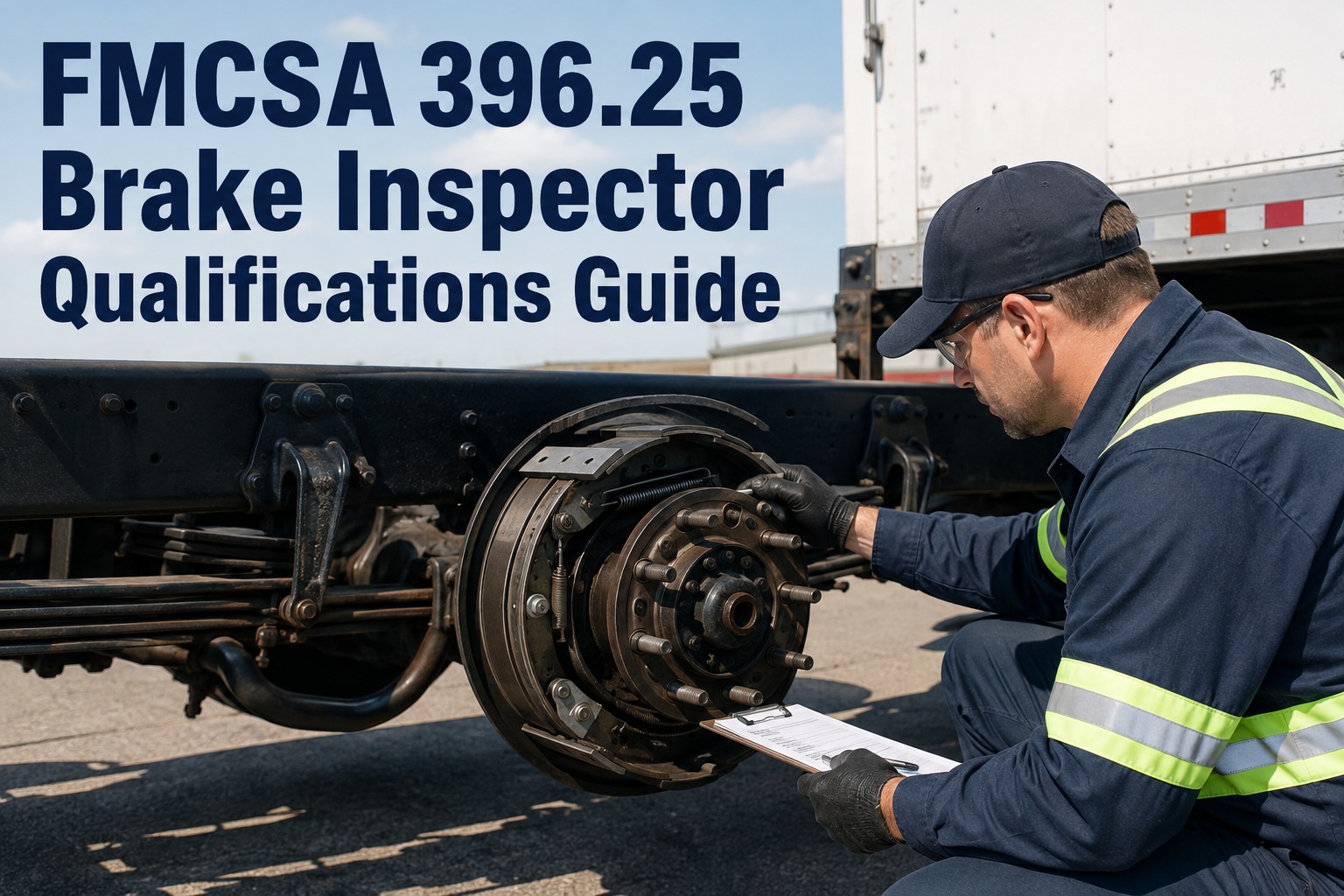
FMCSA 49 CFR §396.25 requires motor carriers to ensure employees performing brake inspections, maintenance, service, or repairs meet minimum qualifications — and to keep evidence on file. Four qualification pathways exist: state/federal apprenticeship, manufacturer training, motor carrier maintenance experience, or commercial garage experience. Missing records — even when the mechanic is genuinely qualified — is a compliance gap at audit. This guide covers who counts as a brake inspector, the four pathways, and required records. Book a demo .
FMCSA §396.25 — The Four Brake Inspector Qualification Pathways
Any employee responsible for brake work needs a qualification route on file. Four pathways under the regulation. Missing records fail the audit even when the mechanic is qualified in practice.
Route: Completed apprenticeship program sponsored by state, Canadian province, federal agency, or labor union — OR training program approved by state/provincial/federal agency — OR state/provincial certificate qualifying the person for the specific brake task. Passage of CDL air brake tests qualifies for brake inspection specifically.
Evidence needed: Apprenticeship completion certificate, state training certificate, CDL with air brake endorsement copy, or agency-issued qualification document.
Route: Training program sponsored by a brake or vehicle manufacturer, or similar commercial training program designed to train students in brake maintenance or inspection similar to the assigned tasks. Combined with any experience under 2B/2C to total the required time.
Evidence needed: Manufacturer training completion certificate, commercial training program certificate, course description showing brake content similar to assigned tasks.
Route: Experience performing brake maintenance or inspection similar to the assigned brake service or inspection task while working in a motor carrier or intermodal equipment provider maintenance program. Combined with training or other experience to total the required time.
Evidence needed: Prior-employer verification letters, work history documentation showing brake-related tasks, dates of brake work performed.
Route: Experience performing brake maintenance or inspection similar to the assigned brake service or inspection task at a commercial garage, fleet leasing company, or similar facility. Combined with training or other experience to total the required time.
Evidence needed: Employment history from commercial garage or leasing operation, verification letters describing brake tasks performed, dates of experience.
FMCSA 49 CFR §396.25 — "Qualifications of brake inspectors" — establishes minimum qualification requirements for any employee responsible for ensuring brake inspections, maintenance, service, or repairs on commercial motor vehicles meet federal standards. The regulation applies to motor carriers and intermodal equipment providers, and it functions as both an operational rule (unqualified persons may not perform the work) and a documentation rule (evidence of qualification must be on file at the carrier's principal place of business or the location where the inspector is employed). The most commonly missed piece is the documentation side: fleets frequently have mechanics with genuine skill and experience but no written qualification statement matching that mechanic to §396.25's specific pathway requirements. At FMCSA compliance review, an experienced mechanic without a qualification statement produces the same finding as an inexperienced person doing brake work — the audit measures the records, not the skill.
Who is a "brake inspector" under §396.25?Definition, scope, and the tasks that trigger the qualification requirement
Section 396.25(b) defines brake inspector as any employee of a motor carrier or intermodal equipment provider responsible for ensuring brake inspections, maintenance, service, or repairs on any commercial motor vehicle under the carrier's control meet applicable federal standards. That definition is broader than "the person who does the annual DOT inspection" and covers a wider range of shop staff than many fleets initially assume. Book a demo to see HVI's personnel qualification records workflow
Mechanics or drivers performing pre-trip or shop-level brake inspection where the outcome determines whether the vehicle is roadworthy. Includes DOT annual brake inspection component (separate from §396.19 annual inspector qualifications for the full DOT annual).
Any employee performing scheduled brake service — brake adjustment, air system service, lining inspection, drum measurement, brake chamber service, ABS system service, slack adjuster verification, or any preventive maintenance task specifically on the brake system.
Employees performing corrective repairs on brake components after defect or failure. Includes brake shoe or pad replacement, drum or rotor replacement, air line or hose repair, brake valve replacement, ABS component repair, and any repair returning the brake system to service.
The qualification requirement is task-specific. A mechanic performing non-brake work (engine service, transmission, cooling system, chassis) doesn't trigger §396.25 for that work — qualification is required for the specific brake tasks assigned, not as a general credentialing of the mechanic across all shop tasks.
Contract mechanics and third-party shop labor are a particularly common gap — §396.25 responsibility stays with the carrier even when the actual work is outsourced. Book a demo to see HVI's contractor qualification records workflow
The four qualification pathways — detailed evidence requirements per routeWhat documentation actually satisfies each pathway at compliance review
The regulation allows four routes to satisfy §396.25 qualification. Each route requires different supporting documentation on file. Fleets that build their qualification records around the specific pathway used for each brake inspector produce audit-ready files; fleets that keep generic "resume + hire date" records typically discover the gap during compliance review. Start a free trial to configure the qualification records templates.
What qualifies: Completed apprenticeship program (state, Canadian province, federal agency, or labor union sponsored), OR agency-approved training program, OR state/provincial certificate for the specific brake task, OR passage of Commercial Driver's License air brake tests (for brake inspection specifically).
Evidence for the file: Copy of apprenticeship completion certificate; state or federal training certificate; CDL copy with air brake endorsement visible; agency-issued qualification document. Include dates of completion.
Common gap: CDL air brake endorsement qualifies for brake inspection but doesn't automatically extend to brake service or repair beyond inspection scope — the task assigned determines the required qualification.
What qualifies: Training program sponsored by a brake manufacturer (Bendix, Meritor, Haldex, WABCO, etc.), a vehicle manufacturer, or a similar commercial training program designed to train students in brake maintenance or inspection similar to the assigned tasks. Counts toward the required training or experience.
Evidence for the file: Manufacturer training completion certificate; course description showing brake content and hours; instructor or provider credentials where relevant; dates of training completion. Combined with experience under 2B/2C to reach the qualification threshold.
Common gap: Generic "attended a training" note without course description or completion certificate doesn't meet the evidence requirement — specificity matters.
What qualifies: Experience performing brake maintenance or inspection similar to the assigned brake service or inspection task, obtained while working in a motor carrier or intermodal equipment provider maintenance program. Counts toward the qualification threshold when combined with training or other experience.
Evidence for the file: Employment verification letter from prior motor carrier or IEP describing specific brake tasks performed; dates of employment covering brake work; names and titles of persons providing verification; description of brake system types worked on.
Common gap: "Worked as mechanic for X years" is not sufficient — the evidence must specifically describe brake-related work similar to the assigned task, not general shop mechanic experience.
What qualifies: Experience performing brake maintenance or inspection similar to the assigned task, obtained at a commercial garage, fleet leasing company, or similar facility that services commercial motor vehicles. Counts toward the qualification threshold when combined with training or other experience.
Evidence for the file: Employment verification from the commercial garage or leasing operation; specific brake-related task description; dates of experience; verification of vehicle types serviced (commercial motor vehicles vs light-duty).
Common gap: Light-duty automotive experience doesn't automatically satisfy commercial motor vehicle brake experience — the equipment class serviced should match or be documented as related.
Records requirement — what §396.25(e) actually requires on fileLocation, content, and the qualification statement components that satisfy compliance review
Section 396.25(e) makes the records piece a specific compliance requirement, not an operational recommendation: no motor carrier may employ any person as a brake inspector unless the evidence of the inspector's qualifications is maintained at the motor carrier's principal place of business, or at the location where the brake inspector is employed. Compliance reviews specifically request these records.
Signed statement identifying the specific person, the brake tasks assigned, the qualification pathway (1, 2A, 2B, or 2C), and the supporting evidence for that pathway. This is the summary document that ties the person to the specific §396.25 route used to qualify.
Certificates, training records, prior-employer verifications, CDL copies where applicable, agency-issued qualification documents. Every claim in the qualification statement should have a matching evidence document.
Description of the specific brake service or inspection tasks the person is assigned to perform. §396.25 qualification is task-specific — a person qualified for brake inspection may or may not be qualified for brake repair depending on training and experience.
Records must be at the motor carrier's principal place of business OR at the location where the brake inspector is employed. Multi-location fleets should decide the storage convention and apply it consistently; the auditor will ask where the file is kept.
Records should be retained for the duration of employment and for a period after separation aligned with the carrier's broader personnel record retention policy per applicable FMCSA and employment record guidance. Consult qualified counsel for specific retention periods applicable to the fleet's jurisdiction.
When a brake inspector's assigned tasks expand (e.g., inspection-only mechanic moving into brake repair), the qualification statement should be updated to reflect the new task scope and any additional training or experience supporting the expanded qualification.
Centralized digital qualification records accessible from principal place of business or authorized shop locations satisfy the §396.25(e) storage requirement in a way distributed paper HR files typically miss. Book a demo to see HVI's centralized personnel records workflow
From a maintenance director on §396.25 records discipline
We failed a compliance review on brake inspector qualifications about four years ago even though every mechanic in the shop had legitimate brake experience. The finding wasn't that the work was wrong — the finding was that we couldn't produce §396.25 qualification statements for six of our eight brake-side techs. Two of them had been with us for over a decade and knew the equipment better than any manufacturer trainer would; but no written statement, no pathway documentation, no supporting evidence file. That was the gap.
The fix wasn't hiring new techs or sending everyone to training — it was building the qualification statement for each existing mechanic based on the pathway that actually applied. For the veterans, pathway 2B: motor carrier maintenance experience with documented brake-task descriptions from prior employer verification letters we requested for the file. For the newer techs, pathway 2A: manufacturer training certificates from courses they'd already completed but never given us copies of. Same team, same equipment — different records discipline. Passed the next review clean. The lesson for any maintenance director: §396.25 compliance is a records exercise more than a training exercise.
Frequently asked questions
What are the FMCSA 396.25 brake inspector qualifications?
Under 49 CFR §396.25, a motor carrier or intermodal equipment provider must ensure that each brake inspector meets three core requirements: (1) understands the brake service or inspection task assigned and can perform it, (2) is knowledgeable of and has mastered the methods, procedures, tools, and equipment required for the assigned task, and (3) is capable of performing the assigned brake service or inspection through one of four qualification pathways: apprenticeship program sponsored by a state, Canadian province, federal agency, or labor union (or agency-approved training program or state/provincial certificate; includes CDL air brake test passage for brake inspection specifically) — OR — brake or vehicle manufacturer or similar commercial training program (Pathway 2A) — OR — experience in a motor carrier or intermodal equipment provider maintenance program (Pathway 2B) — OR — experience at a commercial garage, fleet leasing company, or similar facility (Pathway 2C). Pathways 2A, 2B, and 2C can be combined to satisfy the training or experience requirement. Additionally, §396.25(e) requires the motor carrier to maintain evidence of the inspector's qualifications at the carrier's principal place of business or at the location where the brake inspector is employed. Missing documentation is a compliance gap at FMCSA audit even when the person is genuinely qualified.
Does a CDL air brake endorsement qualify someone as a brake inspector?
Yes for brake inspection specifically, per §396.25(d)(3)(i) which explicitly includes "passage of Commercial Driver's License air brake tests in the case of a brake inspection" within the apprenticeship/training pathway. This means a driver with a CDL and air brake endorsement can be qualified under §396.25 to perform brake inspection tasks assigned by the motor carrier. However, the regulation is task-specific: CDL air brake endorsement satisfies the qualification pathway for brake inspection but does not automatically extend to all brake service or repair tasks that go beyond inspection scope. A driver qualified for pre-trip and post-trip brake inspection through their CDL air brake credential may not be automatically qualified to perform brake adjustment, chamber replacement, or component repair without additional training or experience under Pathways 2A, 2B, or 2C for those specific tasks. The task assigned by the motor carrier determines the required qualification level; the CDL air brake endorsement is a valid pathway but should be matched to the specific brake tasks the driver is authorized to perform. The qualification statement on file should specifically identify the brake tasks the CDL-air-brake-qualified person is authorized to perform.
Is ASE brake certification required under §396.25?
No — ASE (Automotive Service Excellence) brake certification is not required under 49 CFR §396.25. The regulation specifies four qualification pathways: (1) state/federal/provincial apprenticeship or training program including CDL air brake test passage, (2A) brake or vehicle manufacturer or similar commercial training program, (2B) motor carrier or IEP maintenance program experience, (2C) commercial garage or fleet leasing experience. ASE certification is a widely-recognized industry credential and can support the qualification statement (particularly under Pathway 2A as a commercial training program), but it is not itself a required credential under §396.25. Fleets that require ASE certification internally do so for hiring standards or shop competence reasons — not because federal regulation mandates it. ASE certification also does not by itself satisfy §396.25 without the underlying qualification statement identifying the person, the pathway, and the supporting evidence. The written qualification statement is what the FMCSA audit specifically reviews; ASE certification (where held) is supporting evidence within that framework rather than a substitute for it. This is one of the most common misconceptions about §396.25 among maintenance directors and shop foremen.
How long must brake inspector qualification records be retained?
Section 396.25(e) requires that evidence of brake inspector qualifications be maintained at the motor carrier's principal place of business or at the location where the brake inspector is employed for as long as the person is employed as a brake inspector. The regulation does not specify a post-separation retention period as a standalone requirement, but fleets typically retain qualification records for a period after separation aligned with their broader personnel record retention policy and applicable employment record guidance under federal and state labor law. Best practice for audit response is to retain the qualification statement, supporting evidence, and task assignment documentation for the full period the person performed brake inspector duties plus a documented post-separation period consistent with the fleet's records retention policy. Compliance reviews may look back at brake work performed by employees no longer with the carrier, particularly following crash investigations or complaint-triggered audits, so records supporting historical brake work should remain accessible. Specific retention requirements applicable to a given fleet's jurisdiction should be confirmed with qualified DOT compliance counsel; the answer varies by jurisdiction, carrier type, and the nature of the brake inspector's work history with the operator.
How does HVI support §396.25 brake inspector qualification records?
HVI provides the personnel records, qualification statement templates, evidence storage, and audit-response searchable records infrastructure that §396.25 compliance operates within. Features that apply to brake inspector qualification workflow include: configurable personnel records templates supporting written qualification statements per §396.25 pathway (Pathway 1 apprenticeship/CDL air brake, Pathway 2A manufacturer training, Pathway 2B motor carrier experience, Pathway 2C commercial garage experience); training certificate storage with completion dates and course descriptions; prior-employer verification letter retention with searchable date and task-scope metadata; CDL and endorsement copies where applicable; task assignment documentation linking each qualified person to specific authorized brake tasks; centralized records accessible from the principal place of business or authorized shop locations per §396.25(e); and multi-year searchable retention supporting audit response and compliance-review requests. HVI is not itself an FMCSA compliance authority, DOT roadside inspection authority, legal compliance counsel, brake inspector certifying body, or training program — those functions remain with authorized regulatory personnel and qualified DOT compliance professionals. What HVI provides is the digital personnel and qualification records infrastructure that turns §396.25 compliance from a distributed paper-file problem into an accessible, audit-ready records system.
§396.25 compliance is a records exercise more than a training exercise — the audit measures documentation, not skill
HVI supports brake inspector qualification statements per §396.25 pathway, evidence storage with completion dates, task-assignment documentation, and searchable multi-year records — the digital personnel records infrastructure that turns "we have qualified mechanics" into "we can produce the qualification statement for every brake inspector on our shop floor within two minutes of the auditor's request."
No credit card · No hardware · Setup in minutes

.png)