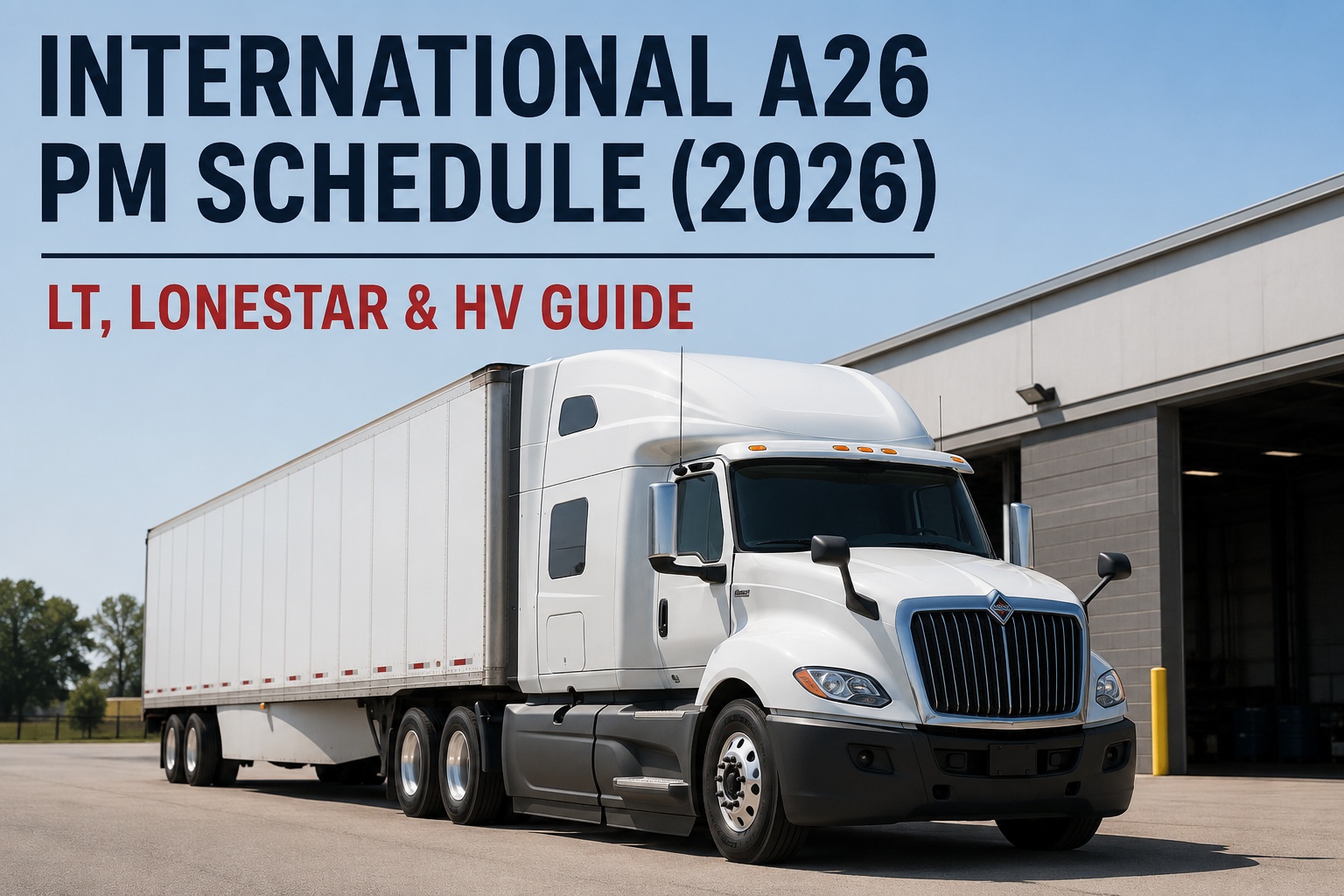
The International A26 PM schedule advertises 70,000-mile oil changes and 600,000-mile DPF intervals — but both come with asterisks. The 70K oil number requires a formal Navistar sampling program. The 600K DPF number assumes fuel economy above 6.5 MPG. Fall outside those conditions and you're back to standard intervals that most fleet managers never adjust for. This guide maps the complete A26 maintenance schedule for LT, LoneStar, and HV Series — long-haul and severe-duty side by side. Book a demo to see it automated.
International A26 PM Schedule: The Interval Map Your Fleet Needs
Four headline intervals. Four asterisks. Know the fine print before you build the schedule.
Those four numbers frame the A26's best-case maintenance ceiling. Below is how to build a real PM program around them — tier by tier, system by system, with the duty-cycle adjustments that separate a schedule that works from one that causes breakdowns.
The A26 at a Glancewhy this engine demands a different PM approach
The International A26 isn't a rebadged version of an older engine — it's a clean-sheet 12.4-liter design built around Compacted Graphite Iron (CGI) and engineered for extended intervals from day one. At 2,314 pounds, it weighs 600 to 700 pounds less than traditional 15-liter engines while producing up to 515 horsepower and 1,850 lb-ft of torque. It powers the LT Series (the backbone of most International long-haul fleets), the LoneStar, and the HV Series for vocational applications.
The B10 rating — meaning 90% of A26 engines are expected to reach 1.2 million miles before a major overhaul — is an industry-leading number. But that durability rating assumes adherence to the Navistar maintenance schedule. What makes the A26 PM program unique is the three-parameter service interval system: the engine's ECM tracks fuel consumed, engine hours, and vehicle distance simultaneously, triggering a service alert on whichever threshold is reached first. It's a built-in dual-trigger system — the question is whether your fleet's PM process actually responds to all three inputs, or just the odometer. Book a demo to see how HVI tracks all three A26 service parameters
The Complete A26 PM Schedulelong-haul vs. severe-duty intervals side by side
Navistar publishes PM intervals across two duty-cycle categories — Long-Haul (interstate, steady-state, high-MPG operations) and Severe (regional, vocational, stop-and-go, and high-idle applications). The difference between the two can be dramatic: a fuel/water separator that lasts 50,000 miles on an LT doing coast-to-coast runs may need replacement at 20,000 miles on an HV doing construction-site work. If your trucks touch both duty cycles — and many mixed fleets do — the severe interval is the safer default.
| System / Component | Long-Haul | Severe / Vocational | Notes |
|---|---|---|---|
| Engine oil + filter | 25,000 mi | 15,000–20,000 mi | CK-4 or FA-4, 10W-30 synthetic. Up to 70K with oil sampling program |
| Fuel/water separator | 50,000 mi | 20,000 mi | DAVCO or Racor frame-mounted filter |
| Engine-mounted fuel filter | 50,000 mi | 25,000 mi | Replace at every other oil service |
| Air cleaner element | By restriction | By restriction | Check at every oil service; replace when indicator shows |
| Chassis lubrication | 25,000–50,000 mi | 10,000–25,000 mi | King pins, U-joints, slack adjusters, fifth wheel |
| Fifth wheel inspect + lube | 50,000 mi | 25,000 mi | Check plate wear, jaw lock, pivot |
| Valve lash adjustment | 120K, 300K, then every 300K | Same | Intake: 0.020″ · Exhaust: 0.031″ |
| Coolant (ELC) | 300,000 mi | 300,000 mi | Add extender or full replace |
| DEF filter | 300,000 mi | 300,000 mi | Part of SCR aftertreatment system |
| DPF cleaning | 600,000 mi* | 300,000–400,000 mi | *Requires >6.5 MPG sustained |
| Air dryer desiccant | 250,000 mi / 24 mo | 240,000 mi / 24 mo | Or sooner in high-moisture climates |
| Cabin HVAC filter | 100,000 mi | 40,000 mi | Dusty environments = accelerated |
| Power steering filter | 500,000 mi | 20,000 mi | Vocational/off-road drastically shortens |
| Brake inspection | 25,000 mi | 15,000 mi | Linings, drums, slack adjuster stroke |
Scroll right on mobile · Source: Navistar LT Series Operation & Maintenance Manual
The gap between "long-haul" and "severe" isn't cosmetic. A power steering filter interval of 500,000 miles versus 20,000 miles is a 25x difference — and it reflects the radically different stress profiles between an LT running I-80 and an HV working a quarry access road. Getting this wrong doesn't just cost a filter; it costs a steering gear. Start free — configure long-haul and severe-duty PM templates per unit in HVI
Engine Oil & the 70,000-Mile Questionwhat the extended interval actually requires
The A26's headline oil interval — up to 70,000 miles — is real, but it's not a default setting. It's the ceiling of Navistar's Extended Oil Drain Interval (ODI) program, which requires a specific, documented process.
Contact International Truck at OilAnalysis@Navistar.com to enroll. Only A26 engines in LT or RH chassis delivering greater than 6.5 MPG are eligible. Must use CK-4 or FA-4 engine oil exclusively throughout the program.
Collect a sample of the new oil directly from the container, then run the engine for 10 minutes and collect an engine oil sample. Submit both to an ISO 9001 or ISO 17025 certified lab for analysis, including TBN (Total Base Number) reading.
Send analysis results to Navistar. If oil quality supports extension, they provide the approved extended interval for the next drain — typically incremental, not a jump straight to 70,000 miles. Book a demo — HVI tracks oil sample history per unit
Oil sampling must continue at every drain. If you switch oil brands, you re-enter the program from scratch. The same oil must be used throughout — including top-offs.
Most experienced fleet managers and owner-operators run the A26 at 25,000 to 40,000-mile oil intervals even without the extended program. The cost difference between a 25K and a 70K interval is a few hundred dollars per year in oil and filters — versus the risk of accelerated wear on an engine that costs $30,000 or more to overhaul. For mixed fleets with trucks running different duty cycles, the 25,000-mile standard interval is the practical baseline most shops build around. Book a demo to see per-truck oil intervals with sample tracking
DPF, DEF, and SCRaftertreatment maintenance on the A26
The A26's aftertreatment system uses Selective Catalytic Reduction (SCR) with Diesel Exhaust Fluid (DEF) to meet EPA emissions standards. The system's extended service intervals are a major selling point — but they're only achievable when the engine runs efficiently enough to keep exhaust temperatures high enough for passive DPF regeneration. When that condition isn't met, the DPF loads up faster and the 600,000-mile cleaning interval contracts significantly.
Cleaning interval: up to 600,000 miles at sustained fuel economy above 6.5 MPG. Severe-duty and lower-MPG applications should plan for 300,000 to 400,000-mile intervals. Ash-loading DPFs that don't regenerate properly can trigger derates and forced stationary regens that take the truck out of service for hours. A DPF cleaning runs $500 to $1,500; a replacement can exceed $5,000.
DEF filter replacement at 300,000 miles. DEF consumption runs roughly 2 to 3% of diesel fuel consumed. The gauge cluster provides progressive warnings — visual and audible — hundreds of miles before the DEF tank is empty. If the driver ignores every warning and runs the tank dry, the engine enters a performance-restricted mode and will eventually refuse to restart. Book a demo — track DEF consumption per truck in HVI
The SCR catalyst itself is a long-life component, but its efficiency depends entirely on clean DEF delivery and proper exhaust temperatures. Contaminated DEF (wrong fluid, diluted concentration, or crystallization in the supply lines) is the most common cause of SCR-related faults. Inspect DEF lines and injectors at every major PM service.
The aftertreatment system is where deferred maintenance produces the most expensive consequences on the A26. A fleet that runs 30% fewer miles per gallon than the 6.5 MPG threshold — common in vocational and regional applications — may see DPF cleaning needs at half the advertised interval. Building your PM schedule around actual fuel economy data, not the spec-sheet ceiling, prevents the surprise $5,000 DPF event.
Long-Haul vs. Severe Dutywhy the same engine needs two different schedules
An International LT running 120,000 highway miles per year and an HV Series mixer truck doing 40,000 miles of stop-and-go both use the same A26 engine — but the maintenance load on those two trucks couldn't be more different. Here's where the divergence is most pronounced.
Oil: 25,000 mi (or extended with sampling)
Chassis lube: Every 50,000 mi
Brakes: Every 25,000 mi
DPF: 600,000 mi (at >6.5 MPG)
HVAC filter: 100,000 mi
Oil: 15,000–20,000 mi
Chassis lube: Every 10,000–25,000 mi
Brakes: Every 15,000 mi
DPF: 300,000–400,000 mi
HVAC filter: 40,000 mi
The critical takeaway: if you're managing a mixed fleet with both LT and HV units, you need per-unit PM templates — not a single fleet-wide interval. An LT running at 25,000-mile oil changes is on schedule; an HV running the same interval may be 5,000 to 10,000 miles overdue. Start free — assign per-truck duty-cycle templates in HVI
5 PM Mistakes That Cost A26 Fleetsthe patterns that lead to six-figure repair bills
Fleets that skip or delay scheduled maintenance on the A26 typically spend three to five times more on emergency repairs. A single roadside breakdown on a Class 8 truck can cost $500 to $2,000 or more once you factor in towing, emergency labor rates, and lost revenue from a missed load. Here are the five most common A26 PM failures — and what each one costs when it compounds.
The extended interval requires formal Navistar enrollment, lab analysis, and approval. Running 70,000 miles on oil without these steps voids the program's protections and accelerates bearing, ring, and turbo wear. Stick to 25,000 miles unless you're actively enrolled.
A single schedule across the fleet means half your trucks are serviced too late. The A26 manual explicitly defines different intervals by vocation. An HV on construction sites needs oil at 15,000 to 20,000 miles, not 25,000.
The first valve lash adjustment is critical on the A26. Intake valves at 0.020 inches, exhaust at 0.031 inches. Skipping this leads to progressive power loss, increased fuel consumption, and eventually valve damage that costs multiples of the adjustment labor. Book a demo — HVI flags milestone PMs like valve lash automatically
The 600,000-mile DPF cleaning interval requires sustained fuel economy above 6.5 MPG. Regional routes with frequent stops, heavy loads, and lower average speeds typically deliver 5.0 to 6.0 MPG — meaning the DPF loads up 30 to 40% faster.
King pins, U-joints, and fifth wheel plates need grease at 10,000 to 25,000-mile intervals on vocational trucks. A dry fifth wheel costs a $400 plate replacement; a seized king pin costs a $2,000+ steer axle repair and takes the truck off the road for days.
From a fleet maintenance manager running 38 LT units
When we first spec'd the A26, the 70,000-mile oil number was a huge selling point. We enrolled in the sampling program on the first 12 trucks. After two cycles, Navistar approved extensions to 45,000 miles on 9 of the 12 — the other 3 were running regional routes with too many stops to sustain the MPG requirement. That split forced us to build per-truck PM profiles instead of one fleet-wide template, which was painful in our old spreadsheet system but trivial once we moved to a CMMS.
The real win wasn't the oil interval — it was the valve lash reminder at 120,000 miles. Two of our trucks in the old system missed that adjustment entirely. Both developed injector issues within 30,000 miles. That's $6,000 in avoidable repair versus a $350 valve lash service.
Automating A26 PM with HVIfrom interval to work order to close-out
The A26's three-parameter service system (fuel, hours, distance) is designed for digital tracking — but it only works if your maintenance platform can match that sophistication. Here's what the automated workflow looks like in HVI.
Set LT units at 25K-mile oil, HV units at 15K. Assign valve lash milestones at 120K, 300K. Attach OEM task lists per tier.
When any threshold (miles, hours, fuel) trips, HVI generates the work order with the full task list for that service tier. No manual lookup.
Techs complete the A26-specific inspection on a phone or tablet. Defects auto-generate follow-up work orders. Book a demo to see the mobile inspection flow
See every truck's PM status at a glance — green (current), yellow (approaching), red (overdue). Filter by model, duty cycle, or location.
Navistar's 2-year unlimited-mile warranty requires documented adherence to the maintenance schedule. A digital maintenance record in HVI provides audit-ready documentation for every service event — dates, mileage, parts, technician, and inspection results — accessible in seconds during a warranty claim or roadside inspection.
Frequently asked questions
What is the standard oil change interval for the International A26?
The standard oil change interval for the International A26 engine is approximately 25,000 miles for long-haul applications and 15,000 to 20,000 miles for severe-duty or vocational applications. The A26 requires CK-4 or FA-4 rated engine oil, with 10W-30 full synthetic as the factory fill. Navistar offers an Extended Oil Drain Interval (ODI) program that can push the interval up to 70,000 miles, but this requires enrollment in the oil sampling program, submission of oil analysis results to an ISO-certified lab including TBN readings, and formal approval from International Truck. Most fleet managers run between 25,000 and 40,000 miles as a practical balance between cost savings and engine protection, particularly on trucks that mix long-haul and regional routes.
How often should the DPF be cleaned on the A26 engine?
Navistar rates the A26's Diesel Particulate Filter for cleaning at up to 600,000 miles, but this maximum interval requires the truck to sustain fuel economy above 6.5 miles per gallon. Trucks that run at lower fuel economy — common in regional, vocational, or stop-and-go applications — should plan for DPF cleaning at 300,000 to 400,000-mile intervals. The DPF relies on exhaust temperatures to complete passive regeneration cycles that burn off accumulated soot. When average speeds drop and idle time increases, regeneration happens less frequently, and ash builds up faster. A DPF cleaning typically costs $500 to $1,500, while a full DPF replacement can exceed $5,000. Monitoring regeneration frequency and exhaust backpressure through your maintenance platform is the best early indicator of when the DPF will need service.
What maintenance does the A26 DEF system require?
The A26's Diesel Exhaust Fluid (DEF) system requires DEF filter replacement every 300,000 miles as part of the SCR aftertreatment maintenance cycle. DEF consumption runs roughly 2 to 3 percent of total diesel fuel consumed, so a truck burning 20,000 gallons of diesel per year will use approximately 400 to 600 gallons of DEF. The DEF tank should be kept topped off and never allowed to run dry — if the driver ignores the progressive dashboard warnings and the tank empties, the engine enters a performance-restricted mode and will eventually refuse to restart until DEF is added. DEF quality matters: contaminated or diluted DEF is the most common cause of SCR-related fault codes on the A26. Inspect DEF supply lines and the injector for crystallization or leaks at every major PM service.
When should valve lash be adjusted on the A26?
The International A26 requires valve lash adjustment at three key milestones: the first adjustment at 120,000 miles, the second at 300,000 miles, and then every 300,000 miles thereafter. Intake valve lash is set to 0.020 inches (0.5 mm) and exhaust valve lash to 0.031 inches (0.8 mm). The first adjustment at 120,000 miles is particularly critical — it accounts for initial wear-in on the valve train components. Fleets that skip this first adjustment frequently see progressive power loss, increased fuel consumption, and in some cases valve or injector damage within the next 30,000 to 50,000 miles. The labor cost for a valve lash adjustment is relatively modest compared to the downstream repairs that result from neglecting it. Use your CMMS to set a milestone-based PM trigger so the work order generates automatically as the truck approaches 120,000 miles.
Can I use a CMMS to automate International A26 PM scheduling?
Yes, and for fleets running multiple International trucks with the A26 engine, a CMMS is the most effective way to manage the complexity. The A26's ECM tracks three service parameters simultaneously — fuel consumed, engine hours, and vehicle distance — and triggers a service alert on whichever threshold is reached first. A platform like HVI (Heavy Vehicle Inspection) lets you mirror this three-parameter approach, configure per-truck PM profiles for different duty cycles (long-haul LT units versus severe-duty HV units), set milestone alerts for events like valve lash adjustment at 120,000 miles, and maintain the digital service records required for Navistar warranty compliance. HVI also supports digital inspection checklists, automatic work order generation, parts tracking, and fleet-wide PM status dashboards — all in one platform that works across mixed fleets.
Your International A26 fleet, maintained on schedule — every truck, every tier
Configure long-haul and severe-duty PM templates. Track miles, hours, and fuel consumed. Auto-generate work orders. Attach OEM checklists. Log parts. Maintain audit-ready records for Navistar warranty and DOT compliance. Live in under two weeks.
No credit card · No hardware required · Works with any telematics provider