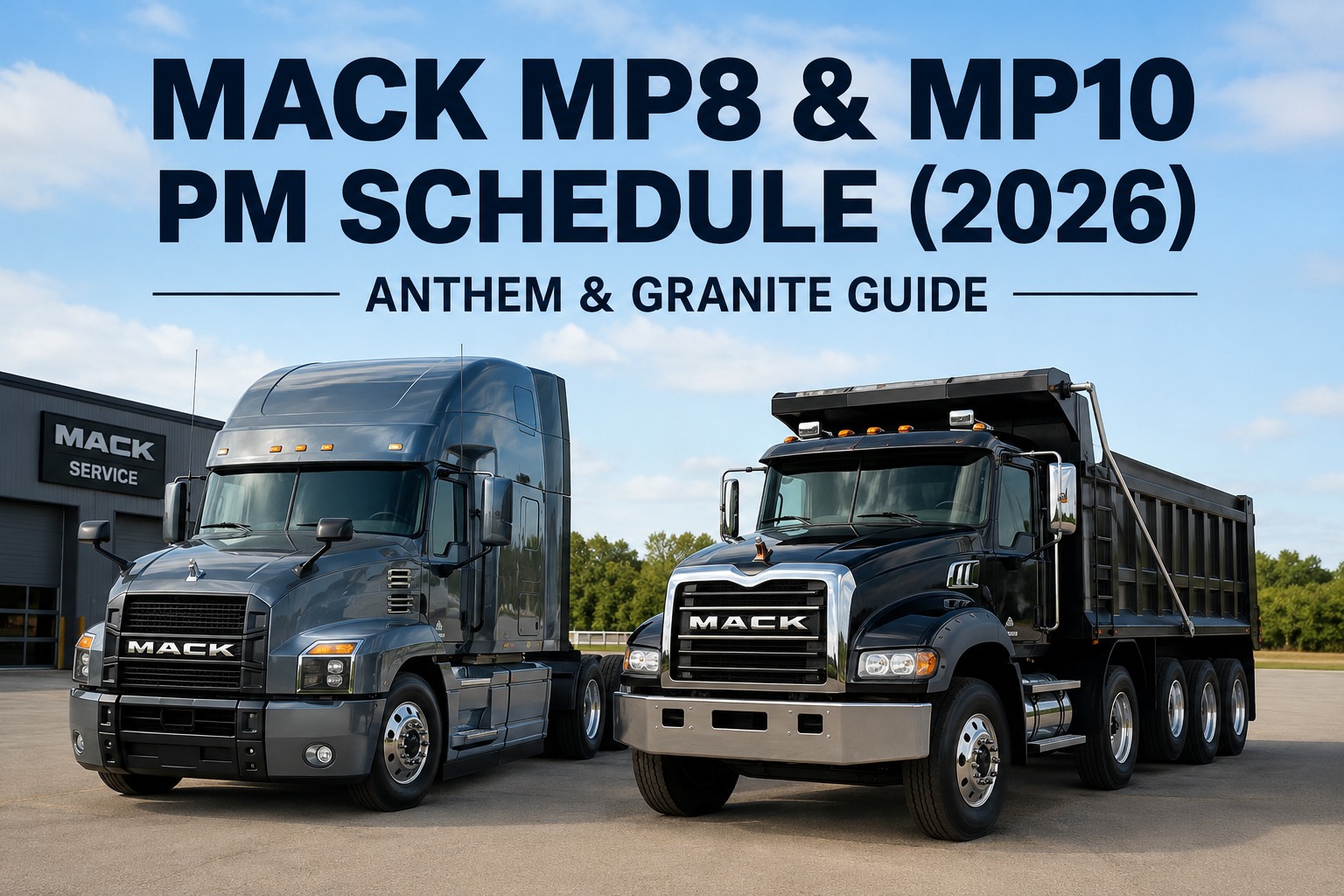
The Mack MP8 PM schedule says 45,000-mile oil changes for long-haul and 25,000 for heavy-haul — but a Granite running refuse at 35% idle should be on the next shorter interval, and the mDRIVE transmission in vocational service needs attention at half the highway interval. This guide maps the complete Mack MP8 and MP10 PM schedule for Anthem and Granite fleets, breaks down the highway-versus-severe split that most shops get wrong, and shows how to automate it all. Book a demo to see Mack PM scheduling live.
Mack MP8 & MP10 PM Schedule: Highway and Severe-Duty Intervals
Two engines. Two duty cycles. One schedule that covers both — or costs you.
Those numbers look clean in a side-by-side card. The reality is messier: a Granite dump truck idling 40% of the time at a construction site lives in a completely different PM world than an Anthem pulling reefer on I-95. Below is how to read the schedule for the way your trucks actually work.
MP8 and MP10 at a Glancewhat makes these engines tick — and what wears them out
Both the MP8 and MP10 are in-line six-cylinder turbodiesels designed and built in Mack's Hagerstown, Maryland plant. The MP8 at 12.8 liters is Mack's workhorse across the full lineup — Anthem, Granite, and Pinnacle. The MP10 at 16.1 liters is the heavy-hitter for applications demanding maximum torque at low RPM: heavy-haul, logging, and large-volume refuse. Both share the same basic PM architecture, with intervals that scale by duty cycle.
What sets Mack engines apart from a PM perspective is the single overhead camshaft design with three rocker arms per cylinder and rear-mounted gear train. The MP8 weighs roughly 2,560 pounds dry and uses electronic unit injectors — each injector is labeled with a trim code that must be reprogrammed in the ECM when replaced. The engine's ClearTech One aftertreatment system integrates the DOC, DPF, and SCR into a single unit, simplifying service but also meaning that a failure in one component often requires attention to the entire assembly. Book a demo to see how HVI tracks MP8 and MP10 PM across mixed fleets
The Complete Mack MP8 & MP10 PM Scheduleevery interval by duty cycle
Mack defines three duty-cycle tiers for PM intervals: Long-Haul (interstate, sustained speed), Regional (mixed highway and urban), and Heavy-Haul/Severe (vocational, construction, refuse, high-idle). The critical rule: if idle time exceeds 30% of total engine-on time, drop to the next shorter interval regardless of which tier the truck nominally belongs to.
| System / Component | Long-Haul | Regional | Severe / Vocational |
|---|---|---|---|
| Engine oil + filters (EOS-5) | 45,000 mi | 35,000 mi | 25,000 mi |
| Engine oil + filters (EOS-4.5) | 35,000 mi | 25,000 mi | 20,000 mi |
| VAH low-capacity oil pan | — | — | 20,000 mi |
| Fuel filters (primary + secondary) | At each oil drain | At each oil drain | At each oil drain |
| Air cleaner element | By restriction gauge | By restriction gauge | By restriction gauge |
| CCV filter (crankcase ventilation) | Every other oil drain | Every other oil drain | Every other oil drain |
| Coolant (ELC) | Test every 25K mi | Test every 25K mi | Test every 25K mi |
| Valve lash adjustment | Every 6,000 hrs or 24 mo | Every 6,000 hrs or 24 mo | Every 6,000 hrs or 24 mo |
| DPF cleaning | 400,000 mi | 400,000 mi | 250,000 mi |
| mDRIVE trans fluid + filter | 500,000–525,000 mi | 500,000 mi | 250,000 mi |
| Rear axle oil (GO-J Plus) | 500,000 mi | 500,000 mi | 250,000 mi |
| Chassis lubrication | 25,000 mi | 15,000 mi | 10,000 mi |
| Brake inspection | 25,000 mi | 15,000 mi | 10,000 mi |
Scroll right on mobile · Source: Mack Service at a Glance + FleetOwner
The 30% idle rule is the single most overlooked detail in the Mack PM schedule. A Granite mixer or refuse truck that idles 35% of the time should be running a 20,000-mile oil interval, not the 25,000-mile "severe" number. That 5,000-mile gap, repeated over a year, means one or two skipped oil changes — exactly the kind of drift that leads to premature CCV filter clogging, seal leaks, and eventually turbo and injector issues. Start free — set idle-adjusted PM intervals per truck in HVI
Anthem vs. Granitethe same engine, two completely different maintenance lives
An Anthem pulling dry van on the interstate and a Granite running concrete to job sites share the same MP8 block — but the duty-cycle stress on every system is dramatically different. Here's where the split matters most.
Oil: 45,000 mi (EOS-5) / 35,000 mi (regional)
Brakes: Every 25,000 mi
DPF: 400,000 mi
mDRIVE: 500,000 mi
Chassis lube: Every 25,000 mi
Oil: 25,000 mi (20K if >30% idle)
Brakes: Every 10,000 mi
DPF: 250,000 mi
mDRIVE: 250,000 mi
Chassis lube: Every 10,000 mi
The mDRIVE transmission interval is where most vocational fleets get burned. The 500,000-mile highway number gets applied to a Granite that runs 40,000 miles a year of construction-site duty — at that rate, a 500K interval means 12.5 years between transmission services. Meanwhile, the harsh cycling of stop-start-reverse-dump is degrading the fluid and clutch wear surfaces far faster than steady highway cruising. Vocational mDRIVE units should be serviced at 250,000 miles or earlier with clutch calibration every 150,000 miles. Book a demo — HVI tracks mDRIVE service separately from engine PM
DPF, DEF, and ClearTech Oneaftertreatment maintenance on the MP8 and MP10
Mack's ClearTech One system packages the DOC (Diesel Oxidation Catalyst), DPF (Diesel Particulate Filter), and SCR (Selective Catalytic Reduction) into a single integrated unit. The DPF service interval was extended from 250,000 to 400,000 miles for long-haul and regional applications starting with MY2011+ engines — driven by cleaner combustion producing significantly less particulate matter. Vocational applications retain the 250,000-mile interval.
400,000-mile cleaning interval for highway duty; 250,000 miles for vocational. Ash loading is the primary service driver — not soot, which is managed by passive and active regeneration. DPF cleaning runs $500 to $1,500; replacement in ClearTech One assembly can exceed $5,000. Monitor regeneration frequency as an early warning of upstream combustion health.
DEF consumption is roughly 2 to 3% of diesel fuel burned. Check DEF quality and supply lines at every major PM service — contaminated or diluted DEF causes SCR catalyst damage and engine derates. The DEF tank level sensor and heating element should be inspected seasonally in cold-climate operations. Book a demo — track DEF consumption per truck in HVI
Replace at every second oil drain — this is the interval most Mack dealers under-emphasize. A clogged CCV filter causes positive crankcase pressure, which pushes oil past seals and creates top-end leaks. On MP8 engines, replacing the CCV filter at the correct interval reduces oil leak complaints by roughly a third.
mDRIVE Transmission Servicethe vocational trap most shops miss
The Mack mDRIVE is a 12-speed automated manual transmission that monitors grade, load, and driver inputs to select the optimal gear automatically. Its maintenance intervals are designed for highway duty — and that's exactly where vocational fleets get caught.
500K mi / 60 months (highway). 250K mi (severe). Use Mack Transmission Fluid 97318 (75W-80) only — generic fluids degrade synchronizer performance within 50,000 miles.
Perform clutch wear reset and calibration every 150,000 miles — not just when issues appear. Proactive calibration extends clutch life by roughly 35% in vocational applications.
Drain transmission air reservoir daily. Moisture buildup causes corrosion in the shift actuators and erratic shifting behavior — one of the most common mDRIVE complaints in cold climates.
500K mi with GO-J Plus spec. 250K mi with standard GO-J. Vocational trucks with frequent starts and heavy loads should use GO-J Plus and still service at 250K intervals. Book a demo
5 Severe-Duty PM Trapsmistakes that cost vocational Mack fleets the most
Mack explicitly states: if idle time exceeds 30%, use the next shorter oil interval. A Granite refuse truck at 35% idle on the 25,000-mile schedule should be at 20,000. That single adjustment prevents accelerated oil degradation and CCV filter clogging.
The crankcase ventilation filter needs replacement every second oil drain. A clogged CCV pressurizes the crankcase, pushing oil past front and rear main seals. On MP8 engines, this is the number-one cause of oil leak complaints.
A 500,000-mile transmission interval on a Granite running 40,000 miles per year means 12+ years between services. That's far too long for stop-start-reverse-dump cycling. Vocational mDRIVE units need service at 250,000 miles with clutch calibration every 150,000.
MP8 and MP10 use wet cylinder liners susceptible to cavitation erosion when coolant additive levels drop. Test coolant every 25,000 miles and add supplemental coolant additive (SCA) as needed. Ignoring this leads to premature liner pitting and head gasket failures at 400,000 to 500,000 miles. Book a demo — HVI flags coolant test intervals automatically
An Anthem on 45K oil and a Granite on 20K oil are both Mack trucks with MP8 engines — but their PM schedules have almost nothing in common beyond the oil spec. Per-unit PM profiles are not optional on mixed Mack fleets; they're the difference between proactive maintenance and reactive repair.
From a vocational fleet supervisor running Granite mixers
We had 22 Granite mixers on a 25,000-mile oil schedule — same as Mack's severe-duty recommendation. But our trucks were idling 40% of the time waiting at batch plants. When we pulled oil samples at 22,000 miles, the lab flagged viscosity breakdown and elevated soot on 16 of the 22 trucks. We dropped to a 17,500-mile interval based on the sampling data, and our oil-related warranty claims went to zero in 8 months.
The CCV filter was the other one we missed. Three trucks had front seal leaks that we blamed on defective seals — turned out all three had CCV filters that hadn't been changed in over 80,000 miles. A $90 filter would have saved $1,200 in seal repairs each time.
Automating Mack PM with HVIwhat the workflow looks like end-to-end
The Mack PM schedule's complexity — three duty-cycle tiers, the 30% idle modifier, separate engine and mDRIVE intervals, milestone-based valve lash, and coolant testing cycles — makes it virtually impossible to manage accurately on spreadsheets once you're past 10 trucks. Here's what the automated workflow looks like in HVI.
Tag each unit as highway (Anthem), regional, or vocational (Granite). HVI applies the correct interval template automatically — 45K oil for highway, 25K or 20K for vocational with idle adjustment.
Engine oil at 25K miles. mDRIVE transmission at 250K. Clutch calibration at 150K. Coolant test at 25K. Valve lash at 6,000 hours. Each system runs its own trigger — no conflicts, no missed items.
When a threshold triggers, HVI generates the work order with the correct Mack-specific task list. Assign it to your shop or a dealer. Techs complete the inspection digitally on mobile. Start free — set up your first Mack PM template in minutes
Log parts consumed (oil filters, fuel filters, CCV filter, DEF). Close the work order. HVI resets the PM counter and starts the clock for the next interval automatically. Fleet-wide dashboard shows every truck's status at a glance.
Frequently asked questions
What is the oil change interval for the Mack MP8 engine?
The Mack MP8 oil change interval depends on duty cycle and oil specification. Using Mack EOS-5 oil, the intervals are 45,000 miles for long-haul, 35,000 miles for regional, and 25,000 miles for heavy-haul/severe-duty applications. Using EOS-4.5 oil, intervals are 35,000 miles for long-haul, 25,000 for regional, and 20,000 for severe. Mack explicitly requires that if idle time exceeds 30% of total engine-on time, the truck should use the next shorter interval regardless of its nominal duty-cycle classification. VAH models with the low-capacity oil pan use a fixed 20,000-mile interval for severe duty. All fuel filters should be replaced at each oil drain.
How often should the DPF be cleaned on Mack MP8 and MP10 engines?
DPF cleaning intervals on Mack MP8 and MP10 engines are 400,000 miles for long-haul and regional applications and 250,000 miles for severe-duty and vocational applications. These intervals apply to all MY2011 and newer engines. The DPF is part of Mack's ClearTech One aftertreatment system, which integrates the DOC, DPF, and SCR into a single unit. Cleaning involves removing accumulated ash that passive and active regeneration cycles cannot burn off. DPF cleaning typically costs $500 to $1,500, while replacing the ClearTech One assembly can exceed $5,000. Monitor regeneration frequency through your telematics or maintenance platform — increasing regen frequency is an early indicator that the DPF is approaching its service threshold.
What maintenance does the Mack mDRIVE transmission require?
The Mack mDRIVE 12-speed automated manual transmission requires fluid and filter changes at 500,000 to 525,000 miles or 60 months for economy and normal duty, and 250,000 miles for heavy-duty and vocational applications. Mack specifies Transmission Fluid 97318 (SAE 75W-80) exclusively — generic fluids can degrade synchronizer performance within 50,000 miles. Clutch wear reset and calibration should be performed every 150,000 miles on vocational trucks, which can extend clutch life by roughly 35%. The transmission air reservoir should be drained daily to prevent moisture-related corrosion in shift actuators. Rear axle oil follows Mack GO-J or GO-J Plus specification, with GO-J Plus enabling extended 500,000-mile intervals versus 250,000 miles for standard GO-J.
How should vocational fleets adjust Mack PM schedules?
Vocational fleets running Mack Granite trucks in construction, refuse, or mixer applications should make several key adjustments beyond the standard severe-duty intervals. First, apply the 30% idle rule: if any truck idles more than 30% of engine-on time, drop to the next shorter oil interval (typically 20,000 miles with EOS-5 oil). Second, replace the CCV filter at every second oil drain without exception — vocational engines under high-idle and high-load conditions produce more crankcase pressure. Third, service the mDRIVE transmission at 250,000 miles, not the 500,000-mile highway interval, with clutch calibration every 150,000 miles. Fourth, test coolant every 25,000 miles and add supplemental coolant additive to protect wet cylinder liners against cavitation erosion. Fifth, inspect brakes and chassis lubrication points at 10,000-mile intervals rather than the 25,000-mile highway schedule.
Can I use a CMMS to automate Mack MP8 and MP10 PM scheduling?
Yes, and for fleets running Mack trucks across multiple duty cycles, a CMMS is the most reliable way to manage the complexity. A platform like HVI (Heavy Vehicle Inspection) lets you configure per-truck PM profiles based on duty cycle (highway, regional, or vocational), set separate triggers for engine oil, mDRIVE transmission, coolant testing, valve lash, and chassis lubrication, adjust oil intervals automatically for idle percentage above 30%, track CCV filter replacement independently from oil service, generate digital work orders with Mack-specific inspection checklists, and maintain the audit-ready service records required for warranty compliance. HVI also supports mixed-brand fleets, so if you're running Mack alongside Volvo, Peterbilt, or International trucks, every unit's PM schedule lives in one system.
Your Mack fleet — Anthem and Granite — maintained on the right schedule
Configure highway and vocational PM templates. Track engine hours, mileage, and idle percentage. Auto-generate work orders. Attach OEM checklists. Log every part. Maintain warranty-ready records. Live in under two weeks.
No credit card · No hardware required · Works with GuardDog Connect and other telematics