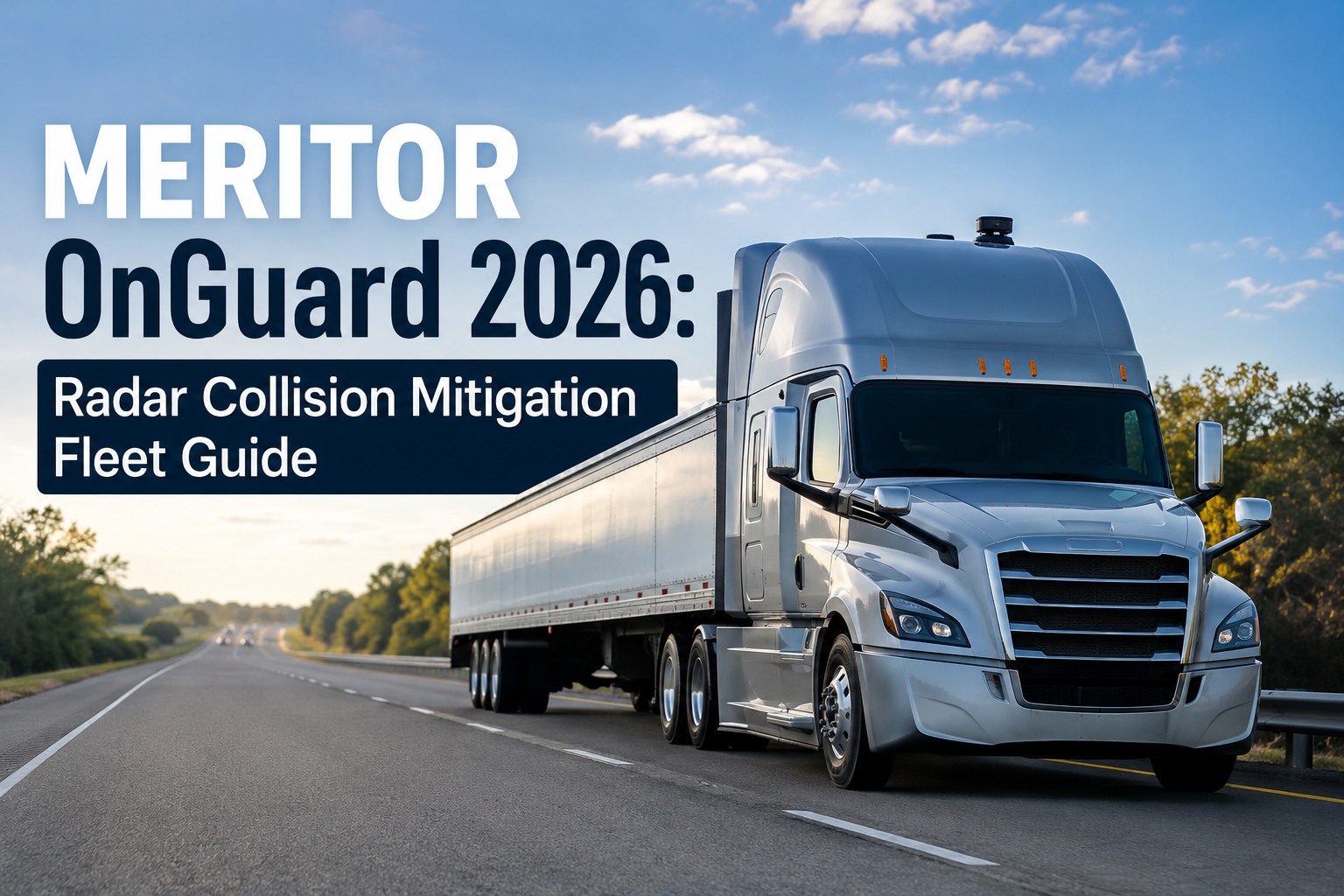
Meritor OnGuard is a radar-only collision mitigation system: single 77 GHz forward radar at the front bumper, feeding Adaptive Cruise Control, Collision Warning, and up to full braking through Extended Brake Assist. Bendix Wingman Fusion adds a windshield camera that cross-checks radar targets and enables speed sign recognition and lane departure warning. Neither is universally better. The right choice depends on duty cycle, weather, retrofit vs new spec, and calibration workflow — book a demo to manage ADAS inspections and safety records in HVI.
OnGuard vs Wingman Fusion — The Sensor Coverage That Determines Which Fits Your Fleet
Same job. Two different sensor stacks. Different detection zones. Different weather performance. Different calibration story. Different fit for different duty cycles.
Heavy trucks hitting stopped vehicles account for 20% of rear-end accidents and 30% of truck-involved fatalities. Both systems address this. The architecture difference matters most on heavy-weather duty cycles (radar wins), retrofit scenarios (radar simpler), and speed-limit-critical operations (camera wins).
The rest of this page walks the specific OnGuard feature stack (CWS + ACC + CMS + Extended Brake Assist), the radar alignment and blockage failure modes that quietly degrade collision mitigation, the ADAS calibration workflow after windshield/bumper/sensor work ($400-$1,200 per event), retrofit-vs-new-spec considerations, and how to run inspection records that catch calibration-required conditions before they become claims exposure. Book a 30-minute demo to see per-unit ADAS inspection tracking in HVI.
OnGuard feature stack — CWS, ACC, CMS, Extended Brake Assist
Meritor OnGuard (ZF-owned since the 2022 ZF-Wabco integration, still marketed as OnGuard and OnGuardMAX in North American aftermarket) is not a single feature. It's four interlocking functions running off the same 77 GHz forward radar, each triggered at different threat thresholds. Understanding the layered response is what separates a spec-and-forget install from a maintenance program that keeps the system delivering the collision reduction it was designed for.
| Function | Trigger threshold | System response |
|---|---|---|
| Collision Warning System (CWS) | Time-to-collision below driver-alert threshold with vehicle ahead | Audible + visual warning in cab; no automatic braking |
| Adaptive Cruise Control (ACC) | Cruise engaged, vehicle ahead within following distance | Automatic throttle reduction and engine braking to maintain gap |
| Collision Mitigation System (CMS) | Time-to-collision below intervention threshold | Up to 50% braking force applied automatically |
| Extended Brake Assist (Active) | Imminent collision predicted, driver not responding | Full braking force applied automatically (OnGuard Active only) |
| Stationary Object Detection (Active) | Stationary vehicle or obstruction in forward lane path | Warning + CMS/Extended Brake Assist as threat closes |
The OnGuard Active update (available as software flash to any OnGuard hardware installed after January 2013) added stationary object detection and full braking — the two capabilities the original 2007-2012 OnGuard specifically lacked. Fleets running older OnGuard hardware should verify the Active flash has been applied; without it, the system treats stopped vehicles as radar clutter and produces no braking response. This distinction alone accounts for the majority of "OnGuard didn't work" complaints on older fleets that never received the software update. Book a demo to see per-unit ADAS software version tracking in HVI.
Radar alignment, blockage, and calibration — the quiet failure modes
OnGuard's collision mitigation depends entirely on the forward radar delivering accurate range and closing-speed data. Anything that disrupts the radar's clear forward path degrades or disables the system — usually silently. The four most common failure modes rarely show up as active fault codes but produce noticeably worse system behavior. Structured inspection catches them; ad-hoc "looks fine" checks miss them.
Radar misalignment
Bumper impact, curb strike, or worn mounting bracket rotates the radar off its calibrated axis. System still functions but returns targets at slightly wrong bearings. Adaptive cruise becomes jumpy; false warnings increase; genuine threats detected late. Requires ADAS calibration to restore.
Radar face blockage
Mud, road spray, ice buildup, insect residue, or aftermarket bumper accessories on the radar face attenuate the signal. Detection range drops sharply; system may declare itself unavailable via dash icon. Daily walkaround should include radar-face wipe. Winter fleets need heated radar cover or frequent manual clearing.
Wiring harness degradation
Front bumper wiring subjected to road vibration, salt exposure, and disconnect/reconnect during service. Intermittent connectivity produces intermittent system faults that clear before diagnostic scan. Requires pin-level continuity check with truck-specific ADAS tool (Jaltest, TEXA).
Post-service recalibration missed
Any bumper repair, radar removal/reinstall, front-end alignment, or windshield work triggers required recalibration. Skipping the calibration leaves the system with drift errors that accumulate. Recalibration costs $400-$800 per single system; industry downtime cost $448-$760 per truck per day.
The pattern most fleets miss: OnGuard degrades gracefully. The system rarely fails outright — it just gets worse, with more false warnings and later actual detections, until drivers stop trusting the alerts and disable or ignore the system. Structured pre-trip inspection with radar-face and mount check plus post-service calibration discipline keeps the system delivering the collision reduction it was designed for. Ad-hoc inspection fails silently over 6-18 months. Book a demo to see ADAS inspection checklists per unit in HVI including calibration event tracking.
OnGuard vs Wingman Fusion — when each fits better
Both systems produce measurable collision reduction. Both are OEM-installable on major Class 8 chassis (International, Freightliner, Mack, Volvo, Kenworth, Peterbilt all offer factory options). The question is not which is universally better but which fits your fleet's specific duty cycle, weather exposure, and calibration workflow. Four decision criteria matter most.
Weather & duty cycle
- Heavy fog / snow / dust routes: radar-only edge (OnGuard)
- Mixed highway with clear conditions: either works
- Camera-dependent features degrade in adverse weather (Wingman)
- Radar less affected but not immune (both)
Speed-critical operations
- Urban / speed-limit-varying routes: Wingman camera wins
- Speed sign recognition with configurable alerts
- Overspeed intervention (dethrottle at 10 MPH over)
- Long-haul steady speeds: less differentiation
Retrofit vs new spec
- OnGuard simpler retrofit (single sensor)
- Wingman requires windshield camera + bumper radar
- Both need OEM ECU/wiring capability check
- New spec typically factory-integrated either brand
Calibration & service network
- Wingman factory-calibrated, less field recalibration
- OnGuard requires field alignment after impact/repair
- Jaltest & TEXA support both brands
- Dealer service network availability varies by region
The Bendix cross-check advantage (radar + camera confirming targets) reduces false positives, which drivers appreciate and helps sustain the "always on" driver trust that makes collision mitigation work at scale. The OnGuard weather-hardness advantage matters most on fleets running Northern winter routes, Gulf Coast fog corridors, or heavy dust duty cycles where camera-dependent features may go unreliable. Neither advantage is decisive across all fleets; both are decisive on specific fleet profiles. Start a free HVI trial to log ADAS inspection status and calibration history per unit regardless of vendor.
A fleet maintenance director on running mixed OnGuard and Wingman across 112 tractors
We run 112 Class 8 tractors, mostly Freightliner and International, mixed regional and long-haul across the Great Lakes and Northeast. Historic split: 68 units with Meritor OnGuard (OEM factory-installed), 44 units with Bendix Wingman Fusion (spec'd on the newer Internationals). Different systems on the same yard means we run both service workflows in parallel.
Real-world observations across 3 years of mixed operation: OnGuard has fewer false alerts on winter Northeast routes — salt spray and blowing snow don't confuse it the way the Wingman camera occasionally can. Wingman catches overspeed and speed-limit-change events OnGuard cannot — roughly 40% of our urban stop-and-go coaching events flag from Wingman's speed sign recognition. Neither has produced a demonstrable at-fault collision on units running the current software.
What matters more than the vendor difference is the inspection discipline. We added radar-face and camera-lens checks to daily walkaround roughly 18 months ago after finding two units with 60%-blocked radar faces (mud caked and unnoticed for weeks) that had degraded silently. Since then: zero radar-blockage findings escaping walkaround. Calibration events tracked per unit with the tech, tool used, and time on system. When an incident happens (thankfully rare) the audit trail is in one system regardless of which vendor's radar was on that truck. That's the piece most fleets skip — and the piece insurers ask about first when reviewing incident claims.
Frequently asked questions
What is Meritor OnGuard?
Meritor OnGuard is a radar-based collision mitigation system for Class 8 heavy trucks, originally developed by Meritor WABCO and now marketed by ZF Group following the 2022 ZF-Wabco integration. It uses a single forward-facing 77 GHz radar mounted at the front bumper to monitor vehicles and obstructions in the truck's forward path. The system delivers four interlocking functions: Collision Warning System (CWS) provides audible and visual alerts when time-to-collision falls below the warning threshold; Adaptive Cruise Control (ACC) automatically maintains a safe following distance by modulating throttle and engine braking when cruise is engaged; Collision Mitigation System (CMS) applies up to 50% braking force automatically when a collision becomes likely; Extended Brake Assist (available on OnGuard Active from 2015 forward) applies full service braking when an imminent collision is predicted and the driver has not responded. OnGuard has been available on major Class 8 chassis from International, Freightliner, Mack, and other OEMs since 2007, with the original version working only when cruise control was engaged and the 2013 always-on version becoming standard. The Active update added stationary object detection and full braking capability, and can be flashed as software update to OnGuard hardware installed since January 2013.
How does Meritor OnGuard differ from Bendix Wingman Fusion?
The core architectural difference is that OnGuard is radar-only while Bendix Wingman Fusion is radar-plus-camera. OnGuard uses a single 77 GHz forward radar at the front bumper to detect vehicles, stationary objects, and closing speeds. Wingman Fusion uses the same bumper radar plus a windshield-mounted camera whose data is cross-checked with the radar to reduce false alerts and to enable camera-only features. The practical differences: OnGuard performs better in adverse weather (fog, heavy snow, dust storms, smoke) because radar penetrates conditions that degrade camera vision, but lacks native speed sign recognition and requires a separate OnLaneALERT product for lane departure warning. Wingman Fusion adds speed sign recognition with configurable overspeed alerts (audible warning at 5 MPH over, engine dethrottle at 10 MPH over), integrated Lane Departure Warning, Highway Departure Braking (added in Gen 2, 2018), Multi-lane AEB, and the SafetyDirect fleet dashboard for event review. Wingman Fusion's dual-sensor cross-check reduces false positives (a target must appear on both radar and camera for high-confidence intervention). Neither is universally better. Fleets running heavy-weather duty cycles typically prefer OnGuard's radar-only reliability; fleets running urban and speed-limit-varying routes typically prefer Wingman Fusion's camera-based speed features.
Does Meritor OnGuard require calibration?
Yes, OnGuard requires ADAS calibration in any of four scenarios: after front bumper repair or replacement, after radar unit removal or replacement, after any windshield replacement (relevant to fleets combining OnGuard with OnLaneALERT camera-based lane departure), and after significant front-end alignment work that could shift radar mounting position. Calibration is typically performed with truck-specific ADAS diagnostic tools including Jaltest ADAS and TEXA ADAS with TRUCK IDC5 software, both of which natively support the SAE J1939 protocol through the Deutsch 9-pin connector used on commercial vehicles. Calibration uses truck-specific alignment targets positioned at documented distances from the sensor. Single-system calibrations typically run $400-$800 in the aftermarket; multi-system work (recalibrating both radar and camera on Wingman Fusion, for example) runs $600-$1,200. Downtime cost for the truck out of service during calibration averages $448-$760 per truck per day. Fleets should build calibration into every relevant maintenance workflow: any bumper repair should trigger scheduled recalibration, any windshield replacement should trigger camera recalibration, and post-collision service should include full ADAS calibration before returning the truck to service. Skipping calibration leaves accumulating drift errors that quietly degrade collision mitigation performance.
Can Meritor OnGuard be retrofitted to existing trucks?
Yes, in most cases, but retrofit feasibility depends on the specific chassis, model year, and existing ECU/wiring capability. OnGuard requires factory-provisioned wiring harness support and compatible braking system integration to deliver the CMS and Extended Brake Assist automatic braking functions. Most Class 8 tractors from International, Freightliner, Mack, Volvo, Kenworth, and Peterbilt from roughly model year 2010 forward have the underlying wiring provisioning to support OnGuard retrofit, though the retrofit typically requires a dealer or specialty ADAS shop with radar mounting expertise. Retrofit cost commonly runs $3,000-$6,000 per truck depending on the extent of wiring work and whether ancillary components (dash icons, brake system integration) require replacement. Fleets should verify three points before committing to retrofit: chassis compatibility with the specific OnGuard model, existing brake system compatibility with the intervention functions, and dealer/service network availability in the fleet's operating region for future calibration and repair. Retrofit generally makes economic sense on tractors with 3+ years of remaining service life; on shorter-remaining-life units the retrofit cost rarely pencils out against expected collision-reduction benefit. New spec is typically the better path when replacement tractors are within 12-18 months of expected order timing.
How much collision reduction does Meritor OnGuard actually deliver?
OnGuard and comparable radar-based collision mitigation systems consistently deliver 20-40% reduction in rear-end collision frequency on fleets with active coaching programs that leverage the alert data. The mechanism operates at two layers: prevention (the system warns or intervenes before collision, avoiding the incident entirely) and mitigation (the system reduces impact speed when collision cannot be prevented, reducing severity and repair cost). Industry data cited by Meritor and referenced by major OEMs indicates heavy trucks hitting stationary vehicles account for approximately 20% of rear-end accidents and 30% of truck-involved fatalities — the specific scenarios OnGuard Active is designed to address. Fleet-realized collision reduction varies with three factors. First, driver-behavior baseline: fleets with elevated preventable-collision frequency before install see the largest absolute reduction. Second, coaching workflow: fleets that review OnGuard warning-event data and coach drivers on the flagged behaviors sustain the safety gains; fleets that install and forget see initial gains erode. Third, system maintenance: fleets that maintain radar alignment, keep sensors clean, and complete post-service calibrations deliver full system performance; fleets that let calibration drift and blockage accumulate lose measurable percentage points of effectiveness. On well-maintained fleets with active coaching, the collision-reduction benefit is durable and produces measurable insurance premium and claims-cost savings.
Keep the system working. Prove it. Document every calibration and inspection.
HVI tracks per-unit ADAS inspection status, radar-face and camera-lens condition, calibration events with technician and tool captured, software version history, and coaching interactions when the collision mitigation system triggers. Works alongside OnGuard, Wingman Fusion, Detroit Assurance, and any other ADAS vendor. When the system prevents an incident, the audit trail is there for the insurer. Live in under two weeks. No hardware. No credit card.
Trusted by ADAS-equipped fleet safety programs across USA & Canada · Ready on day one