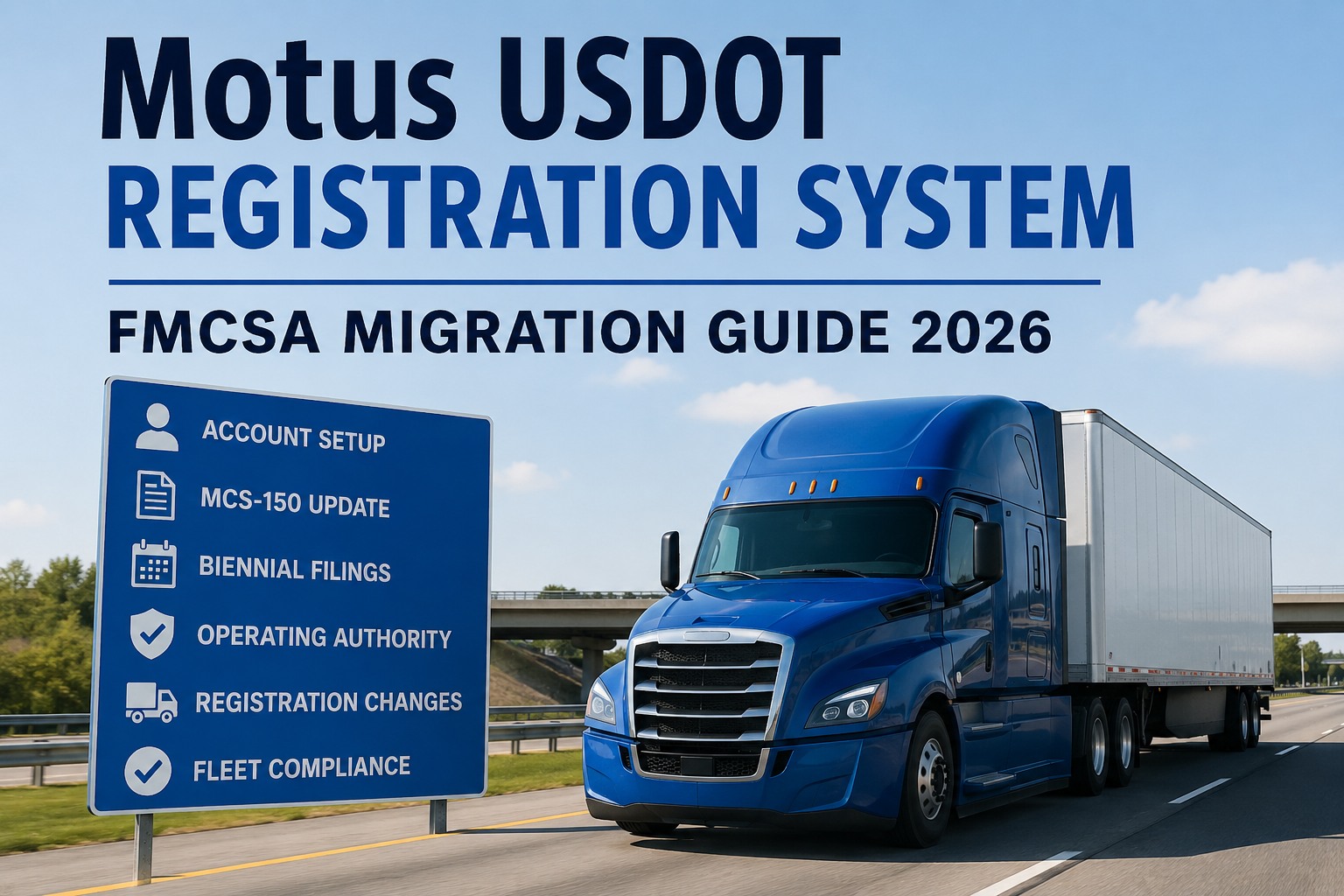
The Motus USDOT Registration System is FMCSA's replacement for the Unified Registration System (URS), the registration components of MCMIS, and the legacy Interstate Commerce Commission Licensing & Insurance system that dates to 1994. Three registration platforms collapse into one. FMCSA announced Motus availability in Federal Register notice FR-2026-08334 on April 29, 2026, with Phase I already live for supporting companies since December 8, 2025, and Phase II opening to all regulated entities during the second quarter of 2026. Every motor carrier, broker, freight forwarder, and owner-operator will encounter Motus the next time they file for a USDOT number, update MCS-150, change operating authority, or complete a biennial update. This is the complete FMCSA migration guide: what Motus is, what it replaces, what's changed for you, and the exact 5-step prep checklist to be ready. Book a demo to see FMCSA compliance tracking that stays current through platform transitions.
The Motus USDOT Registration System
Three legacy systems. One new front door. Here's what consolidates — and what stays exactly the same.
Motus
- Login.gov + IDEMIA identity verification
- Auto-population + real-time validation
- Mobile-ready workflows
- Fraud & chameleon-carrier controls
Motus does not change any underlying registration regulation. The MCS-150 biennial update is still required. The USDOT number identifies the same carrier. The operating authority (MC) number continues to exist. What changes is the front door: how you log in, how identity is verified, how transactions are structured, and which agency system holds the record of authority. For most established fleets, Motus is invisible until the next filing event forces contact with FMCSA. That first contact is when preparation pays off — or when it produces a friction week nobody scheduled.
The 4 numbers that define the Motus transition
Motus is not another feature announcement. It's the largest FMCSA registration overhaul in over a decade, tracing to the MAP-21 statute of 2012 that first mandated a unified registration system. Every carrier will interact with it.
- 3 systems Consolidating: URS + MCMIS registration + legacy ICC L&I into one platform
- Q2 2026 Phase II window — Motus becomes the default for all regulated entities
- Login.gov Multi-factor authentication now required — portal-only accounts sunset
- IDEMIA Biometric identity verification integrated to fight registration fraud
The IDEMIA identity verification is the one operational change most carriers underestimate. FMCSA is using the same identity-proofing service already deployed across federal agencies. A carrier whose registered contact is a former employee, whose principal place of business email is outdated, or whose Portal PIN went dead will hit verification friction the first time they touch Motus — and PIN reissue can go by regular mail. Book a demo to see FMCSA-adjacent compliance tracked continuously
The 3-phase rollout — where the system is now
FMCSA phased Motus intentionally: verify the platform with a small group first, expand to all regulated entities, then sunset the legacy systems. Where you are in this timeline determines what you need to do this week.
-
1
Phase I — Supporting companies onboarded
December 8, 2025 — completeLiveThe BOC-3 process agents, insurance and surety companies, and transportation service providers who file on behalf of carriers moved to Motus first. If your fleet uses a process agent for BOC-3 filings, that filing already routes through the process agent's Motus interface — even if your own registration still lives in URS.
-
2
Phase II — All regulated entities
Q2 2026 — rolling out nowLive NowMotor carriers, brokers, freight forwarders, and owner-operators are now filing through Motus for new USDOT applications, operating authority actions, and biennial updates. Existing registrations remain valid, but the next filing event routes through the new system.
-
3
URS sunset — date TBD
Post-Q2 2026 — separate FMCSA noticeUpcomingFMCSA will sunset URS for new applications once Phase II is stable across all entity types. The exact shutdown date will come in a subsequent Federal Register announcement. Carriers should plan to be fully in Motus by Q3 2026 to avoid any transition-window friction.
The transition is asymmetric. Supporting companies are already on Motus. New applicants have to start on Motus. Established carriers with nothing in flight are effectively still on URS until their next filing event triggers the migration. That gap is where the operational hazard sits — a biennial update coming due can force a Motus onboarding under time pressure. Start free and get MCS-150 biennial update reminders built into compliance tracking
What actually changes — and what stays the same
The federal register notice was explicit: Motus is an operational replacement, not a substantive regulatory change. Here's the practical split between what's new and what continues without modification.
- Login.gov account requiredSingle sign-on with multi-factor authentication
- IDEMIA identity verificationBiometric proofing at first login
- Portal Company Official designationNamed individual owns account authority
- Transaction-oriented flowsTask workflows replace form-based navigation
- Auto-population & real-time validationReduces data-entry errors before submit
- Mobile-ready interfaceFilings work on phone and tablet, not just desktop
- USDOT numbers & MC numbersExisting identifiers continue — no renumbering
- MCS-150 biennial update requirementSame form data, same cadence, new interface
- Operating authority requirementsOP-1, OP-2 flows preserved as workflows
- Registration record legal validityURS filings remain the record of authority
- Underlying regulations49 CFR Parts 385, 387, 390 unchanged
- Safety registration & MC/FF docketExcluded from initial Motus release
The stability of the right column is what makes the left-column change manageable. If Motus had also introduced new substantive requirements, the migration would be a compliance re-architecture. Because it doesn't, the migration is a systems onboarding — disruptive at the transaction level, invisible at the record level. Book a demo to see compliance records preserved across platform transitions
The 5-step Motus migration prep checklist
Run this before your next FMCSA filing event. Each step compounds — doing them out of order produces the friction week most carriers wanted to avoid. Estimated total time: 2 to 4 hours for a small fleet with clean paperwork; longer for enterprise fleets with multiple entities.
-
01
Confirm the FMCSA Portal account is active
Log into the current FMCSA Portal. Verify the account is active and the registered contact is a current employee. If the PIN is dead or the email bounces, request a new PIN — note that reissue can arrive by regular mail, not instant. This is the account Motus will migrate against, so a dead portal today produces a dead Motus onboarding tomorrow.
-
02
Identify your Portal Company Official
Motus requires a named Portal Company Official for each entity. Confirm the person on file is the right person for the Motus account. Update the designation now if the current contact is a former employee, has changed roles, or shouldn't be the point of authority. This is the individual who will claim the account in Motus.
-
03
Set up Login.gov credentials & complete identity verification
Motus authenticates through Login.gov and verifies identity through IDEMIA. Create the Login.gov account under the Portal Company Official's actual identity, complete the multi-factor authentication setup, and prepare the identity documents IDEMIA will request. Doing this before a filing event is far less stressful than doing it during one.
-
04
Validate current MCS-150 record data
Pull your current MCS-150 filing from the FMCSA record. Verify the principal place of business, mailing address, primary operational classification, cargo types, and vehicle counts. Anything stale here will be flagged by Motus's real-time validation on the next biennial update. Update early to avoid Motus surfacing gaps at the worst moment.
-
05
Complete a low-risk transaction first
Don't let a critical filing be your first Motus interaction. If possible, complete a routine action — a BOC-3 update, a contact change, or a non-time-sensitive filing — to work out the account setup, verify workflows work end-to-end, and identify any friction points before an important deadline forces urgency. Enterprise fleets with multiple authorities should validate credential access across affiliated entities early.
Carriers who ran this five-step prep in advance report Motus onboarding in a single 2-hour session. Carriers who skipped it and hit Motus for the first time on a biennial-update deadline routinely lose 2-3 business days to PIN reissues, IDEMIA verification friction, and email-of-record cleanup. Start free and get MCS-150 biennial reminders + audit-ready records from day one
From a compliance manager who migrated in June
Our biennial update was due in June and I figured we had time. Turns out our FMCSA Portal PIN had gone dead sometime in 2024 and nobody noticed because we hadn't filed anything since. Request a new PIN? Comes by regular mail. Add IDEMIA identity proofing on top of that and I lost three business days to system access before I could even open the MCS-150 workflow.
Second time around I ran the 5-step prep on our other authority before the deadline. Whole thing took 90 minutes. Same fleet, same filings, night-and-day difference. The prep isn't a nice-to-have — it's the whole difference between a smooth Motus filing and a scrambling one.
Frequently asked questions
What is the Motus USDOT Registration System?
Motus is FMCSA's new online registration system, announced in Federal Register notice FR-2026-08334 on April 29, 2026. The name derives from the Latin word for "movement" or "progress." Motus consolidates three legacy platforms: the Unified Registration System (URS) that was mandated by MAP-21 in 2012 and became the interface for USDOT and operating-authority applications, the registration components of the Motor Carrier Management Information System (MCMIS), and the legacy Interstate Commerce Commission Licensing and Insurance (L&I) system that dates to 1994. Motus is not a new regulatory requirement; it is an operational replacement for the front-end interfaces carriers, brokers, freight forwarders, and supporting companies use to interact with FMCSA registration. The system introduces Login.gov authentication with multi-factor verification, IDEMIA-based identity proofing, transaction-oriented workflows that replace the older form-based navigation, real-time data validation, and mobile-ready filing capability. Existing USDOT numbers, MC numbers, and registration records continue without modification — Motus is the new door, not a new record.
When does Motus replace URS for my carrier?
Motus rolled out in phases. Phase I launched December 8, 2025 for "supporting companies" — the BOC-3 process agents, insurance and surety companies, and transportation service providers that file on behalf of registered entities. If your fleet uses a process agent, your BOC-3 filings are already routing through their Motus interface. Phase II opened during the second quarter of 2026 to all regulated entities: motor carriers, brokers, freight forwarders, and owner-operators. The exact date URS will sunset for new applications has not yet been published in a Federal Register notice — FMCSA has said only that URS will be retired once Phase II is stable, which is expected in the third quarter of 2026 or later. In practice, most carriers will encounter Motus the next time they file for a new USDOT number, apply for operating authority, complete an MCS-150 biennial update, or update BOC-3 process-agent designations. Existing registrations remain valid throughout the transition — you don't need to refile anything currently on record. But your next filing event will route through Motus rather than URS, and the account setup and identity verification steps are prerequisites, not part of the filing itself.
Do I need to create a new account to use Motus?
Yes, in most cases. Motus authenticates users through Login.gov, which is the federal government's single sign-on service, and adds IDEMIA-based identity verification on top. If you already have a Login.gov account from another federal service, that account will work for Motus, but you'll still need to complete IDEMIA identity proofing specifically for Motus access. If you don't have a Login.gov account, you'll need to create one. The account must be tied to the Portal Company Official designated for your FMCSA registration — a named individual who owns account authority for the entity. FMCSA has indicated that account claiming in Motus uses the same email as the FMCSA Portal Login.gov email, so if the person on your Portal record is a former employee or the email has bounced, you should update it now rather than at the first Motus filing. Multi-factor authentication is required under federal cybersecurity policy. Enterprise fleets running multiple authorities across affiliated carriers should expect to validate credential access, authorization workflows, and inter-entity permissions early — the one-to-one mapping from URS to Motus is straightforward but the credential model may differ from what fleets are used to.
Does Motus change the MCS-150 biennial update requirement?
No. The MCS-150 biennial update requirement under 49 CFR §390.19 continues without modification. Every FMCSA-registered entity must file an MCS-150 update every 24 months based on the last two digits of its USDOT number, even when company information hasn't changed. What changes is the interface: instead of navigating the URS or FMCSA Portal MCS-150 workflow, filers will now complete the biennial update through the Motus transaction-oriented workflow. The underlying data collected is the same — principal place of business, mailing address, operational classification, cargo types, vehicle counts, driver counts — and the legal record of authority remains the FMCSA-held filing regardless of which front end submitted it. Two operational differences to plan for: first, Motus's real-time validation may flag data inconsistencies that URS silently accepted, so validate your current MCS-150 record proactively rather than discovering issues on deadline day. Second, the transaction-oriented workflow may not surface the MCS-150 form name explicitly — you may see "update carrier information" or a similar task label instead of an MCS-150 form reference. It's the same filing under the hood.
What happens to my USDOT number and MC number in Motus?
Both identifiers continue exactly as they are. Motus is a system replacement, not a renumbering. Your existing USDOT number remains your USDOT number in Motus, your MC number (if you have operating authority) remains your MC number, and all associated records — safety rating, CSA scores, inspection history, crash history, insurance filings — move with the identifier. The Federal Register notice was explicit that the initial Motus release does not include MC/FF docket number elimination, safety registration changes, or new registration substantive requirements. Some industry commentary has speculated about eventual consolidation of MC numbers into a USDOT-only identity model as part of longer-term FMCSA modernization, but no such change is currently effective or scheduled under Motus. The practical implication: brokers, shippers, insurers, and enforcement systems that rely on your USDOT and MC identifiers continue to see the same numbers. Your carrier profile, safety data, and operating history are preserved. What changes is who logs in, how identity is verified, and which interface holds the transaction — not who you are or what you're authorized to do on the road.
Compliance built to survive the next FMCSA platform — and the one after that
HVI tracks USDOT numbers, MCS-150 biennial cadence, operating authority, and audit-ready DQ files independently of the FMCSA front door. When URS becomes Motus becomes whatever's next, your compliance record stays intact and your filing reminders keep firing. Live on your fleet in under two weeks.
No credit card · No hardware · Compliance tracking ready day one