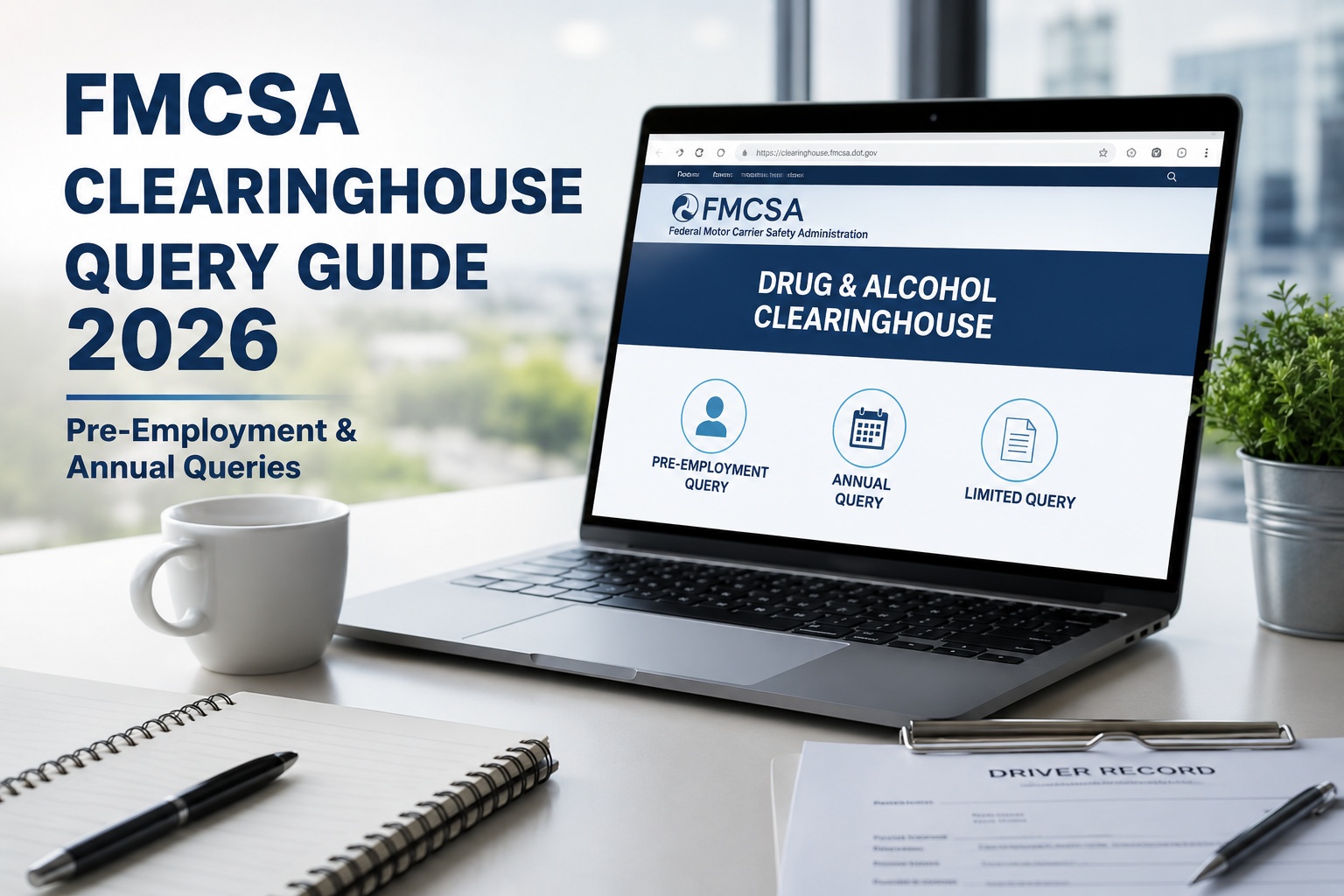
The FMCSA Clearinghouse query guide 2026 has one operational focus: which query type to run, when to run it, what consent is required, what the result actually returns, and what triggers the follow-up. Two query types cover the entire employer workflow — the Full query for pre-employment and the Limited query for annual monitoring — and getting either one wrong is where the $6,386 civil penalty per missed query starts. As of January 2026, over 200,000 CDL drivers sit in prohibited status; 1 in 30 registered Clearinghouse drivers is currently barred from safety-sensitive functions. Missing a single query on a driver whose status changed since your last check exposes both the driver and your operation to enforcement. This is the operational playbook: pre-employment and annual query workflows, cost and consent mechanics, the escalation trigger from limited to full, and the 5 most common mistakes that produce audit findings. Book a demo to see Clearinghouse queries scheduled automatically against driver-specific 12-month cadence.
The Clearinghouse Query Playbook
Two query types. Two operational workflows. One escalation trigger. Get the mechanics right and the compliance follows.
Full Query
- When
- Before first CMV operation
- Cost
- $1.25 per query
- Consent
- Electronic, inside Clearinghouse
- Returns
- Complete violation history
- Retention
- 3 years from query date
Limited Query
- When
- Every 12 months per driver
- Cost
- $1.25 per query
- Consent
- Written, outside Clearinghouse
- Returns
- Yes / No on record presence
- Retention
- 3 years from query date
Two query types is the whole system. Pre-employment gets the Full query — complete history, mandatory before first dispatch, electronic consent inside the Clearinghouse portal. Annual monitoring uses the Limited query — a yes/no check on record presence, general consent form retained by the employer, every 12 months per driver. If the annual Limited query returns "yes," a Full query fires on the same driver with no additional charge. That's the entire operational logic. Everything below is what goes wrong when carriers get any step of it out of order.
The 4 numbers that define query compliance stakes in 2026
The Clearinghouse database has grown consequential enough that four numbers control most of the practical risk picture for a compliance manager. These are the baseline everyone building a query workflow should know.
- 200,000+ CDL drivers in prohibited status as of January 2026 — 1 in 30 registered
- $6,386 2026 civil penalty per missed query — each driver, each cycle, separately
- 7,000+ Query-related violations cited by FMCSA in 2025 — the fastest-growing DQ category
- $1.25 Flat rate per query — whether limited, full, or limited-plus-full escalation
The 7,000+ 2025 violations is the number that reframes the compliance stakes. Every one of those violations was on a driver whose employer had a defensible operational workflow but missed a specific query on a specific date. The Clearinghouse doesn't care about intent, only cadence — every driver's next-query date is a hard boundary that automated tracking makes trivial and manual tracking makes fragile. Book a demo to see per-driver query dates tracked continuously
The 6-step pre-employment full query workflow
Run this sequence for every CDL driver before their first CMV dispatch. Skipping steps is not a shortcut — each step protects a specific compliance requirement, and the audit trail is what defends the operation later.
-
01
Confirm the query plan has capacity
Employers purchase query plans directly from the Clearinghouse portal; C/TPAs can conduct queries on the employer's behalf but cannot purchase plans. Log into the Clearinghouse account before initiating a new query and confirm the plan has an available balance. Running out mid-hire is an operational stall.
-
02
Ask the driver to register in the Clearinghouse
The driver must have an active Clearinghouse account before a full query can be run. If the driver isn't registered, they log into clearinghouse.fmcsa.dot.gov, complete Login.gov identity verification, and connect their CDL. Common blocker: applicants who assume the employer handles this step.
-
03
Initiate the full query in the portal
Log in as the employer and initiate a query on the specific driver. The system sends an electronic consent request directly to the driver's Clearinghouse account. Nothing happens on your side until the driver logs in and authorizes the query. Follow up if the driver hasn't consented within 24 hours.
-
04
Review the complete violation history returned
Full query results include: positive drug tests, alcohol tests with 0.04+ BAC, test refusals, actual knowledge citations, and return-to-duty status. Any unresolved violation puts the driver in "prohibited" status. Do not dispatch until the report is confirmed clear or RTD is complete.
-
05
Download the query receipt immediately
The receipt is the compliance record. Save the PDF to the driver qualification file the moment it's generated. This is what auditors ask for — the report itself, dated, showing the query occurred. Regenerating a lost receipt is possible but slow, and the audit finding is measured at the moment of request.
-
06
Set the driver's next-query date — 12 months out
The moment the pre-employment full query completes, the driver's annual monitoring clock starts. Set a next-query calendar reminder for exactly 12 months from the query date. This single scheduling step is what separates fleets that never miss an annual query from those that produce audit findings.
The full 6-step workflow, run once per new hire, is the foundation the entire annual monitoring cycle is built on. Step 6 — setting the next-query date — is the operational hinge between hiring compliance and ongoing compliance. Miss that step and the annual query cadence goes untracked. Start free and get the 12-month next-query date auto-set on driver hire
The annual limited query cadence — rolling, not calendar
The annual query requirement runs on a per-driver rolling 12-month basis under 49 CFR 382.701(b). This is the single most misunderstood mechanic in the Clearinghouse system, and the source of a meaningful share of the 7,000+ 2025 query violations.
The January batch
Many carriers historically ran all annual queries in a single January batch for administrative simplicity. This is compliant on paper — the regulation says "at least annually" — but it creates concentrated exposure. If a driver's status changed in July and the next January query catches it 6 months late, the intervening 6 months of operation potentially involved a driver whose Clearinghouse status the carrier should have flagged.
Per-driver rolling 12 months
The stronger compliance posture is a per-driver 12-month cadence: set each driver's next-query date at exactly 12 months from their last query. This detects status changes faster and matches the CFR wording more precisely. FMCSA compliance reviewers checking query records look for the gap between queries per driver, not calendar-year batching.
Consent for the limited query lives outside the Clearinghouse: the employer obtains general written consent (a signed form) from the driver, retains it in the DQ file, and can then run limited queries against that driver's record without new consent for each query. That consent stays valid as long as the driver is employed. If the limited query returns a "yes" record-present result, the employer must immediately run a full query — and the full query does require driver's specific electronic consent inside the Clearinghouse. The paired query counts as one billing event ($1.25 total) since the escalation happens on the same driver in the same session. Book a demo to see per-driver 12-month cadence tracked automatically
The 5 most common query mistakes that produce audit findings
Every one of these mistakes shows up in the FMCSA violation data for query-related citations. Each is preventable at the workflow-design level — the fleets producing clean audit records systematically eliminate all five.
Any one of these five mistakes multiplied across a driver roster produces the exposure that turned into $6,386 penalties in 2025. All five are preventable with a workflow-first approach that assigns each mistake to a specific automated control — not a spreadsheet, not a memory prompt, not a manual calendar. Start free and get all 5 mistakes systematically prevented
From a safety director who audited her own query records
We ran all our annual queries in a January batch for years. Never had a violation, never had a complaint. Then a driver hit us with an accident in September, and during the post-crash investigation FMCSA pulled our query records. Our audit finding: the driver's last query was 14 months prior. Not our fault operationally; that's just how our January batch cycle worked.
Penalty: $6,386. Not for the accident, not for the driver's record. For the 60-day query gap. That was the moment we moved to per-driver rolling 12-month cadence. Every driver has an anniversary date now, and the system flags 60 days out. We haven't missed a query since, and honestly the workflow is easier than the January batch ever was.
Frequently asked questions
What is the difference between a Full query and a Limited query?
The two query types serve different operational purposes and have different mechanics. A Full query returns the complete drug and alcohol violation history for a CDL driver: positive drug test results, alcohol tests with 0.04+ BAC, test refusals, actual knowledge violations, and return-to-duty status details. Full queries require the driver's specific electronic consent obtained inside the Clearinghouse — the driver must log into their own Clearinghouse account and authorize each specific full query. Full queries are mandatory for pre-employment screening before any new CDL driver operates a CMV, and are triggered as follow-up when a Limited query indicates a record is present. A Limited query returns only a yes-or-no indication of whether the driver has any record in the Clearinghouse; it does not disclose details. Limited queries require general written consent from the driver (a signed form) obtained outside the Clearinghouse and retained by the employer for the duration of employment. Limited queries satisfy the annual employer query requirement under 49 CFR §382.701(b). Both query types cost $1.25 flat rate. If a Limited query returns a "record present" result and the employer follows up with a Full query on the same driver, only one $1.25 charge applies to the paired transaction.
When is the annual Clearinghouse query due for each driver?
The annual query requirement runs on a rolling 12-month basis per driver under 49 CFR §382.701(b). A driver's next annual query is due no later than 12 months from the date of their most recent query — whether that was the pre-employment Full query at hire or the previous year's annual Limited query. This is the compliance-first interpretation of the CFR text and the standard FMCSA compliance reviewers apply when auditing query records. Some carriers historically ran all annual queries in a single January batch for administrative simplicity, which is compliant on paper for drivers hired mid-year but creates concentrated exposure and can produce audit findings when a driver's 12-month anniversary falls earlier in the year and the batch cycle catches it late. A driver hired March 15 with an initial pre-employment Full query needs their next Limited query by March 15 of the following year. The stronger operational posture is per-driver rolling anniversary tracking with automated 60/30/7-day advance alerts. If a driver leaves and returns to safety-sensitive functions after a break of any length, the cycle effectively resets — a new pre-employment Full query is required before the driver operates a CMV again, and the annual clock restarts from that date.
Do I need driver consent for every Clearinghouse query?
Yes, in both cases, but the consent mechanics differ significantly. For Full queries — which include pre-employment screening and any Limited-to-Full escalation — the driver must provide specific electronic consent inside the Clearinghouse system. The employer initiates the Full query in the portal, which sends a consent request directly to the driver's Clearinghouse account, and the query does not proceed until the driver logs in and authorizes it. This applies per query, not per employment period. A common workflow bottleneck: applicants who haven't yet registered in the Clearinghouse cannot receive the consent request, which stalls the pre-employment process. For Limited queries — which cover the annual monitoring requirement — the employer must obtain general written consent from the driver on a signed form (paper or electronic) that is retained by the employer in the driver qualification file. This general consent remains valid for the duration of employment and covers all future Limited queries on that driver without requiring re-consent for each one. FMCSA provides a sample consent form on the Clearinghouse portal but does not require employers to use that specific format — carriers may use or adapt the content. Losing the general consent form or failing to obtain it before running annual queries is a common audit finding even when the queries themselves are conducted on schedule.
What happens if a query returns a positive result?
The response path depends on which query type produced the positive and what the result contains. If a Limited annual query returns "record present," the employer must immediately follow up with a Full query on the same driver — the Limited-to-Full paired transaction is billed only once at $1.25, so cost is not the barrier. The Full query then discloses the specific violation details. If the Full query reveals an unresolved violation, the driver is in "prohibited" status and cannot perform any safety-sensitive functions, including operating a CMV, until the return-to-duty (RTD) process is complete. RTD requires evaluation by a DOT-qualified Substance Abuse Professional (SAP), completion of any recommended treatment, a return-to-duty test with a verified negative result (under direct observation for drug tests), and a minimum of 6 unannounced follow-up tests in the first 12 months following return to duty. The SAP may require additional follow-up testing for up to 60 months. Under Clearinghouse II changes now in effect, state DMVs automatically query the Clearinghouse before issuing or renewing CDLs, so a driver in prohibited status will also see their CDL downgraded to a standard license within 60 days of state notification. The employer's obligation begins the moment the positive is confirmed: the driver must be removed from all safety-sensitive functions immediately, regardless of RTD progress.
How long must Clearinghouse query records be retained?
Under 49 CFR §382.719, employers must retain all Clearinghouse query records for a minimum of 3 years from the date of the query. This applies to every query — Limited, Full, positive result, negative result, escalated Limited-to-Full pair — no exceptions. The retention record is the query receipt: the Clearinghouse generates a downloadable PDF receipt for every completed query, and that receipt is the compliance artifact FMCSA compliance reviewers request during audits. The query having occurred is not sufficient; the receipt must be produced. A common audit failure pattern: the employer ran the query on time but never downloaded and filed the receipt, and by the time the audit request comes six months or a year later, retrieving the receipt from the portal has become an operational fire drill. The retention obligation applies whether the driver is currently employed or has separated — for drivers who leave employment, query records must still be retained for 3 years from the query date, in addition to the standard 3-year post-termination DQ file retention. Drug and alcohol test results themselves have separate, longer retention requirements under 49 CFR §382.401 (5 years for positive results and refusals; 1 year for negatives). The query receipt is the Clearinghouse-specific artifact that ties the driver's file to the compliance requirement.
Turn the query workflow into a background process
HVI tracks per-driver Clearinghouse query dates on rolling 12-month cadence, stores signed general consent forms in the DQ file, alerts at 60/30/7 days before the annual query is due, files query receipts automatically, and generates the audit export FMCSA reviewers request. Live on your fleet in under two weeks — and every query stays on schedule without any manual tracking.
No credit card · No hardware · Query tracking live day one