If you operate commercial vehicles or manage CDL drivers, the FMCSA Drug & Alcohol Clearinghouse is not optional—it is a federal requirement that directly affects every hiring decision, every annual compliance check, and every driver's ability to hold a CDL. Since its launch in January 2020, the Clearinghouse has recorded over 304,000 drug and alcohol violations, and as of early 2026, more than 200,000 CDL holders are in prohibited status and cannot legally operate a commercial motor vehicle. With Clearinghouse II now fully enforced—including automatic CDL downgrades by state licensing agencies—the consequences of non-compliance have never been more severe. This guide covers everything fleet managers and heavy vehicle operators need to know: registration, query requirements, violation types, the return-to-duty process, 2026 rule changes, and how to stay audit-ready. Sign up for HVI to digitize your fleet's DOT compliance, or book a demo to see how inspection-first compliance works.
FMCSA Drug & Alcohol Clearinghouse: What Every Fleet Must Know
The Clearinghouse is a secure, online database maintained by the Federal Motor Carrier Safety Administration that tracks all drug and alcohol program violations for CDL and CLP holders performing safety-sensitive functions. It gives employers, state licensing agencies, and FMCSA real-time access to violation records—closing the loophole that once allowed drivers with unresolved violations to move between carriers undetected.
Who Must Register & Comply
The Clearinghouse applies to every person and organization involved in operating or employing CDL drivers for safety-sensitive commercial motor vehicle functions. If you touch a CMV, you are in scope:
Must register, conduct pre-employment and annual queries, report violations, and remove prohibited drivers from safety-sensitive functions. This includes interstate and intrastate carriers of all sizes.
Must register to provide electronic consent for full queries. Violations are recorded against your Clearinghouse record. A prohibited status now triggers automatic CDL downgrade by your state DMV.
Subject to both employer and driver requirements. Must register individually, designate a C/TPA for random testing and violation reporting, and query themselves annually by January 5 each year.
Medical Review Officers report positive test results and refusals. Substance Abuse Professionals report RTD evaluations and eligibility. C/TPAs manage testing programs and can report on behalf of employers.
Employer Query Requirements
Clearinghouse queries are mandatory at two critical points—and failure to conduct them is one of the most common FMCSA audit findings, accounting for over 7,000 violations in 2025 alone:
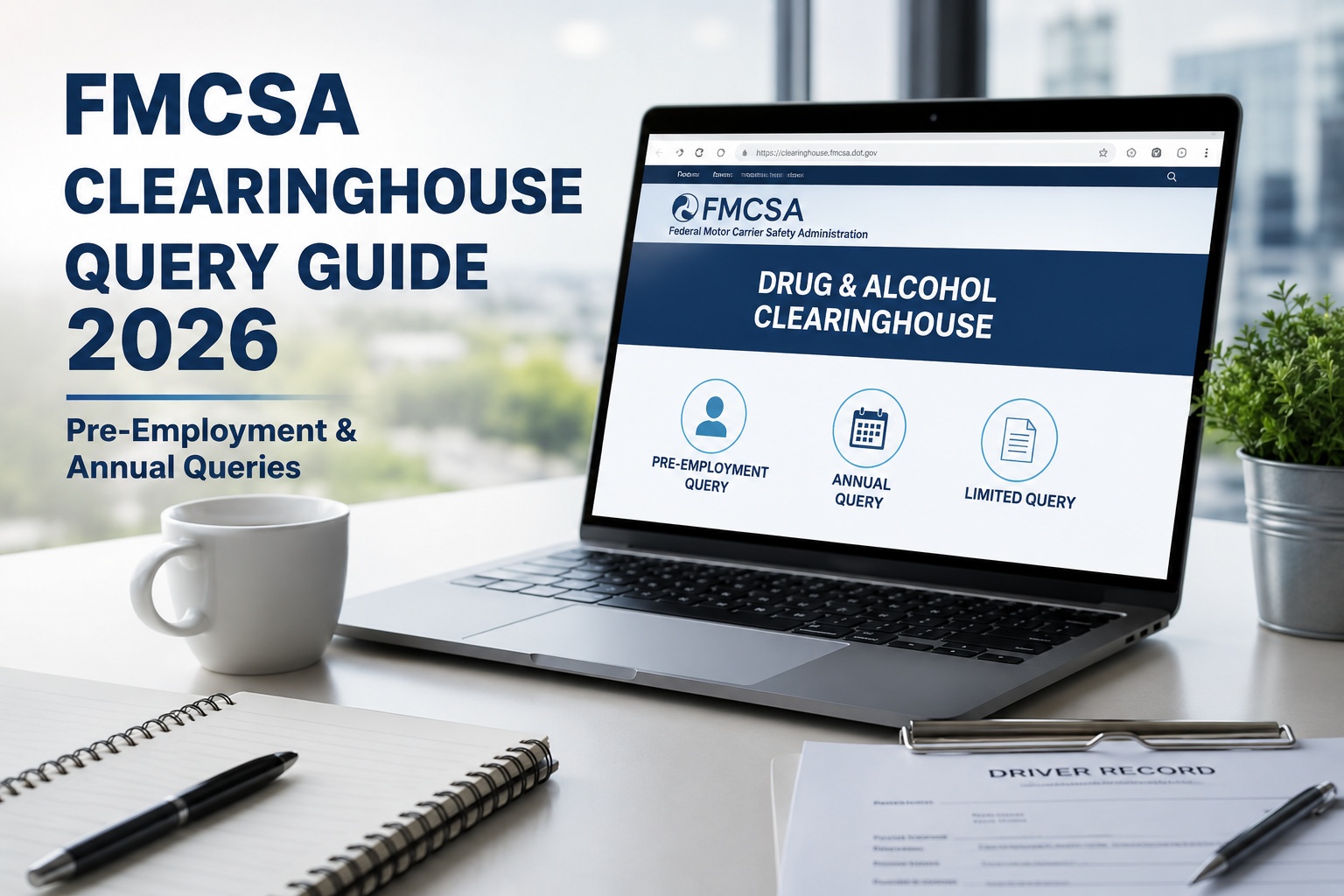
Before any CDL driver can operate a CMV for your fleet, you must conduct a full query of their Clearinghouse record. The driver must provide electronic consent within the Clearinghouse system. No driver may get behind the wheel until the query is completed and returns a "not prohibited" status. If a driver refuses to consent, they cannot perform safety-sensitive functions.
At least once every 12 months for every CDL driver you employ. Deadline is January 5 each year for the prior calendar year. You may start with a limited query (requires general written consent). If a record is found, you must immediately conduct a full query (requires driver's electronic consent) and take appropriate action based on results.
Managing Clearinghouse compliance alongside DVIRs, annual inspections, and maintenance records? Sign up for HVI to centralize your fleet's DOT compliance in one audit-ready platform.
What Violations Are Recorded
The Clearinghouse tracks six categories of drug and alcohol program violations under 49 CFR Parts 40 and 382. Any of these violations places a driver in "prohibited" status, meaning they cannot perform safety-sensitive functions until the return-to-duty process is fully completed:
Confirmed positive result for any DOT-prohibited substance. Marijuana accounts for approximately 60% of all positive drug tests—federal law prohibits CDL drivers from using marijuana regardless of state legalization.
Confirmed breath or blood alcohol concentration of 0.04 or greater while performing or about to perform safety-sensitive functions.
Failure to appear, tampering with a specimen, or inability to provide a sufficient sample without a legitimate medical explanation. Refusals are treated the same as positive results.
An employer determines through direct observation, witness statements, or other evidence that a driver used drugs or alcohol in violation of DOT regulations.
A negative RTD test is required before a driver can resume safety-sensitive functions. Failing this test creates an additional violation record.
Drivers returning to duty must complete a minimum of 6 unannounced follow-up tests in the first 12 months. Missing or failing any follow-up test is recorded as a new violation.
Return-to-Duty (RTD) Process
A violation does not end a driving career permanently—but the path back is structured, mandatory, and fully tracked in the Clearinghouse. Every step must be completed before a driver can regain "not prohibited" status:
The driver must be evaluated by a DOT-qualified Substance Abuse Professional (SAP) who determines the appropriate course of treatment or education.
The driver completes the prescribed treatment or education program as directed by the SAP. Duration varies based on the SAP's clinical assessment.
The SAP confirms the driver has completed all recommended treatment and is eligible for return-to-duty testing. The SAP reports eligibility to the Clearinghouse.
The driver must produce a verified negative drug and/or alcohol test result under direct observation before resuming any safety-sensitive functions.
Minimum 6 unannounced follow-up tests in the first 12 months. The SAP may require additional testing for up to 60 months. All results are reported to the Clearinghouse.
The RTD process adds complexity to your driver qualification management. Book a demo to see how HVI helps you track driver compliance status alongside vehicle inspections and maintenance records.
2026 Clearinghouse Changes You Need to Know
The Clearinghouse II final rule and ongoing FMCSA enforcement updates have introduced several critical changes that are now fully in effect for 2026:
State DMVs now query the Clearinghouse before issuing or renewing CDLs. Drivers with "prohibited" status have their CDL downgraded to a standard license. States must complete downgrades within 60 days of notification. This closes the loophole that allowed prohibited drivers to obtain CDLs in different states.
Employers must report positive test results, refusals, and SAP completions within 24 hours of occurrence. Labs and MROs must submit results within hours, not days. Late reporting is now a finable offense with stricter enforcement.
Previously, employers had to both query the Clearinghouse and contact previous employers for drug/alcohol records. The Clearinghouse now serves as the single source of truth, replacing the manual previous-employer inquiry process.
Civil penalties for Clearinghouse violations can reach up to $16,000 per occurrence. Clearinghouse-related violations account for 4 of the top 10 FMCSA audit findings. Penalties for operating a prohibited driver or missing queries have increased significantly.
How This Connects to Your Fleet Compliance
The Clearinghouse does not exist in isolation—it is one critical layer of a complete DOT compliance program that also includes DVIRs, annual vehicle inspections, driver qualification files, ELD/HOS management, and preventive maintenance documentation. The fleets that handle all of these requirements most effectively are the ones that centralize everything in one digital system rather than managing each obligation separately:
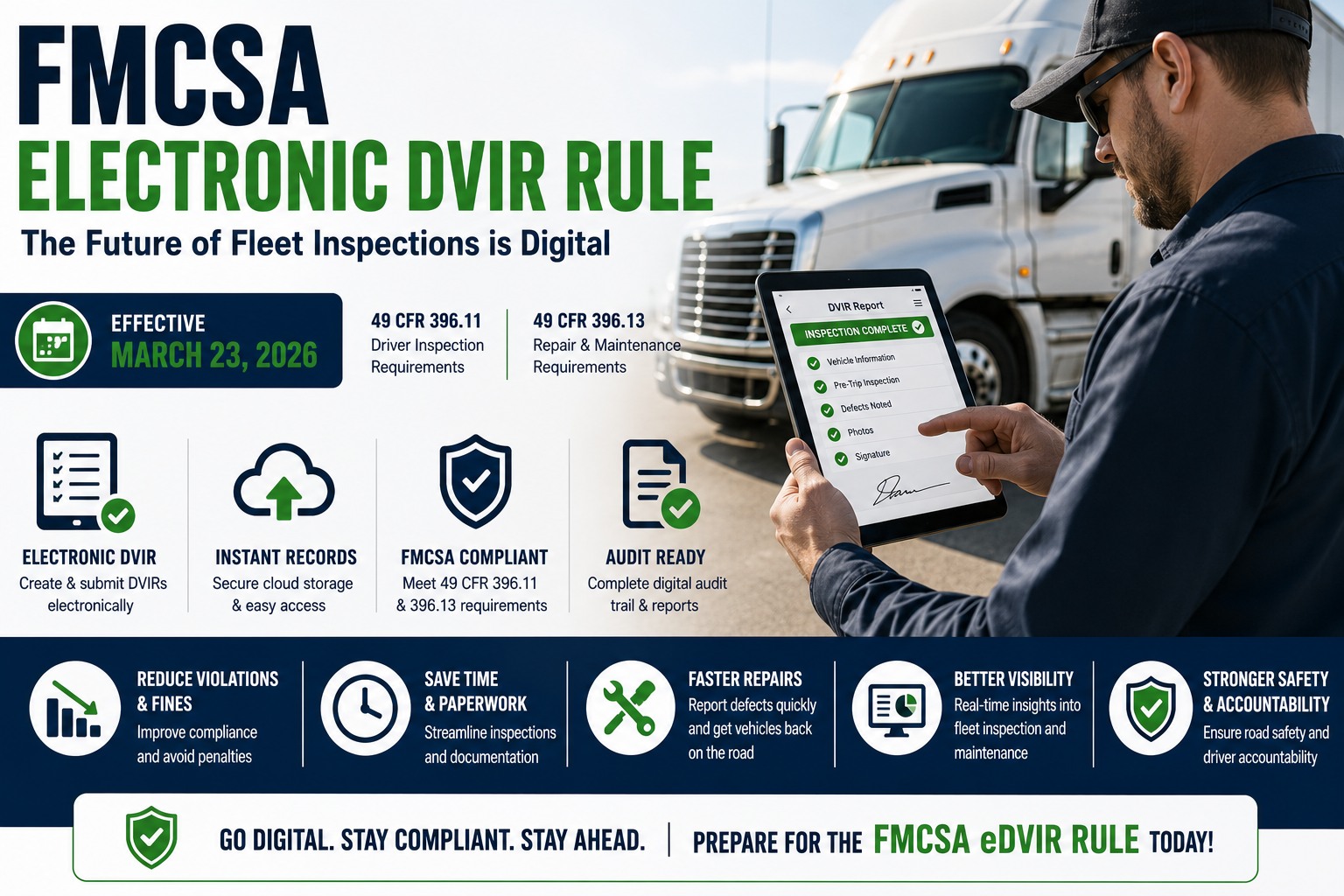
FMCSA-compliant pre-trip/post-trip inspections with photo verification, GPS timestamps, and automated defect-to-work-order workflows.
49 CFR 396.17 periodic inspections tracked with automated reminders, document retention, and audit-ready reporting.
Preventive maintenance schedules triggered by mileage, engine hours, or calendar intervals—keeping vehicles compliant and breakdowns prevented.
One-click compliance documentation covering inspection histories, maintenance records, and repair certifications—ready when the auditor arrives.
93% of carriers fail DOT audits with at least one violation. HVI helps you stay in the 7% that pass clean. Start your free trial—setup takes under 10 minutes, no hardware required.
Frequently Asked Questions
Clearinghouse Penalty Reference Table
Understanding the financial consequences of non-compliance is critical for fleet managers budgeting for risk. Below is a reference of key FMCSA penalty amounts updated for 2026 under the Federal Civil Penalties Inflation Adjustment Act:
| Violation Type | Who Is Penalized | Maximum Penalty (2026) | CFR Reference |
|---|---|---|---|
| DOT recordkeeping violation (per day) | Employer / Carrier | $1,584/day (up to $15,846 total) | 49 CFR Part 382/386 |
| CDL violation (general) | Driver / Employer | Up to $5,833 | 49 CFR Part 383 |
| Operating CMV with prohibited driver | Employer | $7,155 – $39,615 | 49 CFR 383.53 |
| Missing pre-employment Clearinghouse query | Employer | Up to $16,000 | 49 CFR 382.701 |
| Missing annual Clearinghouse query | Employer | Up to $16,000 | 49 CFR 382.701 |
| Failure to report violation to Clearinghouse | Employer / MRO / C/TPA | Up to $16,000 | 49 CFR 382.705 |
| Operating out-of-service vehicle | Employer | Up to $19,277 | 49 CFR 396.9 |
| Failure to cease operations as ordered | Carrier | Up to $27,813 | 49 CFR 386 App B |
| Financial responsibility violation | Carrier | Up to $17,213 | 49 CFR Part 387 |
| Violating OOS order (driver, 1st offense) | Driver | Minimum $3,961 | 49 CFR 383.53 |
Penalty amounts adjusted annually for inflation. In 2025, some carrier penalties exceeded $125,000 across multiple violations during a single investigation.
Clearinghouse by the Numbers
The scale of Clearinghouse enforcement continues to grow. These statistics paint a clear picture of why compliance cannot be treated as optional for any fleet operating CDL drivers:
Employer vs. Driver: Obligation Comparison
Both employers and drivers carry specific responsibilities under the Clearinghouse. Use this side-by-side reference to ensure nothing falls through the cracks:
| Obligation | Employer Responsibility | Driver Responsibility |
|---|---|---|
| Registration | Must register as employer (cannot outsource to C/TPA) | Must register to provide electronic consent for full queries |
| Pre-Employment | Conduct full query before driver operates any CMV | Provide electronic consent within the Clearinghouse system |
| Annual Query | Query every CDL driver at least once/year by January 5 | Provide consent if limited query reveals a record |
| Violation Reporting | Report actual knowledge violations and refusals within 24 hours | No direct reporting (reported by employer/MRO/SAP) |
| RTD Oversight | Must not allow safety-sensitive functions until RTD complete | Must complete SAP evaluation, treatment, RTD test, and follow-ups |
| Record Retention | Maintain query results and consent in driver qualification files | Maintain awareness of own Clearinghouse status |
| Random Testing | Ensure all CDL drivers in random pool (50% drug / 10% alcohol) | Submit to random tests when selected; refusal = violation |
Need help organizing driver compliance alongside vehicle inspections and maintenance records? Schedule a free consultation to see how HVI keeps your fleet's DOT obligations centralized and audit-ready.
Stay Compliant Across Every DOT Requirement
The Clearinghouse is just one piece of your DOT compliance puzzle. HVI handles the rest—digital DVIRs, automated work orders, annual inspection tracking, and audit-ready documentation for your entire heavy vehicle fleet. Don't let compliance gaps put your operation at risk.
No credit card required. No hardware needed. Operational in under 10 minutes.