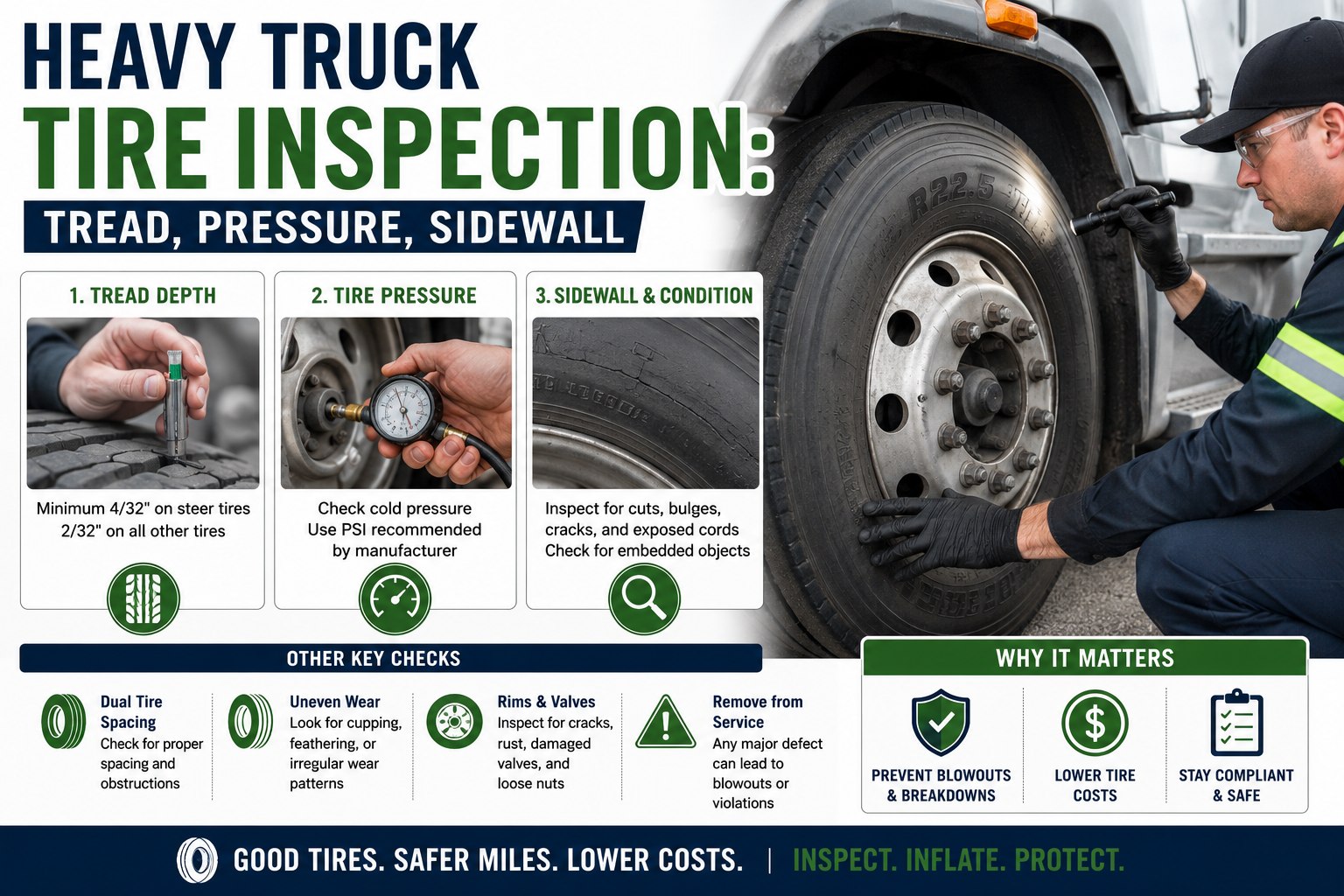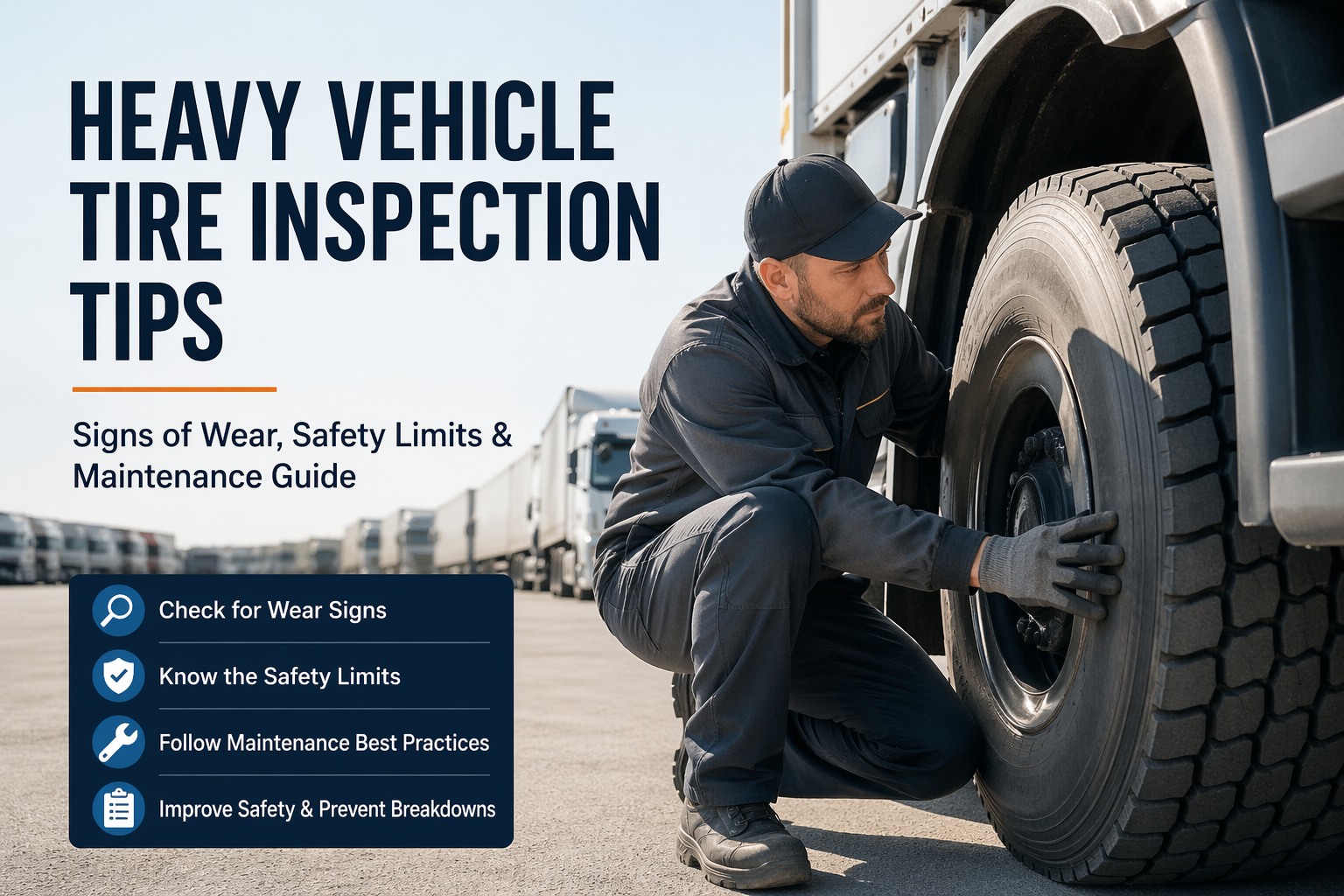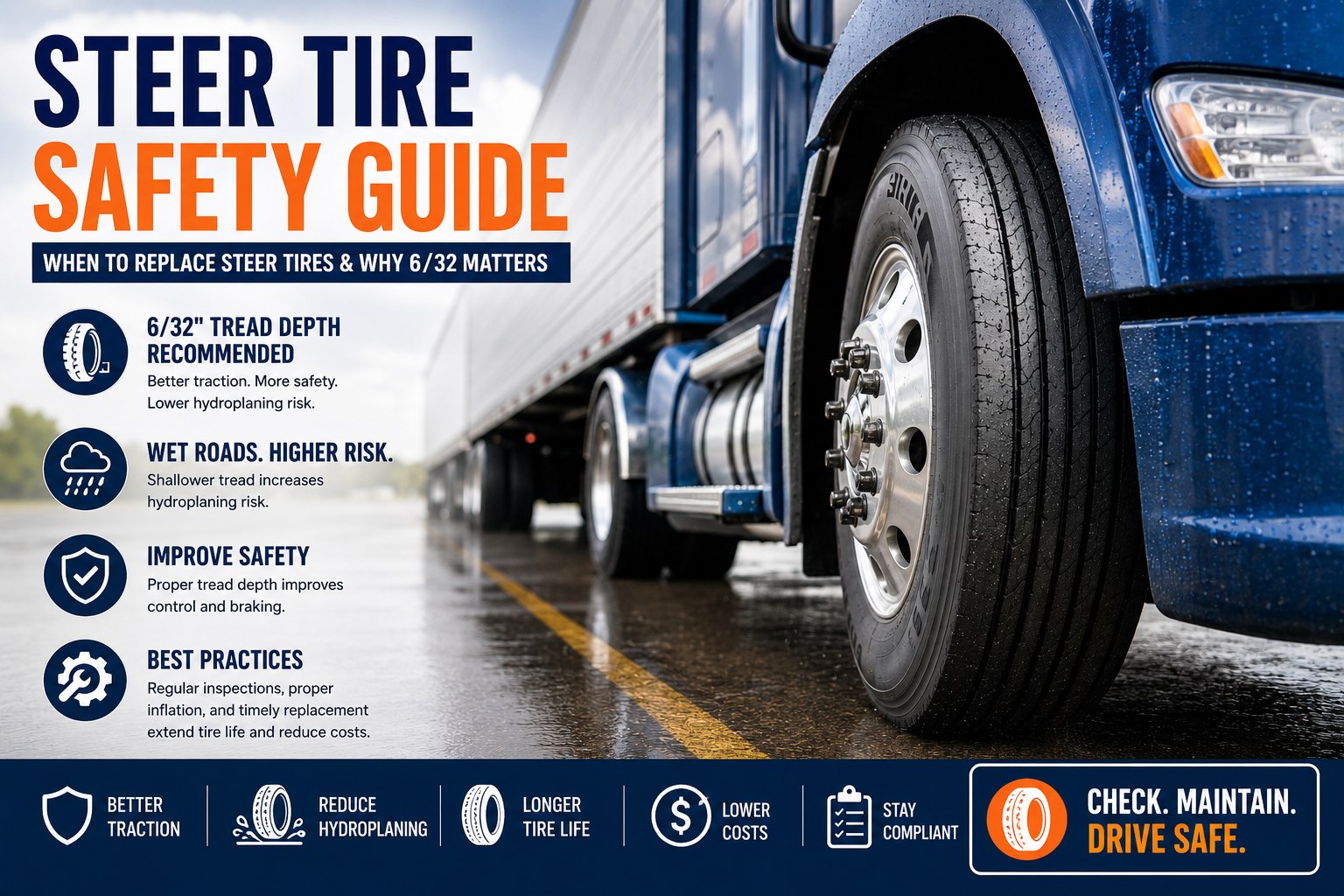
A steer tire doesn't give you a second chance. Drive and trailer tires fail and you've still got grip from the ones around them — a steer tire lets go at highway speed and you lose the one thing standing between the driver and the ditch: control. That's why the number that matters for steer tire safety isn't the legal minimum. The law says 4/32", but most well-run fleets pull steer tires at 6/32" — and that two-thirty-second gap is where wet-weather stopping distance and hydroplaning risk quietly climb. This guide covers when to replace steer tires, why 6/32" is the number experienced fleets watch, and how tread depth actually changes what happens in the rain. Book a 30-minute walkthrough to see steer tread tracked to the pull point automatically.
Steer Tire Safety: When to Replace & Why 6/32" Matters
The legal minimum for steer tires is 4/32" — but the smart replacement point is 6/32". Here's the gap between compliant and safe, what tread depth does to hydroplaning and stopping distance, and how to measure it right.
Front axle · Position 1 & 2
- Legal minimum
- 4/32"
- Fleet pull point
- 6/32"
- Measured in
- Every major groove
- Governs
- Shallowest reading
Replace before the legal floor
-
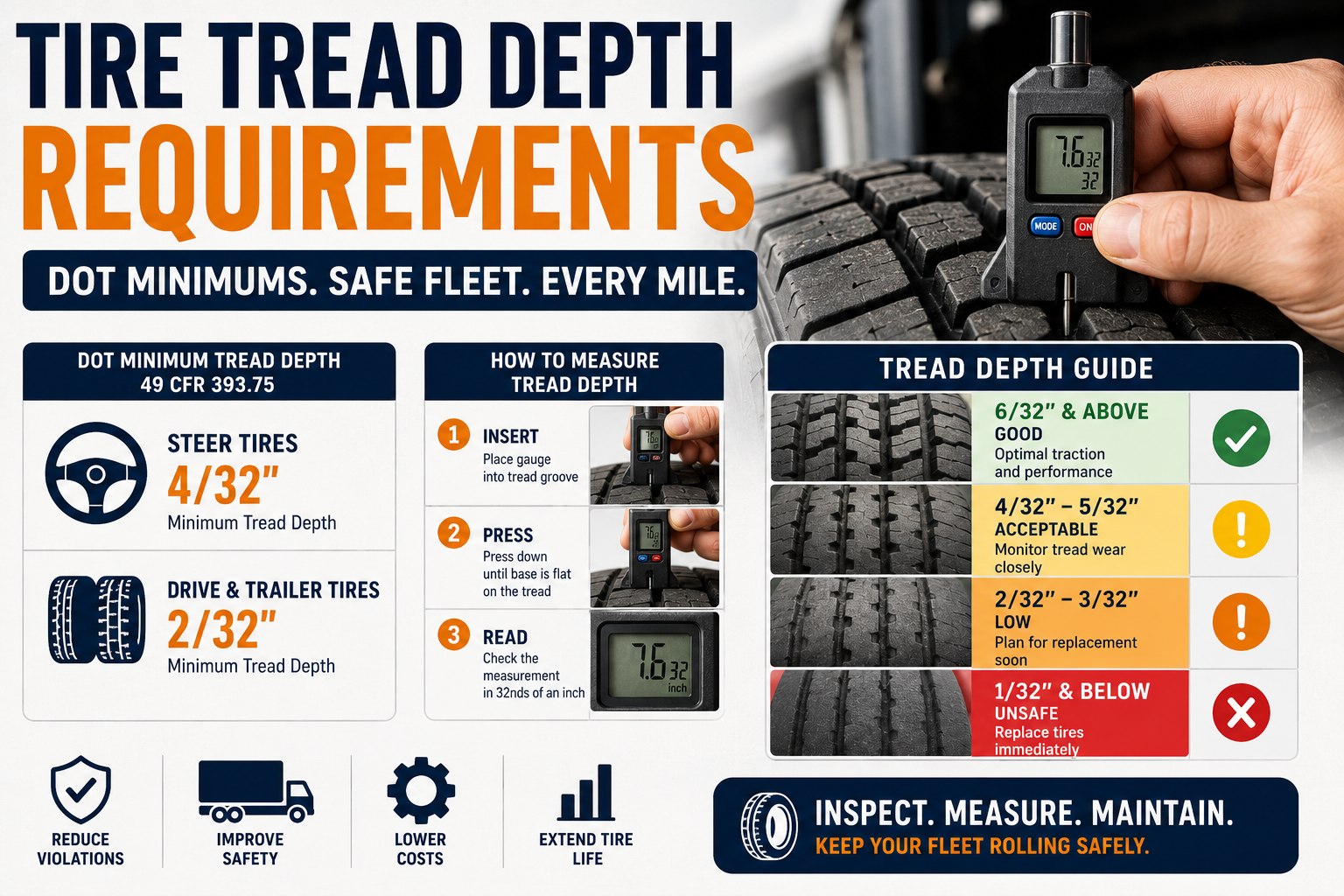
4/32"
FMCSA legal minimum for steer tires — double the 2/32" for other positions
49 CFR 393.75(b) -
6/32"
the replacement point most well-managed fleets use for steer tires
fleet best practice -
~87 ft
extra wet stopping distance at 4/32" vs. new tires at 60 mph — a 43% increase
AAA highway-speed testing -
~11,000
crashes a year involve worn tires — many preventable with tread tracking
industry crash data
The steer tire tread depth scale
Tread depth isn't a simple pass/fail — it's a slope. A steer tire moves through zones as it wears, and each one changes how the tire behaves in the wet. The gap between the 6/32" pull point and the 4/32" legal floor is exactly where a proactive fleet acts and a reactive one gets caught.
-
8/32"+
New / healthyFull water evacuation and wet grip. Nothing to do but keep measuring.
-
6/32"
Fleet pull pointThe smart replacement threshold. Schedule the swap now, during planned maintenance — not at the roadside.
-
4/32"
Legal minimumStill compliant, but wet stopping distance and hydroplaning risk are already climbing sharply. Replace immediately.
-
<4/32"
Out of serviceBelow the steer minimum. Roadside OOS, CSA points, and a truck that can't legally move until it's replaced.
The whole point of the 6/32" pull point is turning tire replacement into a scheduled event instead of an emergency. See how HVI flags steer tires approaching 6/32"
Why steer tires have a stricter limit
The FMCSA sets the steer minimum at 4/32" — double the 2/32" allowed everywhere else — and it's not arbitrary. The difference comes down to redundancy. Under 49 CFR 393.75(b), any tire on the front wheels of a truck or tractor must have at least 4/32" in every major groove, because the steer axle has none of the backup the other positions do.
Two tires carry the entire job of directional control and take the brunt of braking. There's no redundancy — if a steer tire loses grip or blows, the driver instantly loses steering authority at speed. That's why the limit is higher and the pull point higher still.
Power and load are spread across eight or more tires. If one wears or fails, the others share the work, so the position tolerates a lower minimum — though many fleets still pull these at 4/32" to avoid roadside failures and CSA points.
An out-of-service steer tire — below minimum, flat, or with exposed cord — sidelines the truck on the spot and adds CSA points. The 6/32" buffer exists precisely so a steer tire never gets close to that line in service. Track tread by position across your fleet
How tread depth drives hydroplaning and stopping
Tread grooves have one job in the rain: evacuate water from under the tire so rubber stays on road. As the grooves get shallower, that water-channeling capacity drops — and below 4/32" it drops sharply. That's the physics behind every wet-weather steer tire warning.
-
New tire (8/32"+)
Baseline
-
Pull point (6/32")
Noticeably longer
-
Legal min (4/32")
+87 ft at 60 mph
AAA highway-speed testing found 4/32" tires needed roughly 87 extra feet to stop on wet pavement versus new — a 43% increase, and that's before reaching the legal floor.
The dangerous part is that hydroplaning most often bites in light rain, when the road looks merely damp and drivers don't slow down. On a steer tire, a moment of lost water evacuation is a moment of lost steering. Book a demo to see wet-weather tread alerts in action
How to measure steer tread the right way
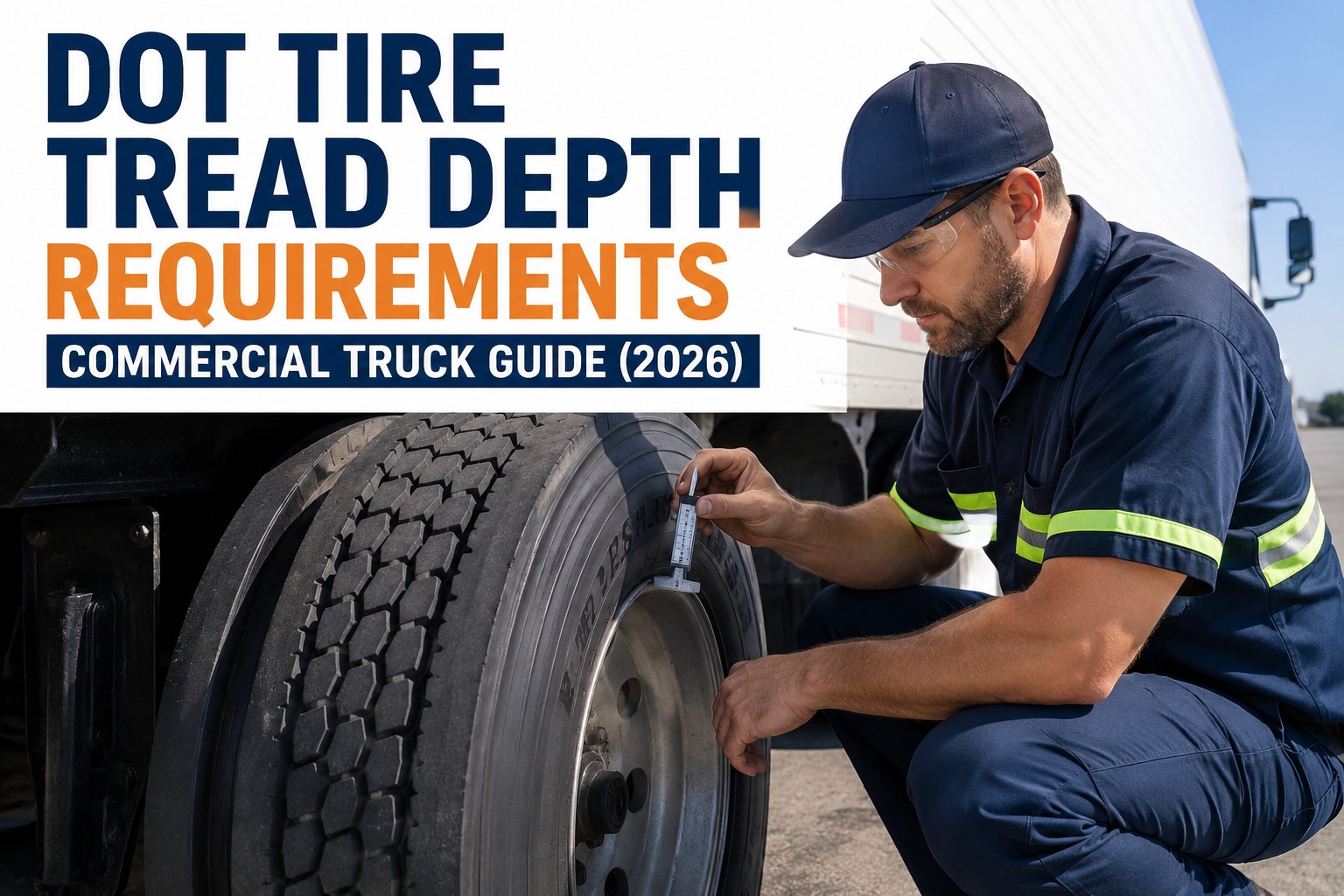
A steer tire can read fine in one groove and be below limit in another, so how you measure matters as much as when. Eyeballing it or thumping it with a bar tells you nothing reliable — use a gauge, and check the whole tire.
-
1
Use a tread depth gauge, not a coin or your eye
A gauge reads exact 32nds. A quarter marks 4/32" (Washington's head) and a penny 2/32" (Lincoln's), useful as a rough field check — but for a real replacement decision, read the number.
-
2
Measure every major groove
Check inner edge, center, and outer edge across the tire face. Steer tires wear unevenly from alignment and inflation, so one groove can be well below the others.
-
3
Check multiple points around the circumference
Rotate and re-check at several spots around the tire. Cupping and irregular wear mean a single reading can miss the shallowest point — which is the one that counts.
-
4
Record the lowest reading and log it
The shallowest groove determines compliance and the replace decision. Log every reading so you can trend wear per tire and see the 6/32" pull point coming weeks out.
That last step is the one paper misses. A single number scribbled on a form tells you today's depth; a logged history tells you when this tire hits 6/32" — before it does. Log tread readings per position with HVI
When to replace a steer tire beyond tread depth
Tread depth is the headline number, but it isn't the only reason to pull a steer tire. Several conditions warrant replacement even when the tread still reads above 6/32" — and some are immediate out-of-service items.
-
Exposed cord or belt material
Any ply or belt showing through the tread or sidewall is an automatic out-of-service condition, regardless of tread depth. The tire is failing from the inside out.
-
Uneven wear or cupping
Feathering, one-sided wear, or scalloped cupping signals alignment, inflation, or suspension problems. The tire won't wear evenly to 6/32" — and the root cause will eat the next one too.
-
Bulges, cuts, or sidewall damage
A bulge means internal structural failure and a blowout waiting to happen. Deep cuts and cracks compromise the casing — on a steer tire, that's a control-loss risk you don't run.
-
Age and a flat or audible leak
Rubber degrades with age even at good tread, and a flat or audible air leak is a top-cited OOS violation. Both mean the tire comes off before the truck rolls, tread depth aside.
The common thread: a steer tire earns replacement on any one of these, not just a low number. Catching them is what a real inspection — not a rushed glance — is for. Book a demo to see steer-tire defect capture with photos
Reactive vs. planned steer tire replacement
The 6/32" pull point only pays off if you can see it coming. That's the difference between a fleet that schedules tire work and one that discovers it on the shoulder.
Reactive fleet
- Finds worn steer tires at a roadside inspection
- Tread judged by eye or a thump, never measured
- No wear history, so the pull point is a surprise
- Runs steer tires to the 4/32" legal edge to save cost
- Emergency road-service call and OOS downtime
Planned fleet
- Steer tread measured and logged every inspection
- Wear trended per position, pull point predicted
- Alert fires as a steer tire nears 6/32"
- Replacement scheduled during planned maintenance
- No roadside OOS, no CSA points, no half-football-field stop
Replacing a steer tire two thirty-seconds early costs a little rubber. Replacing it after a roadside OOS or a wet-weather incident costs downtime, CSA points, and worse. Sign up free and put steer tires on a schedule
Expert view
Marcus K.
Tire & Maintenance Manager
Long-haul carrier
220 power units
Drivers ask why we pull steer tires at 6/32" when the law says 4/32". I tell them: the law is where you get a ticket, 6/32" is where the tire still steers in the rain. Those two thirty-seconds are the whole ballgame on the front axle.
Once we started logging steer tread every inspection instead of guessing, the pull point stopped being a surprise. We see it coming a month out and swap it on a Tuesday in the shop — not on the shoulder of I-80 in a thunderstorm. Cheapest insurance in the fleet.
— Marcus K., Tire & Maintenance Manager, long-haul carrier
Frequently asked questions
When should you replace steer tires?
The legal minimum tread depth for steer tires under FMCSA 49 CFR 393.75(b) is 4/32" in every major groove, but most well-managed fleets replace steer tires at 6/32" to build a safety buffer. The 6/32" pull point keeps the tire well clear of the legal floor, reduces hydroplaning and wet stopping risk, and lets replacement be scheduled during planned maintenance rather than triggered by a roadside failure. You should also replace a steer tire regardless of tread depth if it shows exposed cord or belt, a bulge, deep cuts or sidewall damage, severe uneven wear or cupping, or a flat or audible air leak — any of which can be an out-of-service condition or a blowout risk on the axle that controls the truck.
Why do many fleets use 6/32" for steer tires instead of 4/32"?
4/32" is the legal minimum, but tire performance degrades before a tire reaches that limit. Hydroplaning resistance and wet stopping distance both worsen noticeably as tread wears from 6/32" toward 4/32", because shallower grooves evacuate less water from under the tire. By setting the replacement point at 6/32", fleets keep steer tires in their safe performance range, avoid running to the legal edge where an inspection or a rainstorm can catch them out, and turn tire replacement into a scheduled maintenance event instead of an emergency. On the steer axle specifically — where there's no redundant tire to compensate for lost grip — that extra two thirty-seconds of buffer is a meaningful safety margin, not just conservatism.
What is the legal minimum tread depth for steer tires?
Under FMCSA 49 CFR 393.75(b), any tire on the front (steer) wheels of a truck, truck tractor, or bus must have a tread groove depth of at least 4/32" measured at any point in a major tread groove. That's double the 2/32" minimum required for drive and trailer tires, because steer tires are the vehicle's single point of directional control and take the primary braking load. Compliance is judged by the shallowest reading — if any major groove is below 4/32", the tire fails, even if the rest of the tire reads higher. A steer tire below the minimum, or one that's flat, leaking, or showing exposed cord, is an out-of-service condition that sidelines the truck and adds CSA points.
How does tread depth affect hydroplaning?
Tread grooves exist to channel water out from under the tire's contact patch so the rubber stays in contact with the road. The deeper the grooves, the more water they can evacuate. As tread wears down, that capacity drops — and research shows hydroplaning resistance declines sharply once tread falls below 4/32". Below that point, more water stays trapped under the tire, reducing grip and raising the chance the tire lifts off the road surface entirely. Hydroplaning most often happens in light rain, when roads look only damp and drivers don't slow down. On a steer tire, losing water evacuation means losing steering authority at the worst possible moment, which is exactly why the steer position carries a higher tread minimum and why fleets replace earlier.
How do you correctly measure steer tire tread depth?
Use a dedicated tread depth gauge rather than a coin or a visual guess — a gauge gives an exact reading in 32nds of an inch. Measure in every major groove across the tire face, checking the inner edge, center, and outer edge, because steer tires often wear unevenly from alignment or inflation issues. Then check several points around the tire's circumference, since cupping and irregular wear can hide the shallowest spot. The lowest reading you find is the one that determines both legal compliance and your replacement decision. Finally, record every reading. A logged history lets you trend wear per tire and see the 6/32" pull point coming weeks in advance, instead of finding a worn steer tire during a roadside inspection.
Never let a steer tire drift past its pull point again
HVI records steer tread depth per position on every inspection, trends the wear, and alerts you before a tire reaches your 6/32" pull point — with defect photos for cuts, bulges, and exposed cord. Turn steer tire replacement from a roadside emergency into a line on next week's maintenance schedule.
No credit card · No hardware · Live on your fleet in under two weeks