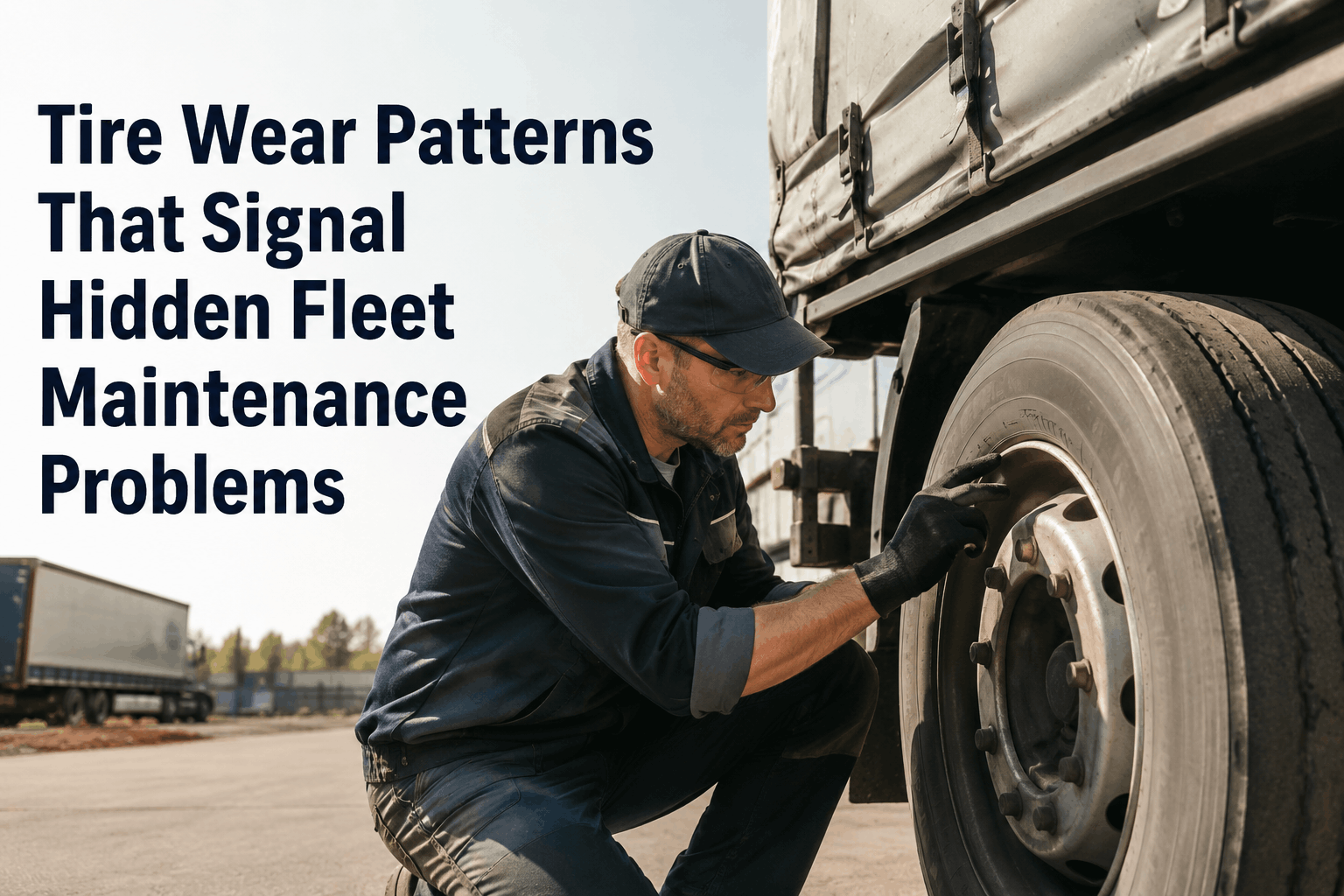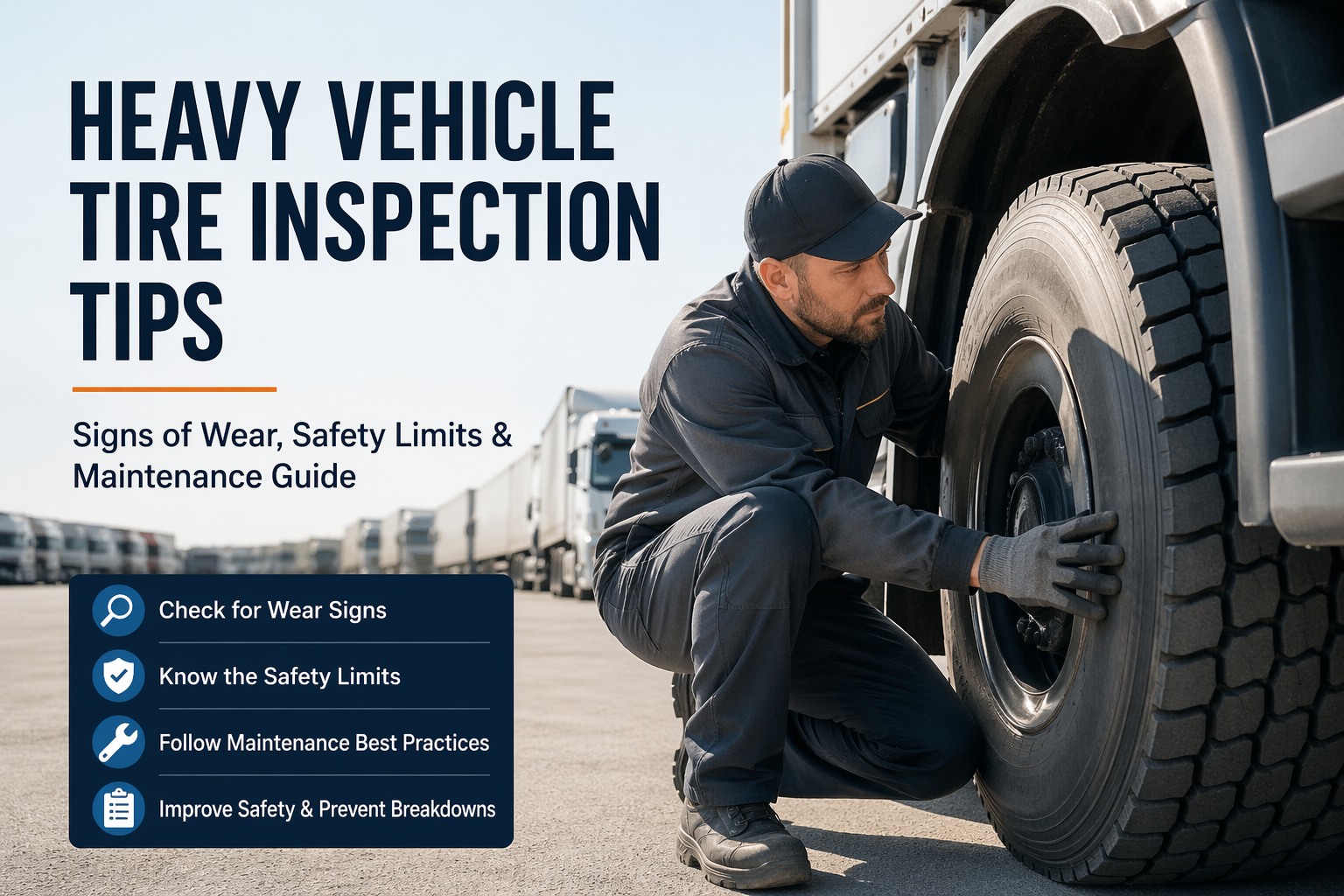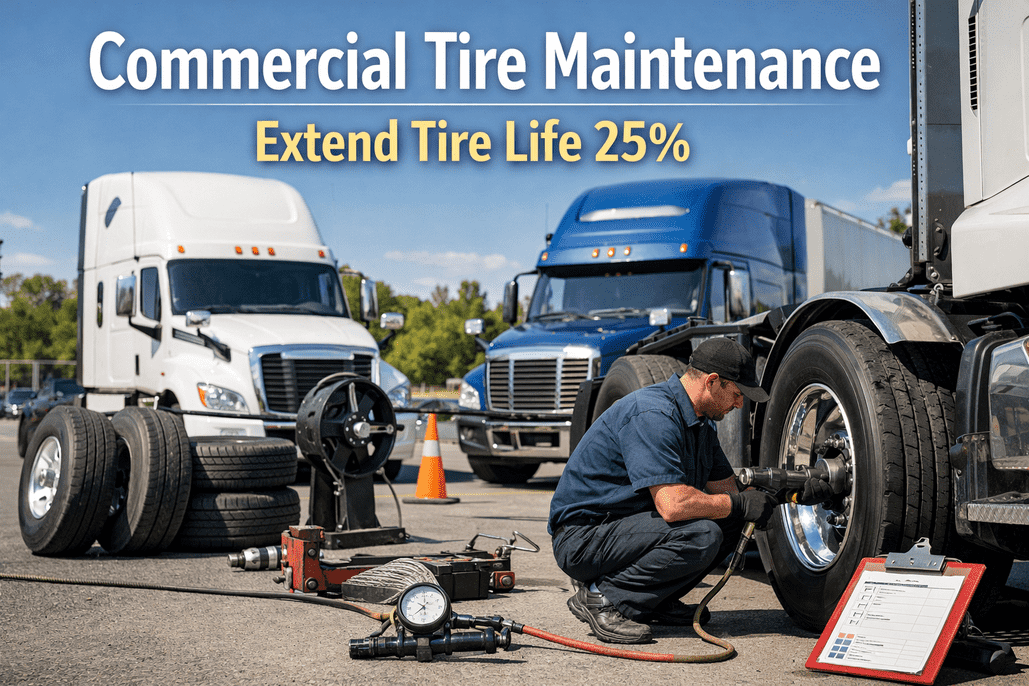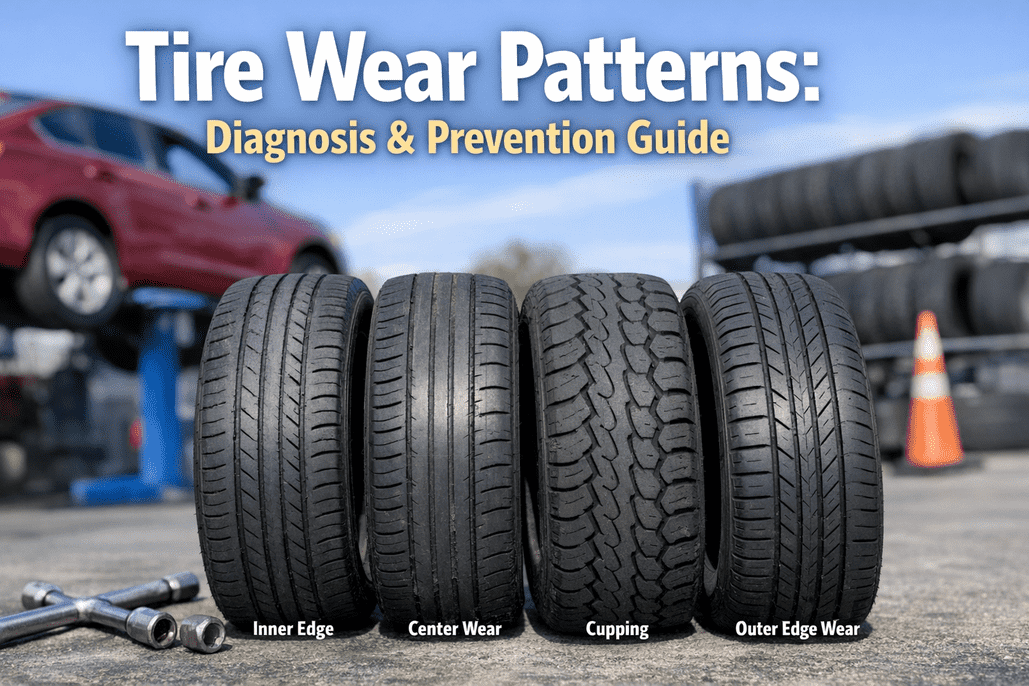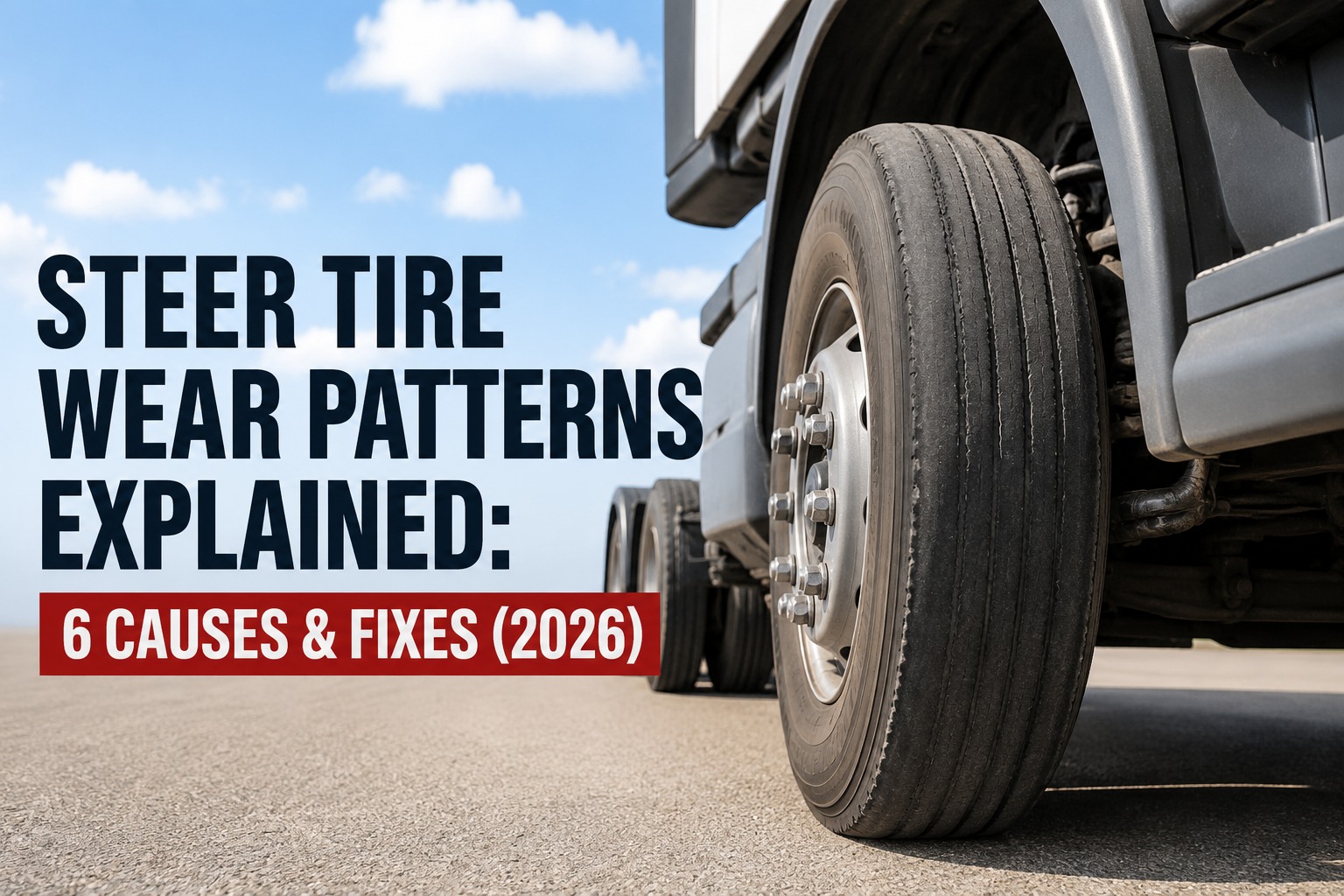
A steer tire pulled off at 45,000 miles instead of 120,000 isn't just an early replacement bill — it is a diagnostic clue you're missing. Every steer tire wear pattern — feathering, cupping, an inside edge worn to the belt, one shoulder shaved before the other — points to a specific mechanical failure upstream. This guide decodes the six patterns and the exact fixes — or book a 15-min HVI demo and we'll show you what's actually eating your steer tires, per truck, per position.
The 6 Wear Patterns That Reveal What's Really Wrong
A steer tire never wears wrong for no reason. Match the pattern to the cause — before you buy the next $500 tire.
The six most common steer tire wear patterns are feathering, cupping, inside edge wear, outside edge wear, center wear, and shoulder wear on both sides. Each points to a distinct mechanical or inflation issue — incorrect toe, camber drift, failing shocks, worn kingpins or ball joints, or pressure that's chronically off spec. Diagnosing the pattern before replacing the tire prevents the second tire from wearing out the same way in another 30,000 miles.
A steer tire is the most stressed rubber on a truck — carrying disproportionate front axle load, absorbing every steering input, living at the intersection of alignment, suspension geometry, and inflation. With commercial steer tires running $250 to $600 each and premium models pushing $1,200+, a mis-diagnosed pattern isn't a $500 mistake — it's the same $500 mistake happening again in 90 days. A steer tire that should have hit 200,000 miles coming off at 40,000? The pattern is the paper trail. Read it right.
Feathering
The angled-rib pattern that screams "toe is off"Run your hand across the tread inside to outside. Ribs feel sharp one way, smooth the other. Every rotation is scrubbing rubber off one side of each rib because the tire isn't rolling — it's being dragged sideways.
Toe misalignment. 1/16" over the wheel diameter shaves visible rubber in 15,000 miles. Toe-in feathers outside rib edges; toe-out feathers inside.
Brush your palm across the tread laterally. Sharp one direction, smooth the other = confirmed. No tools needed.
Full 3-axis alignment on a heavy-duty rack. Toe rarely drifts alone — camber and caster usually close behind.
Cupping
Scalloped high-and-low spots — the suspension is brokenThe tread feels wavy under your palm, like a golf ball. That's not a steering problem — it's the suspension losing control of the tire between the ground and the truck. Bounce, slam, wear. Bounce, slam, wear.
Worn shock absorbers (most common), failing wheel bearings, loose ball joints, or an unbalanced tire. Shocks fail in pairs — cupping usually appears in pairs too.
Push down hard on the fender over the wheel and release. Bounces more than 1.5× before settling = shock is toast.
Shocks in matched pairs, verify bearing play, rebalance. Fresh tire on bad shocks = new cupping inside 20K miles.
Inside Edge Wear
One shoulder shaved bare — the geometry is brokenThe inside shoulder is worn flat while the outside still has 8/32" left — sometimes belt is already showing on the inside. This is the pattern fleets miss most because it hides on the invisible side of the tire.
Negative camber. Worn ball joints, sagging leaf springs, a bent axle from a hard curb strike, or loose wheel-end components tilting the wheel inward.
Reach behind the tire, feel the inside shoulder. Belt exposure or feather-thin tread = confirmed. Check kingpin play: spec is under 0.010".
Component inspection first — kingpins, ball joints, tie rods, axle beam. Then align. Fresh tire without a component check guarantees a repeat.
Outside Edge Wear
Visible from the driver's side — and often ignored anywayOutside shoulder rounded off, inside still shows full tread. Unlike inside edge wear this one is visible on every walkaround — but drivers report it as "aggressive driving" and shops don't always check the geometry.
Positive camber from sagging suspension on the loaded side, worn ball joints, or a bent axle. Constant left-hand turns in tight yards accelerate outside-right shoulder wear.
Walkaround visible — but torque-check the wheel fasteners first. Loose lugs let the wheel walk laterally and mimic camber wear.
Torque check → alignment → review the route pattern. Cross-rotate side-to-side if only one steer position is wearing this way.
Center Wear
Middle of the tread gone, shoulders untouchedCenter rib at the wear indicator, shoulders look almost new. On a steer tire this is a pressure story — and the difference between 105 PSI and 115 PSI on an underloaded axle shows up in just 20,000 miles.
Chronic over-inflation for the actual load. The contact patch bulges in the middle, so only the center rib touches the road and does the work.
Measure depth at three points across each rib (inner / center / outer). Center 3/32"+ lower than shoulders = confirmed.
Match PSI to actual axle load, not the factory sticker. Weekly cold pressure check. Compensate for load and season.
Both Shoulders Worn
Under-inflated — and one hard corner from a blowoutBoth outer edges worn, center rib still has depth. This is the mirror of center wear and the more dangerous one — under-inflation is the leading precursor to sidewall separation and blowouts.
Chronic under-inflation for the load, or overloading beyond rated capacity. Either produces the same casing heat and sidewall flex.
Both shoulders low, center full. Sidewall hot to touch after a run = casing damage already happening internally.
Weekly cold PSI matched to axle load. Log every under-inflation event with a reason. Retire compromised casings before OOS threshold.
The Diagnostic TablePattern → cause → inspection → fix, at a glance
Print this or keep it on your phone. When a driver flags irregular wear on a walkaround, this is the shortest path from "something's off" to "here's the actual problem."
| Wear Pattern | Root Cause | Inspection Method | Corrective Action |
|---|---|---|---|
| Feathering | Toe misalignment (in or out) | Hand-brush ribs sideways — sharp one way, smooth the other | 3-axis alignment on heavy-duty rack |
| Cupping | Worn shocks, bearings, ball joints, or balance | Wavy/scalloped tread; bounce test at wheel | Replace shocks in pairs, check bearings, rebalance |
| Inside Edge | Negative camber, worn ball joints, sagging spring | Feel inside shoulder from behind tire; check kingpin play | Component inspection, then alignment |
| Outside Edge | Positive camber, hard cornering, loose fasteners | Walkaround visible; check torque, ball joints | Torque check, alignment, review route pattern |
| Center | Chronic over-inflation for the load | Center rib wear indicator below shoulders | Match PSI to actual axle weight, log weekly |
| Both Shoulders | Under-inflation, overload, casing heat | Both shoulders low; sidewall heat/bulge check | Weekly PSI, load audit, retire compromised casings |
The 3 Root-Cause CategoriesAlignment vs Suspension vs Inflation — every pattern maps to one
All six wear patterns fall into three root cause categories. Learning which category a pattern belongs to tells you which department fixes it, what parts get ordered, and how much shop time to plan.
Toe and camber drift over time from potholes, curb strikes, and normal component wear. Realign every 40,000–60,000 miles on steer axles, or immediately after any hard front-end impact. A proper 3-axis heavy-duty alignment runs $150–$300 — a fraction of one prematurely replaced steer tire.
Shocks, kingpins, ball joints, tie rods, wheel bearings, springs. These are the components that let alignment drift, that let the tire bounce, that let the wheel lean. Inspection at every PM, replacement in matched pairs where applicable, and documented shock replacement history are non-negotiable for a fleet that wants steer tires to last.
PSI is not a set-and-forget number — it changes with load, ambient temperature, and slow leaks. Steer tires need weekly cold-pressure checks matched to actual axle load, not a generic sticker value. This is the single highest-ROI habit in tire management, and the one most fleets skip.
The Kingpin QuestionThe hidden component behind half of "mystery" steer wear
When a steer tire wears strangely and the alignment, shocks, and inflation all check out, the answer is almost always in the kingpins. On heavy trucks, kingpins are the pivot that lets the steer wheels turn — and when they wear, the wheel develops both radial and axial play that no alignment machine will catch on a static rack.
Worn kingpins masquerade as alignment issues, ball joint problems, even cupping. A truck with 0.030" of kingpin play chews through a fresh steer tire in 20,000 miles no matter how perfect the toe setting — which is why documented inspection at every PM interval matters. The pattern shows up in the data before it shows up on the tire.
The Cost of Missing the PatternWhy tire violations are 21% of all OOS write-ups
Wear patterns aren't just a maintenance problem — they're a compliance problem. The 2025 CVSA International Roadcheck identified 2,899 tire-related out-of-service violations, or 21.4% of all vehicle violations. Tires are the single most frequently cited reason a commercial vehicle gets pulled off the road.
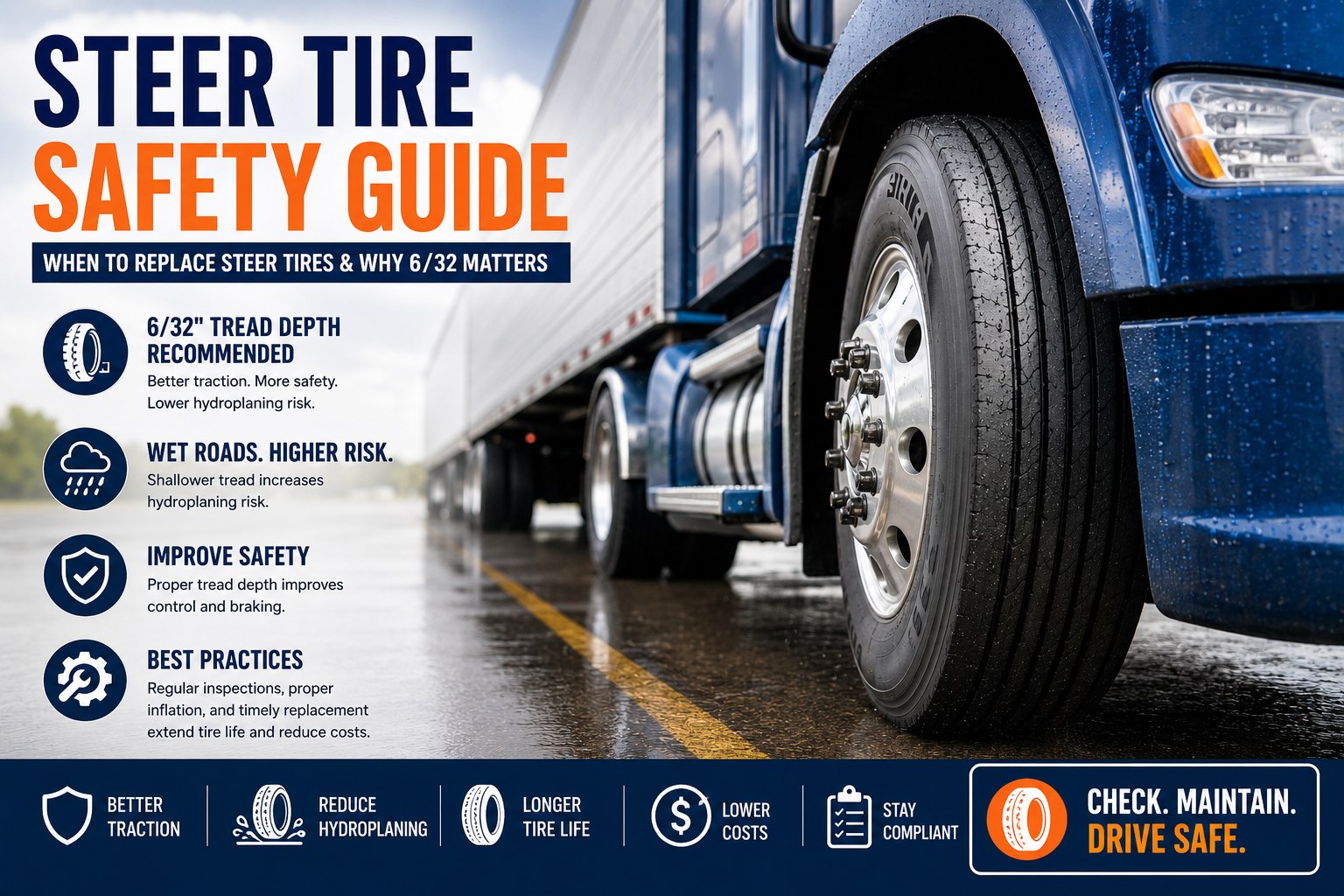
Under 49 CFR 393.75, a steer tire is placed OOS immediately if any groove measures less than 4/32" tread depth, if body ply or belt is exposed, if there is sidewall separation, or if pressure drops to 50% or less of sidewall max. Every one of those failure modes shows up as a wear pattern first. The fleet that catches feathering at 6/32" prevents the OOS write-up at 3/32". Each violation adds 8 severity-weighted points to the Vehicle Maintenance BASIC score — compound that across a fleet and CSA scores climb, insurance follows, and top shippers start asking for compliance reports.
From a shop supervisor who stopped guessing
For years we were replacing steer tires and just guessing at why. Alignment shop said toe was fine, drivers said "it just wears," and we kept eating $500 tires every 40,000 miles on a couple of specific trucks.
When we started logging the pattern on the walkaround — feathering vs. cupping vs. inside edge — we spotted three trucks with the same cupping pattern in one month. All three had shocks over 250,000 miles old. Replaced shocks in pairs, and the next set of steers went to 110,000. The pattern was the answer all along; we just weren't writing it down.
Frequently asked questions
What causes feathering on steer tires?
Feathering on steer tires is almost always caused by toe misalignment. When the front of the tires is angled inward (toe-in) or outward (toe-out), the tire scrubs sideways with every rotation instead of rolling straight, shaving rubber off one side of each tread rib and leaving the other raised. Toe-in feathers the outside edge of each rib; toe-out feathers the inside edge. Misalignment as small as 1/16" across the wheel diameter can produce visible feathering inside 15,000 miles. The fix is a proper 3-axis alignment on a heavy-duty rack that reads toe, camber, and caster together — toe rarely drifts alone. Fleets that align every 40,000–60,000 miles on steer axles, or immediately after any hard front-end impact, rarely see feathering as a chronic issue.
What causes tire cupping on the steer axle?
Cupping — the scalloped, wavy pattern around the tire's circumference — is caused by the suspension losing control of the tire's road contact. Most often it's worn shock absorbers: when a shock can no longer dampen vertical bounce, the tire lifts and slams down repeatedly, wearing rubber only where it lands hard. Other causes include worn wheel bearings, failing ball joints, an out-of-balance tire, or a bent wheel. Shocks fail in pairs, and cupping typically appears in pairs too. The fix is component-first: replace shocks in matched pairs, verify bearing play, rebalance, then rotate or replace the tire. A fresh tire on a truck with failed shocks just cups the new one within another 20,000 miles.
Why is my steer tire wearing more on one side than the other?
One-side wear on a steer tire points to a camber issue, but the cause depends on which side. Inside edge wear indicates negative camber — top of the wheel tilted inward — typically from worn ball joints, sagging leaf springs, a bent axle from a curb strike, or loose wheel-end components. Outside edge wear indicates positive camber, usually from sagging suspension on the loaded side, worn ball joints, under-tightened wheel fasteners, or routes with heavy left-hand turns. The tire is a lagging indicator either way — the underlying component has been failing for thousands of miles before wear becomes visible. Inspect kingpins, ball joints, tie rod ends, and axle integrity before ordering a replacement tire, or the new one will wear the same way.
How do I know if my steer tire has center wear from over-inflation?
Center wear from over-inflation shows up as tread depth being significantly lower in the middle ribs than at the shoulders — sometimes 3/32" or more difference across the tread face. On a steer tire this happens when PSI is set higher than the load calls for; the contact patch bulges in the middle, so only the center rib touches the road. On a high-mileage lane, the difference between 105 PSI and 115 PSI on an underloaded steer axle shows up in as little as 20,000 miles. Confirm by checking depth at three points across each rib (inner, center, outer) against sidewall pressure history. The fix is to match inflation to actual axle load, not the factory sticker, and check pressure weekly cold.
Are irregular tire wear patterns a DOT violation?
The pattern itself isn't the violation — the condition it leads to is. Under 49 CFR 393.75, a steer tire is placed out of service if any groove measures less than 4/32" tread depth (2/32" for non-steer positions), if body ply or belt material is visible through tread or sidewall, if there is any tread-carcass separation, or if pressure is at 50% or less of sidewall max. Irregular patterns — especially edge and center wear — can drive one section of a tire below those thresholds while other sections still look OK. The 2025 CVSA International Roadcheck flagged 2,899 tire-related OOS violations (21.4% of all vehicle violations), each carrying 8 severity-weighted points against the Vehicle Maintenance BASIC score. Documented pattern-based inspection keeps a slow-developing pattern from becoming an OOS write-up.
Related HVI guides
Turn the wear pattern into the diagnosis
HVI captures tread depth, PSI, and wear pattern on every walkaround — then trends it against alignment history, shock replacement dates, and mileage. Feathering, cupping, edge wear, and inflation issues become alerts before they become DOT violations. Live in under two weeks. No hardware.
Mobile-first · Offline-capable · DVIR-compliant