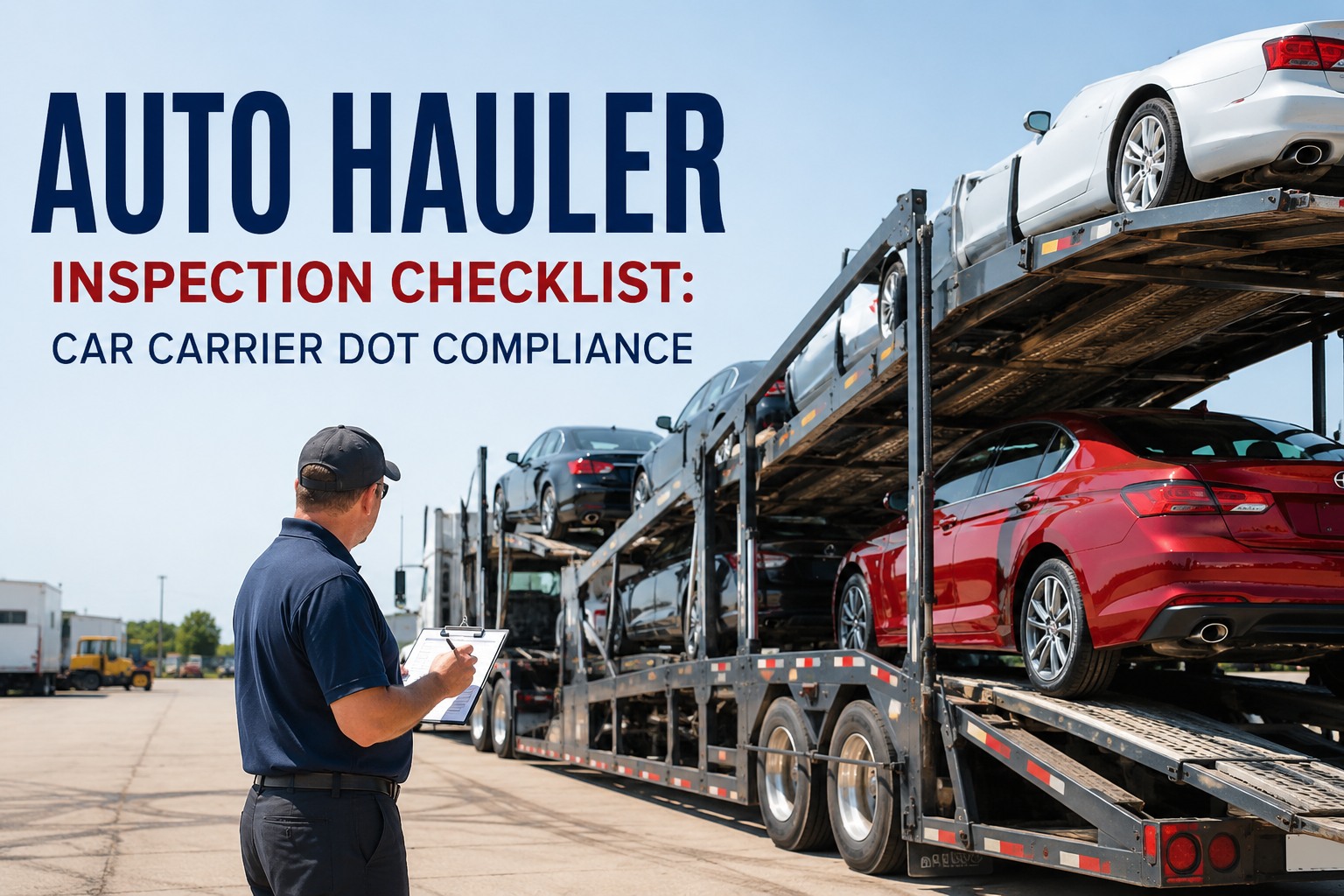
Auto haulers carry cargo that costs more per pound than almost anything else on the road. Nine or ten vehicles, $300K+ of stock, riding on hydraulic decks and wheel straps rated for the job when new — and worn 10% every trip since. This auto hauler inspection checklist covers the eight hotspots that fail first on Cottrell and Boydstun rigs, the DOT cargo securement math every driver should know, and how photo-verified DVIR protects the fleet from both the roadside violation and the dented-fender claim. Book a demo
Two risks share one pre-trip: the roadside violation and the cargo damage claim. One inspection covers both.
A missed hydraulic leak becomes an OOS. A worn wheel strap becomes a delivered-with-scratches call. A skipped tiedown check becomes a $2,470 CVSA violation. Photo-verified DVIR captures every hotspot before every load — the compliance record and the damage-claim evidence, in one workflow.
The 8 hotspots on a loaded car hauler — where inspection actually catches the failure
Most auto hauler DVIRs are done as generic tractor-trailer walkarounds, missing the failure points specific to car-carrying equipment. A real auto hauler inspection walks the rig as a car-hauling system: headramp to trailer bumper, hydraulic to mechanical, top deck to lower deck. Below is the hotspot map that catches what a generic walkaround misses.
The eight-hotspot walk is the difference between a generic pre-trip and a real auto hauler pre-trip. Every zone corresponds to either a common roadside OOS category or a common cargo damage claim — and photographs of every zone before dispatch settle both disputes when they arise. Book a demo to see the 8-hotspot template running as a photo-verified DVIR
Two risks, one inspection — the compliance side and the claim side
Every auto hauler pre-trip serves two audiences. The DOT inspector who might pull the rig at a scale. And the receiving dealer's lot manager who might spot a scratch at delivery. The same eight hotspots protect against both, but for different reasons. Here's how the inspection splits.
Photos beat memory. Photos beat driver notes. Photos beat "I'm sure it wasn't there when I loaded it." A photo-verified DVIR that captures both sides of the risk is a compliance record and a claim defense in the same workflow — and both live in HVI's inspection archive without duplicate data entry. Start free and configure a photo-verified auto hauler DVIR template this week
Cargo securement math — the WLL calculation the inspector runs
49 CFR 393 doesn't give the roadside inspector any latitude. The math is fixed: the sum of the working load limits of the tiedowns must equal at least 50% of the cargo weight, and a minimum of four tiedowns is required per vehicle. Below is a worked example on a common 9-car load configuration. Get this wrong once and it's a Class III violation — and depending on inspector discretion, an out-of-service.
The rule is not "aggregate WLL ≥ 50%" alone — it's both that AND the minimum four tiedowns. Miss either half and the inspector writes the citation. The DVIR that reminds the driver to count the tiedowns before departure catches exactly this failure mode. Book a demo to see the aggregate WLL calculator built into the auto hauler DVIR
From a Safety Manager running 22 Cottrell rigs on a 3-state loop
Our fleet ran on paper DVIRs for six years. The compliance side was fine most days — drivers had been doing walkarounds since they got their CDL. The problem was the claim side. We were paying out $80K-$120K a year in cargo damage claims where the dealer said the scratch was ours and we couldn't prove otherwise. No photos, no timestamps, just a driver saying "I'm pretty sure it wasn't there."
Photo-verified DVIR with the 8-hotspot template changed the claim math completely. Every vehicle gets photographed at load and unload, every strap position, every deck lock. The rig itself gets the hotspot walk with photos of the hydraulic cylinders, deck pins, and anchor points. Twelve months in: cargo damage payouts down 68%. Roadside inspection defect rate dropped from around 14% to under 6% because drivers were catching the hydraulic seepage and worn tiedowns during the structured walkaround instead of missing them. The same workflow protected both sides.
Frequently asked questions
What does a complete auto hauler inspection checklist cover?
A complete auto hauler inspection checklist covers the standard DOT tractor-trailer items (lights, brakes, tires, suspension, coupling, driveline) plus the eight car-carrier-specific hotspots that generic walkarounds miss. Those eight zones: headramp attachment (bolt torque per Cottrell / Boydstun spec, weld condition, ramp folding pins), hydraulic tank and pump (fluid level, tank mount torque, filter condition, PTO engagement, no seepage), upper deck and deck pins (every deck position pin fully seated, deck surface clear, no weld cracks at deck-to-frame joints), upper deck hydraulic cylinders (chrome rod condition, seal weep, hose integrity, no hold-drift under load), lower deck and rear skids (rear-loading skids smooth with Cottrell-supplied bar, jump skids seated, Loxall pins present), tiedown anchor points (every position free of cracks and distortion, ratchet heads turn freely, no mushroomed strike plates), wheel straps and securement chains (no cuts, abrasion, or heat damage on straps; chain stretch within wear-gauge spec; pretzel and spring locks engaged), and trailer suspension (no sagging corner from broken spring or deflated airbag, bushings intact, shock absorbers dry). Every zone corresponds to either a common CVSA roadside violation or a common cargo damage claim — and photo capture at each zone creates the record that defends against both.
How does DOT cargo securement law apply to car carriers?
49 CFR Part 393 Subpart I governs cargo securement on commercial motor vehicles, and 49 CFR 393.130 specifically addresses vehicles being transported on car carriers. The two hard rules: the sum of the working load limits (aggregate WLL) of the tiedowns must equal at least 50% of the cargo weight being secured, and a minimum of four tiedowns per vehicle is required regardless of the WLL math. Both conditions apply simultaneously — a vehicle secured with three straps whose combined WLL is 20,000 lbs is still non-compliant because the four-tiedown minimum was missed, even though the WLL far exceeds the 50% threshold. Additional requirements: if the loaded vehicle has crawler tracks or wheels, the four tiedowns must prevent movement side-to-side, forward, rearward, and vertically; indirect tiedowns routed through anchor points and attached to both sides of the trailer count as two tiedowns if the routing is correct with proper slack management; enroute securement inspections are required per FMCSA rules at defined intervals during the trip. Violations are Class III and can be cited as OOS at inspector discretion, particularly if the aggregate WLL is significantly under-spec or if visible strap damage suggests imminent failure. Photo-verified DVIR with an aggregate WLL calculator built in is what prevents the miscalculation, the missed strap, and the citation.
Why do auto haulers face more cargo damage claims than other cargo types?
Auto haulers carry cargo that is uniquely visible, uniquely valuable, and uniquely inspected on arrival by professional lot managers whose job is to catch scratches, paint chips, dents, and wheel damage. A flatbed carrier moving construction materials doesn't face this: nobody counts the scratches on a stack of I-beams. A car carrier delivering nine new SUVs to a dealership faces a formal walk-around by the lot manager on every vehicle, at every stop, with a claim form pre-filled in case any damage is spotted. Cargo damage on a car carrier is also easy to attribute wrongly — a scratch that existed at the origin lot but wasn't documented becomes "the hauler's damage" the moment it's spotted at destination. Without a photo record from load-time, the carrier has no way to prove the damage was pre-existing. This is why photo-verified DVIR matters more on car haulers than on almost any other cargo type: the same photo that documents the pre-trip strap position also documents the pre-load vehicle condition, and both live in the timestamped inspection record that settles the claim conversation the moment it starts.
What are the most common Cottrell and Boydstun auto hauler failure points?
The failure patterns are consistent across the major auto hauler OEMs (Cottrell, Boydstun, Kaufman). Hydraulic system leaks are the top defect category — cylinder rod seals, hydraulic hoses, and tank fittings account for the majority of "hydraulics" citations at roadside. Chrome scoring on cylinder rods appears well before an outright leak and is the leading indicator that seal replacement is due. Deck pins and Loxall pins fail from missed lubrication and impact wear — a pin that doesn't seat cleanly compromises deck-position security under load. Ratchet head wear on the tiedown mechanisms (particularly the Cottrell aluminum batwing design) is a slow-degradation failure that eventually prevents proper strap tensioning. Wheel strap abrasion from repeated tightening against sharp anchor edges reduces the effective WLL well before the strap looks visibly failed. Headramp mounting bolt torque loss occurs after high-impact loading events and requires periodic torque verification per Cottrell operator manual. Trailer airbag sag from a slow leak or worn ride height sensor produces the "sagging corner" that suggests broken spring but is often just a suspension issue with a simple fix. All of these are catchable during a structured 8-hotspot inspection walkaround; none of them are catchable during a generic tractor-trailer walkaround. This is why a hauler-specific DVIR template matters — the template forces the walk that catches the failure before it becomes an OOS or a claim.
How does HVI's photo-verified DVIR support auto hauler operations?
HVI's auto hauler DVIR template is built specifically for car carrier operations. The 8-hotspot walkaround runs in the mobile app with prompted photo capture at every critical zone: headramp attachment, hydraulic tank and pump, upper deck and deck pins, upper deck hydraulic cylinders, lower deck and rear skids, tiedown anchor points, wheel straps and securement chains, and trailer suspension. On top of the rig inspection, the app prompts per-vehicle load photos (corners, quarter-panels, wheels, roof) at load time and again at unload — timestamped and tied to the load record so any post-delivery damage claim can be evidenced against the pre-departure condition. An aggregate WLL calculator is built into the tiedown section: enter cargo weight, confirm strap WLL and count, and the app validates against the 49 CFR 393.130 threshold (50% aggregate WLL, minimum 4 tiedowns per vehicle). Every completed DVIR generates a signed PDF stored in the inspection archive, searchable by vehicle VIN, load ID, driver, date, or route — both the compliance record for FMCSA and the claim evidence for insurers. For safety managers running fleets of 15+ Cottrell or Boydstun rigs, the typical result is roadside defect rates cut in half within the first quarter and cargo damage payouts reduced by 40-70% over the first twelve months. Book a demo to see the auto hauler DVIR template running live.
Two risks share one pre-trip. One workflow covers both.
HVI's auto hauler DVIR walks the 8 car-carrier hotspots with prompted photo capture, calculates aggregate WLL against cargo weight, and stores the whole record with signature and timestamp. The DOT scale gets a clean paper trail; the cargo-damage claim conversation gets photo evidence tied to the load record. Two problems, one workflow, live in under two weeks.