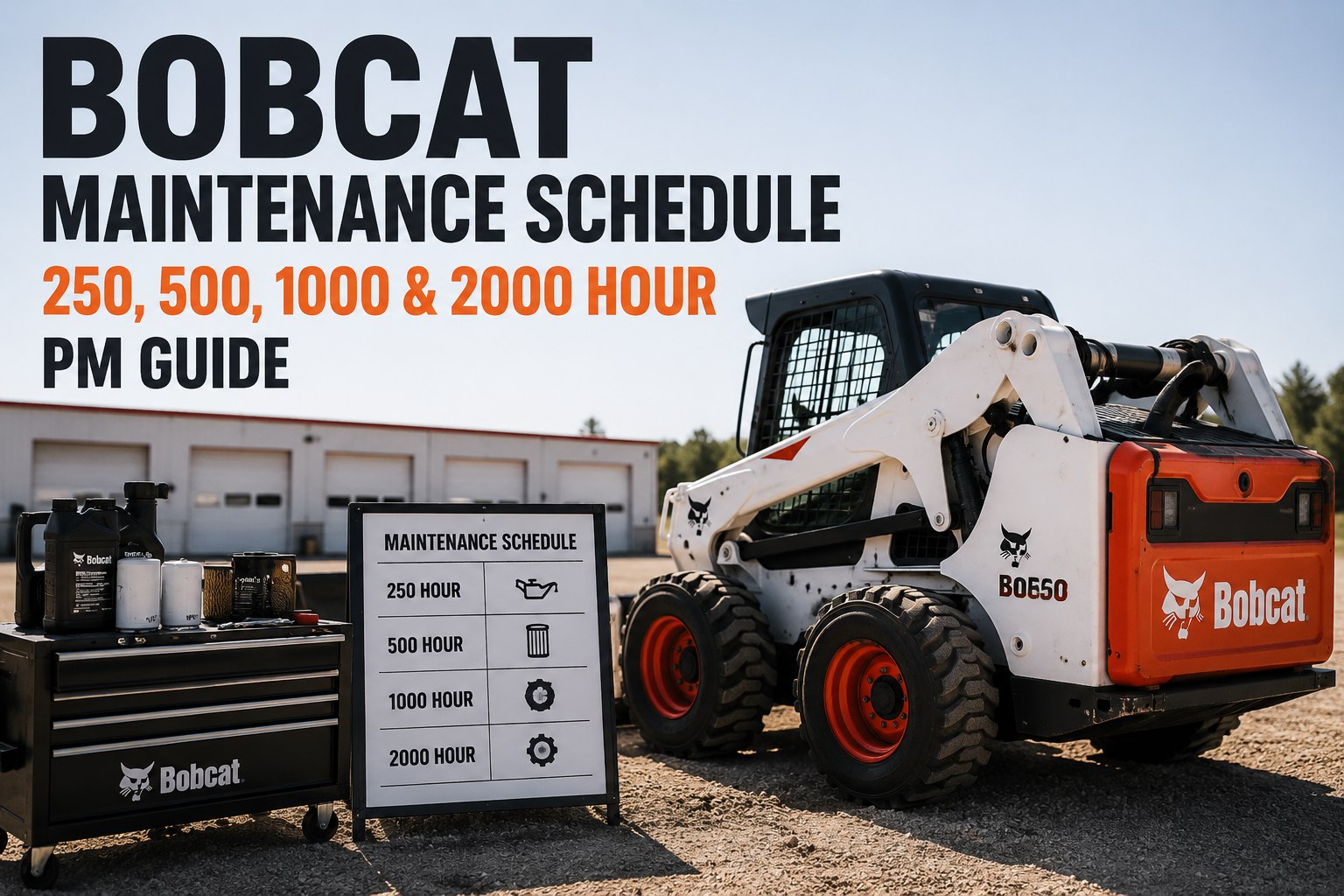
Bobcat machines earn a living in the roughest, dustiest, most schedule-critical corners of a jobsite — concrete demolition, landscape prep, snow removal, farm work, urban construction where nothing bigger fits. That reality has one implication most owners underestimate: the Bobcat maintenance schedule the manual prints is a starting point, not the target. Every Bobcat skid steer, compact track loader, mini excavator, and compact loader has a real-world interval that's usually 20–30% shorter than the published number because of the conditions these machines actually work in. This guide walks through the full PM schedule — daily walkaround, 250 / 500 / 1,000 / 2,000-hour services — plus the condition modifiers that turn the manual number into your actual service window, and the machine-class quirks that separate S-series skid steers from T-series CTLs from E-series mini excavators. Book a demo when you're ready to automate it.
The 4 milestones every Bobcat crosses
Standard schedule — before condition modifiers. Fits every S, T, E, and L series machine.
The Bobcat condition modifier chart: your real service intervals
Every Bobcat interval is expressed as a "standard" hour number in the operator's manual. Standard = clean air, moderate temps, mixed load cycle, occasional heavy use. If your Bobcat's actual duty cycle doesn't match that description — and most don't — here are the adjusted intervals to run on instead.
Most fleet managers set PM triggers on the manual's standard intervals and wonder why their filter samples come back with elevated wear metals or why their engine oil is dark and depleted before the change window. The condition modifier is the missing variable. Book a demo to see condition-adjusted PM triggers
The daily Bobcat walkaround: 10-hour check plus BICS test
Bobcat's compact platform packs a lot of hydraulic and mechanical work into a small footprint, which means a lot of failure surface to inspect in 10 minutes before shift start. The BICS (Bobcat Interlock Control System) test is what separates a real Bobcat walkaround from a generic compact-equipment inspection — it's the safety interlock that prevents lift arm and hydraulic function without the seat belt fastened, and a failing BICS is an OSHA-relevant defect.
The BICS test is where most operator walkarounds fail on audit. Getting it into the digital daily template — with a mandatory pass/fail response — is the single highest-leverage change you can make to your Bobcat compliance posture. HVI's daily operator reporting ships with a Bobcat template that includes BICS as a mandatory step. Book a demo to see it configured
The 4-step Bobcat maintenance schedule progression
Bobcat intervals are additive — each service includes everything from the prior one plus the additions. Below is the exact progression staircase for a standard S/T/E-series machine, with the key additions at each new step.
Routine service
2–3 hr labor- Engine oil & filter change (Kubota or Doosan diesel, spec per manual)
- Grease all fittings — lift arms, tilt cylinder pins, idler adjusters
- Air filter inspection — check restriction indicator
- Fuel/water separator drain
- Wheel nut torque check (S/L-series)
First major additions
4–5 hr labor- Everything from 250 hr, plus:
- Fuel filter replacement (primary and secondary)
- Hydraulic filter check — inspect magnet for metallic debris
- Accessory drive belt condition (alternator, A/C, water pump)
- BICS function test — documented
- Battery cable & connection check
- Track tension springs on T-series (proper tension extends track life significantly)
The comprehensive service
Full day (7–9 hr)- Everything from 250 & 500 hr, plus:
- All three hydraulic filters — main, case drain, charge (Bobcat has three separate hydraulic filters, not one)
- Hydraulic reservoir fluid replacement + vent filter
- Final drive transmissions (chaincases on S-series — unique to Bobcat skid steers)
- Heater coil & A/C evaporator cleaning
- Coolant condition test & replacement per condition
- Complete engine oil sample to lab for wear metal baseline
Deep service & long-life items
1–2 days- Everything from 250 / 500 / 1000 hr, plus:
- Drive motor / hydraulic pump inspection under load
- Injector spray pattern check via diagnostic tool
- Structural inspection — lift arms, boom (mini ex), chassis welds, mounting brackets
- Complete undercarriage measurement (T-series — documented against wear limits)
- Complete electrical harness & ground strap inspection
- Swing bearing play measurement (E-series mini excavators)
What wears out first on each Bobcat machine class
Every Bobcat family has one or two components that fail first under real-world use, and knowing which item to prioritize on which machine is the difference between a schedule that protects the fleet and a generic checklist that misses. Here are the four Bobcat platforms and their signature wear items.
Watch: Chaincase oil & wheel bearings
Skid steers wear their chaincases faster than almost any other component — the final drive transmission takes the entire torque load through skid-turn cycles. Chaincase oil at 1000 hr is not optional, and the drain magnet on inspection often shows the earliest wear signals. Wheel bearing failure is the second most common Bobcat skid steer breakdown after chaincase issues.
Watch: Track tension & undercarriage
CTLs put roughly 50% of their lifetime maintenance cost into the undercarriage. Rubber tracks last 1,000–2,000 hours depending on terrain; running them too loose accelerates sprocket damage, too tight accelerates roller/idler wear. Weekly track-tension check plus 500-hour documented measurement is the discipline that extends track life by hundreds of hours.
Watch: Swing bearing & boom pins
Mini excavators concentrate their wear at the swing bearing and boom-cylinder pin bushings. The swing bearing gets grease at 250 hr and a documented radial-play measurement at 2000 hr — a sloppy swing bearing is a $8,000–20,000 repair caught by a 5-minute measurement. Boom pin bushing measurement (not just visual) at 1000 hr is the second most-missed item.
Watch: Front & rear differentials
Bobcat's articulated compact loaders (L-series) use front and rear differentials instead of chaincases. Differential oil replacement at 1000 hr is the critical service — skipped or delayed differential service is the #1 cause of catastrophic L-series drivetrain failure, and the repair is 15–30× the cost of the scheduled service.
The failure chain: what one missed Bobcat service actually costs
The value of running the Bobcat maintenance schedule on time isn't the parts you save on the interval — it's the cascade of failures the timely service prevents. Here's the actual chain that a missed 500-hour hydraulic filter starts on a T-series compact track loader.
The gap between the $60 filter and the $28,000 worst case is 3–4 orders of magnitude. That's the multiplier every skipped Bobcat interval carries — not always to the worst case, but always somewhere on that ladder. Start a free trial and get Bobcat PM triggers automated on your fleet this week.
Bobcat Machine IQ + HVI: telematics-driven PM automation
Bobcat Machine IQ is the standard telematics platform on most current-model Bobcat machines — it captures engine hours, fault codes, location, and utilization automatically. What Machine IQ does not do: generate work orders, dispatch technicians, verify PM completion with photo proof, or apply condition modifiers to the base intervals. That's the gap fleet maintenance software fills.
- Engine hours (live)
- Fault codes & diagnostic messages
- Location & utilization %
- Fuel burn & DEF (if equipped)
- Auto-generated work orders at 90% of interval
- Condition modifier applied per machine
- Machine-family-specific PM checklists
- Photo-verified completion & audit trail
- Zero missed PM windows
- ~25% lower annual maintenance cost
- Machine service history stays complete
- Payback typically inside a quarter
The integration is what turns a Bobcat fleet from "we do our best" to "the schedule runs itself." Book a demo to see the Bobcat + Machine IQ integration
From a fleet manager running 27 Bobcat machines
We run a mix — twelve S650 and S770 skid steers, nine T650 and T770 CTLs, four E35 and E50 mini excavators, and two L85 compact loaders. Before we automated the PM triggers we were consistently 8–15% over the manual's hour intervals across the fleet, and our chaincase and hydraulic filter samples showed it.
The real change was the condition modifier. Half our fleet runs in demolition dust — we adjusted those to 0.75× automatically in the system, and the wear metal counts came back down within two service cycles. Unplanned downtime dropped roughly 32% year over year. On our T770 fleet alone that's about $95,000 of recovered productivity annually.
The bottom line on the Bobcat maintenance schedule
The Bobcat maintenance schedule is deceptively simple — four hour-based service milestones (250 / 500 / 1000 / 2000) on top of a 10-hour daily walkaround. What makes it hard to run correctly across a real fleet is the condition modifier that shortens intervals under the conditions Bobcat machines actually work in, plus the machine-class quirks that mean an S-series skid steer needs different attention than a T-series CTL, an E-series mini excavator, or an L-series compact loader. Get all of that right and a well-maintained Bobcat comfortably hits 8,000+ hours before major overhaul. Miss the modifier or skip a service and the same machine ends up on the used market at 3,500. The tooling that makes the schedule actually run — hour capture on the daily inspection, condition-adjusted triggers, machine-family templates, photo-verified completion — is what closes the gap between the manual on the shelf and the maintenance you actually deliver.
Frequently asked questions
What are the standard Bobcat maintenance intervals?
Bobcat's standard hour-based maintenance intervals are 10-hour (daily), 50-hour (weekly), 250-hour (routine service), 500-hour (first major additions), 750-hour (engine oil change on some models), 1000-hour (comprehensive major service), and 2000-hour (deep service). Some Bobcat models also add a 3000-hour interval. Intervals are additive — every 500-hour service includes the 250-hour tasks, every 1000 includes 250 and 500 tasks, and 2000 includes everything below it. Critically, Bobcat's own service schedule states that all published intervals assume "general environmental conditions," and that filter and oil life can be reduced significantly in high-dust environments, extreme temperatures, or under continuous heavy load. In practice, most Bobcat machines running real-world jobsite conditions should be on intervals 20–30% shorter than the manual number.
Do I really need to shorten Bobcat service intervals in dusty conditions?
Yes — and this comes directly from Bobcat's own service schedule documentation, not third-party opinion. Bobcat's published intervals are calibrated for standard operating conditions. High-dust environments (demolition, gravel operations, agriculture, unpaved sites) accelerate air filter and hydraulic filter degradation. Extreme temperature exposure (sustained above 95°F or below 10°F) shortens engine oil and coolant life. Continuous high-load applications (material handling, snow removal, forestry, mine work) compound thermal stress and lubricant depletion. Industry best practice under any one of these conditions is to shorten filter and fluid intervals by 20–25%. Under two or more combined conditions (e.g. concrete demolition in summer with long shifts), 30–40% shorter intervals are appropriate. Oil sampling every service is the best way to confirm your specific application's actual wear rate and calibrate future intervals precisely.
What is Bobcat Machine IQ and does it replace maintenance software?
Bobcat Machine IQ is the standard telematics platform on most current Bobcat machines. It captures engine hours, fault codes, GPS location, utilization percentage, and (on newer models) fuel and DEF consumption. Machine IQ does an excellent job of the data capture layer. What Machine IQ does not do: generate work orders when PM intervals come due, dispatch those work orders to technicians, verify PM completion with photo evidence, apply condition modifiers to base intervals, or provide machine-family-specific PM checklists. That workflow layer is what dedicated fleet maintenance software provides. The combination — Machine IQ for capture, HVI for PM automation and completion — is what typically moves a Bobcat fleet from the industry-average 85% uptime to the 95%+ target. Machine IQ alone is a visibility tool; combined with HVI it becomes a PM production system.
Are Bobcat skid steer and compact track loader PM schedules the same?
The interval cadence (10 / 250 / 500 / 1000 / 2000 hours) is the same across all Bobcat compact platforms, but the specific tasks at each interval differ meaningfully by machine class. Skid steer loaders (S-series) have chaincases as the critical 1000-hour item — the final drive transmission that takes the entire skid-turn torque load. Compact track loaders (T-series) don't have chaincases but need track tension monitoring, undercarriage measurement, and drive sprocket wear inspection instead. Mini excavators (E-series) have swing bearing play measurement and boom-cylinder pin bushing checks that don't apply to loaders. Compact loaders (L-series articulated loaders) have front and rear differentials instead of chaincases. Digital PM software that pre-loads the correct template per machine family is the cleanest way to handle this on a mixed Bobcat fleet, so a technician assigned a 1000-hour PM on a T770 gets the CTL-specific checklist, not a skid steer's.
What happens if I skip a Bobcat 1000-hour service?
The 1000-hour Bobcat service is the comprehensive one — it's where all three hydraulic filters get replaced, hydraulic reservoir fluid gets changed, chaincases (on S-series) or differentials (on L-series) get serviced, and the heater/AC evaporator gets cleaned. Skipping it starts a cascade: filter media saturates and bypass valves open, allowing unfiltered fluid to circulate. Metallic debris begins scoring the hydraulic pump internals within 100–300 hours. Left uncorrected, the pump fails under load — a $2,000–$4,500 repair on early diagnosis, or $8,000–$18,000 if the failure spreads to the valve bank and drive motors before it's caught. The chaincase or differential side of the 1000-hour service is even more consequential: chaincase failure on a skid steer is typically $6,000–$12,000 to repair, and differential failure on an L-series can exceed $15,000. In every case, the skipped service was $200–$400. The multiplier on a missed Bobcat 1000-hour service typically lands in the 30–80× range.
Turn the Bobcat maintenance schedule into a system that runs itself
HVI ships with pre-built templates for every Bobcat family — S-series skid steers, T-series CTLs, E-series mini excavators, and L-series compact loaders. Hour capture via Machine IQ telematics or the daily inspection app. Condition modifier applied automatically. Machine-class-specific checklists routed to your technicians with photo verification. Live for your Bobcat fleet in under two weeks — typical payback inside a quarter.
No credit card · Pre-built Bobcat PM templates · Works with Machine IQ & manual hour capture