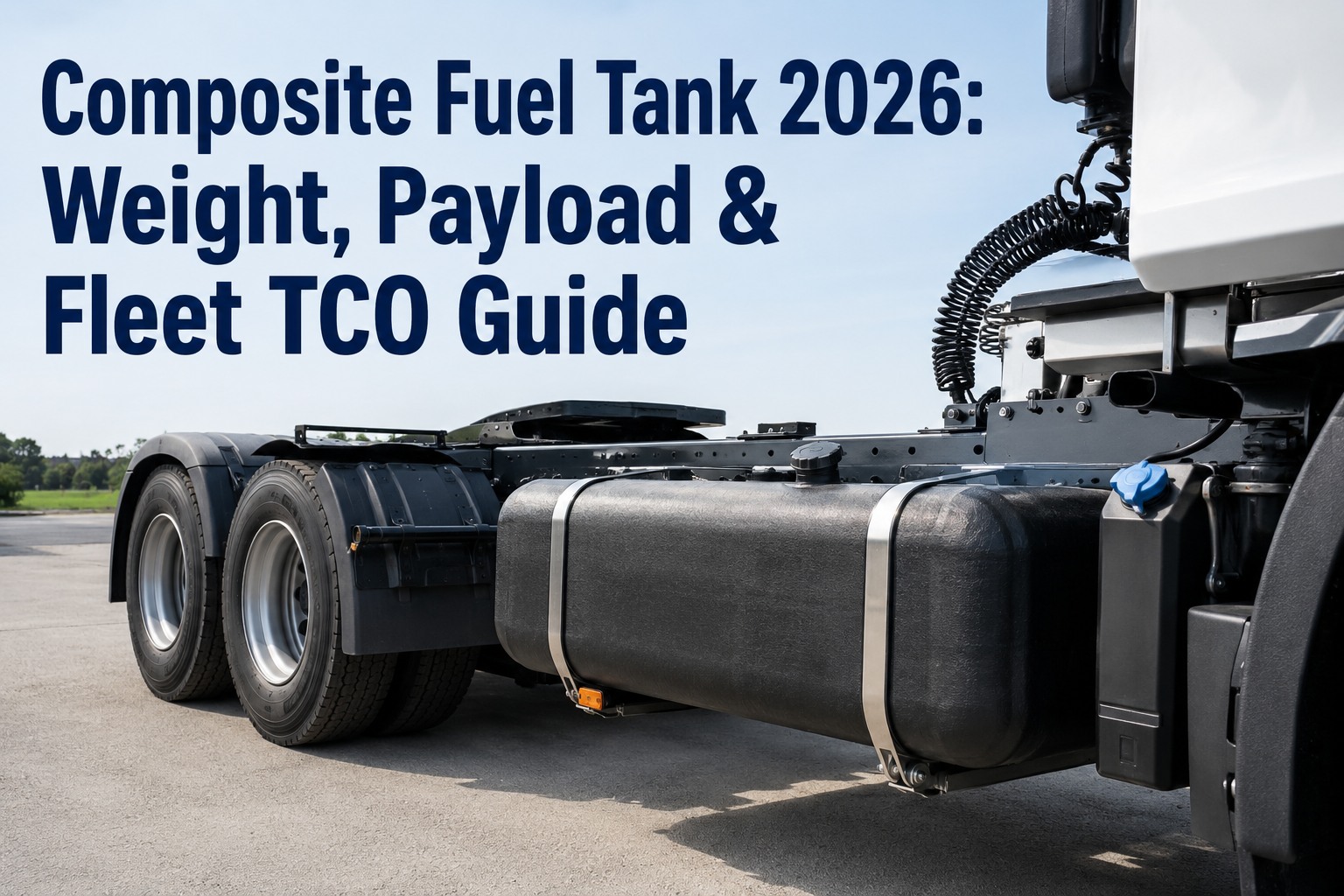
Composite fuel tank technology is moving from niche vocational spec to mainstream Class 8 option. Fibre-reinforced polymer tanks weigh 40-60% less than steel and 20-40% less than aluminum for the same 100-gallon capacity, resist corrosion for the truck's life, and cost 30-50% more up front. On weight-limited hauls where every pound of tare saved becomes billable payload, the TCO math is compelling. This guide walks the 3-way scorecard, payload revenue math, and payback scenarios — book a demo to measure fuel and TCO per unit in HVI.
Steel vs Aluminum vs Composite Fuel Tank — The 3-Way Scorecard
Same 100 gallons of diesel. Three very different tanks holding it. Different weight, different life, different cost, different corrosion story — different TCO across the truck's whole service life.
Dual-tank Class 8 truck: switching from steel to composite saves roughly 200-240 lbs of tare weight. On weight-limited hauls that's 200-240 lbs of new revenue payload every trip for 20+ years.
The rest of this page walks the per-pound payload revenue math, the fuel economy secondary win (~0.5% MPG per 100 lbs saved), corrosion vs galvanic corrosion at bracket contact, when composite genuinely pays back versus when aluminum is the right answer, and how to measure the impact per truck once installed. Book a 30-minute demo to see fuel-per-unit trending and payload capture per truck in HVI.
The payload revenue math — what 200 lbs of tare saved actually earns
Every pound of tare weight saved becomes a pound of legal payload gained under GVW limits. On weight-limited hauls (aggregates, bulk cement, liquid tanker, scrap metal, refuse) that payload is directly billable revenue. On volume-limited hauls (parcel, dry van, refrigerated food) the payload upside is smaller because the truck cubes out before it grosses out. The composite tank ROI hinges on which side of that line the fleet operates.
| Fleet type | Load pattern | +200 lbs payload = value | Composite ROI |
|---|---|---|---|
| Aggregate / bulk haul | Weight-limited (grosses out) | Direct revenue per trip; roughly $2-5 additional revenue per load | Strong — often 12-18 months |
| Liquid tanker (fuel, chem) | Weight-limited | Additional gallons per load; scales with commodity value | Strong — often 12-18 months |
| Refuse / recycling | Weight-limited | More tons collected per route; fewer transfer trips | Strong — 12-24 months |
| Flatbed / heavy hauling | Mixed weight and dimension | Variable; strong on weight-critical loads | Moderate — 18-30 months |
| Dry van / general LTL | Volume-limited (cubes out) | Minimal direct revenue; fuel savings only (~0.5% MPG) | Weak — 36+ months |
| Refrigerated food | Volume-limited | Minimal direct revenue; slight fuel benefit | Weak — 36+ months |
| Parcel / express | Volume-limited | Negligible direct revenue upside | Weak — not TCO-justified alone |
For weight-limited fleets the math often gets built the wrong way around. Spec managers compare the $500-900 tank cost delta and stop there. The correct comparison is 20 years of additional payload revenue against a one-time tank premium. On a 5,000-load-per-year aggregate operation, an extra $3 per load is $15,000 per year per truck — the tank pays back in 2-4 months and returns 20+ years of upside afterward. Book a demo to see payload-per-load and fuel-per-mile trended per unit in HVI.
Corrosion, galvanic corrosion, and why aluminum tanks fail at the brackets
Aluminum's corrosion resistance is real but not automatic. The metal forms a self-healing oxide layer that protects the tank surface from atmospheric and chemical corrosion — but the layer fails at any point where aluminum contacts a dissimilar metal in the presence of an electrolyte (road salt, rain, condensation). This is galvanic corrosion, and it's the leading cause of premature aluminum fuel tank failure on commercial trucks. Composite tanks skip the problem entirely because they are electrically inert.
Steel bracket contact
Aluminum tank + steel mounting strap + saltwater = galvanic couple. Aluminum sacrifices itself as the anode, corroding through at the contact points within 3-7 years on unprotected installs. Rubber isolators required.
Rubber isolator failure
Rubber isolators break down under UV, ozone, and vibration over 5-10 years. Cracked or missing isolator allows direct metal contact, resuming galvanic corrosion. Annual isolator inspection critical on aluminum tank fleets.
Coastal / salt-belt severity
Northern salt-belt operations (US Midwest / Northeast winters, Canadian Prairie roads) and coastal fleets see galvanic corrosion progression 3-5x faster than dry southwestern climates. Aluminum tank life effectively halves.
Composite immunity
Fibre-reinforced polymer composite tanks are electrically non-conductive. No galvanic couple possible at any bracket, strap, or fitting. No rubber isolator ageing to manage. Life measured by mechanical wear only, not chemical degradation.
Practical consequence: an aluminum tank in a Michigan winter operation may not reach its full 15-20 year rated life. A composite tank in the same operation will. On multi-year TCO models the composite tank's true service life advantage often exceeds the 25% headline number, particularly in northern-tier and coastal fleets. Start a free HVI trial to log tank-mount inspection per unit including isolator condition.
When composite pays back — and when aluminum is still the right answer
Composite fuel tanks are not universally the right spec. The premium over aluminum is real, the field repair story is weaker (composite tanks are typically replaced rather than welded), and the parts availability is thinner outside major OEM dealers. Four scenario patterns describe when composite pays back cleanly and when aluminum remains the better commercial choice.
Weight-limited + salt-belt
- Aggregate, tanker, refuse operations in northern winter climates
- Payload revenue upside stacks with corrosion life advantage
- Payback 12-18 months typical
- Full 20-year life realized
High-idle sleeper long-haul
- 150-gal tank on long-haul benefits from 100+ lbs savings
- Fuel economy improves ~0.5% per 100 lbs saved
- Multi-year fuel savings meaningful across 500K+ miles
- Payback 24-36 months on fuel alone
Vocational / severe service
- Construction, forestry, mining vocational trucks
- Composite dent resistance an advantage vs steel
- Rock impact risk higher than aluminum
- Case-by-case ROI depending on repair economics
Volume-limited dry van / parcel
- Cubes out before grossing out on payload
- 200 lbs saved does not become revenue
- Only fuel savings remain (~0.5% MPG)
- Aluminum better commercial answer
The default answer for most Class 8 highway fleets today remains aluminum. But the composite tank is now genuinely competitive on a defined set of weight-critical, salt-belt applications where the 20-year corrosion advantage plus per-load payload revenue combine to make the upfront premium a very short-payback investment. Fleet spec teams that structurally measure fuel consumption, tare weight, payload per load, and tank life per unit produce data-driven spec decisions rather than intuition-driven ones. Book a demo to see spec-tracking and TCO dashboards per unit in HVI.
A vocational fleet spec manager on the aggregate-haul TCO math
We run 42 tri-axle aggregate haulers in northern Ontario, mixed sand, gravel, and construction fill. Weight-limited on every load — we gross out before we cube out on 100% of hauls. Spec'd composite fuel tanks on 8 new units in 2024 as a pilot, standard aluminum on the rest. Tank cost delta $750 per side, $1,500 per truck for dual-tank spec. Total pilot premium: $12,000.
Measured 2025 payload data: composite-tank trucks averaged 235 lbs additional legal payload per load versus aluminum-tank baseline. At $2.80 per additional loaded ton on our aggregate rates, that's roughly $0.33 more revenue per load. Sounds small until you multiply: 4,200 loads per truck per year on our routes = $1,386 additional revenue per truck per year. On 8 pilot units: $11,088. Pilot premium recovered inside 13 months.
The corrosion advantage was the second surprise. Our aluminum tanks on the Ontario winter routes typically show galvanic-corrosion pitting at bracket contact points by year 7-8, and full tank replacement at year 11-12. Composite tanks show zero. We're now spec-ing composite on all replacement orders and new tri-axle builds. Aluminum stays on our southern regional fleet where payload upside is smaller and salt exposure is lower.
Frequently asked questions
What is a composite fuel tank?
A composite fuel tank is a diesel fuel tank manufactured from fibre-reinforced polymer (typically fibreglass or carbon-fibre composite) rather than the traditional steel or aluminum. Composite tanks weigh 40-60% less than steel and 20-40% less than aluminum for the same 100-gallon capacity — roughly 65-85 lbs empty for a composite 100-gallon tank versus 110-130 lbs for aluminum and 185 lbs for steel. Composite construction is electrically non-conductive, which eliminates galvanic corrosion at mounting bracket contact points — the leading cause of premature aluminum tank failure on commercial trucks. Service life is typically 20-25 years versus 15-20 years for aluminum and 8-12 years for steel, largely because chemical degradation mechanisms don't apply. Upfront cost premium is significant — $900-$1,500 for a composite 100-gallon tank versus $600-$900 for comparable aluminum and $400-$600 for steel. The TCO calculation depends heavily on whether the fleet operates weight-limited hauls (where saved tare becomes billable payload) or volume-limited hauls (where tare weight matters less), and on climate exposure to road salt and coastal humidity.
How much weight does a composite fuel tank save vs aluminum?
A 100-gallon composite fuel tank typically weighs 65-85 lbs empty versus 110-130 lbs for a comparable aluminum tank — a saving of roughly 30-60 lbs per tank, or 20-40% weight reduction. On a dual-tank Class 8 spec (200-300 gallons total capacity) the saving typically totals 100-140 lbs per truck. Compared to steel tanks, the composite advantage is much larger: 100-120 lbs saved per single tank, 200-240 lbs per dual-tank spec, or 40-60% weight reduction versus steel. The practical impact of that weight saving depends on the fleet's load pattern. On weight-limited operations (aggregates, bulk cement, liquid tanker, scrap metal, refuse collection) every pound of tare saved becomes a pound of legal payload gained under GVW limits — directly billable revenue on every trip for the 20+ year life of the tank. On volume-limited operations (dry van, refrigerated food, parcel express) the truck cubes out before it grosses out, so tare weight savings produce only the secondary benefit of roughly 0.5% fuel economy improvement per 100 lbs saved. Fuel savings alone rarely justify the composite premium on volume-limited fleets, but stack with payload revenue on weight-limited fleets to produce short paybacks.
Are composite fuel tanks worth the extra cost?
It depends on the fleet's specific load pattern, climate, and truck duty cycle. Composite fuel tanks are worth the premium in two main scenarios. First, weight-limited operations in salt-belt or coastal climates: aggregate haulers, bulk tankers, refuse collection, scrap metal, and similar fleets that gross out before they cube out on 100% of loads combine per-load payload revenue upside with corrosion-life advantage. Real fleet data on aggregate haulers has shown 12-18 month payback and 20+ year revenue upside thereafter. Second, high-mileage long-haul fleets with large tank capacity (150-gallon dual spec) where the fuel economy improvement (approximately 0.5% MPG per 100 lbs saved) accumulates meaningfully across 500,000+ mile duty cycles. Payback typically 24-36 months on fuel savings alone. Composite tanks are generally not worth the premium on volume-limited fleets (dry van, refrigerated food, parcel express, general LTL) that cube out before grossing out — the payload revenue upside doesn't materialise and the fuel savings alone don't justify the cost. Aluminum remains the better commercial answer for the majority of Class 8 highway fleets today, with composite becoming genuinely competitive on the specific weight-critical, salt-belt applications where the TCO math stacks.
Do composite fuel tanks resist corrosion better than aluminum?
Yes, categorically. Aluminum fuel tanks resist atmospheric and chemical corrosion through a self-healing oxide layer on the tank surface, but that protection fails at any point where aluminum contacts a dissimilar metal (steel mounting straps, brackets, fasteners) in the presence of an electrolyte (road salt, rain, condensation). The resulting galvanic corrosion is the leading cause of premature aluminum fuel tank failure on commercial trucks — typically presenting as pitting or perforation at bracket contact points within 3-7 years on unprotected installs, or 10-15 years on installs using rubber isolators (which themselves degrade under UV and vibration over 5-10 years, then allow direct metal contact and resumed corrosion). Composite fuel tanks (fibre-reinforced polymer) are electrically non-conductive, so no galvanic couple can form at any bracket, strap, or fitting. There is no rubber isolator to age and fail. There is no salt-induced degradation mechanism. Service life is limited only by mechanical wear (impact damage, UV exposure of exterior gel coat) rather than chemical degradation. In salt-belt and coastal operations the effective service life advantage of composite over aluminum often exceeds the 25% headline number because aluminum tanks in those environments rarely reach their full rated life.
Can composite fuel tanks be repaired in the field?
Not to the same standard as aluminum or steel. Aluminum and steel fuel tanks can be welded, patched, or brazed by any qualified truck shop technician using standard equipment, and small pinhole leaks or minor impact damage are routinely field-repaired for a fraction of tank-replacement cost. Composite tanks (fibre-reinforced polymer) can technically be repaired using resin patching kits or professional laminate repair, but the repair strength and reliability are generally lower than the original tank material, and DOT compliance on repaired composite fuel tanks is less clear than on repaired metal tanks. Most fleets running composite tanks treat significant damage as a tank-replacement event rather than a repair event, which means keeping a replacement tank in inventory for the specific truck model or accepting a longer downtime window when damage occurs. The practical implications: composite tanks perform very well in environments where impact damage is rare (highway operations, paved yards, controlled loading environments); the field-repair disadvantage weighs more heavily in vocational service (construction, mining, forestry, off-road applications) where rock impact and yard damage are frequent enough that field-weldable aluminum or steel tanks remain the better commercial choice despite the weight and corrosion penalties.
Prove the spec on a pilot. Roll fleet-wide with data, not intuition.
HVI captures per-truck fuel consumption, per-load payload, tare weight, and tank/mount inspection history in one system. Composite vs aluminum tank decisions become measurable outcomes: dollars per load, MPG per unit, corrosion progression, TCO per year. Prove the spec on 5-10 pilot units, produce hard data for the CFO, then scale with confidence. Live in under two weeks. No hardware. No credit card.
Trusted by fleets running TCO-driven spec decisions across USA, Canada & EU · Ready on day one