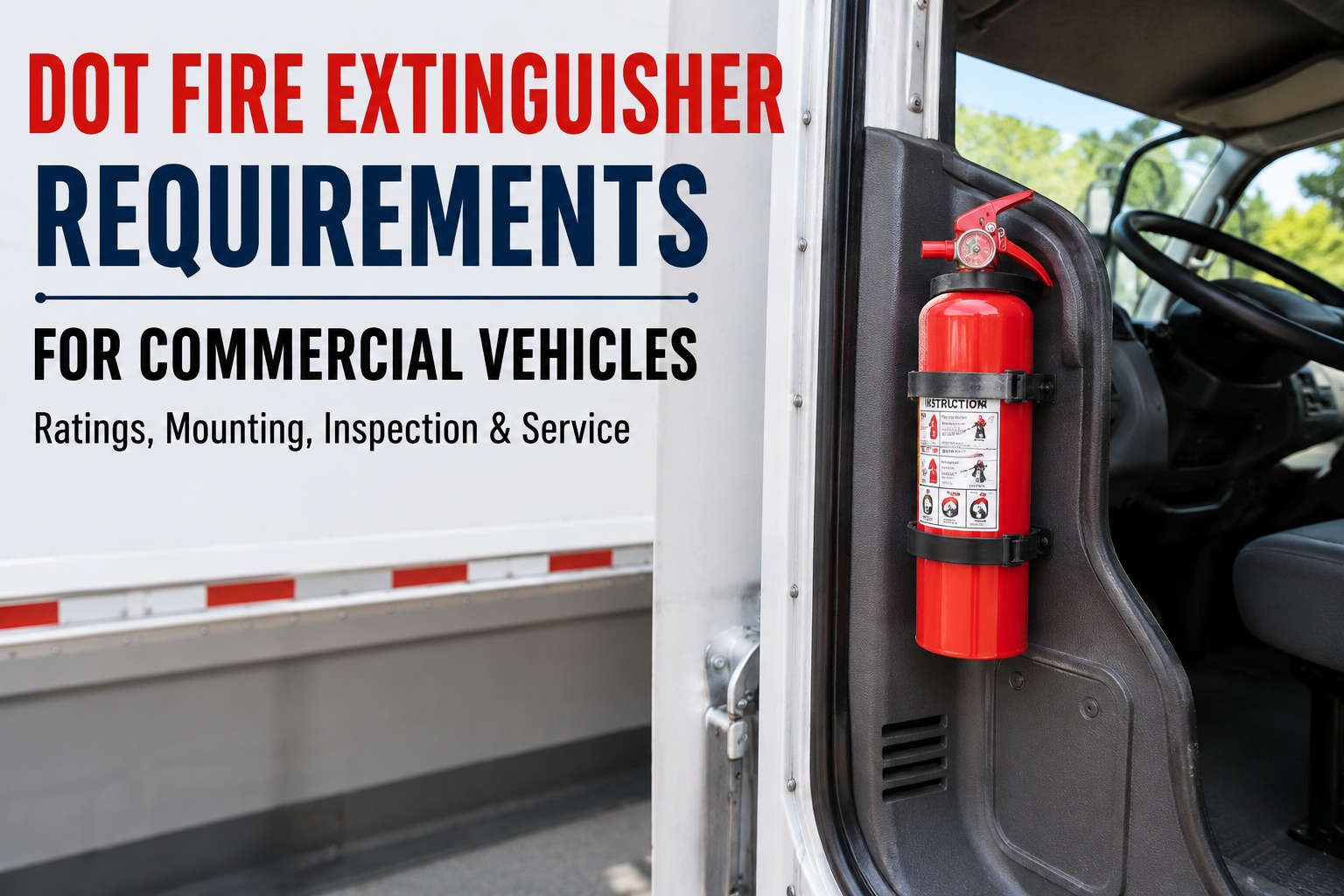
The extinguisher is right there on the truck. It still fails the inspection. It's the wrong rating, or it slid under the seat, or the service tag expired eight months ago — and now you've got a DOT violation on a piece of equipment you actually own. That's the frustrating truth about DOT fire extinguisher requirements: having one isn't the same as passing. Under FMCSA rule 49 CFR 393.95, the extinguisher has to be the right rating, properly mounted, reachable, and documented. This guide walks the whole checkpoint so nothing on your fleet gets flagged. Book a demo to see how HVI tracks it across every vehicle.
DOT Fire Extinguisher Requirements, Decoded
Rating · mounting · accessibility · documentation. Miss any one and a present extinguisher still writes a violation.
Commercial vehicle fires move fast, and 393.95 exists to give a driver a fighting chance. But for a fleet manager, the rule is also a recurring compliance exposure: it applies to every power unit — truck, tractor, and bus — that meets the CMV definition, and it shows up on roadside inspections. The good news is the requirement breaks into four plain checkpoints. Let's walk each one the way an inspector would.
1The right rating
This is where most confusion starts — and it hinges on one question: are you hauling placardable hazmat? The answer sets your minimum UL rating. Weight isn't the rating; the UL B:C number is.
Either one of these satisfies the rule:
The minimum jumps significantly:
Placarding generally applies at 1,001+ lbs of a hazmat class, or any quantity of certain high-hazard materials.
A practical note that trips people up: a common 5 lb ABC dry-chemical extinguisher is usually rated 3-A:40-B:C, which comfortably clears the 5 B:C floor. The "5 lb" is the agent weight, not the rating — always read the UL label, not the sticker weight. The extinguisher must also be UL-labeled, use an agent that needs no freeze protection, and meet EPA SNAP toxicity rules. Book a demo to build rating checks into your pre-trip templates
2Mounted & accessible
An extinguisher rolling around the cab floor fails two ways at once: it's not secured, and it's not reliably reachable. The regulation is specific about both. Here's what "compliant" physically looks like.
- Secured in a bracket that prevents sliding, rolling, or vertical movement
- Mounted where the driver can reach it quickly and get it out fast
- UL rating label visible and legible
- Charge indicator/gauge reading in the green
- Pull pin and tamper seal intact
- Loose on the floor or seat — no secure mount
- Buried under gear, behind the seat, or blocked by cargo
- Gauge in the red, or no visible charge indication
- Cracked hose, corrosion, dents, or signs of prior discharge
- Broken seal or missing pull pin
"Readily accessible" is judged from the driver's seat and reach, not from where the bracket happens to be bolted. A perfectly charged, correctly rated extinguisher that's pinned behind a week's worth of paperwork is still a finding. Access and mounting are the two conditions drivers most often let slip mid-shift. Start free on HVI to make mount-and-access a required, photo-verified pre-trip step.
3The pre-trip check
Federal rule doesn't spell out a daily extinguisher checklist, but a smart pre-trip catches every failure mode before the road does. Thirty seconds, five looks — this is what a driver should verify each day.
It's on the truck, in its bracket, where it belongs.
Bracket holds it firm — no slide, roll, or drop.
Nothing blocking it; grab it in one motion.
Gauge in the green; seal and pin intact.
No cracks, corrosion, or signs of discharge.
This is exactly the kind of small-item check that's easy to wave through on paper and easy to forget under time pressure — until it's the line item that puts a truck out of service. Pairing it with the other 393.95 emergency gear (spare fuses where needed, and warning devices) turns five separate worries into one repeatable routine a driver runs the same way every morning — the surest way to keep a small item from becoming an out-of-service order.
4Two different rulebooks
Here's the distinction fleets most often blur — and it matters. The FMCSA rule is the legal floor for the road. NFPA 10 is the maintenance standard for keeping the extinguisher genuinely functional. They're related, not identical.
- Sets the minimum UL rating (5 B:C / two 4 B:C / 10 B:C hazmat)
- Requires secure mounting & ready accessibility
- Requires a visible charge indicator and UL label
- Enforced at roadside inspections; failures hit CSA
- Monthly visual inspection (uncertified staff can do it)
- Annual maintenance by a certified technician + service tag
- 6-year internal exam on stored-pressure dry-chem units
- Hydrostatic test every 12 years (5 for CO2/water/wet chem)
Why the split matters: passing a roadside check on rating and mounting doesn't mean the extinguisher is on schedule for its internal exam or hydrostatic test — and a missing or outdated service tag is itself a common finding. Treating the DOT floor and the service standard as one thing is how fleets end up technically legal on the road but out of date on maintenance. Always confirm the exact schedule against your extinguisher type and current standards. Book a demo to track both the road rule and service intervals together
The service timeline paper tags can't manage
This is the operational heart of the problem. Each extinguisher has its own manufacture date, so its 6- and 12-year milestones are staggered — unique to that single unit. Across a fleet, that's dozens of individual clocks a paper tag on a cylinder can't help you see.
In place, accessible, gauge green, seal & pin intact, no damage. Trained staff can do it — no certification needed.
Certified technician examines the unit, verifies condition, and attaches a dated service tag. Records retained.
Stored-pressure dry-chemical units are emptied and inspected internally for corrosion, then recharged.
Cylinder pressure-tested for structural integrity (every 5 years for CO2, water, and wet-chemical types).
One more trap: non-rechargeable extinguishers must be removed from service 12 years from their manufacture date regardless of condition — no test can extend them. Tracking four intervals, each staggered per unit, across an entire fleet is precisely the job paper tags fail at and a digital system is built for. Start free and let recurring reminders surface every due date automatically.
The violations inspectors actually write
Almost every fire-extinguisher finding falls into one of these buckets — and every one is preventable with a real inspection routine. Know them, and you know exactly what to check for.
No extinguisher on a unit that requires one.
Below 5 B:C, or below 10 B:C on placardable hazmat.
Not mounted to prevent sliding, rolling, or dropping.
Buried under cargo or gear, not readily reachable.
Low gauge, corrosion, cracked hose, or broken seal.
No or outdated service tag; records not maintained.
Notice the pattern: only one of these is about not owning an extinguisher. The other five are about condition, placement, and paperwork — the things that drift over time and that a once-and-done purchase never fixes. That's the case for managing this as an ongoing system, not a one-time buy. Book a demo to close every one of these gaps in your workflow
From a safety manager who stopped chasing tags
We failed a roadside on an extinguisher that was on the truck — the annual tag had lapsed and nobody caught it. On a paper system, every cylinder has its own little tag and its own dates, and across 80 units you simply cannot see what's due when.
Moving the check into our digital pre-trip changed it overnight. Drivers verify mounting and the gauge every morning, and the service dates surface as reminders before they lapse. We stopped treating the extinguisher as a thing we bought once and started treating it as a thing we manage. The violations stopped.
Manage the requirement, not just the equipment
DOT fire extinguisher requirements are simple to state and easy to fail. Under 49 CFR 393.95, every qualifying power unit needs an extinguisher of the right UL rating — 5 B:C standard, or 10 B:C for placardable hazmat — that's securely mounted, readily accessible, charged, and in good condition. Layer on NFPA 10's monthly, annual, six-year, and twelve-year service intervals, each staggered per unit, and the real challenge becomes obvious: this isn't a purchase, it's an ongoing compliance system across every vehicle.
That's exactly where paper tags fall down and a digital inspection platform earns its keep. HVI lets you build the extinguisher — and warning devices, spare fuses, and every other small-item check — into configurable pre-trip templates, capture photo-verified digital records, surface recurring service reminders before they lapse, and see fleet-wide compliance at a glance. Manage the requirement as a system and the roadside inspection stops being a gamble. Book a demo to make fire-extinguisher compliance automatic across your fleet.
Frequently asked questions
What fire extinguisher rating does a commercial truck need?
Under 49 CFR 393.95, a power unit that does not transport hazardous materials must carry either one fire extinguisher with a UL rating of 5 B:C or more, or two extinguishers each rated 4 B:C or more. A power unit transporting hazardous materials in a placardable quantity must carry one extinguisher rated 10 B:C or more. Remember that the rating is the UL B:C figure marked on the label, not the agent weight in pounds — a common 5 lb ABC dry-chemical extinguisher is typically rated 3-A:40-B:C, which exceeds the 5 B:C minimum. The extinguisher must also be UL-labeled, use an extinguishing agent that needs no protection from freezing, and comply with EPA SNAP toxicity provisions. Many carriers choose ABC dry-chemical units because they cover Class A, B, and C fires in one bottle, and many spec above the federal minimum as a matter of policy.
How must the extinguisher be mounted and located?
The regulation requires that the fire extinguisher be filled and located so it is readily accessible for use, and securely mounted to prevent sliding, rolling, or vertical movement relative to the vehicle. In practice that means it belongs in a proper bracket — not loose on the floor, under the seat, or rolling around the cab — and it must be reachable quickly from the driver's position without moving cargo or gear out of the way. Two of the most common roadside findings are an extinguisher that isn't secured and one that isn't readily accessible because it's blocked or buried. Accessibility is judged from the driver's reach, so even a correctly mounted unit can fail if something is stored in front of it. A visible charge indicator and a legible UL rating label are also required.
Is FMCSA 393.95 the same as NFPA 10?
No, and it's important not to treat them as one rule. FMCSA 49 CFR 393.95 is the federal motor-carrier requirement enforced on the road — it sets the minimum extinguisher rating, requires secure mounting and ready accessibility, and requires a visible charge indicator, and failures show up on roadside inspections and CSA. NFPA 10 is the separate national standard for the inspection, maintenance, and testing of portable fire extinguishers — it defines the monthly visual inspection, annual professional maintenance, six-year internal examination, and twelve-year hydrostatic testing schedule. Meeting the DOT road requirement doesn't automatically mean an extinguisher is current on its NFPA 10 service intervals, and a missing or outdated service tag is itself a frequent finding. The safest approach is to satisfy the federal floor and follow the applicable service standard, confirming the exact schedule against your extinguisher type.
How often does a truck fire extinguisher need to be inspected and serviced?
Under NFPA 10 practice, portable fire extinguishers follow a four-tier schedule. A monthly visual inspection confirms the unit is present, accessible, charged (gauge in the green), with seal and pin intact and no visible damage — trained staff can perform this without certification. An annual maintenance inspection by a certified technician provides a thorough examination and a dated service tag. Stored-pressure dry-chemical extinguishers require an internal examination at six years, and a hydrostatic pressure test at twelve years; CO2, water, and wet-chemical types are on a five-year hydrostatic cycle instead. Non-rechargeable extinguishers must be removed from service twelve years after their manufacture date regardless of condition. Because each extinguisher has its own manufacture date, the six- and twelve-year milestones are staggered per unit across a fleet, which is why tracking them on paper tags alone is so error-prone. Always confirm intervals against the current standard and the manufacturer's manual.
How can a fleet track extinguisher compliance across many vehicles?
The core difficulty is that fire-extinguisher compliance isn't one date — it's a monthly check plus annual, six-year, and twelve-year service intervals, each staggered by every unit's individual manufacture date, across every vehicle in the fleet. Paper tags live on the cylinder, so no one can see what's due when without physically walking the yard. A digital inspection platform like HVI solves this by letting you build the extinguisher check into configurable pre-trip inspection templates as a required, photo-verified item, capturing a digital record for every vehicle, and setting recurring reminders that surface annual and multi-year service dates before they lapse. It also lets you manage the extinguisher alongside other commonly missed small-item requirements — warning devices, spare fuses, and the rest of the 393.95 emergency gear — so compliance is handled as one system with fleet-level visibility, rather than as isolated checks scattered across paper logs. That turns a roadside inspection from a gamble into a predictable pass.
Make fire-extinguisher compliance automatic on every truck
HVI builds 393.95 into configurable pre-trip templates, captures photo-verified digital records, and sends recurring reminders for annual and multi-year service dates — with fleet-wide compliance visibility in one place. Handle extinguishers, warning devices, and every small-item check as one system. Mobile-first for drivers, live in under two weeks.
No credit card · Configurable pre-trip templates · Compliance records on day one