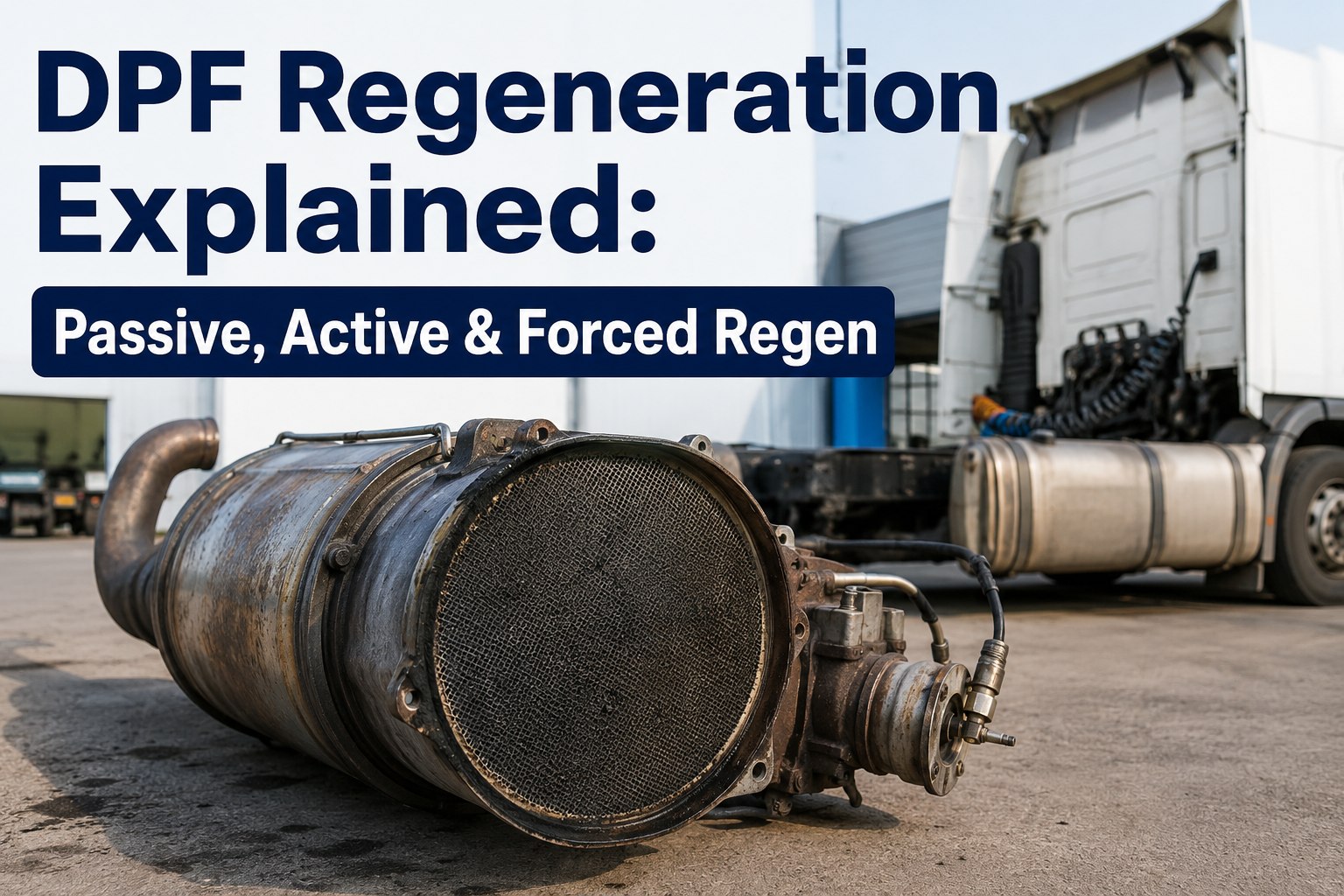
A DPF regeneration is not one thing. It's four stages, each triggered when the previous one couldn't finish the job — and knowing which stage the truck is in tells you whether to keep driving, park for 30 minutes, or book shop time. Most drivers experience only stages one and two without knowing. Trucks that end up on a rollback got there because someone treated stage three like one. This is DPF regeneration explained the way it actually escalates — book a demo to route DPF codes into work orders.
The Regen Ladder — What Each Step Actually Means
Each stage kicks in when the one below it couldn't finish. If you know which step the truck is on, the right action — keep driving, park, or shop — picks itself.
Passive regeneration
Background burn during steady highway operation. Exhaust gases stay hot enough to oxidize soot as it accumulates. No dashboard indication, no power impact, no time cost. Long-haul lanes live here almost exclusively.
Active regeneration
ECU injects extra fuel via post-injection to raise exhaust temperature above what natural operation is producing. Runs while driving. Driver notices higher idle, fan running harder, hot exhaust smell. Interrupt this and you stack soot — the next regen comes sooner and lasts longer.
Parked regeneration
Active regen kept getting interrupted (short trips, drop-and-hooks, idling), so the ECM asks the driver to hold still and let it finish. Dash button, keep the engine running, don't drive, wait for the complete signal. Skipping this step is what forces step 4.
Forced (service) regeneration
Technician commands the regen via OEM scan tool because the ECM won't self-initiate anymore — usually because a fault code has locked it out or soot load is beyond safe self-regen thresholds. Last stop before ash-cleaning service or filter replacement.
If a filter reaches step 4 repeatedly, the fix is not another forced regen — it's finding out why passive and active can't keep up. Duty cycle, sensor fault, or ash buildup: three different roots, three different fixes.
The rest of this page covers why regens fail, how to tell soot from ash, which sensor faults masquerade as DPF problems, and the discipline that keeps trucks on step 1 instead of climbing to step 4. Book a 30-minute demo to see regen-frequency tracking built into HVI.
Why regens fail: it's almost always duty cycle
A DPF designed for highway operation doesn't know the truck spends its days doing 15-minute drop-and-hooks. The engine simply never produces enough sustained exhaust heat for passive regen to keep up — and every time an active regen tries to run, the driver shuts down before it completes. Soot stacks. Frequency climbs. Eventually the ECM commands a parked regen the fleet can't spare time for, and the escalation to step 4 is set in motion.
Long-haul highway (mostly passive)
Steady loads, sustained speeds, exhaust temps above 575°F for hours at a time. Soot is oxidized continuously. Active regens rare, parked regens almost never. If the DPF light appears at all, one long trip fixes it.
Regional route with mixed highway (active every 1–2 days)
Enough highway miles to trigger passive burn, but frequent starts and stops mean soot builds faster than passive can clear. Active regens are normal — expect one to complete every day or two. Drivers should be trained to complete the cycle rather than shut down mid-burn.
Urban delivery / stop-and-go (frequent active + parked)
Low speeds, cold-idle time, frequent shutdowns. Passive is rare. Active regens get interrupted almost every cycle. Parked regens become a weekly requirement. Fleets on this duty cycle need to schedule parked-regen windows the same way they schedule fuel stops.
Excessive idle / short-trip cycling (chronic regen failure)
Idling at low load produces cold, sooty exhaust and no regen opportunity. Trucks that idle 40%+ of engine hours — parked reefers, service vehicles waiting for calls, long dwell at loading docks — are the fleet's DPF problem children. Address the idle behavior or plan for filter replacement earlier than nameplate.
The pattern in every case: the DPF didn't fail — the operating environment prevented it from cleaning itself. A truck reaching step 4 more than once or twice a year isn't a filter problem; it's a duty-cycle problem or an interruption-discipline problem. Book a demo to see HVI trend regen frequency per unit against idle percentage and highway hours so the pattern shows up before the third forced regen.
Soot vs. ash: the difference every fleet manager needs to know
The single most expensive misunderstanding in DPF maintenance is the belief that "another forced regen will fix it." Sometimes it will. Sometimes it can't, because what's plugging the filter isn't soot anymore — it's ash. And ash doesn't burn.
Soot
What it is: Carbon particulate from incomplete combustion. Every diesel engine produces it constantly.
How it clears: Regeneration — passive, active, parked, or forced. Heat oxidizes it to CO₂, which exits the exhaust.
What causes buildup: Duty cycle that prevents regen, interrupted regen cycles, sensor faults, cold operation.
How to remove: Successful regeneration. A forced regen at 1,100°F clears soot-only loading.
Ash
What it is: Inorganic residue from engine oil additives, wear metals, and fuel additives. The stuff that stays behind after soot burns.
How it clears: It doesn't — not through regeneration. Ash physically occupies filter cells forever until the filter is professionally cleaned or replaced.
What causes buildup: Miles, plus oil consumption. Every truck accumulates ash — it's the eventual end-of-life for every DPF.
How to remove: Professional bake/blow cleaning service at 200,000–500,000 miles (depending on duty cycle and oil quality), or filter replacement.
The diagnostic tell: a filter with high backpressure at idle immediately after a successful regen is ash-loaded, not soot-loaded. Another regen will not touch it. If the differential pressure sensor is reading high on a truck that just completed a parked regen cleanly, the filter is telling you its useful capacity is filled by non-combustible material and the next fix is a shop visit, not another burn.
Sensor faults that look like DPF problems
A truck can request regen after regen when the DPF itself is fine — the sensors watching it are lying to the ECM. Before condemning a filter for repeated regen requests, verify the sensor readings against known baselines. These are the four sensor faults that most often generate false DPF problem reports.
| Sensor | Common SPN | False-signal pattern | Verification |
|---|---|---|---|
| Differential pressure sensor | SPN 3251 | Reads high with a clean filter → triggers unnecessary regens | Compare live reading against manufacturer spec at idle after known-good regen; inspect sensor hoses for restriction |
| DPF inlet temperature sensor | SPN 3242 | Reads low → ECM believes regen isn't reaching temperature and extends/repeats cycle | Cross-check with outlet sensor during active regen; both should rise together |
| DPF outlet temperature sensor | SPN 3246 | Reads erratically → ECM aborts regens midway | Verify wiring, connector, and sensor resistance vs. temperature curve |
| Soot load calculation (model-based) | SPN 3720 | Estimated soot climbs even after successful regen → nuisance regen requests | Perform learned-value reset per OEM procedure after confirmed clean filter |
The rule that separates fast shops from slow ones: verify the sensor before condemning the filter. A $400 differential pressure sensor is a lot cheaper than a $4,000 DPF assembly — and replacing the filter without correcting a lying sensor guarantees the same pattern on the new filter within months.
Warning stages: when to keep driving, when to stop
DPF warning lamps escalate through predictable stages. Reading them correctly means the difference between finishing the shift and calling a rollback.
Regen-in-progress lamp (active regen)
Not a fault — it's the truck telling you it's cleaning. Keep driving. Don't shut down until it goes out. If you must shut down, expect the next active regen to start sooner and last longer.
Parked-regen-requested lamp
Active regen has been interrupted enough times that the ECM is asking for a stationary cycle. Complete a parked regen within 24 hours per OEM guidance. Waiting escalates to Stage 3.
High soot load warning
Soot load is approaching the threshold where the ECM will lock out self-initiated regens and require a service regen. Park the truck for a controlled regen now — if you continue driving, Stage 4 is next.
Regen locked out + engine derate
ECM has locked out self-regen. Only a technician-commanded forced regen at the shop will clear it. Under the EPA's post-August-2025 staged schedule this may give you Stage 1 or Stage 2 derate runway to reach a shop; under older programming it can drop to 5 mph within hours.
The escalation is one-directional: once you're at Stage 3, going back to Stage 1 requires a complete parked regen; once you're at Stage 4, going back requires a shop visit. Every stage skipped upward costs money the next stage cannot recover, and the cost compounds because every hour in a higher stage puts more thermal stress on the aftertreatment components downstream. Book a demo to see HVI stamp each DPF stage against the asset in real time so dispatch knows before the driver calls in.
The 6-step DPF diagnosis workflow
A DPF warning light with no obvious cause needs a systematic pass through the possibilities, not another forced regen and hope. This sequence catches the real root of most repeat-offender DPF problems.
-
1Capture DM1 & DM2 with OC before anything else5 min
Photo or export active and stored DPF-related codes. High Occurrence Count on inactive codes means an intermittent that's been building for weeks. Clearing codes without capturing destroys the pattern.
-
2Pull regen history & frequency from telematics5 min
How often has the truck been requesting parked regens? Increasing frequency over the last 90 days points to duty-cycle or ash-load issues, not filter failure. A sudden spike in a previously well-behaved truck points to a sensor fault.
-
3Verify sensor readings against baseline15 min
Live-data check of differential pressure at idle (should be within OEM range on a clean filter), inlet and outlet temperature sensors during a commanded regen, and model-calculated soot load. Anomalies here point to sensor, not filter.
-
4Complete a parked regen — then measure again30–60 min
Run the controlled parked regen per OEM procedure. Wait for the complete signal. Re-check differential pressure at idle. If pressure stays high after a clean regen cycle, the filter is ash-loaded and needs service — no more regens will help.
-
5Check for upstream causes: EGR, DEF, injector30 min
Excessive soot production often has an upstream cause: stuck EGR valve, DEF quality fault, leaking injector dumping raw fuel. A DPF forced to burn double the normal soot load fails faster no matter how well you regen it. Fix the source, not just the symptom.
-
6Document repair & regen history against the asset5 min
Which code was resolved, by which part, on which regen event. The next time the same unit visits with a DPF complaint, the last diagnosis is the starting point — not a blank sheet.
Every step in the sequence saves hours downstream. The shops that stopped losing money on DPF work standardized this workflow across every DPF ticket — each ticket runs the same six steps, and each result gets logged against the specific unit for the next visit. Over time the pattern data becomes its own diagnostic tool: which units regen twice as often as their peers on the same routes, which sensor faults recur seasonally, which drivers habitually interrupt cycles. None of that is visible from a single scan-tool session, but it's obvious in six months of standardized logs. Start a free HVI trial to attach every regen event, DTC, and repair to the unit record so the history is one screen away, not one filing cabinet away.
The habit that costs fleets more than any single repair
Interrupting active regens is the #1 preventable DPF cost
The most common way a $0 problem becomes a $6,000 problem is a driver shutting down mid-regen. Active regeneration takes 20–30 minutes to complete once the ECM starts it — and if the truck is shut down after 5 minutes of that cycle, the partially burned soot doesn't come back out. It stays in the filter, gets compressed by the next accumulation, and makes the next regen harder to complete. Do this a few times a week and within a couple months the truck is requesting parked regens weekly, then daily, then locked out into a forced regen at the shop. Every one of those escalations was preventable by finishing the active regen once the light came on. Driver training makes the largest single ROI improvement in fleet DPF management — larger than sensor replacement, larger than filter cleaning intervals, larger than any parts investment. Don't shut down until the regen-in-progress lamp goes out. That's the whole training.
A shop foreman on the truck that forced a regen 11 times
The unit came in with the DPF light on. Previous shop had done a forced regen. It cleared, truck went out, came back the next week. They did another forced regen. Same result. By the time we saw it, eleven forced regens had been performed on that truck in about three months, and the owner was ready to spend $6,200 on a new DPF assembly.
We ran the regen once ourselves, then measured differential pressure at idle immediately after. Still high. That's ash, not soot — the filter's soot-loading was fine, but its usable capacity was being taken by ash from about 340,000 miles of accumulation. Sent the filter out for professional bake cleaning, $650 including shipping. Truck went back into service with normal regen frequency and hasn't had a DPF ticket since. Every one of those eleven forced regens was chasing the wrong root cause.
Frequently asked questions
What are the four types of DPF regeneration?
Modern diesel trucks use four regeneration modes that escalate as needed. Passive regeneration happens continuously during highway operation when exhaust gas temperature stays above roughly 575°F — the ECM doesn't do anything special, the natural exhaust heat oxidizes soot as it accumulates. Active regeneration is initiated automatically by the ECM when soot load exceeds a threshold (typically around 45%) and duty cycle isn't producing enough heat for passive burn. The ECM uses post-injection strategies to raise exhaust temperature to approximately 1,100°F for 20–30 minutes while the truck continues driving. Parked regeneration is a driver-initiated stationary cycle requested by the ECM when active regens have been interrupted repeatedly — the driver parks the truck, engages the dash switch, and waits 30–60 minutes with the engine running. Forced regeneration is a technician-commanded cycle performed at the shop via OEM scan tool, typically when soot load has exceeded self-regen thresholds or a fault code has locked out automatic regens. Each stage is triggered by the previous stage's inability to keep up — the escalation is not random, and understanding which stage a truck is in tells you the correct response.
What causes a DPF regeneration to fail?
Duty cycle is by far the most common cause. Trucks that operate at low speed, low load, or with excessive idle simply don't produce enough sustained exhaust heat for passive regeneration to keep up with soot accumulation. When the ECM initiates an active regen and the driver shuts down before it completes, the partially burned soot stays in the filter and makes the next regen harder. Repeat this pattern for a few weeks and the truck escalates from occasional active regens to daily parked regens. Beyond duty cycle: interrupted regens (driver shutdown mid-cycle) stack soot; sensor faults (differential pressure sensor, inlet or outlet temperature sensors) can make the ECM abort regens midway or falsely report high soot; upstream problems like a stuck EGR valve or leaking injector dump excessive soot faster than the filter can burn it off; and low ambient temperatures reduce the heat available for passive burn. The filter itself rarely "fails" in the way drivers describe — what usually fails is the ecosystem around it: the drive cycle, the shutdown discipline, or an upstream component sending more soot than the DPF can process.
What is the difference between soot and ash in a DPF?
Soot is the carbon particulate produced by combustion — it is combustible, meaning regeneration cycles can burn it off and convert it to CO₂ that exits through the exhaust. Every diesel engine produces soot constantly, and every functioning DPF removes it constantly through regeneration. Ash is the inorganic residue that stays behind after soot burns — primarily from engine oil additives, wear metals, and fuel additives. Ash is non-combustible. No amount of regeneration removes it. Ash accumulates over the life of the DPF and physically occupies filter cells until the filter is professionally cleaned or replaced. The critical implication for maintenance: a filter with high differential pressure at idle immediately after a successful regen is ash-loaded, not soot-loaded — and another forced regen will not clear it. Typical ash cleaning intervals are 200,000 to 500,000 miles depending on duty cycle and engine oil quality. Fleets that treat every DPF warning as a soot problem, and force regen after regen, are often chasing an ash-loading issue that needed a shop visit thousands of miles earlier.
Is it safe to interrupt a DPF regeneration?
Occasionally, yes. Habitually, no — and habitual interruption is the single most common cause of preventable DPF problems. When the ECM initiates an active regen, it plans a 20–30 minute cycle to raise exhaust temperature high enough to oxidize accumulated soot. Shut down at minute five, and the soot that was mid-oxidation doesn't come back out — it stays in the filter as partially processed particulate, which compounds with new soot accumulation and makes the next regen harder to complete. A few interruptions per year is manageable. Multiple interruptions per week is a fast path to escalating regen frequency, parked-regen requests, and eventually forced regens at the shop. The rule that prevents most DPF problems: once the regen-in-progress lamp is on, keep the truck running until it goes out. If a stop is unavoidable, complete the parked regen at the next opportunity rather than letting it stack. Driver training on regen behavior produces larger ROI improvement in fleet DPF management than any parts investment, sensor replacement, or filter service interval change.
Can I keep driving with the DPF warning light on?
Depends on which DPF lamp and which stage. The regen-in-progress lamp during automatic active regen is not a fault — keep driving, let it complete. The parked-regen-requested lamp (solid or flashing DPF icon) means the ECM wants a stationary cycle within about 24 hours; you can typically finish the current shift, but book a parked regen before day's end. The high-soot-load warning (flashing DPF plus amber warning) means self-regen is close to being locked out; the truck needs a parked regen now, not tomorrow. Once the regen-locked-out plus derate condition appears, only a technician-commanded forced regen at the shop will clear it, and continued driving under an emissions derate risks secondary damage to the SCR catalyst and upstream components. Under the EPA's post-August-2025 staged inducement schedule, on-road heavy-duty trucks get a warning-only phase for 650 miles or 10 hours, then a torque-reduction phase to 4,200 miles or 80 hours, before final speed limitation. Trucks not yet updated to the new schedule may derate faster. Either way, the amber DPF lamp is a scheduling signal, not a "keep driving forever" permission.
Catch the DPF pattern before it costs $6,000
HVI captures DPF-related J1939 codes from telematics or scan captures, tracks parked-regen frequency and duration per unit, correlates against idle percentage and highway hours, and opens work orders when the pattern crosses the soot-load / ash-load threshold. The truck the previous shop force-regenned eleven times becomes the truck yours booked for ash cleaning at the first sign. Live in under two weeks. No hardware. No credit card.
Trusted by fleets across North America · Ready on day one