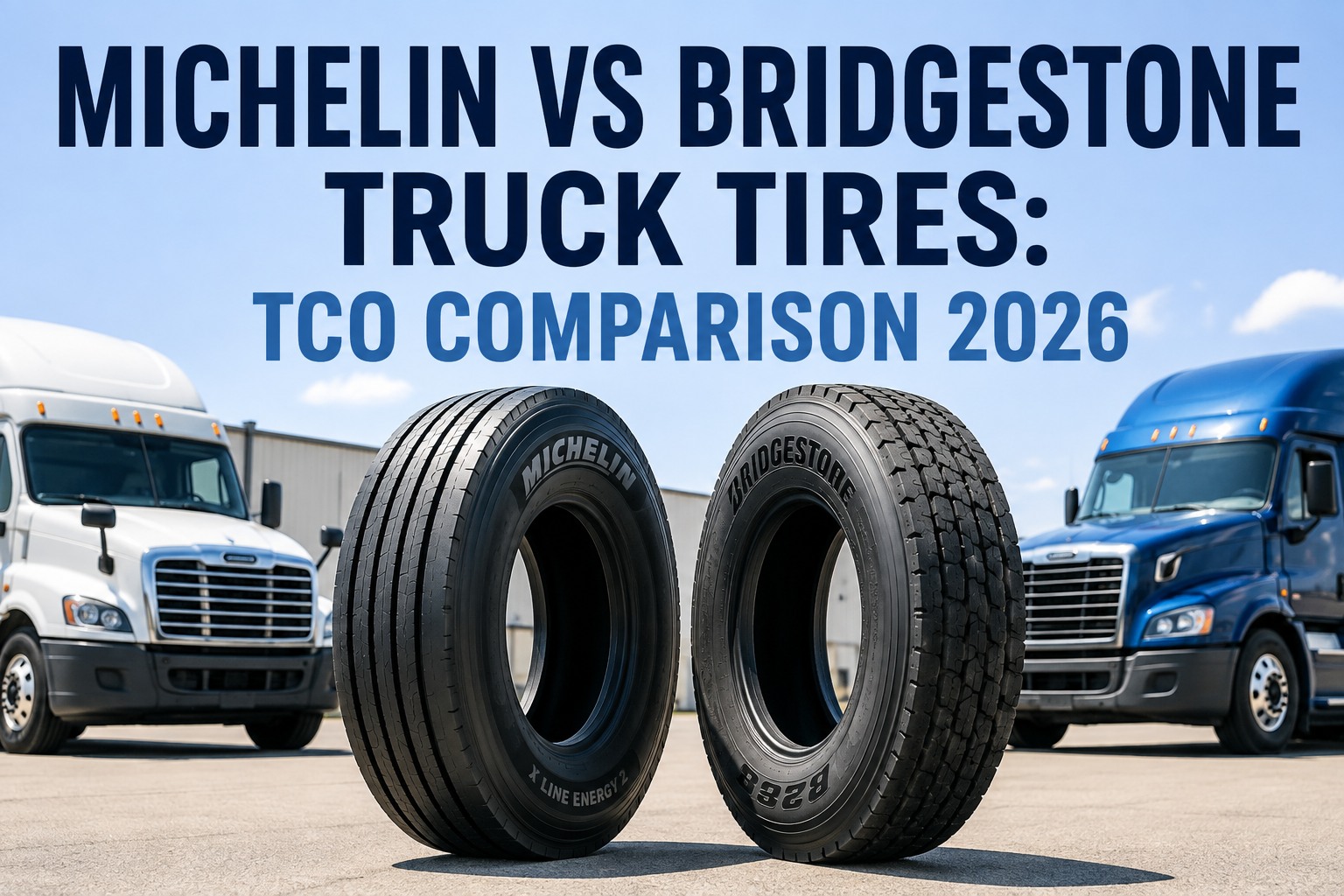
You're standing in front of a spreadsheet with two quotes: a set of Michelin steers at a premium, and a comparable Bridgestone set that saves you real money per casing today. The michelin vs bridgestone truck tires debate almost always starts here — at the purchase price — and that's exactly where fleets lose money. The cheaper sticker can quietly become the more expensive tire once fuel burn, tread life, retreads and downtime are counted. This page breaks the two brands down on total cost per mile, not brand reputation. Book a demo once you've seen how the math actually shakes out.
Both brands are genuinely excellent. Michelin and Bridgestone are the two largest tire makers on earth, and at the same application and price point the gap is often smaller than the marketing suggests. But "smaller" isn't "zero," and on a fleet running millions of miles a year, a fraction of a cent per mile is a five-to-six-figure swing. Below, we compare them the way a fleet actually should — by axle position, by mission and by measured cost per mile.
Michelin vs Bridgestone truck tires: the TCO snapshot
Before the detail, here's the head-to-head at a glance. These are directional tendencies drawn from manufacturer specs and independent fleet commentary — not universal verdicts, because the right answer flips with tire model, axle, load, route and how disciplined your retread program is.
| TCO factor | Michelin | Bridgestone | What it means for your CPM |
|---|---|---|---|
| Purchase price | Higher upfront (premium tier) | Often lower on comparable line | Lower sticker helps cash flow, not always CPM |
| Fuel / rolling resistance | X Line Energy line very strong | Ecopia line very strong | Both SmartWay-focused; tiny gaps, huge fuel dollars |
| Tread / removal mileage | Class-leading longevity reputation | Competitive; some claim longer on rough surfaces | More miles per casing lowers cost per mile directly |
| Casing / retreadability | Infini-Coil casing, up to ~1M mi / 4 retreads | Bandag retread network, strong casing value | Retreads are where real TCO is won or lost |
| Dealer / service network | Michelin Commercial Service Network | Very broad dealer + Bandag footprint | Faster service = less downtime cost per event |
| Best-fit mission | Long-haul fuel economy, max casing life | Regional, mixed-surface, rugged duty | Match tire to route, not to reputation |
Bottom line up front: Michelin tends to win on long-haul fuel economy and casing longevity, while Bridgestone tends to win on upfront value and rugged regional duty. Neither is universally cheaper — the winner is decided by your route, load and retread discipline. The only way to know for sure is to measure cost per mile on your own trucks, which is exactly what a quick HVI demo shows you.
The 5 costs hiding inside every truck tire
Purchase price is one number. Cost per mile is five. Here's the full stack that decides which brand actually wins on your P&L — and why the cheapest casing on the loading dock is often the most expensive one on the road.
Purchase price
The only cost most buyers compare — and the smallest slice of lifetime spend. Michelin usually sits at the top of the premium tier; Bridgestone's comparable lines often land a little lower. Real, but rarely decisive.
Fuel (rolling resistance)
The biggest hidden cost by far. Lower rolling resistance means fewer gallons burned per mile. Michelin's X Line Energy and Bridgestone's Ecopia lines both chase this hard — and both are SmartWay-focused.
Tread / removal mileage
More miles before pull-point spreads the price over more distance. Michelin's longevity reputation is well earned; Bridgestone stays competitive and some fleets report it holding up better on gravel and dirt.
Casing & retreadability
Where TCO is truly won. A casing that retreads two or three times cuts your per-mile tire cost dramatically. Michelin's Infini-Coil casing and Bridgestone's Bandag network both make the second and third life cheap.
Downtime & road calls
A blowout on a shoulder costs far more than the tire — road service, lost load time, CSA exposure. Both brands run wide service networks, so the deciding factor is how fast you catch problems before they strand a truck.
Add these five up and the picture flips constantly. A Bridgestone that's $40 cheaper but burns slightly more fuel and retreads once instead of twice can cost more per mile than the pricier Michelin — or vice versa on a different route. Start a free HVI trial and you can log all five factors per tire instead of guessing.
Compare by axle position, not by brand
The single biggest mistake in the michelin vs bridgestone truck tires question is treating a whole brand as one product. A fleet doesn't buy "Michelin" — it buys a steer tire, a drive tire and a trailer tire, and each competes on different terms. Here's how the two stack up position by position.
Notice the pattern: each maker's internal testing favors its own tire. That's normal — and it's exactly why fleet-measured data beats any brochure. The tire that wins on your trucks is the one your own mileage and fuel logs say wins. See how HVI captures that per position.
Where the money actually goes: a cost-per-mile breakdown
To make this concrete, here's how a single drive tire's lifetime cost splits across the five factors. The exact numbers vary by fleet, but the shape holds nearly everywhere: purchase price is a minority of what you spend, and fuel plus retread value dominate.
This is why brand-versus-brand purchase-price arguments miss the point. If fuel is ~40% of the cost and purchase price ~30%, a tire that's 10% pricier but 5% more fuel-efficient and retreadable one extra time can easily deliver a lower total cost per mile. The premium brand isn't automatically the expensive choice — and the cheap brand isn't automatically the value choice.
The numbers every fleet should know before choosing
Tire decisions don't happen in a vacuum — they happen against a backdrop of rising fleet costs. A few current data points that frame just how much this choice is worth:
Industry-average tire cost per mile (parts and labor) in 2025, up 6.4% year over year, according to ATRI's 2026 Operational Costs of Trucking report.
Average annual tire spend per truck, per ATRI data cited by FinditParts — a line item big enough that small per-mile gaps compound fast.
Casing life Michelin designs its X Line Energy D+ to reach with up to 4 retreads — the clearest example of why casing value drives TCO.
Tire-wear cost reduction Bridgestone cites from retreading an Ecopia casing three times with Bandag — proof the second and third life is where savings live.
On a 100-truck fleet running 100,000 miles each per year, a single cent per mile is roughly $100,000 annually. That's the stakes hidden inside "which brand is cheaper." The U.S. DOT also reports that underinflated tires alone waste millions of gallons of fuel daily nationwide — a reminder that how you manage the tire often matters more than which brand you bought. Book a demo to see your real tire CPM before your next big order.
From a fleet manager who ran both brands side by side
For years I bought whichever brand the last rep talked me into. When we finally started tracking cost per mile by position, the picture wasn't what either sales guy told me. Our Michelin drives were genuinely cheaper per mile on the long lanes because of fuel and a clean second retread. But on our regional gravel routes, the Bridgestones outlasted them and the lower buy-in won.
The lesson wasn't "brand X beats brand Y." It was that I'd been guessing. Once I had removal miles, retread counts and fuel trends in one place, I stopped picking a brand and started picking a tire for the route. That change alone took a couple cents off our tire line.
So which should your fleet buy?
There's no universal winner — and any article that declares one is selling you something. Instead, match the tire to the mission:
- You run long-haul highway lanes where fuel economy dominates TCO
- You run a disciplined multi-retread program and want maximum casing life
- You keep trucks and casings long enough to capture second and third lives
- Even wear and wet performance are top priorities on steer positions
- You run regional or mixed-surface duty with more scrub and rougher roads
- Upfront cash flow and lower buy-in price matter to your budget cycle
- You value a very broad dealer footprint for fast local retread turnaround
- Your routes favor ruggedness and comfort over squeezing every last MPG
The honest answer to michelin vs bridgestone truck tires is: run both, measure both, and let cost per mile decide per route and per axle. The brands are close enough that the real savings come from managing tires well — correct inflation, timely pulls, clean casings for retreading — not from swearing loyalty to one logo. That's the gap HVI is built to close.
People also ask
Neither is universally better. Michelin tends to lead on long-haul fuel economy and casing longevity; Bridgestone tends to lead on upfront value and rugged regional duty. The better choice depends on your route, load and retread strategy.
The one that delivers the most miles per dollar across new tread plus retreads, minus fuel burned. Premium fuel-efficient lines from both brands often beat cheaper tires on cost per mile despite a higher sticker.
Michelin has a strong, well-documented longevity reputation, and its casings are engineered for high mileage and multiple retreads. Bridgestone stays competitive and some fleets report it wearing better on gravel and dirt.
Bridgestone's comparable commercial lines often carry a lower purchase price. But cheaper upfront doesn't guarantee a lower total cost per mile once fuel, tread life and retreads are counted.
Frequently asked questions
How do I actually calculate cost per mile for Michelin vs Bridgestone on my fleet?
Cost per mile is total lifetime cost divided by total miles delivered. For each tire, add the purchase price, an allocation of fuel cost tied to its rolling resistance, and any mounting and maintenance cost, then subtract the value recovered through retreading the casing. Divide that net figure by the removal miles on the original tread plus the miles from each retread life. Do this for a representative set of Michelin tires and a matched set of Bridgestone tires in the same axle position and route type, and compare the two averages. The reason this is hard to do by hand is data collection: you need clean removal-mileage records, retread counts, fuel trends and replacement reasons for hundreds of tires. Fleet software like HVI captures those data points automatically as tires are inspected, rotated, pulled and retreaded, so the cost-per-mile comparison is a report you pull rather than a spreadsheet you rebuild every quarter. Book a demo to see the calculation run on real data.
Does the fuel-efficiency difference between the two brands really matter?
Yes, more than most fleets expect, because fuel is typically the single largest share of a tire's lifetime cost. Both Michelin's X Line Energy lines and Bridgestone's Ecopia lines are engineered specifically for low rolling resistance and are aligned with the EPA's SmartWay program, so the gap between them is often small. But small matters at scale: a fraction of a mile per gallon across a fleet running hundreds of thousands of miles annually translates into real money. Each maker's own testing tends to favor its own tire, so the only reliable way to know which line saves your fleet more fuel is to trend your own miles-per-gallon against tire changes. The brand comparison is really a rolling-resistance comparison, and rolling resistance is a per-model, per-position spec, not a whole-brand trait.
How important is retreadability to total cost of ownership?
It's often the deciding factor. A premium casing that safely retreads two or three times spreads the original purchase price across two or three tread lives, which dramatically lowers cost per mile. Michelin designs casings such as the X Line Energy D+ to reach very high total mileage with multiple retreads, and Bridgestone's casings feed its Bandag retread network, which the company says can cut tire-wear costs meaningfully after repeated retreads. The catch is that retread value only materializes if the casing comes back clean — which means correct inflation, timely removal before the casing is damaged, and good inspection discipline throughout the tire's first life. A fleet that runs tires to destruction destroys casing value regardless of which brand it bought. This is why tire management practices frequently move the cost-per-mile needle more than the brand choice itself.
Should I standardize my whole fleet on one brand?
Standardizing simplifies purchasing, inventory and retread logistics, and there's real operational value in that. But standardizing on a single brand across every route and axle can leave money on the table if your operation mixes mission types — for example, long-haul highway lanes where fuel economy dominates alongside regional gravel routes where ruggedness and lower buy-in win. Many well-run fleets standardize by application rather than by brand: one preferred tire for highway drive positions, another for regional steers, and so on, chosen on measured cost per mile. The right level of standardization depends on your fleet's diversity and your team's capacity to manage multiple SKUs. The prerequisite either way is data — you can't optimize a mixed strategy without tracking performance by tire, position and route.
Can fleet software really settle the Michelin vs Bridgestone question?
It can't pick a brand for you, but it can replace opinion with evidence — which is usually what the argument is missing. A platform like HVI logs each tire by serial or position, tracks tread depth at every inspection, records removal mileage and the reason for removal, follows the casing through each retread cycle, and captures replacement cost. Layered against fuel trends and vehicle history, that produces a true cost-per-mile figure you can compare brand to brand, model to model, and route to route. Instead of trusting a sales rep's brochure or a driver's gut feel, you see which tire actually delivers the lowest total cost on your trucks, in your conditions. The brands are close enough that this measured, fleet-specific view is where the savings genuinely come from. Start a free HVI trial to begin building that history from your next tire change forward.
The takeaway
The michelin vs bridgestone truck tires decision isn't a loyalty test — it's a math problem. Both brands make excellent commercial tires, and at matched applications the gap is narrow. Michelin generally rewards long-haul fuel economy and long casing life; Bridgestone generally rewards upfront value and rugged regional duty. But the real savings — the couple of cents per mile that add up to six figures on a mid-sized fleet — come from measuring cost per mile by tire, position and route, then buying accordingly and managing casings well enough to retread them. Pick the tire the data points to, not the logo the last rep favored.
Turn the tire debate into a tracked number
HVI records every tire by position, mileage, tread depth, removal reason, retread cycle and cost — then calculates true cost per mile across brands so you buy on evidence, not reputation. Digitize tire inspections, catch problems before they strand a truck, and see which tire actually wins on your fleet. Live in under two weeks.
No credit card · Track your first tire from day one · Cost-per-mile reporting built in