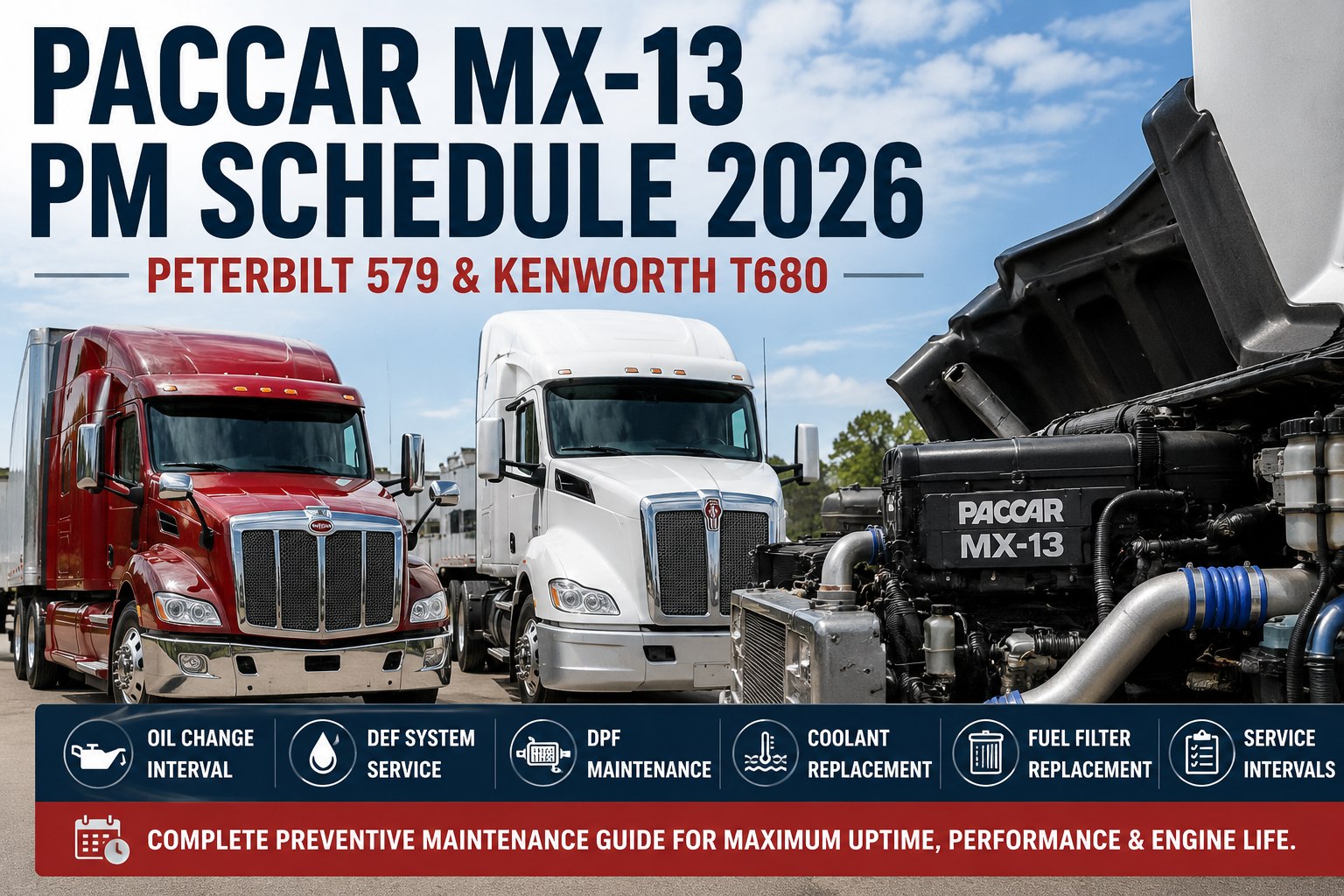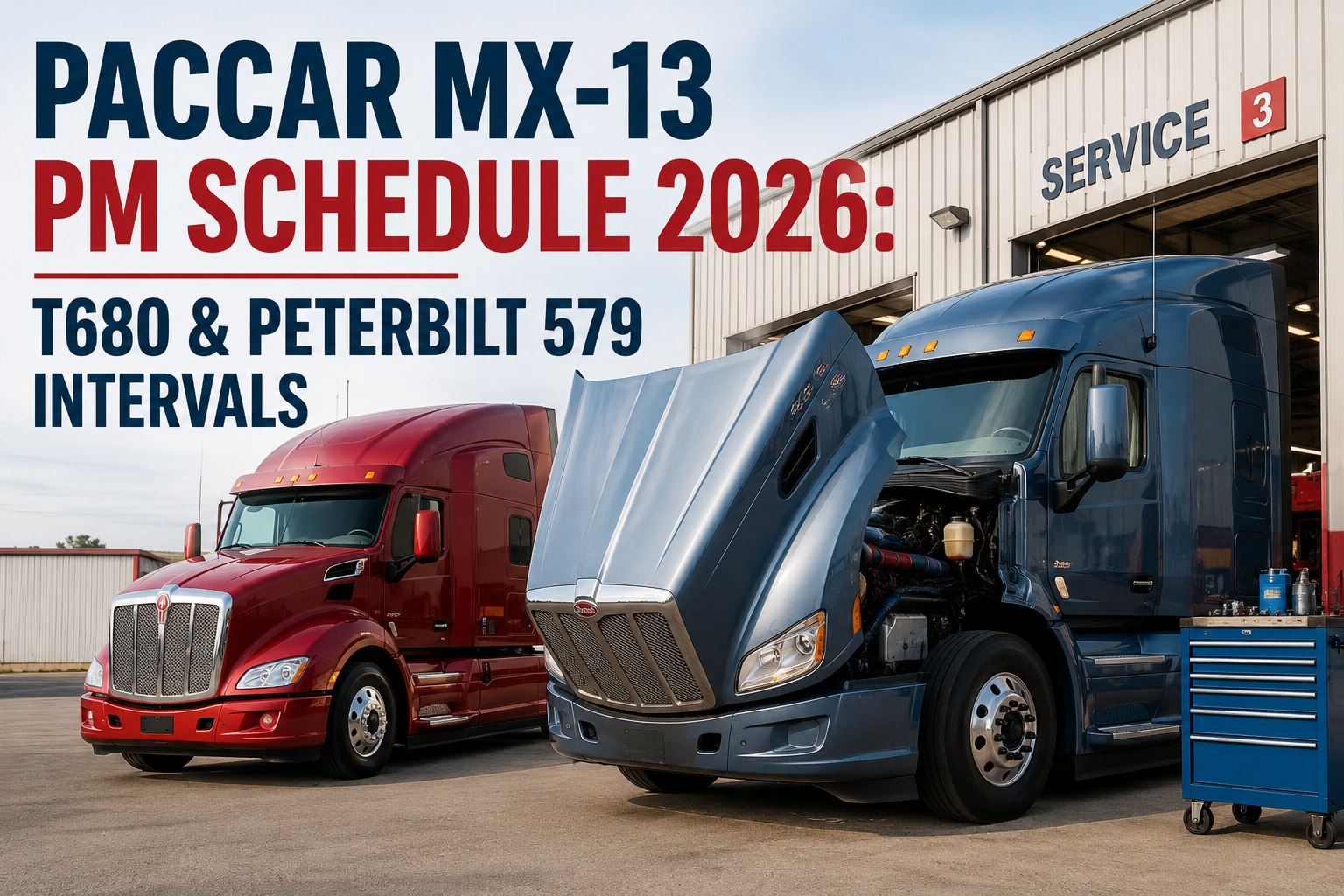
The paccar mx-13 pm schedule is one engine in two trucks — the Kenworth T680 and Peterbilt 579 — but TruckTech+ and SmartLINQ don't talk to each other, and mixed fleets end up running two disconnected PM systems for one engine. This guide walks the MX-13 OEM interval matrix, the chassis items where T680 and 579 diverge, and how to run one unified PM strategy across the whole fleet. Book a demo to see mixed PACCAR fleets managed as one in HVI.
One Engine. Two Trucks. One PM Strategy.
The MX-13 is identical in a Kenworth T680 and a Peterbilt 579. The service systems around it aren't.
The PACCAR MX-13 is a 12.9-liter inline-six diesel engine rated 405-510 hp with peak torque of 1,450-1,850 lb-ft, and it powers the two most common Class 8 tractors on North American highways: the Kenworth T680 and the Peterbilt 579. Both trucks share the same MX-13 engine, same 42-quart oil capacity, same aftertreatment architecture, same 1,000,000+ mile design life. What they don't share is the service ecosystem around the engine — and that gap is what turns mixed PACCAR fleets into two parallel maintenance operations instead of one.
Why Mixed T680 + 579 Fleets Run Two PM Systems
The engine is one platform, but the trucks are separate product lines under two different OEM brands, each with its own dealer network, telematics, and service software. Fleets with both models routinely end up managing what should be one PM strategy through two disconnected data streams. Book a demo to see both brands unified in one HVI view.
- TruckTech+ telematics dashboard
- Kenworth dealer service intervals
- PACCAR Solutions parts catalog
- Kenworth-specific fault codes
- SmartLINQ telematics dashboard
- Peterbilt dealer service intervals
- PACCAR Solutions parts catalog
- Peterbilt-specific fault codes
Same Engine, Two Chassis: What's Actually Shared vs Different
The distinction matters because PM planning splits along the same line. Engine-side items are identical across brands; chassis-side items are where the T680 and 579 diverge.
- MX-13 engine oil & filter
- Fuel filter (two-stage)
- DPF cleaning cycle
- DEF pump & injector
- SCR catalyst & sensors
- Coolant & deaeration system
- Air compressor
- PACCAR TX-12 / TX-18 transmission (where equipped)
- HVAC condenser routing & filter access
- Cab air filter location and part number
- Wiper motor & wash reservoir
- Steer axle greasing points
- Suspension bushing service points
- Interior trim removal for panel access
- Body harness routing (electrical service)
- Telematics data structure & fault-code taxonomy
The MX-13 PM Interval Matrix (Both Trucks)
These are the PACCAR Powertrain-published intervals for the MX-13 engine — identical across the T680 and 579. Duty cycle classification is the single largest variable.
Chassis-Specific PM: Where T680 and 579 Diverge
Engine-side PM is identical. Chassis-side PM is where the two brands require separate playbooks — and where fleet techs often mix up part numbers or service procedures.
Aftertreatment: DPF, DEF, SCR — Identical Across Both Trucks
The MX-13 aftertreatment stack is one of the most under-serviced parts of the PACCAR powertrain. Neglect here surfaces as engine derates — not check-engine warnings — and it's identical across the T680 and 579.
Unifying the Data Layer Across TruckTech+ and SmartLINQ
The mixed-fleet problem isn't the OEM PM intervals — those are already unified by PACCAR Powertrain. The problem is the data layer above the engine, where Kenworth and Peterbilt operate as separate ecosystems. Four data streams need to be normalized to run one PM strategy.
How HVI Runs a Unified PACCAR MX-13 PM Strategy
The four data-layer gaps above are what turn a shared engine platform into two disconnected fleets. HVI closes them in one workflow.
Frequently Asked Questions
Is the PACCAR MX-13 in the Kenworth T680 the same engine as in the Peterbilt 579?
Yes — identically the same PACCAR MX-13 12.9-liter inline-six diesel, produced by PACCAR Powertrain and installed in both Kenworth and Peterbilt Class 8 tractors. Same 42-quart oil capacity, same 405-510 hp range with 1,450-1,850 lb-ft of torque, same aftertreatment architecture, same 1,000,000+ mile design life. Engine-side PM intervals published by PACCAR Powertrain apply identically across both truck platforms. Where the two brands diverge is not the engine but the chassis-specific service items, telematics platforms (Kenworth TruckTech+ vs Peterbilt SmartLINQ), fault code taxonomies, and dealer service ecosystems around it.
What is the PACCAR MX-13 oil change interval?
The MX-13 oil change interval is duty-cycle-dependent. Under linehaul operation with less than 20% idle time using API CK-4 oil, PACCAR Powertrain recommends 75,000 miles or 2,250 engine hours — whichever comes first. Linehaul with more than 20% idle drops the interval to approximately 50,000 miles / 1,500 hours. Severe or vocational duty (heavy-haul, off-highway, high stop-start cycles) drops it further to 25,000-30,000 miles. PACCAR's Technical Information Bulletin E256 explicitly warns that mileage alone is insufficient — engine hours, time, fuel consumption, GVW, application, and B6-B20 biodiesel usage all factor into the interval determination. Preferred oil viscosity is SAE 10W-30 API CK-4 or CJ-4.
Can I run one PM software across both my Kenworth T680 and Peterbilt 579 fleet?
Not through the OEM channels — Kenworth TruckTech+ and Peterbilt SmartLINQ are separate platforms that don't share data directly. Both feed different dashboards, use different fault-code labels, and operate as brand-specific ecosystems even though the underlying MX-13 engine is identical. To run one PM strategy across a mixed T680 + 579 fleet, you need a unifying layer that ingests both telematics streams, normalizes the data schemas, applies the shared MX-13 PM matrix, and keeps the chassis-specific service overlays separate per truck model. Try HVI free to see both brands running in one dashboard.
When does the PACCAR MX-13 DPF need service?
DPF cleaning or replacement runs on the same duty-cycle logic as the oil interval. Linehaul with less than 20% idle: 200,000-250,000 miles. Linehaul with more than 20% idle: 150,000-200,000 miles. Severe or vocational duty: 125,000 miles. Regardless of the scheduled interval, forced or active DPF regens occurring more than twice per week on a linehaul unit are a leading indicator that intervals need to shorten — either because idle percentage has crept up, injector fouling is affecting combustion, or the turbo is degrading. Extended DPF life is contingent on clean engine operation upstream; frequent regens shorten actual DPF life below scheduled.
What's the biggest PM difference between the T680 and 579 chassis?
The biggest divergences are in cab access, air filter part numbers, telematics platforms, and dealer service networks — not the engine or powertrain. The cab air filter on a T680 is accessed via the glovebox panel using a Kenworth-specific part; on a 579 it's accessed from behind the passenger seat using a Peterbilt-specific part. HVAC condenser routing at the firewall differs slightly. Steer axle greasing intervals are the same but fitting locations vary. Interior trim removal for panel access follows brand-specific service manual sequences. Fault codes report through different platforms with different taxonomies. Everything engine-side, powertrain, and aftertreatment is identical.
Run the paccar mx-13 pm schedule as One System
HVI ingests TruckTech+ and SmartLINQ telematics, normalizes both data streams, applies the shared MX-13 PM matrix per unit, and keeps chassis-specific service overlays separate for T680 and 579 — the unified fleet PM strategy PACCAR's own ecosystem doesn't deliver. Live in under two weeks. No hardware. No IT project.
No credit card · No hardware · MX-13 PM dashboard ready on day one