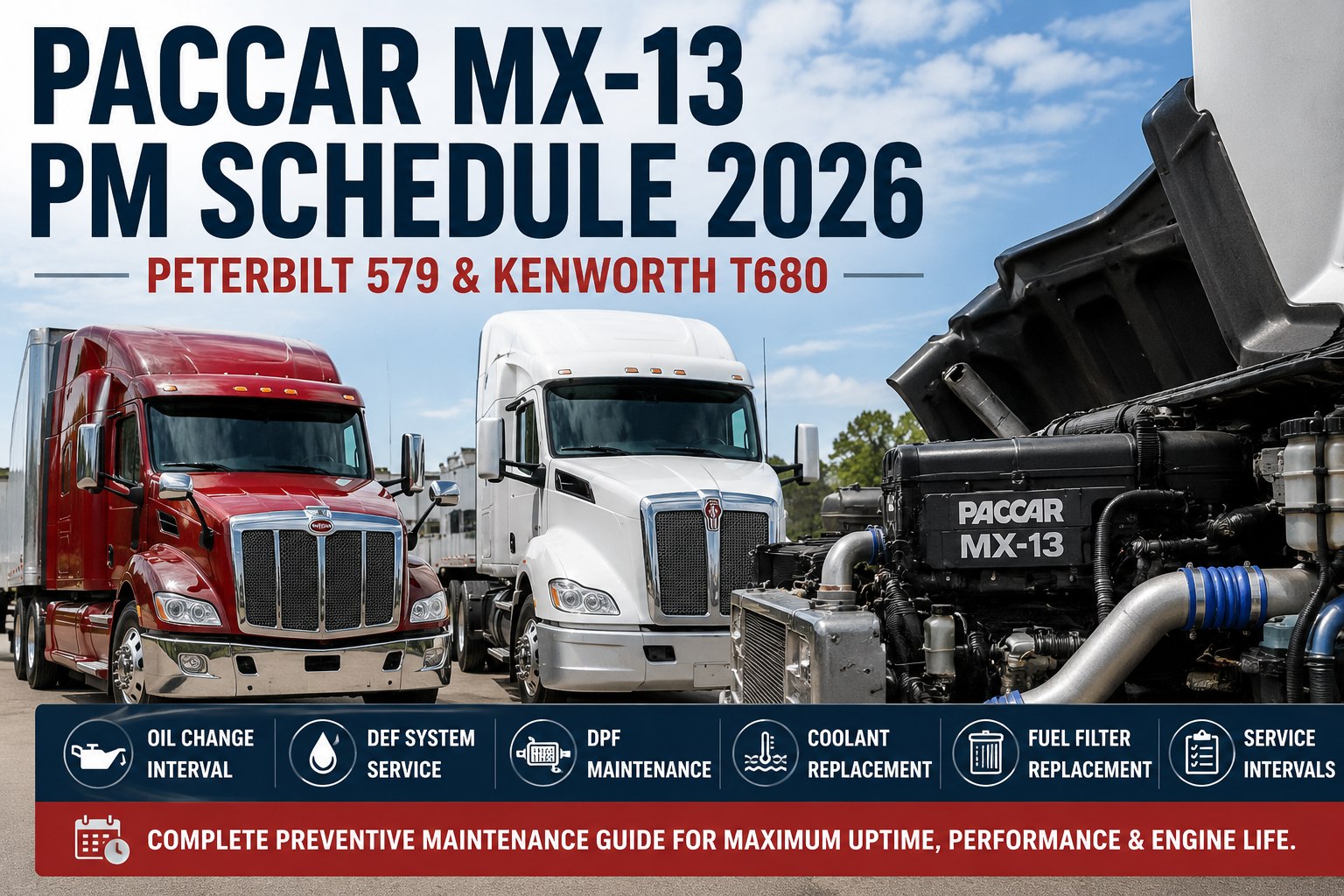
The Peterbilt 579 and Kenworth T680 are the two most common Class 8 tractors on North American highways, and both run the same PACCAR MX-13 12.9L inline-6 diesel — producing 405 to 510 horsepower and 1,450 to 1,850 lb-ft of torque. Same engine, same 42-quart oil capacity, same aftertreatment architecture, same 1,000,000+ mile design life. But the PACCAR MX-13 preventive maintenance schedule is not one schedule — it's three, and choosing the wrong one is what costs owner-operators warranty coverage, causes premature DPF failures, and drains fleet budgets on unnecessary services. PACCAR Powertrain publishes distinct intervals for severe/vocational duty, normal/linehaul with more than 20% idle time, and normal/linehaul with less than 20% idle time. The gap between the three matters: a 75,000-mile oil change on the wrong duty cycle destroys engine bearings; a 30,000-mile change on a light-duty long-hauler wastes $8,000 a year per truck. This guide is the 2026 official reference — the exact PACCAR intervals for oil, fuel, coolant, DEF, and DPF services across all three duty classifications, plus the chassis-specific PM items that differ between the Peterbilt 579 and Kenworth T680. Book a demo to automate all of it by engine hours.
Same engine. Two trucks. Three PM schedules.
The exact PACCAR-published service intervals for the Peterbilt 579 and Kenworth T680 — matched to your fleet's actual duty cycle
Which duty cycle applies to your fleet
The single most important classification decision for any MX-13-powered truck is which of the three duty cycles it operates under. Get this wrong — either aggressive or conservative — and the math on your PM program breaks. Here are PACCAR's own operational definitions, translated into plain language for maintenance managers and owner-operators.
Heavy-duty work applications
The shortest PM intervals. Applies to trucks operating in harsh conditions with high thermal cycling, heavy loads, and stop-and-start duty patterns.
Standard highway with elevated idle
Most regional operators and long-haul fleets with meaningful yard and dock idle time. Idle percentage above 20% (~2 hours per 10-hour driving day) triggers this classification.
Optimized long-haul operations
The longest PM intervals PACCAR authorizes. Reserved for well-managed long-haul operations with disciplined idle reduction and higher MPG averages (typically above 6.0 MPG).
The economic gap between severe and optimized-linehaul intervals is $6,000-$9,000 per truck per year on oil alone. Getting the classification right — and enforcing it consistently — is where a real PM program pays for itself. Book a demo to see duty-cycle-aware PM scheduling configured on your fleet
The 6 critical MX-13 PM services explained
Each service in the interval matrix has its own operational context. Here's what a maintenance manager or owner-operator needs to know about executing each one correctly on a Peterbilt 579 or Kenworth T680.
The MX-13 requires 42 quarts of API CK-4 or CJ-4 10W-30 oil in normal ambient temperatures (5W-30 for climates below 5°F). Both the full-flow oil filter and centrifugal filter are replaced at each interval. The oil interval is also capped at 1,200 engine hours — whichever threshold hits first triggers the service. High-idle trucks routinely hit the hour threshold before the mileage threshold, which is why hour-based PM tracking is essential.
The MX-13 fuel system uses a two-stage filtration setup — both the suction-side and pressure-side filters must be replaced together at each interval. Located on the left side of the engine viewed from the driver's seat. Use of poor-quality fuel or extended idle in dusty environments may require more frequent replacement. Non-genuine filters can cause low-pressure fuel fault codes or severe engine damage.
The MX-13 uses OAT-based Extended Life Coolant (ELC), which is a nitrite-free formulation. The SCA-charged coolant filter is replaced on interval, but the coolant itself is designed for up to 750,000 miles of service life with proper testing. Maintain coolant level at all times — running low damages the water pump and cylinder head over time. Never mix OAT and conventional coolants; contamination fouls the SCR system.
The DEF filter is part of the SCR (Selective Catalytic Reduction) aftertreatment system that converts NOx emissions into nitrogen and water. Replaced at 300,000 miles across all duty cycles. Never run the DEF tank empty — low-DEF derates engine power to 5 mph as a compliance safeguard. DEF consumes at roughly 2-3% of fuel usage under normal operation, so a truck burning 20,000 gallons of fuel per year uses about 500 gallons of DEF.
Diesel Particulate Filter dry cleaning removes accumulated ash that passive and active regenerations can't burn off. Performed by a certified PACCAR dealer using a dedicated pneumatic cleaning machine that reverses airflow through the filter substrate. The 300,000-mile interval is fixed across all duty cycles — severe-duty trucks reach it sooner in calendar time, not sooner in mileage.
The deep-clean cycle. Wet cleaning uses controlled chemical baths and thermal cycles to remove deposits dry cleaning cannot reach. Performed at 600,000 miles — typically once in a well-managed truck's service life before end-of-lease resale. A missed wet clean at the 600K mark is one of the most common causes of unexpected DPF failure between 700K-800K miles.
Each of the six services is governed by mileage or engine-hour thresholds — whichever hits first. Fleets tracking only mileage routinely miss the 1,200-hour oil trigger on high-idle trucks and end up doing severe-duty maintenance on the wrong schedule. Book a demo to see hour-based MX-13 PM scheduling live on your fleet
Peterbilt 579 vs Kenworth T680 — chassis differences that affect PM
The MX-13 engine is identical between the two trucks. But the chassis, cab, aftertreatment plumbing routing, and OEM-specific service points differ — and these affect a handful of PM-adjacent items that maintenance managers should track separately.
The 579 and T680 share so much underlying architecture that most PM procedures port cleanly between them. Fleets running mixed Peterbilt/Kenworth rosters can use identical PM templates for the MX-13 portion of the service — only the chassis-specific items above need OEM-specific work orders. Start a free trial with pre-loaded MX-13 PM templates for both platforms.
DPF and DEF — the aftertreatment side maintenance managers most often ask about
Aftertreatment failures are the most expensive avoidable events on any MX-13-powered truck. Understanding how the DPF and DEF systems work — and what triggers each service — keeps a $200,000 truck out of a $12,000 repair bill.
Traps soot from diesel combustion. Cleared through three cleaning modes:
- Passive regen: Normal exhaust heat during highway driving burns off accumulated soot continuously. Requires sustained temperatures — extended idle prevents it.
- Active regen: ECM injects extra fuel into the exhaust to raise DPF temperature and burn accumulated soot. Truck signals it to the driver. Duration 20-40 minutes.
- Stationary regen: Driver-initiated regen while parked, required if the truck can't complete active regen during operation. Never ignore an illuminated DPF warning lamp.
- Ash removal: Dry cleaning at 300K mi and wet cleaning at 600K mi remove non-combustible ash that regen cycles can't handle.
Injected into the SCR catalyst to convert NOx into nitrogen and water. Three operational rules:
- Never run the tank empty: Low-DEF derates the engine to 5 mph as a federal compliance safeguard. Refill before the gauge hits E.
- Consumption rate: Roughly 2-3% of diesel fuel volume. A truck burning 20,000 gal/yr uses ~500 gal DEF.
- DEF filter replacement: 300,000 miles across all duty cycles. Contaminated DEF fouls the SCR catalyst — use ISO 22241-compliant fluid only.
Both DPF and DEF service costs run into the tens of thousands when neglected — but stay under $1,500 per event when maintained on PACCAR-published intervals. The economics of aftertreatment maintenance always favor prevention. Book a demo to see DPF regen tracking and DEF consumption monitoring on your MX-13 fleet
Common MX-13 issues to watch for
The MX-13 is one of the most reliable heavy-duty diesel engines in the North American market — low-wear oil-analysis reports are the norm, not the exception. But four specific issues account for most of the maintenance escalations fleets experience.
Idle below 850 RPM in ambient below 25°F prevents the DPF from staying at regen temperature. Solution: raise idle to 1,000 RPM in cold conditions until coolant hits 150°F, then drop back to 850. Prevents packed-soot DPF fault codes.
Aftermarket fuel filters with wrong part numbers cause low-pressure fault codes and can cause severe engine damage. Only use genuine PACCAR fuel filters. This is the single most common warranty claim on MX-13 engines.
High-idle trucks hit the hour cap before the mileage cap. Fleets tracking only mileage miss it. Solution: hour-based PM scheduling. This is where telematics-driven PM programs deliver measurable value on MX-13-powered fleets.
Never top off OAT ELC with conventional green coolant. Contamination fouls the SCR system and can cause catastrophic aftertreatment failure. Cost of the mistake: $8,000-$15,000 in repairs. Cost of doing it right: correctly labeled coolant containers in the shop.
Every issue on this list is preventable with disciplined shop practices and the right maintenance software tracking the correct duty cycle for each truck. Start a free trial to configure duty-cycle-aware MX-13 PM tracking on your fleet this week.
From a shop foreman running 62 MX-13-powered tractors
We run 40 Peterbilt 579s and 22 Kenworth T680s, all MX-13. Same engine, same PM procedures, but we had six trucks a year drift out of duty-cycle spec — construction-support runs classified as normal linehaul, or idle-heavy regionals classified as optimized. We were servicing early on some and late on others. Two premature DPF failures in one quarter finally forced the conversation.
The fix was hour-based scheduling instead of mileage-only. Every truck gets classified against actual telematics data — if idle percentage crosses 20%, the schedule shifts automatically. First year post-implementation: zero premature DPF failures, $340,000 in avoided repairs, and our PACCAR warranty rate came in the lowest it's been in five years. The PACCAR intervals are correct. The problem was never the schedule — it was matching each truck to the right column.
Frequently asked questions
What is the PACCAR MX-13 oil change interval?
PACCAR publishes three official oil change intervals for the MX-13 depending on duty cycle: 30,000 miles (48,000 km) for severe or vocational duty applications including construction, refuse, concrete, and heavy equipment hauling; 50,000 miles (80,000 km) for normal linehaul operations with more than 20% idle time; and 75,000 miles (120,000 km) for normal linehaul operations with less than 20% idle time and above 6.0 MPG averages. All three intervals are also capped at 1,200 engine hours — whichever threshold hits first triggers the service. High-idle trucks routinely reach the hour cap before the mileage cap, which is why engine-hour-based PM tracking is essential rather than mileage-only. Oil specifications call for API CK-4 or CJ-4 classified 10W-30 in normal ambient temperatures, or 5W-30 in climates below 5°F. Total oil system capacity for the MX-13 is 42 U.S. quarts (40 liters). Extending intervals beyond PACCAR's published recommendations decreases engine life through corrosion, deposits, and accelerated wear — the 75,000-mile interval is only authorized for operators disciplined about idle management and fuel economy.
Do the Peterbilt 579 and Kenworth T680 use the same PM schedule?
Yes for the engine, mostly yes for the aftertreatment, and no for chassis-specific items. Both trucks use the identical PACCAR MX-13 12.9L engine, share the same PACCAR-published PM intervals for oil, fuel filter, coolant filter, DEF filter, DPF dry cleaning, and DPF wet cleaning, and use the same 42-quart oil capacity with CK-4/CJ-4 10W-30 specification. Chassis-specific items differ: cab air filter location (behind driver-side dash panel on 579, behind glove box on T680), DPF service access clearance (T680 has slightly more room), roof fairing designs (different fatigue patterns on high-mileage units), and specific aerodynamic panel checkpoints. Both platforms use PACCAR MX-13 fuel filters located on the left side of the engine as viewed from the driver's seat, use identical OAT-based Extended Life Coolant, and follow the same DPF regeneration protocols. Fleets running mixed 579/T680 rosters can use identical MX-13 PM templates for the engine portion of the service, with only the chassis-specific items requiring OEM-specific work orders. This makes mixed-brand PACCAR fleets significantly easier to maintain than fleets mixing different engine families.
How often does an MX-13 DPF need cleaning?
The PACCAR MX-13 Diesel Particulate Filter requires two distinct cleaning services at PACCAR-published intervals. Dry cleaning at 300,000 miles (480,000 km) removes accumulated ash that passive and active regeneration cycles cannot burn off. Performed by a certified PACCAR dealer using a pneumatic cleaning machine that reverses airflow through the filter substrate. Wet cleaning at 600,000 miles (965,000 km) is the deep-clean cycle that uses controlled chemical baths and thermal cycles to remove deposits dry cleaning cannot reach. Both intervals are fixed across all three duty cycle classifications — severe-duty trucks reach them sooner in calendar time, not sooner in mileage. Between these scheduled services, the DPF is cleaned continuously through passive regeneration during normal highway driving, and through active regeneration triggered by the ECM when soot loading reaches thresholds. Stationary regeneration may be required if the truck cannot complete active regeneration during operation — never ignore an illuminated DPF warning lamp, as continued operation with a blocked DPF can cause thousands of dollars in aftertreatment damage. Missing the 600,000-mile wet clean is one of the most common causes of unexpected DPF failures between 700,000 and 800,000 miles.
What DEF (Diesel Exhaust Fluid) does the MX-13 use?
The PACCAR MX-13 uses ISO 22241-compliant Diesel Exhaust Fluid, which is a solution of 32.5% high-purity urea and 67.5% deionized water. Any DEF meeting the ISO 22241 specification is compatible — brand doesn't matter, only compliance with the standard. DEF is injected into the SCR (Selective Catalytic Reduction) catalyst where it reacts with nitrogen oxide emissions to produce nitrogen gas and water vapor, meeting EPA 2010+ emissions standards. Consumption runs at roughly 2-3% of diesel fuel usage under normal operation, so a truck burning 20,000 gallons of fuel per year uses approximately 500 gallons of DEF. Never allow the DEF tank to run empty — the engine derates to 5 mph as a federal compliance safeguard when DEF is exhausted, and cannot be restored until refilled. The DEF filter (part of the SCR system) is replaced at 300,000 miles across all duty cycles under PACCAR's published intervals. Contaminated DEF from non-compliant sources can foul the SCR catalyst and cause $8,000-$15,000 in aftertreatment repairs — only use ISO 22241 compliant fluid from reputable sources.
Can I extend the MX-13 oil interval to 75,000 miles?
Only if your operation genuinely qualifies as normal linehaul with less than 20% idle time. PACCAR authorizes the 75,000-mile (120,000 km) oil interval only for MX-13 engines model year 2017 and newer operating under strict conditions: idle time consistently below 20% of engine-on hours, fuel economy averaging above 6.0 MPG, use of certified API CK-4 oil, and disciplined operational practices supporting idle reduction. Trucks that don't meet all four criteria default to the 50,000-mile interval (normal linehaul >20% idle) or 30,000-mile interval (severe/vocational duty). Verifying which classification applies requires telematics data — specifically idle percentage and running MPG — captured over 90+ days of operating history. Fleets that extend intervals beyond what their actual duty cycle authorizes see accelerated engine wear, premature bearing failures, and voided warranty claims. The economic upside of the 75,000-mile interval is significant ($6,000-$9,000 per truck per year in oil and labor savings versus the 30,000-mile schedule), but only if the underlying operational discipline supports it. This is where telematics-driven PM programs deliver measurable value — the system automatically classifies each truck against actual usage patterns rather than assumed duty cycles.
Peterbilt 579. Kenworth T680. One PM program that gets both right.
HVI reads live ELD data from your MX-13-powered fleet, classifies each truck against actual duty cycle (idle %, MPG, engine hours), and schedules every PACCAR service — oil, fuel filter, coolant, DEF, DPF — at the correct interval automatically. Never miss the 1,200-hour trigger. Never late on a DPF clean. FMCSA-compliant records built in. Live for your fleet in under two weeks.
No credit card · Works with Samsara, Motive, Geotab · MX-13 templates pre-loaded