You're hauling 44,000 pounds of boxed beef from Omaha to Miami, and three hours into the run the reefer alarm screams. By the time you find a safe pull-off, the return-air sensor is reading 38°F and climbing on a load that was supposed to be locked at 28°F. A single warm load can cost more than the freight payment, trigger a rejected shipment, and land you in a temperature-abuse claim that takes months to unwind. The reality is that most cold chain failures aren't catastrophic mechanical breakdowns — they're small, missed inspection points like a slipping belt or a disconnected air chute. A proper reefer trailer inspection covers the diesel engine, the refrigeration cycle, and the trailer's ability to deliver that cold air to the back pallets. Start free with HVI to build a digital reefer checklist that catches these failures before the trailer leaves the yard.
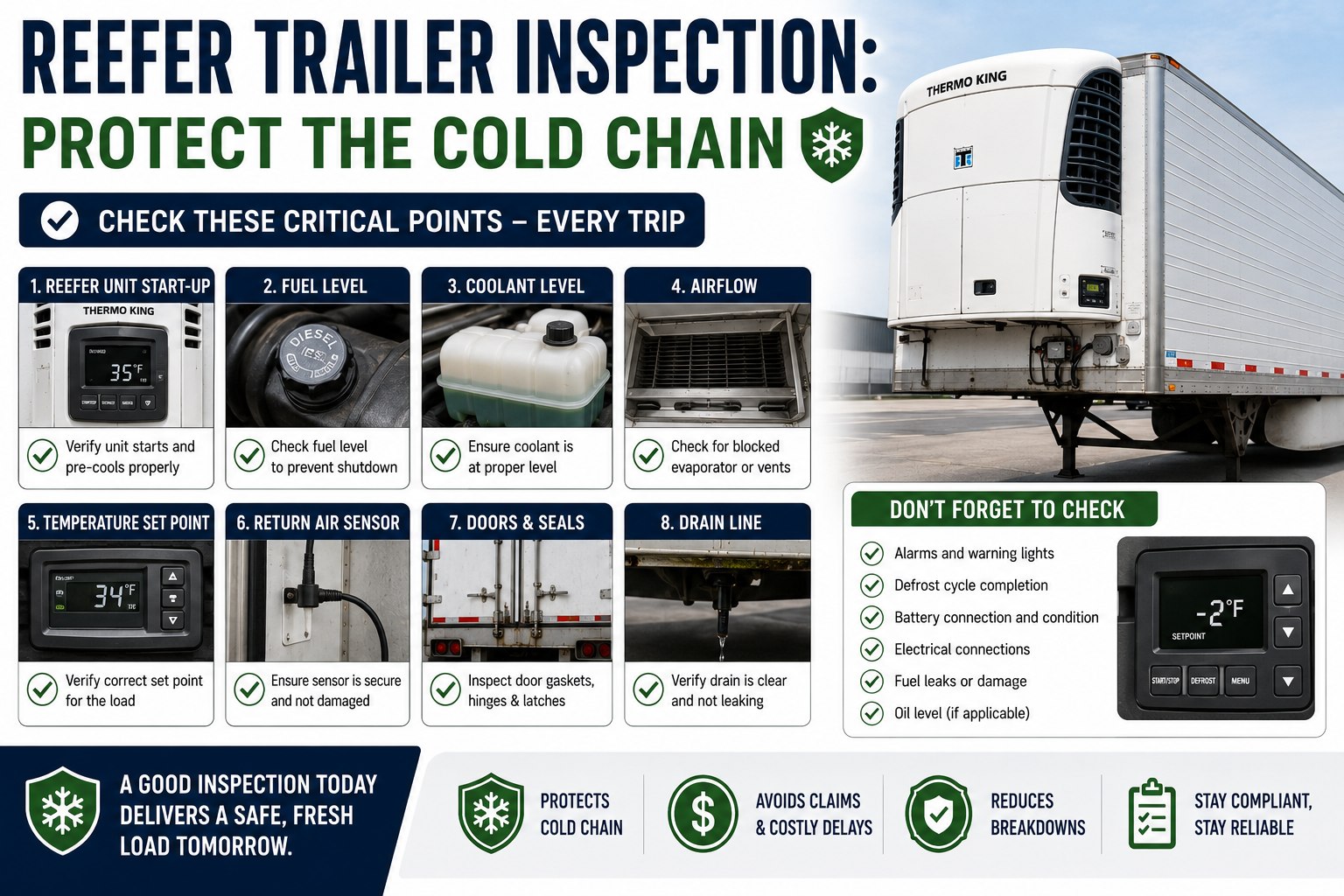
Reefer Trailer Inspection: Protect the Cold Chain
The complete pre-trip inspection workflow for refrigerated trailers — covering the diesel drive engine, the sealed refrigeration system, and the airflow path that actually keeps rear pallets cold.
- Setpoint-10°F (Frozen)
- Return Air-9.8°F
- Fuel Tank78% Full
- ModeContinuous
- 1,800 hrs
annual run-hours logged by a single-temperature reefer unit
Carrier Transicold service data - 40,000 hrs
expected working life of a well-maintained reefer before major rebuild
Industry manufacturer baseline - FSMA
Sanitary Transportation rule requires documented temperature control for food
FDA Food Safety Modernization Act - 3,000 hrs
maximum interval for drive belt replacement on most modern reefer units
OEM maintenance schedules
Why Reefer Inspections Fail Differently Than Dry Van
A standard dry van pre-trip looks at brakes, tires, lights, and suspension. A reefer trailer inspection adds three complex layers that a dry van driver never has to think about: an independent diesel engine, a sealed refrigeration cycle, and a specialized airflow delivery system. If any one of these three layers fails, the trailer becomes a hot box, regardless of how good the tractor pulling it is. The hardest part for maintenance managers is that a reefer unit can run perfectly, sound normal, and show no fault codes — while the cargo at the back of the trailer slowly cooks. You can't just listen for the engine and drive away; you have to verify the physics of the cold air path. See how HVI digitizes reefer workflows to ensure drivers check all three layers every time.
The 3-Layer Reefer Pre-Trip Workflow
A cold chain inspection isn't a single checklist; it's a sequence of verifications across three distinct systems. Skipping a layer is what leads to roadside failures. Here is the step-by-step workflow your drivers and technicians should run before hooking up to a refrigerated load.
Layer 1: The Drive Engine
Fuel · Oil · Coolant · BatteryThe reefer engine runs independently from the tractor. A full tractor tank means nothing if the reefer fuel tank is dry. Running out of fuel mid-route means the unit stops cooling with no warning until the alarm fires — by then, the load is already warming.
- Check reefer fuel tank level separately from the tractor.
- Verify engine oil level and coolant level at the reservoir.
- Inspect battery terminals for corrosion; weak batteries cause Cycle-Sentry stalls.
- Confirm alternator, water pump, and compressor belts are tensioned and uncracked.
Layer 2: The Refrigeration Cycle
Compressor · Condenser · RefrigerantYou don't need to break into the sealed system to know if it's healthy. The sight glass is your primary diagnostic tool. A low reading means the unit is undercharged — it will run continuously, burn extra fuel, and never reach setpoint.
- Check the refrigerant sight glass for bubbles or low charge indicators.
- Clear the condenser coil of bugs, dirt, and road debris blocking airflow.
- Listen for compressor knocking or unusual cycling noises on startup.
- Verify the unit reaches setpoint within 15-20 minutes of activation.
Layer 3: Airflow Delivery
Chute · T-Floor · Seals · SetpointThis is the layer drivers miss most. The unit can be mechanically perfect, but if cold air isn't reaching the rear pallets, the load fails. A torn air chute or blocked T-floor causes the return-air sensor to lie, tricking the unit into throttling back prematurely.
- Inspect the vinyl ceiling air chute for tears, disconnects, or collapse.
- Ensure cargo is not stacked to the ceiling, blocking the front-to-back airflow.
- Sweep the T-floor channels to remove debris blocking the return-air path.
- Verify door seals and gaskets are intact to prevent warm air infiltration.
Continuous Run vs. Cycle-Sentry: The Mode That Kills Batteries
Setting the right operating mode for the cargo is a critical part of refrigerated fleet maintenance. Frozen loads and highly sensitive pharmaceuticals require Continuous Run — the unit never shuts off, maintaining a tight temperature tolerance. Less sensitive loads, like produce, often use Cycle-Sentry, which starts and stops the engine to save fuel. But Cycle-Sentry relies entirely on battery strength to restart the diesel engine after each stop cycle. If the battery is weak, the unit stalls and doesn't restart, silently ending the cold chain overnight while the driver sleeps. Always verify battery health during a reefer pre trip if the unit is set to Cycle-Sentry. Book a demo to map your reefer modes to specific cargo profiles in HVI.
For Frozen & Sensitive Loads
- Engine runs 24/7 without stopping
- Tightest temperature tolerance (±1°F)
- No battery restart required
- Higher fuel consumption
- Best for ice cream, pharmaceuticals, deep frozen
For Chilled & Stable Loads
- Engine starts/stops to maintain setpoint
- Wider tolerance (±3°F to 5°F)
- Heavy reliance on battery for restarts
- Lower fuel consumption
- Best for produce, beverages, ambient goods
The Hidden Cause of Rear-Pallet Spoilage
If you've ever had a receiver reject the last three pallets of a load while the front pallets were rock solid, you've met the air chute problem. The air chute is the flexible vinyl duct running along the ceiling that pushes cold air to the back of the trailer. When it tears, disconnects, or gets blocked by cargo stacked too high, the cold air short-cycles. It dumps out near the front of the trailer, hits the return-air sensor, and the unit thinks the whole box is satisfied. It throttles back. The cargo at the back stays warm. And because the sensor reads cold, zero alarms are triggered.
The unit is working perfectly; it's just being lied to by its own sensor. This is why a visual inspection of the chute and cargo clearance is non-negotiable. A quick flashlight check down the roofline before loading can save a $20,000 produce claim. Build mandatory photo gates for your reefer checks using HVI's digital DVIR.
FSMA Compliance & The Paperwork That Saves You
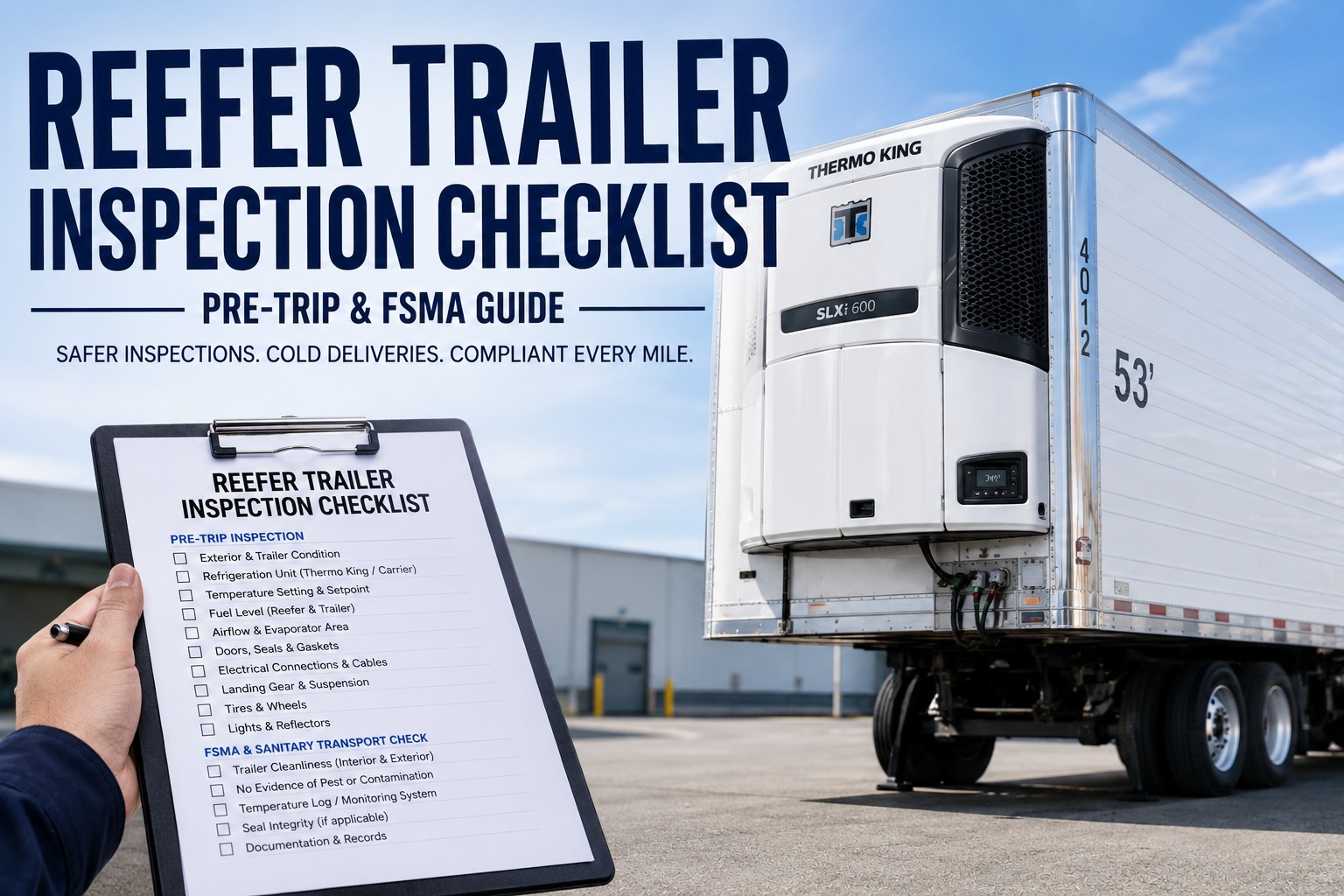
The Food Safety Modernization Act's Sanitary Transportation rule is the regulatory backbone for any food-grade reefer load. FSMA requires verifiable sanitary conditions — clean floors, clear drains, intact chutes — and documented temperature control. It's not enough to have a working compressor; you have to prove the trailer was pre-cooled, set to the right temperature, and clean before loading. When a receiver rejects a load as "temperature abused," a clean, time-stamped inspection record is often the only thing that protects the carrier in a claims dispute. It proves the unit was verified functional and properly set before departure. See how HVI generates FSMA-ready records automatically from your driver's phone.
1,800 Run-Hours/Year
A typical single-temperature reefer logs 1,800 hours annually. That's the equivalent of driving a car 100,000 miles every year in pure engine wear.
10-Month Service Interval
Scheduled service is recommended every 10 months. A mid-interval inspection halfway between services is what catches the belt wear and refrigerant leaks.
40,000-Hour Lifespan
Most units are built for a 40,000-hour working life. Consistent pre-trip checks and mid-interval inspections are what actually get a fleet to that number without an early rebuild.
Expert view from the shop floor
"I spent two years chasing phantom reefer failures. We'd pull the unit, bench-test it, and it would run perfectly. Turns out the drivers weren't checking the air chute — cargo was packed too tight, cold air short-cycled at the nose, and the back pallets cooked while the unit read -10°F. Now, a chute photo is a mandatory gate before the trailer leaves the yard.
-- Marcus S., Fleet Maintenance Manager, regional refrigerated carrier
Frequently asked questions
What is the most common cause of reefer trailer temperature failures?
The most common cause is not a mechanical failure of the reefer unit itself, but an airflow issue. A torn or disconnected ceiling air chute causes cold air to short-cycle at the front of the trailer. The return-air sensor reads cold, the unit throttles back, and the cargo at the back of the trailer warms up without triggering any alarms.
How often should a reefer unit be inspected and serviced?
A reefer pre-trip inspection should be done before every load. Scheduled maintenance is typically required every 10 months or 1,800 run-hours, with a mid-interval inspection recommended halfway between services. Belts should be replaced every 1,500 to 3,000 engine hours depending on the manufacturer.
What is the difference between Continuous Run and Cycle-Sentry modes?
Continuous Run keeps the reefer engine on 24/7 to maintain tight temperature tolerances for frozen or sensitive loads. Cycle-Sentry starts and stops the engine automatically to save fuel on less sensitive loads. Cycle-Sentry relies heavily on battery strength to restart the engine; a weak battery can cause the unit to stall and fail to restart overnight.
How does FSMA impact reefer trailer inspections?
The FDA's Food Safety Modernization Act (FSMA) Sanitary Transportation rule requires verifiable sanitary conditions and documented temperature control for food-grade loads. Carriers must prove the trailer was clean, pre-cooled, and set to the correct temperature before loading. A digital inspection record is often the primary defense in a temperature-abuse claim.
Why do I need to check the reefer fuel tank separately from the tractor?
The reefer unit has its own independent diesel engine and fuel tank. A full tractor fuel tank does not mean the reefer has fuel. If the reefer runs dry mid-route, the unit will stop cooling immediately, often without warning until the temperature alarm fires, by which point the load is already compromised.
Conclusion: The Cold Chain Is Only As Strong As Your Inspection
Protecting a refrigerated load requires more than just turning on the unit and driving away. A proper reefer trailer inspection verifies the diesel engine's fluids and belts, confirms the refrigeration cycle's charge via the sight glass, and physically ensures the air chute and T-floor are delivering cold air to the back of the trailer. From FSMA compliance to avoiding rear-pallet spoilage, the details you check before departure are what keep your cold chain intact and your claims rate low. Stop relying on paper checklists that get skipped in the rain. Digitize your reefer inspection process today and ensure every layer of your refrigerated trailer is verified before the wheels turn.
Put a complete reefer inspection workflow on every driver's phone
HVI guides drivers through the engine, refrigeration, and airflow layers with mandatory photo gates, temperature logging, and FSMA-ready records — so no warm load leaves your yard unnoticed.
No credit card · No hardware · Live on your fleet in under two weeks