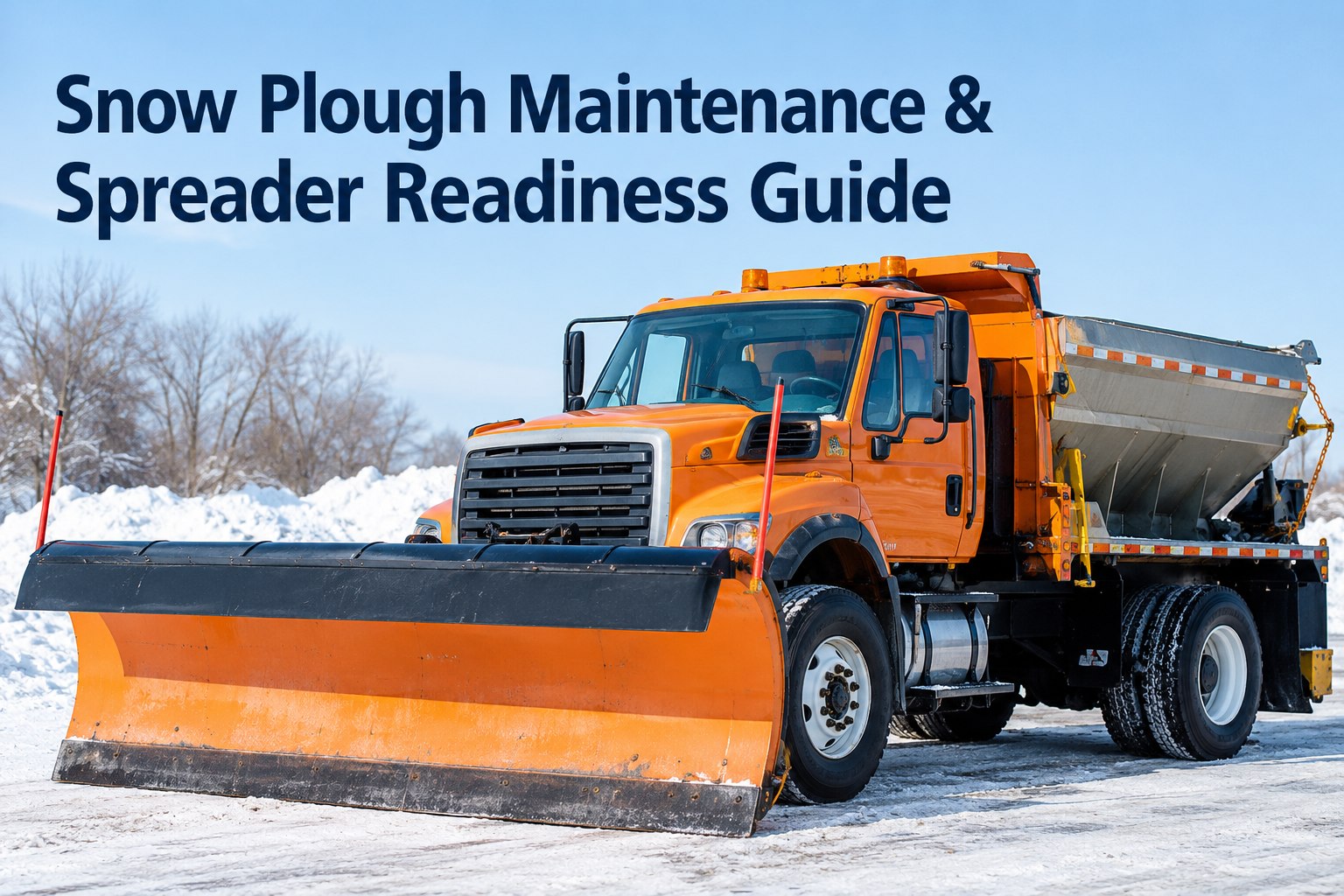
It's 4am, the first real storm of the season is dropping two inches an hour, and truck 14 is sitting in the yard with a spreader that won't spin — nobody caught it in October's walkaround. That is what snow plough maintenance is really about: catching the failure in the yard, not on the road. Below is what actually breaks on winter equipment, why, and the readiness process fleets are running instead — book a demo to see it in action.
Snow Plough Maintenance: The Five Parts That Actually Fail Mid-Storm
Snow equipment doesn't fail randomly. It fails at the same five points, storm after storm, fleet after fleet — because these are the parts doing the most work under the worst conditions, and they're the ones a quick October walkaround tends to skip. Knowing where the stress concentrates is what turns snow plough maintenance from a generic PM checklist into something that actually prevents a breakdown at 2am on route 9.
Hydraulic Lift & Angle Circuit
This is the number-one field call. Cold-cracked hoses, weeping cylinder seals, and low fluid from a slow leak all show up the same way: a blade that won't lift, angle, or holds crooked mid-route. Pressure-test the circuit and check fluid level and condition before the first freeze, not after a hose lets go on a state route.
Cutting Edge & Moldboard
A worn edge doesn't clear the road — it drags a thin film of snow the whole route and burns extra diesel doing it. Carbide and rubber edges wear unevenly depending on surface (asphalt eats them faster than concrete) and need measuring, not eyeballing, against minimum thickness.
Mount, Push Frame & Pins
Elongated pin holes and a cracked or bent push frame turn into a blade that walks sideways under load, chewing up curbs and mailboxes. Torque and inspect mounting bolts and pins on a set schedule — this is the failure that looks fine parked and fails the instant it hits packed snow at speed.
Spreader Chain, Auger & Spinner
Salt and brine are brutal on drivetrain components most operators never look at directly. A stretched chain, a seized auger bearing, or a spinner motor with corroded connectors means a truck driving a route while spreading nothing — and nobody finds out until the ice report comes in the next morning.
Controls, Wiring & Sensors
In-cab controllers, ground-speed sensors, and wiring harnesses live in a spray zone of salt and moisture all season. Corroded connectors cause the most confusing failures — the spreader "works" on the shop floor but drops out cold on the road because a connector only fails under vibration and temperature.
Most of these failures don't show up on a static, parked inspection — they show up under load, in the cold, mid-route. A structured pre-season and in-season inspection catches the early signs (a weeping seal, a stretched chain, a corroding connector) while they're still a five-minute fix instead of a truck off the road. Book a demo to see how HVI schedules these checks automatically by hours and by date so nothing gets skipped between storms.
The Four-Phase Snow Plough Maintenance & Readiness Cycle
Fleets that get through winter without a truck stuck on the shoulder aren't running better equipment — they're running the same equipment on a tighter cycle. Snow plough maintenance and spreader readiness aren't a single fall inspection; they're four phases that each feed the next, and a gap in any one of them shows up as downtime you didn't budget for.
-
1
Fall Fleet Build-Up
Aug – OctPull every plough, spreader and support vehicle out of summer storage and run a full component inspection: hydraulics, mounts, wiring, cutting edges, chain and auger condition. This is also when worn parts still have lead time — a cutting edge or hydraulic hose ordered in September arrives before the season; ordered in December, it arrives after the storm. Book a demo to build a build-up checklist once and reuse it every fall.
-
2
Commissioning & Wet Test
NovMount the plough, load the spreader with material, and run it — angle the blade through full range, cycle the lift, and run the spreader at multiple ground speeds to confirm it's throwing an even pattern before the first snow. A truck that "checks out" sitting still can still fail this step, which is exactly why it exists.
-
3
In-Season Weekly Checks
Dec – MarBetween storms, run a short digital DVIR-style check on hoses, edges, chains and lights — the parts that degrade fastest under active use. Sign up free to put a driver-facing version of this checklist on a phone in the cab, so it happens between routes instead of getting skipped when the crew is exhausted.
-
4
Spring Teardown & Storage
AprWash the undercarriage and spreader bed thoroughly — this single step is what separates a truck that lasts eight winters from one that's fighting frame corrosion by year four. Grease every fitting, back off hydraulic pressure, and log what needs replacing before next fall's build-up, while the failure is still fresh in memory.
Why an Uncalibrated Spreader Costs More Than a Broken One
A spreader that doesn't work gets noticed immediately. A spreader that works but is miscalibrated doesn't — and it's usually the more expensive problem, because it runs invisibly for an entire season. Ground-speed-oriented controllers are supposed to adjust material output automatically as the truck slows in traffic or speeds up on open stretches; when the calibration drifts, the truck either overspreads (burning through salt budget and adding unnecessary corrosion load onto every vehicle on that route) or underspreads, leaving ice untreated on exactly the stretch that generates the complaint call.
- Material output drifts from what the controller display shows
- Overspreading burns through seasonal salt budget early
- Underspread sections leave ice untreated and generate complaint calls
- Higher unnecessary corrosion load on roads, bridges and vehicles
- Discovered only when the salt bin runs dry ahead of schedule
- Verified output rate matches controller setting, checked per material
- Material usage tracks the season's actual storm activity
- Consistent coverage across the whole route, low- and high-speed sections alike
- Lower material cost and lower corrosion exposure fleet-wide
- Logged and re-verified on a set interval, not left to assumption
Calibration should be checked at commissioning and re-checked at least once mid-season, since auger wear and material moisture content both shift the actual output rate over time — the controller display doesn't know that, only a physical catch-test does. Book a demo to see calibration checks logged against each spreader's maintenance history, so a drifting unit gets flagged before it burns through three weeks of salt inventory in one storm.
Off-Season Storage: The Step Most Fleets Skip
Winter equipment spends more of the year parked than plowing, and how it's stored during those eight idle months quietly decides how much work it needs next October. A plough or spreader put away wet, still loaded with residual salt, is corroding in the shed just as surely as it would be corroding on the road.
- Undercarriage and spreader bed washed and fully dried, not just rinsed
- Hydraulic cylinders retracted or protected, exposed rod surfaces greased
- Auger, chain and spinner bearings greased and cycled dry before storage
- Wiring harness connectors dielectric-greased and checked for corrosion
- Worn parts (edges, bits, chain sections) logged now for fall ordering
- Stored under cover, off bare ground, away from moisture pooling
Skip this step and the fall build-up phase stops being an inspection and turns into a repair job — which is exactly the gap that leaves fleets short-staffed on trucks when the first storm watch is issued. Sign up free to log this teardown checklist against each unit so next fall's build-up starts from a known state instead of a guess.
What a Site Supervisor Actually Tracks
We used to lose at least one truck every storm to something that had clearly been failing slowly — a weeping hose, a spinner that was getting sluggish. Nobody was lying about it on the walkaround sheet, they just weren't seeing it because paper doesn't flag a trend. Once we started logging hydraulic and spreader checks digitally with photos, the pattern jumped out immediately: the same three trucks kept showing minor faults weeks before they became a road call. Now those three get pulled and serviced before the watch is even issued, not after the call comes in.
The Takeaway
None of this requires new trucks or a bigger budget — it requires treating snow plough maintenance as a four-phase cycle instead of a single fall checklist. Build-up catches the parts that fail in the cold, commissioning catches what a parked inspection can't, weekly in-season checks catch the slow failures before they're road calls, and a proper teardown means next fall starts from a known state instead of a guess. Fleets that run this cycle consistently aren't the ones with newer equipment — they're the ones who stopped assuming and started checking. If your current process still lives on paper or in someone's memory, that's usually the first gap worth closing.
Frequently Asked Questions
How often should snow plow hydraulics be inspected?
Hydraulic hoses, cylinder seals and fittings should be inspected at fall build-up, again during commissioning wet-test, and at least every two to three weeks through the active season. Cold temperatures make rubber hoses more prone to cracking, and a slow leak that's manageable in October can lose enough fluid to disable the lift circuit mid-storm by January. Fluid level and condition should be checked every time the truck is mounted for the season, and any visible weeping at a fitting should be treated as a same-week fix, not a wait-and-see item.
What causes a spreader to stop spinning mid-route?
The most common causes are a seized or corroded spinner motor, a chafed or corroded wiring connector to the controller, a stretched or jumped drive chain, or an auger jammed by clumped or wet material. Salt and brine accelerate corrosion on exactly the connectors and bearings that control spinner and auger function, which is why these components need direct physical inspection rather than a visual check from a distance — a connector can look fine and still fail under vibration once the truck is moving.
How do you calibrate a salt or sand spreader?
Spreader calibration is done with a catch test: run the spreader at a fixed ground speed and controller setting, collect the material discharged over a measured distance or time, weigh it, and compare the actual output rate to what the controller display shows. Any gap between the two means the auger gear ratio, material density setting, or spinner speed needs adjusting. This should be checked at commissioning each fall and re-verified at least once mid-season, since material moisture content and auger wear both shift the real-world output rate over time even when the controller setting hasn't changed.
When should plow blades or cutting edges be replaced?
Cutting edges should be measured against the manufacturer's minimum thickness specification, not judged by eye — a worn edge drags a thin film of snow across the whole route and quietly increases fuel burn and pass count. Replacement frequency depends heavily on surface type and storm frequency: edges on asphalt wear faster than on concrete, and a high-mileage route in a heavy-snow region may need edges checked weekly during peak season versus monthly on lighter-duty routes.
How should snow plows and spreaders be stored in the off-season?
Off-season storage should start with a full wash of the undercarriage and spreader bed to remove residual salt, followed by drying, greasing all fittings and exposed hydraulic rod surfaces, protecting or dielectric-greasing wiring connectors, and storing under cover off bare ground. Equipment put away wet or still coated in salt continues corroding through the idle months just as it would on the road, which is why fleets that skip this step often find their fall build-up phase turns into an unplanned repair job instead of a routine inspection.
Get Every Plough and Spreader Storm-Ready Before the First Watch
HVI schedules pre-season readiness checks, hour- and calendar-based PM, and in-season inspections for ploughs, spreaders, loaders and every other winter asset in one connected system — with offline inspections built in for yards where signal is weak and full maintenance history per unit, available in the field or from the office.
No credit card · No hardware required · Live before your next build-up season




.png)