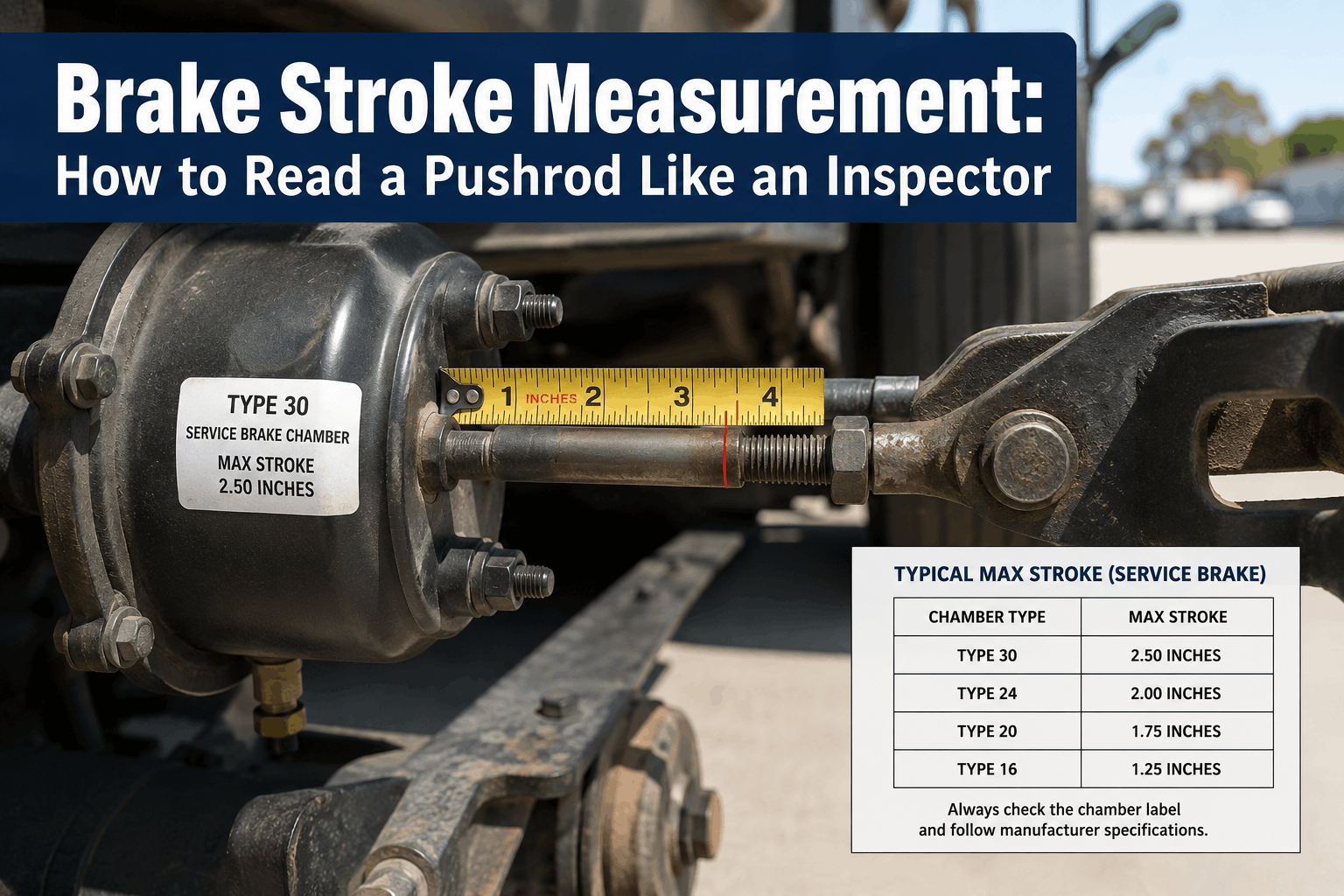
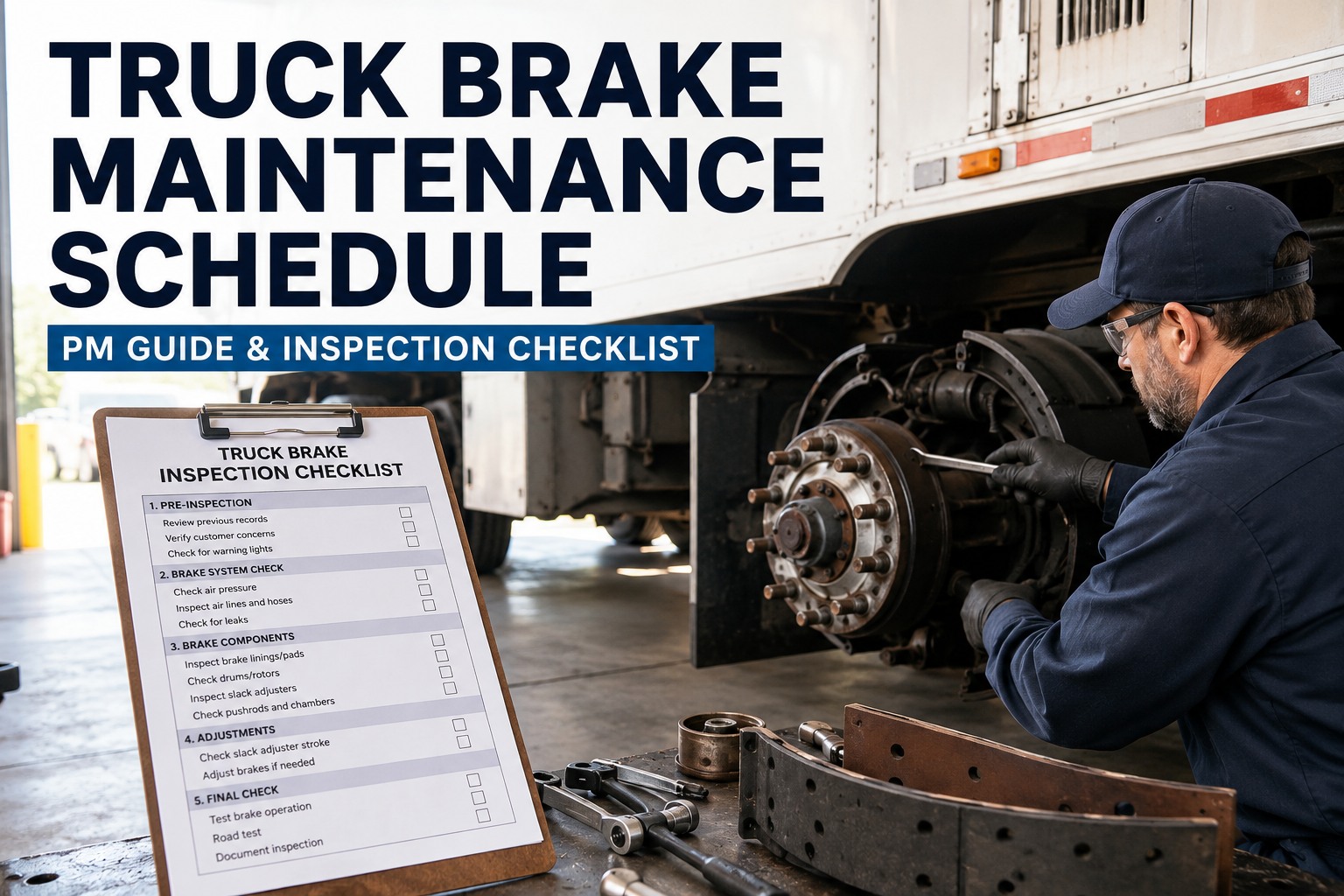
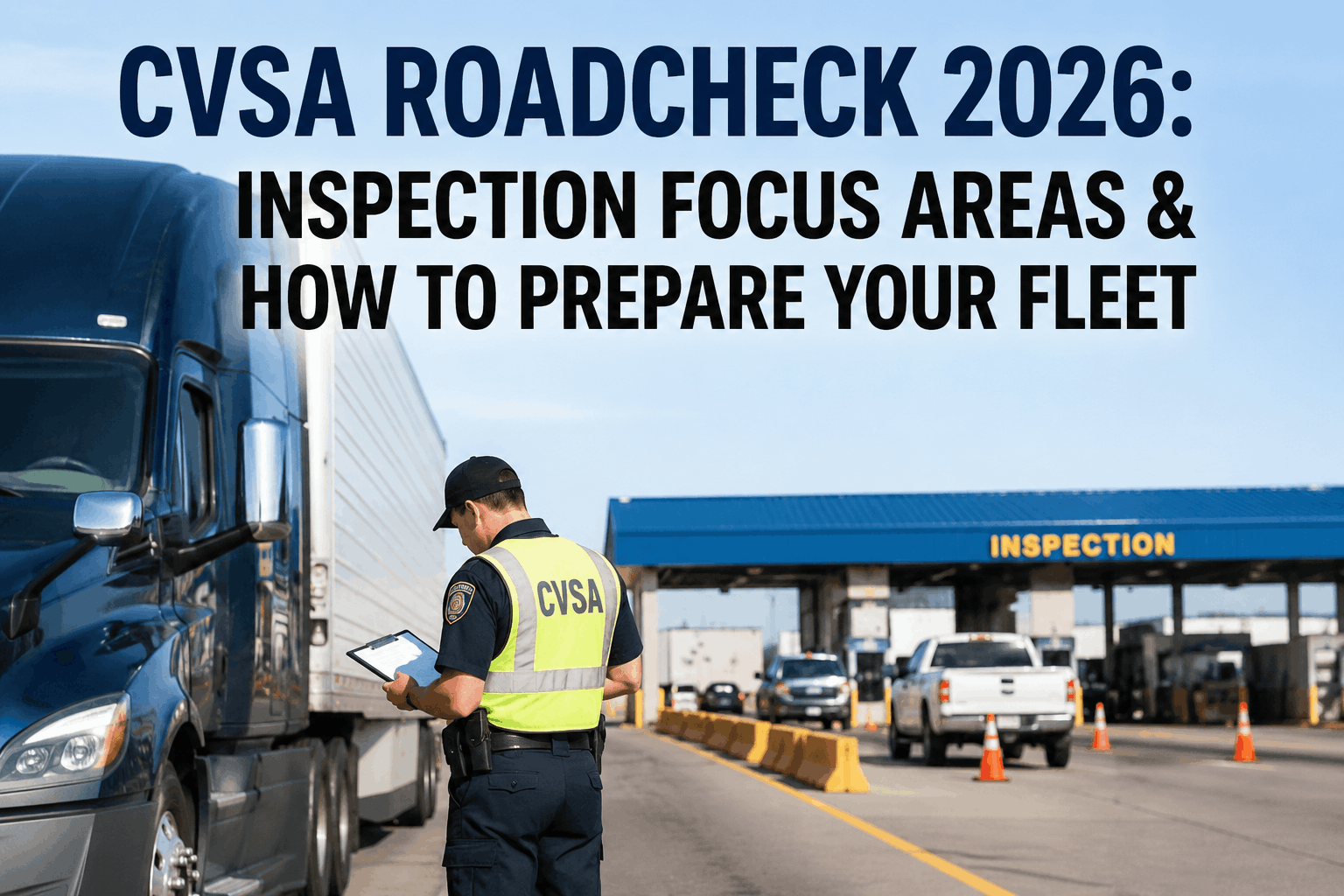
Brake system violations are the number one out-of-service offence in commercial vehicle inspections — accounting for 29–30% of all vehicle OOS citations. During the 2025 Brake Safety Week, 15.1% of inspected vehicles were placed out of service for brake violations alone. The single most common finding: pushrod stroke exceeding the regulation limit for the brake chamber type. A Type 30 standard chamber fails at 2 inches. A Type 30 long-stroke fails at 2.5 inches. Get these numbers wrong — or worse, measure at the wrong air pressure — and a perfectly good truck gets parked at the weigh station. This guide teaches you to read a pushrod like a CVSA inspector: the exact measurement procedure at 90–100 PSI, the marking technique inspectors use, the OOS stroke limits for every chamber type, and the common over-stroke causes that drift brakes out of adjustment between PM intervals. HVI's digital inspection platform includes brake-specific photo verification and stroke measurement logging at every walk-around — so your drivers catch over-stroke at the yard, not at the scale.
Catch Over-Stroke Before the Inspector Does
HVI's guided brake inspection includes pushrod measurement prompts, photo verification at every chamber, and auto-flagging when stroke approaches OOS limits.
The Measurement Procedure: Step by Step
This is the exact CVSA procedure that roadside inspectors follow. If you measure differently, your readings will not match theirs — and you will be surprised at the scale.
1
Park on Level Ground & Chock Wheels
Vehicle must be stationary on a level surface with wheels chocked. Spring brakes released. Transmission in neutral. This is a safety step — you will be under the vehicle.
2
Build Air Pressure to 90–100 PSI
Engine running until air pressure reaches 90–100 PSI on both primary and secondary gauges, then engine off. This pressure range is critical — every 10 PSI variation changes your reading by approximately 0.1 inches. A 20 PSI error can flip a pass into a fail.
3
Mark the Pushrod — Brakes Released
With brakes fully released, make a clear reference mark on the pushrod where it exits the brake chamber. Use chalk, paint marker, or tape. This is the "zero" point — your starting position for the stroke measurement. Inspectors use a straight edge or tape marker.
4
Fully Apply and Hold the Brakes
Have someone press and hold the brake pedal firmly (full application). The pushrod extends from the chamber. With brakes held, measure the distance the pushrod has moved from your reference mark — this is the applied stroke.
5
Measure & Compare to the Stroke Limit Table
Measure the distance from the reference mark to the new pushrod position. Compare this measurement to the regulation stroke limit for the specific chamber type on that wheel. If it exceeds the limit — that brake is out of adjustment and is a violation.
6
Repeat at Every Wheel End
Check every brake chamber on the vehicle and combination. Remember the 20% rule: if 2 or more out of 10 brakes on a 5-axle tractor-trailer exceed stroke limits, the entire vehicle goes out of service.
HVI's guided brake inspection walks drivers through this exact sequence — with photo capture at each chamber and measurement entry fields that auto-flag readings approaching OOS limits.
Schedule a demo to see the brake inspection workflow.
OOS Stroke Limits by Chamber Type
This is the table that determines pass or fail. Memorise your fleet's chamber types — or better, let HVI track them per vehicle so the correct limits display automatically at every inspection.
Type 6
4 1/2" (115mm)
1 1/2" (38mm)
1 1/4" (32mm)
Type 9
5 1/4" (133mm)
1 3/4" (44mm)
1 3/8" (35mm)
Type 12
5 11/16" (144mm)
1 3/4" (44mm)
1 3/8" (35mm)
Type 16
6 3/8" (162mm)
2 1/4" (57mm)
1 3/4" (45mm)
Type 20
6 25/32" (173mm)
2 1/4" (57mm)
1 3/4" (45mm)
Type 24
7 7/32" (184mm)
2 1/4" (57mm)
1 3/4" (45mm)
Type 30
8 3/32" (206mm)
2 1/2" (64mm)
2" (51mm)
Type 36
9" (229mm)
3" (76mm)
2 1/4" (57mm)
Long Stroke Chambers (marked "L" or with stroke tag)
Type 16LS
6 3/8" (162mm)
2 1/2" (64mm)
2" (51mm)
Type 20LS
6 25/32" (173mm)
2 1/2" (64mm)
2" (51mm)
Type 24LS
7 7/32" (184mm)
2 1/2" (64mm)
2" (51mm)
Type 30LS
8 3/32" (206mm)
3" (76mm)
2 1/2" (64mm)
How to Identify Your Chamber Type
Applying the wrong limit to the wrong chamber is the most common brake measurement error — and it can result in either a false pass or a false fail. Here is how to identify what you have.
Method 1: Read the Stamp
Most chambers have the type number stamped or cast directly on the chamber body. Look for "20," "30," "24LS," etc. Some show the SAE J2899 letter code (A through E). Long-stroke chambers must be marked with "L" or have a stroke tag attached.
Method 2: Measure the Diameter
If the stamp is unreadable, measure the outside diameter of the clamp area. Cross-reference with the table above: 6 3/8" = Type 16, 6 25/32" = Type 20, 8 3/32" = Type 30. Carry a tape measure — this is the inspector's fallback method.
Method 3: Check for Long-Stroke Indicators
Long-stroke chambers have larger stroke limits — but only if properly identified. Look for: "L" marking, a square port on the chamber, or a separate stroke tag. If a chamber has no long-stroke marking, apply the standard stroke limit — even if you think it is long-stroke.
The 5 Most Common Causes of Over-Stroke
Understanding why pushrod stroke drifts out of adjustment between PM intervals helps you catch problems earlier — and know when your automatic slack adjusters need attention. Sign up free for HVI and track brake adjustment trends across inspections.
1
Worn Brake Linings
As lining wears, the pushrod must travel farther to press the shoe against the drum. Automatic slack adjusters compensate — but they have limits. When lining is worn beyond 50%, stroke increases accelerate faster than the adjuster can compensate.
2
Automatic Slack Adjuster Failure
Mandatory on US trucks since October 1994, ASAs should maintain adjustment automatically. When they fail — seized internal mechanism, worn worm gear, or incorrect installation — stroke drifts with no self-correction. An ASA that is not adjusting is the root cause, not a symptom to manually fix.
3
Drum Expansion from Heat
Heavy braking heats brake drums, causing them to expand. The shoe-to-drum gap increases and pushrod travel lengthens. This is why hot brakes can measure out of adjustment when they would pass cold — and why repeated measurement after cooling is important.
4
New Brake Shoe Break-In
After relining, new shoes have a break-in period where material compresses and conforms to the drum surface. During the first 500–2,000 miles, stroke can increase rapidly as the lining seats — requiring heightened monitoring that most fleets skip.
5
Contamination or Corrosion
Water, road salt, and debris corrode slack adjuster internals, seize pivot points, and create binding that prevents proper automatic adjustment. Harsh winter conditions accelerate this — and fleets in northern climates see 2–3x higher over-stroke rates during spring thaw.
The 20% Rule: When One Bad Brake Kills the Whole Vehicle
Under CVSA OOS criteria, if 20% or more of the service brakes on a vehicle or combination are defective or out of adjustment, the entire vehicle is placed out of service. Schedule a demo to see how HVI tracks brake status per axle.
3-Axle Tractor (6 brakes)
2 over-stroke brakes = OOS
5-Axle Tractor-Trailer (10 brakes)
2 over-stroke brakes = OOS
6-Axle Doubles (12 brakes)
3 over-stroke brakes = OOS
2024 Brake Safety Week
56.6% of OOS vehicles failed on this criterion
Measure Like an Inspector — At Every Walk-Around
Brake pushrod stroke measurement is not a PM-only check — it is a daily walk-around item that takes 2 minutes per axle and prevents the most common OOS violation in commercial vehicle inspections. Know your chamber types. Measure at 90–100 PSI with the engine off. Mark the pushrod at rest, fully apply, and compare to the stroke limit table. If any brake exceeds the limit — pull the vehicle until it is corrected. HVI embeds this procedure into every daily inspection: brake photo checkpoints, stroke measurement entry fields, chamber type stored per vehicle, and auto-flagging when readings approach OOS limits. The next CVSA Brake Safety Week is August 23–29, 2026 — and an unannounced Brake Safety Day is coming in spring 2026. Be ready. Start free today — or schedule a demo and see brake inspection tracking on your fleet.
Track Brake Adjustment at Every Inspection
Photo-verified brake checkpoints. Stroke measurement logging. Chamber type tracking. Auto-flagging at OOS approach. CVSA Brake Safety Week ready. Trusted by 25,000+ users.
Frequently Asked Questions
Q: What is the stroke limit for a Type 30 brake chamber?
Type 30 standard chamber: 2 inches (51mm) OOS limit. Type 30 long-stroke (30LS): 2.5 inches (64mm) OOS limit. The critical distinction is whether the chamber is marked with "L" or has a stroke tag — if not, apply the standard limit even if you believe it is long-stroke. Measuring at 90–100 PSI with the engine off is mandatory for accurate readings.
Q: At what air pressure should pushrod stroke be measured?
90–100 PSI per CVSA procedure, with the engine off. Pressure outside this range produces unreliable readings — approximately 0.1 inch of stroke change per 10 PSI variation. A 20 PSI error can swing your reading by nearly 1/4 inch, enough to flip a pass into a fail. Always verify both primary and secondary gauges before measuring.
Start free with HVI — pressure verification is built into the brake inspection checklist.
Q: What is the 20% defective brake rule?
If 20% or more of the service brakes on a vehicle or combination are out of adjustment or defective, the entire vehicle is placed out of service. For a 5-axle tractor-trailer with 10 wheel ends, just 2 defective brakes trigger OOS. In 2024, 56.6% of all OOS vehicles failed on this criterion.
Schedule a demo to see how HVI tracks brake status per axle position.
Q: How often should pushrod stroke be checked?
CVSA recommends checking stroke as part of every pre-trip inspection — not just during PM services. At minimum, check after every brake service, during the 500–2,000 mile break-in period after relining, and weekly for vehicles in heavy-use service. HVI includes brake stroke measurement fields in every daily inspection template with auto-flagging at approach to OOS limits.
Q: When is the next CVSA Brake Safety Week?
The next CVSA Brake Safety Week is scheduled for August 23–29, 2026. An additional unannounced one-day Brake Safety Day will also be held at some point during the year. In 2025, 15.1% of inspected vehicles went out of service during Brake Safety Week. Prepare your fleet now — audit brake adjustment status across every vehicle before August.
Start free with HVI.