A log loader works in a place where nothing about a breakdown is easy. A hydraulic hose lets go on a landing three hours from the shop. A boom pin walks out at the end of a stick that's just picked up a 30-foot fir. A slewing bearing develops slop that grows every day until the house begins to lift on one side. A chaff-clogged cooler overheats the engine in dry Class 3 forest and starts a fire that a paper crew can't outrun. OSHA 29 CFR 1910.266(d)(1)(i) is unambiguous: "each machine, including any machine provided by an employee, is inspected before initial use during each workshift" — and "defects or damage shall be repaired or the unserviceable machine shall be replaced before work is commenced." That's the law. The economics say the same thing: a $80 hose replaced pre-shift is 15 minutes; a hose failure on the landing is a full day, a truck up the road, and a crew standing around. Forestry logging is the industry with the deadliest injury rate in the US at 100+ deaths per 100,000 workers, and machine failure ranks alongside felling error as the leading trigger. Pre-shift inspection is the single most cost-effective control — but only when the record actually captures what was checked. Paper log books get soaked, torn, and lost in the woods; the defect noted at 6 AM never reaches the shop. A digital log loader inspection & maintenance app built for forestry operations runs the walkaround on a phone or tablet, enforces every 1910.266(d)(6) item, requires photos on defects, and stores the record on the machine — so when the next crew climbs in, they see what the last crew left. This guide is the complete inspection best-practice for landing-and-yard log loaders.
OSHA 1910.266 + SAE J1040 + FOREST SAFETY
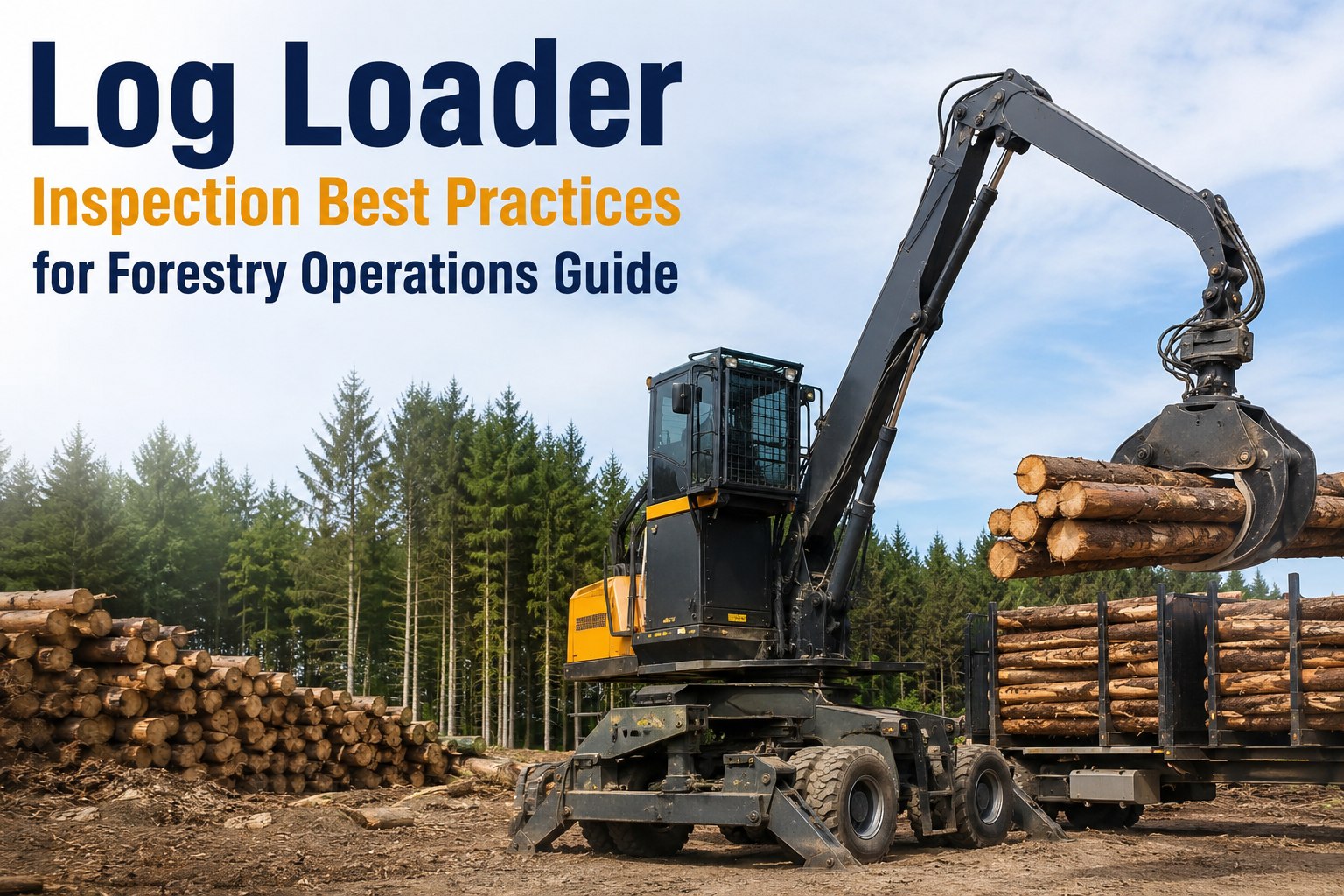
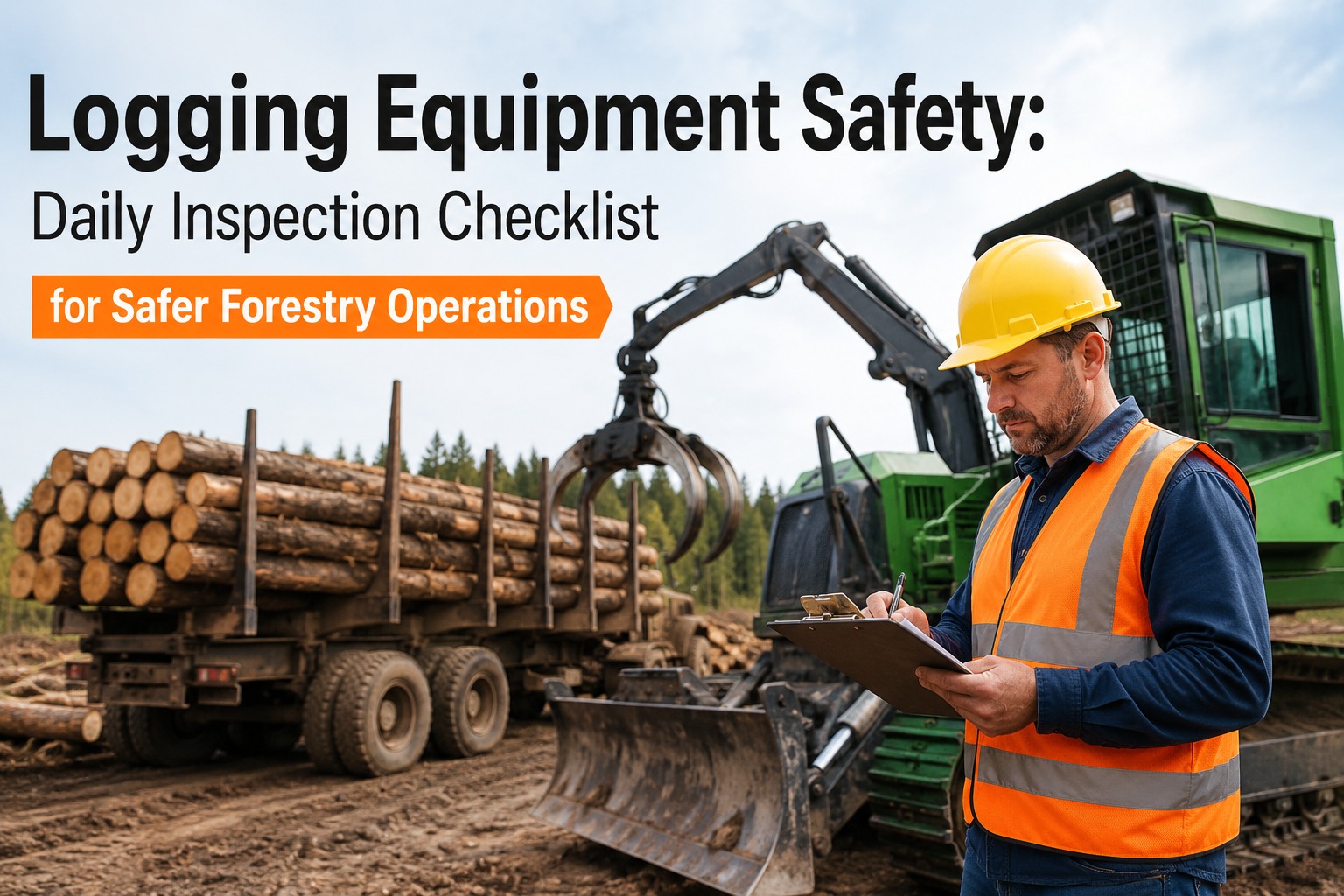
Log Loader Inspection Best Practices for Forestry Operations
Boom, grapple, slewing bearing, hydraulics, undercarriage, brakes, ROPS/FOPS, and fire-prevention — every system verified, photo-evidenced, and signed on the machine's HVI record before the first turn of the day.
1910.266
OSHA rule requiring pre-shift inspection
100+
logging deaths per 100K workers annually
$25K+
cost of a lost landing day
8
systems on a defensible log loader check
Why a Log Loader Inspection Is Different
A log loader isn't a standard excavator with a bucket. Four operating conditions shape the inspection — and each one shows up as a specific line item that a generic template will miss.
Remote Location
The nearest parts store is 90 minutes away. Every defect caught pre-shift saves a full landing day of unproductive crew time.
Forest Fire
Dry duff, chaff on the exhaust, hot bearing, wildfire zone. Fire prevention is a daily inspection item in dry season, not a paperwork check.
ROPS & Seat Belt
1910.266 requires an SAE J1040 ROPS on every logging machine built after Aug 1996 — and the operator wears the seat belt, period. Both inspected daily.
Full-Rotation Load
A grapple full of logs slewing 360° puts unique load cycles on the boom, stick, and turntable. Structural inspection is a weld-by-weld check.
Anatomy of the Log Loader — The Six Systems
Every pre-shift inspection follows the same path through the machine: structure → hydraulics → power → running gear → cab → safety. Group the checks this way and nothing gets missed.
Boom, Stick & Grapple
Structure, weld condition, pins, bushings, grapple tips, hoses at the tip.
Slewing / Turntable
Bearing bolt torque, no play, no rise on lift, gear teeth clean.
Hydraulic System
Reservoir, pump, valves, cylinders, hoses, filters, fluid condition.
Engine & Cooling
Fluids, belts, radiator, air cleaner, chaff on manifold, exhaust shielding.
Undercarriage / Wheels
Tracks, rollers, idlers, sprockets — or wheels, tires, axles, brakes.
Cab, ROPS/FOPS & Safety
Seat belt, glass, guards, e-stop, fire extinguisher, first aid, comms.
The Complete Pre-Shift Inspection — Eight Sections
Every item below is what HVI's forestry log loader template prompts in sequence. Required fields, photo evidence on defects, hour meter auto-captured, and a signed sign-off before the first pick.
01
Walkaround & Overnight Damage
START
360° walk — new damage, log strikes on cab guards, gouges on side plates
Ground under the machine — fresh oil, hydraulic, coolant, or fuel drips
Steps & grab handles secure; no snapped or bent
Access ladder / catwalk grating intact; anti-slip surface visible
Machine ID legible on the house or door; capacity plate present
02
Boom, Stick & Grapple
STRUCTURE
Boom & stick — no weld cracks, no paint stress at pivots
Boom-to-house, boom-to-stick, stick-to-grapple pins retained
Bushings — no elongation, pin end-play within spec
Grapple tips — no cracks, wear pads within spec
Grapple rotator — no leak, rotates full 360° smoothly
Grapple opening cylinder — full stroke, no drift closed
Hoses routed through boom — no rub-through or chafe
Tip hoses secure; no couplings marginal or misaligned
03
Slewing Bearing & Turntable
CRITICAL
No house rise when boom loaded — the earliest slew-bearing wear symptom
Slewing bearing bolts — sample check, torque marks aligned
No grease starvation streaks at the bearing race
Slew motor(s) — no leak at output shaft or hoses
Gear teeth clean and greased; no metal shavings in cavity
Full 360° rotation smooth, no notchy motion, no thump at 90° intervals
04
Hydraulic System
POWER
Reservoir level at sight glass; fluid clear, not milky or foamy
Every hose visible — no bulges, no cracks near fittings
Cylinder rods — no scoring, pitting, or active seep at gland
Boom drift < 1 inch/minute under load (per manufacturer)
No leak at main valve, manifolds, pump, or return filter housing
Suction / return / pilot filters within service interval
Pressure gauges responding on movement; no abnormal reading
Quick-disconnect couplers — no seep, safety clip in place
05
Engine, Cooling & Fire Prevention
FIRE RISK
Engine oil, coolant, fuel levels & condition
Belts — no cracks, glazing, missing chunks; tension to spec
Radiator core & hydraulic cooler chaff-free
Air cleaner restriction indicator clear
Exhaust manifold shielding intact; no chaff accumulation
No fuel or oil leak near exhaust or turbo
Battery terminals clean, hold-downs tight
Engine bay compressed-air blowdown fresh (dry season)
06
Tracks / Wheels & Brakes
RUNNING GEAR
Track tension within manufacturer spec; sag correct
Track pads, rollers, idlers, sprockets — wear within limit
Final drives — no oil seep at seals
Wheel machines: tires no cord cuts, pressure to spec
Wheel lugs tight; no rust streaking at studs
Service brake & parking brake — 1910.266 requires functional
Travel motors — no unusual noise, no leak
Undercarriage free of packed debris and slash
07
Cab, ROPS, FOPS & Seat Belt
1910.266(d)
ROPS structure — no cracks, no weld disturbance, SAE J1040 tag present
FOPS overhead guard secure; no impact damage
Cab glass, guards, screens — falling-log protection intact
Seat belt — latch, retraction, webbing; wearable and worn
Operator seat suspension functional; controls in reach
Emergency stop reachable and functional
08
Safety Devices, PPE & Comms
CLOSING
Backup alarm audible over engine + landing noise
Horn, work lights, beacons all functional
Two ABC fire extinguishers — cab + ground, charged, in date
First-aid kit stocked per 1910.266 Appendix A
Radio & cell phone charged; comms with landing/truck
Hard hat, high-vis, hearing & eye protection worn
Operator training / certification current on this machine
Pre-op briefing done; two-tree-length spacing confirmed
Boom & Grapple — The Deep-Dive That Prevents Catastrophic Failure
The boom, stick, and grapple carry every load cycle of the day. Three failure modes account for most catastrophic incidents, and each one is visible in the pre-shift walkaround.
A
Weld Fatigue Cracks
Cyclic loading over years produces beach-mark fatigue cracks at boom mounting points, stick pivots, and grapple linkages. First visible as a hairline through paint at a stress concentrator.
Look at: boom foot, boom-to-stick pivot, grapple mount ears. Photo any suspect line.
B
Pin & Bushing Wear
A worn bushing lets a pin walk and hammer the housing every cycle. Left long enough it egg-shapes the bore and the entire mounting has to be rebuilt.
Look at: end-play at every pin. Grease weeping fresh grease = pin still moving. Rust-orange staining = wear.
C
Grapple Hose Rub
Hoses routed through the boom and to the grapple rub against structure at every rotation. A hose that failed in-service was rubbing yesterday and the day before.
Look at: hose sleeves, hose bundles, tie points. Any exposed reinforcement = replace before the shift.
Forest Fire Prevention — The Pre-Shift Item Skipped Most
Forestry equipment starts wildland fires at a rate that surprises operators until they've seen one. Four inspection habits stop nearly all of them.
1
Compressed-Air Blowdown
Engine bay, radiator, hydraulic cooler, exhaust shielding — every shift in dry season. Chaff on a 900°F manifold ignites in seconds.
2
Two Extinguishers, Charged
One in the cab, one at ground level. Both ABC, both dated, both accessible. 10-second response is the fire response window.
3
Bearings & Belts
A failed bearing turns red-hot in minutes. A slipping belt generates enough heat to ignite duff. Both flagged on shift check.
4
Hot-Work & Fire Watch
Welding or grinding on the landing = fire watch for 30 min post-work per SPI/state industrial fire precaution level. Pre-shift confirms the plan.
Out-of-Service Criteria — The Stop-Now List
1910.266(d)(1)(ii) says "defects or damage shall be repaired or the unserviceable machine shall be replaced before work is commenced." These are the items that trigger an instant lockout in HVI — the loader does not turn a load.
CRITICAL — DO NOT OPERATE
Weld crack visible anywhere on boom, stick, or grapple mount
Loose or missing pin retainer on any structural pivot
Slewing bearing house-rise, notchy rotation, or metal in gear cavity
Hydraulic hose bulge, exposed reinforcement, or active spray
Grapple rotator drift or loss of open/close authority
Service or parking brake failure
ROPS damage, missing SAE J1040 tag, or disturbed weld
Seat belt missing, damaged, or non-functional
Backup alarm or horn inoperable
Fire extinguisher missing, discharged, or out of date
Paper Log Book vs. HVI Mobile Workflow
In the woods, paper log books get soaked, torn, and left in the cab of a machine that goes to the shop for a week. HVI keeps every check, defect, and hour reading on the machine's asset record — visible to the next crew, the mechanic, and the fleet manager.
PAPER LOG BOOK
Soaks in wet weather, tears in the woods, disappears
Defects noted but never routed to the shop
No photos of weld cracks, hose wear, or grease starvation
Hours tracked in a notebook, PMs guessed at
Audit prep is days of digging through folders
HVI MOBILE APP
Works offline in the woods; syncs when radio comes back
Every defect auto-creates a work order for the shop
Photo evidence required on every defect flag
Hours auto-captured; PMs scheduled by real usage
Audit package exports in under 5 minutes
Roll Every Log Loader Off a Verified Pre-Shift Check
HVI gives forestry operations a digital inspection and maintenance platform for log loaders, feller bunchers, skidders, forwarders, processors, and support fleet — pre-built templates aligned to OSHA 1910.266, SAE J1040 ROPS, and manufacturer requirements. Offline mode for the woods, photo-verified defects, auto-routed work orders, hour-meter capture, and full audit exports. Trusted by 25,000+ users worldwide.
Frequently Asked Questions
What OSHA standard governs log loader inspection?
29 CFR 1910.266 — the Logging Operations standard. Paragraph (d)(1)(i) requires that "each machine, including any machine provided by an employee, is inspected before initial use during each workshift," and (d)(1)(ii) requires that "defects or damage shall be repaired or the unserviceable machine shall be replaced before work is commenced." Paragraph (d)(6) covers stability, boom reliability, and inspection procedures specifically. Machines built after August 1, 1996 must have a ROPS tested and installed per SAE J1040 and a seat belt that the operator uses. First-aid kit contents are specified in Appendix A. Loading and transport operations are governed by (h). OSHA CPL 02-01-022 provides the inspection procedures and interpretive guidance compliance officers use during a citation. HVI's log loader template encodes all of it into one workflow.
Start a free HVI trial to run the full check.
How long should a log loader pre-shift inspection take?
A trained operator running HVI's eight-section template completes the full walkaround in roughly 15–20 minutes — about 10 minutes for the cold visual (structure, hoses, fluids, tracks, cab) and another 5–10 for the functional test (slewing, boom cycles, grapple rotate, brake check, backup alarm, cab controls). Time varies with machine size and dry-season fire-prevention steps: on a Class 3 or higher industrial fire precaution level (IFPL), the compressed-air blowdown and hot-work fire watch prep add time. HVI keeps the check short by prompting the operator through in sequence, auto-capturing hour meter, and only requiring photos on defects. The trade is favorable: 15 minutes pre-shift prevents the 4–8 hour landing shutdown that a mid-shift hose failure creates.
Book a demo to time it yourself.
What are the most critical structural items to inspect on a log loader?
Three items. First, the slewing bearing — check for house rise on lift, notchy rotation, thumps at 90° intervals, and metal shavings in the gear cavity; a failing slew bearing is the most expensive repair on the machine and the one most likely to strand it in the woods. Second, the boom-to-house, boom-to-stick, and stick-to-grapple pivots — pins retained, bushings within end-play tolerance, no fresh grease weeping from a walking pin. Third, welds at every stress concentrator — boom foot, boom-to-stick pivot, grapple mount ears — where fatigue cracks begin as hairlines through paint before propagating. Photograph anything suspect. HVI's structural inspection step requires a photo on any flagged item so the shop sees the exact area before the loader arrives.
Sign up for a free HVI trial to log structural findings.
How do you prevent forestry equipment from starting a wildfire?
Four habits stop nearly all equipment-caused wildland fires. First, compressed-air blowdown of the engine bay, radiator, hydraulic cooler, and exhaust shielding every shift in dry season — chaff on a 900°F manifold ignites in seconds. Second, two charged ABC fire extinguishers on every machine, one in the cab and one at ground level, both dated and accessible. Third, catch failing bearings and slipping belts on the pre-shift check — both generate the heat that ignites duff. Fourth, follow the state or landowner IFPL protocol for hot-work — welding or grinding requires a 30-minute post-work fire watch, and industrial fire precaution levels can shut down operations entirely at Level 4. On dry days, the shift-close check adds a second blowdown before park. HVI's fire-prevention step is a required field on every pre-shift check during the operations season.
Schedule a demo to see fire-prevention tracking.
Does HVI work offline in the woods where there's no cell signal?
Yes — HVI's mobile app captures the full inspection offline and syncs the record when the device reconnects to cellular or Wi-Fi. Operators can complete the pre-shift check at 5:30 AM on a landing with no signal, log defects with photos, and sign off; the record is stored locally on the phone or tablet until the machine or truck returns to signal range. When it does, the inspection uploads to the machine's asset record, defects auto-create work orders, hour meters roll into the PM scheduler, and the audit trail becomes searchable. Between-shift handoffs work the same way — the incoming crew opens the machine record and sees the last recorded state, offline if needed. The offline capability is essential for forestry, mining, and remote utility work; it's the reason paper log books still exist, and it's built into HVI so they don't have to.
Sign up for a free HVI trial to test the offline mode.
Can HVI manage the full forestry fleet — loaders, skidders, feller bunchers?
Yes. Every logging machine — log loaders, feller bunchers, grapple skidders, forwarders, processors, dozers, water trucks, service trucks, and lowboys — can have its own asset record on HVI. Each machine gets a QR code on the cab; the operator scans it and the right pre-shift template loads on their phone with the machine's hour meter and any open defects. Defects flow into one maintenance work-order queue across the fleet, with severity routing — Critical items auto-lockout and page the supervisor, Alert items open work orders for the shop, Monitor items feed the PM scheduler. Fleet managers get a dashboard showing every machine's status, open defects, PM-due, and certification expiry across every landing and camp. Hours from every operator roll up into accurate usage-based PM scheduling — so no machine slips past its 250- or 500-hour service in the middle of a burn ban.
Book a demo to see forestry fleet coverage.